Siwa Oasis: What It's Really Like, and Who Should Go
Siwa Oasis is a palm oasis in Egypt's Western Desert, close to the Libyan border and about 10 hours by road from Cairo. It has salt lakes, a mud-brick fortress, hot and cold springs, and a Berber culture with its own language. It also has a long, dull drive at either end, and that puts a lot of people off.
How do you get there from Cairo?
The drive from Cairo takes roughly ten hours. There are no scheduled passenger flights and no railway. Most people head north-west to Alexandria or west along the coast to Marsa Matruh first, then turn south for the last four hours or so across empty desert. Public buses run overnight and are cheap; a private car with a driver costs more and lets you stop where you want. Either way you will pass military checkpoints, so carry your passport.
Breaking the journey helps. A night in Alexandria or on the Mediterranean coast turns one punishing day into two easy ones, and the same applies coming back. If your Egypt trip is under ten days, the maths rarely works: two days of driving buys you two days in the oasis, and Luxor or Aswan will give you more for that time.
The road itself is a sealed two-lane highway for its whole length, not a desert track, so the drive is dull rather than difficult. The last leg south from Marsa Matruh runs through open desert with little to look at and few places to stop, which is why the tedium, not the terrain, is the real obstacle. At the checkpoints the driver will usually hand over passport and vehicle details; keep your passport somewhere you can reach it rather than buried in a suitcase, and expect the stops to add time rather than trouble. A driver who knows the road will time the run to reach Siwa before dark, which matters because the final stretch is unlit.
What is there to see in Siwa Oasis?
The old town, Shali, is a collapsing fortress of salt and mud brick in the middle of the modern village. Heavy rain in the 1920s dissolved much of it and people moved out. You can walk up through the lanes in half an hour. Above the palms at Aghurmi stand the remains of the Oracle of Amun, the temple Alexander is said to have consulted in 331 BC. Little of it survives, but the setting does the work.
The salt pools people swim in are quarry workings rather than natural lagoons, though the oasis has real salt lakes as well. They are the strongest image most people take home: white crust, water the colour of bleach, and enough salt to float in. Rinse in fresh water afterwards, and skip them if you have cuts or have just shaved. Cleopatra Spring is the famous one and the weakest: a stone-lined pool by the road, often busy, and awkward for women who would rather not swim watched.
Most people also take an afternoon into the Great Sand Sea by 4x4, ending at a hot spring and a cold pool near the dunes. It is the best half day in Siwa. The dune driving is deliberately rough, so say something beforehand if you have a bad back or would rather not.
Close to the Oracle stands a second, more broken temple, usually pointed out as Umm Ubayda, of which only a fragment of wall is left. It is worth the two minutes it takes rather than a visit in its own right. The pattern holds across most of Siwa's ancient sites: the ruins themselves are slight, and it is the position of them, above the palms and against the desert, that earns the walk. Come for atmosphere, not for masonry, and you will not be disappointed by how little is standing.
The Mountain of the Dead and Siwa's older layers
On the northern edge of the village a low, cone-shaped hill called Gebel al-Mawta, the Mountain of the Dead, is honeycombed with rock-cut tombs. They date from the later stages of Egypt's ancient history, and a handful still carry painted decoration inside, which is the reason to climb up. During the Second World War, when Siwa was bombed, some of these tombs were used as shelters, and a few were damaged then. It is a short, steep walk, and the view back over the palm sea from the top is as much the point as the tombs.
This is the part of Siwa that rewards a slow eye. The oasis has been lived in for a very long time, and its layers do not sit neatly one above the next: an ancient necropolis on one hill, a Greek-era oracle on another, a medieval salt-brick town in the middle, and a modern village of concrete and satellite dishes wrapped around all of it. Nothing is presented, roped off or explained by a plaque in the way it would be at Luxor. You are largely left to work out what you are looking at, which suits some travellers and frustrates others. A local guide is worth hiring for a morning simply to join the dots, and to keep you off the tombs and walls that should not be climbed on.
Salt lakes, springs and the sand baths
Water is the whole reason Siwa exists, and it surfaces in three quite different forms. There are the natural salt lakes, shallow and blindingly white at the edges, which sit below the surrounding desert and mirror the sky at dusk; the freshwater springs that feed the palm groves and give the oasis its old bathing pools; and the man-made salt quarries that have become the pools people photograph. Understanding which is which saves disappointment: the lakes are for looking at and floating in at the marked spots, the springs are for a cooler swim, and the quarry pools are the intense, bleach-white water most images promise.
Fatnas, a palm-covered spit reaching into one of the salt lakes west of the town, is the usual place to watch the sun go down. It is quiet, a short ride out, and pleasantly free of anything to buy beyond tea. The salt trade is not only scenery, either: salt is dug and exported from the lakes, and you will see it stacked in blocks and sold as lamps and bath crystals in the market, which is as close as Siwa comes to a souvenir industry.
One local tradition belongs to high summer rather than the tourist season. Around the hill of Dakrour, people bury themselves to the neck in hot sand for a few days at a time, a folk remedy for aching joints. It happens in the worst of the July and August heat, which is precisely when almost no foreign visitor is there, so treat it as background colour rather than something to plan around. If you are in Siwa in the cool months, the salt floating and the springs are the water experiences that actually fit your trip.
Dates, olives and what you will eat
Siwa is a farming oasis before it is anything else, and its two crops are dates and olives. The palm groves that soften every edge of the town are working orchards, and the olive trees between them press into a good local oil that is sold by the roadside and used in most kitchens. This is not a place with a restaurant scene; you eat what the guesthouses cook and what the few simple cafes around the market serve, and it is plain, fresh and cheap rather than refined.
Expect a lot of vegetables, bread, beans, rice and slow-cooked meat, with dates and olives turning up at almost every meal. Vegetarians manage easily here, more easily than in much of Egypt, because the everyday food is largely plant-based to begin with. The date harvest around October is the culinary high point, when the town is busiest and the freshly picked fruit is everywhere. Alcohol is not sold openly, so if a cold beer with dinner matters to you, adjust your expectations before you arrive rather than after.
Getting around the oasis
You do not need your own vehicle inside Siwa. The centre is flat and compact, built around a market square, and the classic way to move about is the caretta, a small cart pulled by a motorbike or donkey, which you flag down like a taxi. Bicycles are easy to hire and cover the town, the old fortress, the Mountain of the Dead and the nearer springs comfortably in a day. The pace of all this is slow by design, and part of what people come for.
A 4x4 with a driver is only needed for the things that sit out in the sand: the Great Sand Sea trip, the more distant salt pools, and the hot and cold springs at the dune edge. These are arranged through your guesthouse or a local operator rather than hailed in the street, and they are priced by the vehicle and the afternoon. Because the desert beyond the town has no phone signal, no fuel and no one to call, the dune trips are always run with a local driver who knows the ground, never improvised on your own.
Where to stay, and what 'basic' means here
Accommodation runs from simple guesthouses in and around the town to a small number of eco-lodges set out towards the palm groves and the desert edge. The better lodges are built in the traditional way, from kershef, the local mix of salt rock and mud that the old fortress is made of, which keeps rooms cool without air conditioning. It also means thick, irregular walls, uneven floors and the general handmade feel of the place. That is the appeal, not a shortcoming.
Be honest with yourself about what basic means before you book. The good places are deliberately stripped back: no televisions, limited or solar power that may go off at night, hot water that depends on the sun, and Wi-Fi that is slow when it works at all. This is a feature for the people who come to Siwa on purpose and an irritation for anyone expecting resort comfort. Book ahead in the cool months, because the handful of well-run lodges fill up, and the difference between a considered eco-lodge and a bare concrete room in the village is large for not much money.
A short history: why Siwa feels apart
Siwa's distinctiveness is a product of its isolation. For most of its history it had no surfaced road to the coast, and reaching it meant days across the desert, which is why it kept a Berber language and customs while the rest of Egypt did not. Only in recent decades did a paved road tie it properly to Marsa Matruh and the Mediterranean, and the sense of a place that was left to itself for a long time is still the strongest thing about it.
The ancient thread runs deeper still. The Oracle of Amun made Siwa famous in the classical world, and the visit attributed to Alexander in 331 BC, when he is said to have been recognised here as a son of the god, is the single fact most people arrive knowing. What that history leaves on the ground today is thin, as noted above, but it explains why a remote farming oasis carries a name out of all proportion to its size. You are visiting somewhere that mattered to the Greek and Egyptian imagination long before it mattered to tourism.
When is the best time to go?
Between October and April. Summer in the Western Desert runs to roughly 40C and higher, and almost everything worth seeing is outdoors with no shade. November to February is comfortable by day, but desert nights get cold, into single figures Celsius, and rooms are often unheated. Bring a fleece even though you are in a hot country. The dates are harvested around October, which is the oasis at its busiest and most interesting.
Within that window, the trade-off is heat against cold rather than crowds against quiet, because Siwa is never crowded by Egyptian standards. October and April give you warm days and milder nights but a stronger midday sun on the exposed sites. December to February give you the most comfortable daytime walking and the coldest nights, when an unheated kershef room is genuinely chilly after dark and a warm layer stops being optional. If the salt floating and the dune trip are your priorities, aim for the shoulders of the season; if long walks around the town and the ruins are, aim for midwinter.
What is Siwan culture like?
Siwa is Berber, not Arab. People speak Siwi, a Berber language rather than a dialect of Arabic, and the town is socially conservative by Egyptian standards. Local women are rarely seen in public and are not photographed. Visitors of both sexes should cover shoulders and knees, and women who want to swim usually need a private pool or a quiet spot with a guide who knows where. Alcohol is not sold openly. Ask before you photograph anyone.
The conservatism is not hostility, and most visitors find Siwans reserved rather than unwelcoming; it is simply a smaller, more traditional community than the tourist towns of the Nile, and it expects to be treated as one. A little care goes a long way. Dress modestly in the town even when it is hot, keep public affection to a minimum, learn a word or two of greeting, and treat the palm groves and family plots as the private working land they are rather than a backdrop for photographs. The reward for reading the place correctly is a genuinely different corner of Egypt; the cost of getting it wrong is a community that quietly closes to you.
Who is it right for, and who should skip it?
It suits people on a second or third trip to Egypt, people who like slow days and empty landscape, and anyone who would rather see a working oasis than another temple queue. It does not suit first-timers with ten days, families with small children who hate long drives, or anyone expecting resort comfort. Accommodation runs from simple guesthouses to a few eco-lodges, and the good ones are basic by design, with no televisions and limited power.
A word on expectations. This is not a wilderness retreat and not a spa town. It is a real place of roughly thirty thousand people, with traffic, litter in places and building work. The quiet comes from the palm groves and the desert edge, not from the centre. Go for the landscape and the oddness of it, not for polish.
How long do you need, and how does it fit an itinerary?
Three nights is the working minimum: one to arrive, one full day for the town and the temples, one for the dunes. Four is better. Most itineraries reach it from Cairo or Alexandria and return the same way. The desert route east to Bahariya and the White Desert exists, but it needs permits, a convoy of 4x4s and a firm plan, so it is not something to arrange on arrival.
In practice Siwa is a set-piece within a two-week Egypt trip, not a stop on a shorter one. The clean way to build it is Cairo and the Nile valley for the antiquities, then a deliberate loop out to the Western Desert with Siwa at the end of it, and back the way you came. Trying to bolt it onto a week that already includes Luxor and Aswan is how people end up spending half their holiday in a car. If the desert is what you want, give it the days it needs; if the monuments are, leave Siwa for another trip.
Siwa or the White Desert: which western trip?
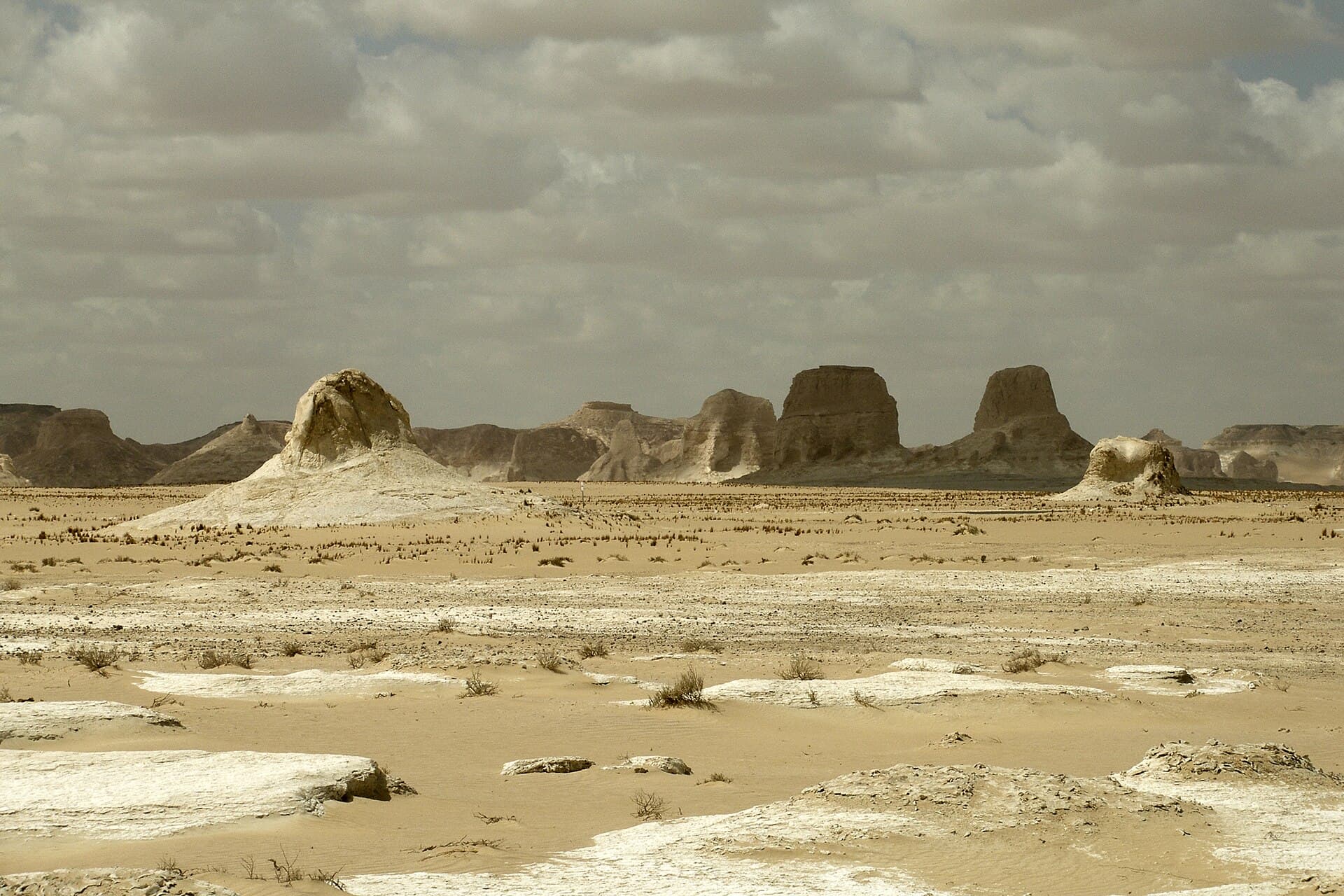
If your time only stretches to one Western Desert experience, it is worth understanding how the two main options differ, because they are not interchangeable. The White Desert, reached from Bahariya oasis about four hours south-west of Cairo, is a landscape trip: chalk eroded into white towers and mushrooms, best camped among overnight rather than driven through, and comparatively quick to reach and return from. Siwa is a place trip: a living oasis with a culture, a market, ruins and a farming economy, much further out and worth several days once you have made the effort.
The short version is that Bahariya and the White Desert give you the strangest scenery for the least driving, while Siwa gives you the strongest sense of somewhere apart for the most. First-time desert travellers and anyone short on days are usually better served by the White Desert; Siwa rewards the return visitor with a fortnight and a taste for slow travel. Access and routing across the far Western Desert change with security conditions, so both should be confirmed rather than assumed when you plan, and the sand crossing that would link the two directly is an expedition, not a shortcut.
Common questions
Is it safe, given how close it is to Libya?+
The town itself is quiet and the road in is a normal main road with military checkpoints. The border zone is a restricted military area and closed to visitors. Some governments do advise against travel near the frontier, so read your own foreign ministry's advice before you book, and carry your passport for the checkpoints.
Do you need a car to get around the oasis itself?+
No. The centre is flat and small, and bicycles or a motorbike-drawn cart cover most of it, including the old town, the Mountain of the Dead and the springs on the edge of the palm groves. You only need a 4x4 and a driver for the dunes and the salt pools further out.
Should I bring cash, and will my phone work?+
Bring cash. Card payment is uncommon outside a couple of larger hotels, and cash machines are few and sometimes empty, so draw what you need in Cairo or Marsa Matruh. Mobile signal covers the town but drops in the desert. Guesthouse Wi-Fi is slow and unreliable, which most people end up liking.
Can it be done as a day trip from Marsa Matruh?+
Technically yes, and it is not worth it. The drive is about four hours each way, so a day trip gives you three or four hours in the oasis and eight in a car. The salt pools and the dunes both work best at either end of the day, which a day trip misses entirely.
What should I pack that I would not pack elsewhere in Egypt?+
A warm layer for the desert nights, sandals you can walk into salt water, a bottle of fresh water to rinse the salt off, a head torch for unlit lanes, and clothes that cover shoulders and knees. Sun protection matters more here than in Cairo, because most of the day is spent outside.
Will English get me by, or do I need Arabic?+
In the guesthouses, eco-lodges and with drivers and guides, enough English is spoken to arrange everything you need. Away from tourism the everyday languages are Siwi, the local Berber tongue, and Arabic, and English thins out quickly. A few words of Arabic greeting are appreciated, but you will not be stuck without them.
Is there anything for children in Siwa?+
Not in the organised sense: there are no attractions built for children, and the long drive is hard on small ones. Older children who like swimming, cycling and bumping across dunes in a 4x4 tend to enjoy it, and the salt floating is a novelty for any age. Families with toddlers usually find the journey costs more than the oasis returns.
How much should I budget for a trip to Siwa?+
Once you are there, Siwa is cheap: guesthouse rooms, plain food and bicycle hire cost little, and the main spend is the 4x4 desert afternoon, priced per vehicle. The real cost is transport and time to reach it, whether that is a private car and driver from Cairo or two long days of your holiday. Bring enough cash to cover the whole stay, since drawing more locally is unreliable.
Official sources
Entry rules, opening hours, security advice and exchange rates all move. Check them at the source, not here.
Written and checked by the Nile Trip Guide editorial team · Last reviewed . Entry rules, prices and opening hours change — check anything critical against the official sources linked on this page.
Fourteen days that add the Western Desert to the usual route: Cairo, two days of Luxor on land, four nights sailing to Aswan, then a drive west to Bahariya and a night out among the white chalk formations.