Bahariya Oasis: what it is really like, and how to visit it well
Bahariya Oasis is a farming depression in Egypt's Western Desert, about four hours by road from Cairo, and the usual starting point for trips into the White and Black Deserts. It is a working place rather than a resort: date palms, olive groves, ore lorries and a few hot springs. Most people come for one night and wish they had stayed two.
What is Bahariya Oasis, exactly?
Bahariya is a natural depression in the Western Desert, roughly 360 kilometres south-west of Cairo. The floor is green in patches, where springs feed palm groves and small fields, and dark hills capped with volcanic rock stand over them. The main town is Bawiti, with the older village of El Qasr attached to it. A few tens of thousands of people live here, and much of the steady work is in the iron ore mines to the north-east rather than in tourism.
The drive from Cairo takes about four hours on a single desert road, longer if you leave during the morning traffic. It is a plain road with fuel stops and ore lorries, not scenery. Everything of interest starts once you turn off it. Carry your passport: checkpoints along the way are routine, and guides are regularly asked for names and numbers.
The word oasis does a lot of unhelpful work in people's heads. This is not a spring in open sand with a few palms around it. It is a wide floor lying below the surrounding plateau, ringed by escarpment, with cultivated gardens in the wet patches, bare ground between them, a town, a road, quarry traffic and mobile masts. The green is real and in places it is deep and beautiful. It is simply set inside an ordinary working landscape rather than a picture.
How do you actually get there?
One tarmac road runs south-west out of Cairo across open desert to Bawiti, about 360 kilometres and roughly four hours in a normal vehicle, closer to five if you have not cleared the city before the morning build-up. There are fuel stops and tea stops along it and very little else. The same road carries on south towards Farafra. Part of the drive will be spent behind lorries running to and from the ore workings, which is dull rather than difficult.
Military checkpoints on the route are routine. The driver hands over vehicle details and passenger names and passport numbers, which is the reason your passport belongs in a day bag rather than at the bottom of a suitcase. It is a formality, not an obstacle, but it adds time and it is not negotiable.
Buses run from Cairo to Bawiti and cost very little. The difficulty is that departure times move, journeys stretch and published schedules are not dependable, so anything you read online wants confirming locally on the day. The larger problem arrives with you: there is almost no local transport in the oasis, and any desert trip needs a 4x4 and a driver, which you will be arranging in Bawiti regardless. Most people either take a private car or join a trip that includes transport from Cairo, and treat the bus as a way of paying with time instead of money.
A hire car will get you to Bawiti and on to Farafra without trouble; the tarmac is fine. It will not get you into the desert. Past the road you need a 4x4 with the tyres let down and a driver who knows where the soft sand sits. Getting stuck out there is routine rather than exceptional, and recovery means a second vehicle, not a phone call.
Why does Bahariya matter for a desert trip?
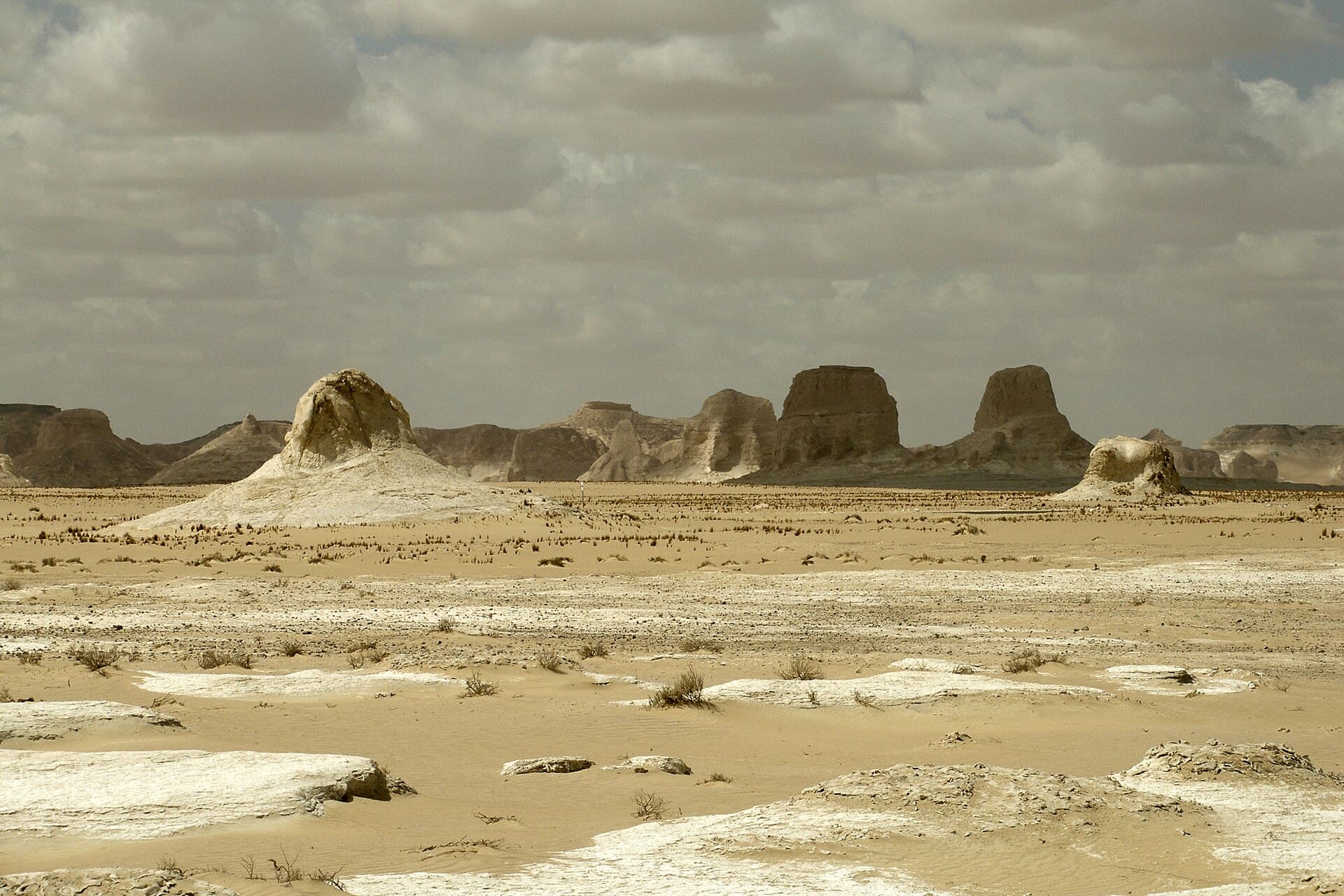
Bahariya's real value is position. The Black Desert begins within half an hour of Bawiti: low hills capped with dark, crumbling rock that gives the sand a burnt look. Another hour south brings the Crystal Mountain outcrop and the Agabat valley, and beyond that the chalk formations of the White Desert, which is a protected national park and the reason most people drive this far.
The White Desert is genuinely unusual: wind-cut chalk shapes standing on a pale floor, best seen in the last hour of light and again at dawn. You need a 4x4 and a driver who knows the tracks. Camping inside the park is the standard way to do it, and a trip that turns back before dusk misses the part that justifies the journey.
Black Desert and Crystal Mountain, Egypt: what you see on the way
These three stops sit between Bawiti and the White Desert and they are sold with equal weight, which they do not deserve. The Black Desert is a field of low cone-shaped hills capped with dark, weathered volcanic rock, the fragments scattered down the slopes over orange sand. You can climb one in ten minutes and see the whole range from the top. It is a thirty-minute stop, it photographs better than it looks, and a second hill adds nothing after the first.
One of the Black Desert hills carries the remains of a British lookout post from the First World War.
Crystal Mountain, further south beside the road, is a low ridge of crystalline calcite with a natural arch through it. The name promises a mountain and delivers something around head height. Decades of visitors have broken pieces off, so the ground glitters and nothing large is left standing. Five minutes is right, and do not add to the collecting.
The stop most itineraries rush is the one worth the time. Wadi el-Agabat, past Crystal Mountain on the last stretch before the White Desert proper, is a sand valley with pale chalk shapes rising out of the floor of it, quieter than the Black Desert and much closer to what people came for. Most trips give it twenty minutes. It deserves an hour, and the way to get that hour is to say so before you set off, not from the back seat on the day.
Why is the Black Desert black? The hills are iron-rich sandstone, and most of them are capped with ironstone and dolerite, a dark volcanic rock. That cap is what breaks up and spreads down the slopes. Researchers at Tanta University describe the hills this way in a 2022 geological study of Bahariya. It was published in the journal Sustainability (checked October 2026).
Crystal Mountain sits right beside the main road from Bahariya to Farafra, between the two oases. Our 14-day tour does the desert day in one run. It goes to the Black Desert, the hot spring at El Haize and Crystal Mountain. Then it crosses the Agabat valley and goes on into the White Desert.
Are the hot springs worth a stop?
Yes, with expectations lowered. These are not spas. Most are concrete tanks or open pools fed by boreholes, some hot and sulphurous, some tepid, set among palms or beside the road. Bir al-Ghaba and the spring on the edge of Bawiti are the ones usually offered, and a pause at a roadside bore on the way in is common. Temperature and cleanliness vary and change over the seasons, so ask locally which one is worth using that week. Women should expect to bathe covered, in a T-shirt and leggings, unless the pool belongs to your lodge.
Two practical points. The hot ones are genuinely hot, because the water comes up from depth rather than from a heated tank, so test it with a hand and a foot before committing and keep your head out of it. And the time to go is the end of the day or after dark, when the air has cooled and the temperature difference is the point. A sulphur pool at two in the afternoon in a shadeless oasis is an odd way to spend an hour.
Bring a towel you do not mind and something to change into, because facilities at most of them amount to a wall and a gap in it. Sandals matter more than you would think: concrete edges and the ground around a bore are rough, hot and often wet.
Bawiti and El Qasr: what the town is actually like
Bawiti is a working town of low concrete buildings, a market street, workshops, a bus stop and a good deal of dust. El Qasr, attached to it, is the older settlement, mud-brick and narrower. Neither is picturesque in the way the word oasis suggests, and visitors who have arrived expecting a film set tend to go quiet for the first hour.
What is good here is off the main street. The palm groves start a few minutes on foot from the centre and are deep, green and noticeably cooler than the road, with irrigation channels running between walled plots. There is a salt lake out beyond the gardens, flat and bright and worth the short drive at the end of a day. And the hill above the oasis carrying the remains of a First World War British lookout post gives the best view of the whole depression: the green floor, the dark capped hills, the escarpment closing it in.
The town goes quiet after dark. There is no nightlife, and little to do in the evening beyond eating where you are staying and talking to whoever is there. Treat Bawiti as somewhere to sleep and to walk early and late, and the desert as the reason you came, and the proportions of the trip come out right.
What can you actually see of the Golden Mummies?
The usual account is that in 1996 a guard's donkey put its foot through the ground south-west of Bawiti and opened a Greco-Roman cemetery. Excavation from 1999 turned up burials with gilded cartonnage masks, which is where the name comes from. Estimates of how many bodies lie in the Valley of the Golden Mummies run into the thousands, but that figure is an extrapolation from a small excavated area, not a count, and archaeologists differ on how far it can be pushed.
The valley itself is not a visitor site. What you see is a handful of mummies in a small, plain room in Bawiti, usually a short stop, with limited labelling and poor light. Go with that in mind and it is interesting. Go expecting a proper museum and it is not. Access arrangements change, so have it confirmed before the day rather than turning up.
What the display does do, if you let it, is set the oasis in time. These are Roman-era burials of provincial people who could afford gilding, hundreds of kilometres from the Nile, in a place that was worth living in and worth being buried in. That is a more interesting thought than the room itself, and it is the frame worth carrying to the other ancient sites here.
Ancient Bahariya beyond the mummies
The mummies take the attention and they are not the only old thing here. At Qarat Qasr Salim, on a mound within Bawiti, there are rock-cut tombs of the 26th Dynasty with painted decoration still on the walls, cut for local people of standing rather than for royalty. At Ain el-Muftella, on the edge of the oasis, there are chapels of broadly the same period. And there is a temple carrying the cartouche of Alexander the Great, which is unusual this far from the river, though whether Alexander himself ever came here is disputed and the remains are modest.
Keep these in proportion. Each is small, none is spectacular, and after Karnak or Saqqara none of them will move you on its own terms. What they do is explain the place. Taken together with the gilded masks in the museum, they show a long stretch of time during which this depression was populated, governed and connected enough to be worth the effort of proper burial and proper building.
Practicalities are informal. Opening depends on whoever holds the keys, sites are sometimes shut with no notice, labelling is limited when you do get in, and a guide is worth having because there is almost nothing on site to read. Have someone confirm on the day rather than walking up and hoping, and do not build a morning around any one of them.
Dates, olives and a working oasis
Bahariya lives off water and fruit. Springs and wells irrigate date palms, olives, and smaller amounts of apricot, guava and citrus, in walled plots that pass down through families. Dates come in from late summer into autumn, and olives follow, with pressing through late autumn and early winter. Visit in that window and you will see the work happening, nets under the trees and fruit spread to dry on roofs. An hour walking the groves with someone who farms them is time well spent. Olive oil and dates are the sensible things to buy here.
It is worth understanding what holds the whole thing up, because it is water and nothing else. The gardens exist where groundwater reaches the surface or can be pumped up to it, and the boundary between cultivation and bare desert is often a single wall. That is also why the hot springs and the farms are the same story: the same water, brought up in different places for different purposes. Nobody here treats water casually, and it is an ugly look to be the visitor who does.
Eating, shopping and what is worth buying
Food is domestic rather than commercial. Lodges cook for their guests and the menu repeats across the week: rice, stewed vegetables, chicken, bread, salad, soup, tea. It is decent and it is plain. There are a few simple places to eat in Bawiti and no restaurant scene to speak of. Say in advance if you are vegetarian or cannot eat something, because dinner is cooked once for everybody and substitutions are not made at the table.
Water deserves more attention than the food. Drink bottled, carry more in the vehicle than you think you need, and remember that dry desert air pulls fluid out of you without the usual warning of feeling hot and sticky. From May to September that stops being advice and becomes the main problem of the day.
What is worth buying is what the oasis grows. Dates and olive oil from local groves are the honest souvenirs, and they travel well. Ask where you are staying who is pressing oil that season rather than taking whatever sits on a shelf. If your trip falls during Ramadan, expect daytime eating to be limited outside your accommodation and the rhythm of the town to shift several hours later, which changes when things open more than whether they do.
What is a stay in Bahariya actually like?
Modest. Accommodation is small lodges and desert camps rather than hotels: simple rooms, thin walls, hot water that depends on the day, and power that sometimes goes off. Wi-Fi is unreliable and mobile signal thins as soon as you leave town. Meals are cooked in-house and repeat across the week, mostly rice, vegetables, chicken, bread and tea.
Camping in the desert is basic in a different way. You get a mat, blankets, a windbreak, dinner cooked on a fire, and no facilities of any kind. Nights are cold from November to February, colder than most people pack for. If a night without a lavatory is a problem, sleep in Bawiti and drive out for the light instead.
One thing to check rather than assume: rooms in Bawiti are usually unheated, so a cold January night is not only a camping problem. Ask what bedding the room has before you decide that the lodge is the soft option and the desert is the hard one. The difference between the two on a winter night is smaller than the price suggests.
Money, signal and power in the oasis
Bahariya runs on cash. Card payment is not dependable, cash machines should not be relied on, and the vehicle, the camp, tips and anything bought in the groves will all be settled in notes. Draw what you need in Cairo, bring small denominations because change is a constant nuisance, and carry more than the trip should cost so that a change of plan does not turn into a problem.
Mobile signal exists in Bawiti and thins as soon as you leave it. Off the tarmac there is none, and it does not return until the drive back. Download offline maps and anything you want to read before you leave Cairo, and tell whoever expects to hear from you that you will be uncontactable overnight. Lodge Wi-Fi is slow when it works and often does not.
Power is the same story. Camps and some lodges run generators for limited hours, and mains power in town goes off from time to time. A power bank is not an optional extra here, and a head torch matters more than the phone light you were planning to use instead. Pharmacy stock in Bawiti is thin, so bring the medication you take rather than assuming you can replace it locally.
When should you go?
October to April, and within that, November to March is best. Daytime temperatures are comfortable, and low sun does the White Desert far more good than midday glare, which flattens the chalk into something dull. Summer is a genuine problem: the Western Desert gets extremely hot from May to September, and camping then is unpleasant rather than adventurous.
Two things to plan around. Nights in midwinter fall close to freezing in open desert, so bring a fleece, a hat and proper socks. And spring brings the khamsin winds, which can fill the air with sand for a day or two and kill the light. They are not dangerous, but they can waste an afternoon you have driven a long way for.
If you are camping, the moon is worth a thought before the month is. There is effectively no light pollution for hundreds of kilometres out here, so a new moon gives you the Milky Way properly and a full moon trades that for lit-up white rock you can walk between without a torch. Both are worth having; they are not the same night. Egyptian weekends and public holidays also fill the accessible part of the park with domestic trips, so midweek in the cool season is the quiet combination and it costs nothing to ask for.
A realistic plan for two nights
The shape that works: leave Cairo early, reach Bawiti for lunch, and give the afternoon to the oasis itself. The groves, the salt lake, the hill for the view over the depression, a spring at the end of the day. Sleep in town. That afternoon is the difference between seeing an oasis and driving through one, and it is the first thing a rushed itinerary cuts.
Day two changes vehicle. A slow start, the Black Desert and Agabat through the early afternoon, and into the White Desert with an hour of daylight still in hand so the camp goes up while the light is worth having. Dinner is cooked on the fire, and most people are asleep by ten, partly because there is nothing else to do and partly because the cold discourages sitting up.
Day three begins before you want it to. Dawn is the second good hour of the whole trip and the one most people sleep through, and the chalk takes colour going up much as it does going down. Camp comes down after breakfast, you are back on the tarmac by late morning and in Cairo by the evening. Add a further night and the driver can take you somewhere a single-night trip has no time to reach, which is the night the camp is genuinely alone. If you have to choose between an extra night in Bawiti and an extra night in the desert, take the desert.
How does Bahariya fit into an itinerary?
The common shape is three days: drive from Cairo, an afternoon in and around Bawiti, a night camping in the White Desert, then the return the following day. Two nights out is better if you want the Black Desert, Agabat and a slower start to each morning. Going from Cairo and back in one day means eight hours of driving for two hours of desert, and is not worth doing.
Bahariya also opens the longer route south. Farafra is a few hours on, then Dakhla and Kharga, and from Kharga you can cut east to Luxor. That loop takes roughly a week of driving and suits people who want distance and emptiness more than monuments. Check what the current access rules are, because permissions for parts of the Western Desert change.
Carrying on south: Farafra, Dakhla and Kharga
The road does not stop at the White Desert. Farafra, a little further on, is the smallest and quietest of the Western Desert oases: palm gardens, hot springs, mud-brick walls and very few visitors. Most trips touch it briefly or not at all. A night there is a different experience from Bawiti, which has traffic, ore lorries and a working tourism trade of its own.
Beyond Farafra the chain continues to Dakhla and Kharga. Dakhla has the best surviving mud-brick architecture of the group, including a medieval village you can walk through street by street. Kharga holds a Persian-period temple of Amun and an early Christian cemetery of domed mud-brick chapels, and both see almost nobody. From Kharga a road runs east to the Nile valley and comes out near Luxor, which turns the oases into a one-way route rather than an out-and-back from Cairo.
Be clear about what that costs. It is roughly a week of driving, and it buys emptiness and landscape rather than monuments, so it competes directly with days you could otherwise spend at the strongest sites in the country. It also needs the current access position checked rather than assumed. Deeper still, out towards the Great Sand Sea, is expedition territory: permits, several vehicles, fuel and water carried in, and planning done months ahead rather than arranged from a lodge in Bawiti.
Booking the desert trip: from Cairo, or arranged in Bawiti?
There are two ways to do this. Buy a package from Cairo that covers transport, the oasis night and the camping, or travel to Bawiti independently and hire vehicle, driver and camp locally. The Cairo package costs more and removes the negotiation. Arranging it in Bawiti costs less and asks you to judge who you are dealing with in an afternoon, in a town where everyone will tell you they are the best driver in the oasis. Neither approach is wrong. What matters is who ends up behind the wheel, because out there the driver's judgement is the safety equipment and there is nothing else.
A few direct questions do most of the work. Is the operator licensed to run trips in the national park, and is park entry, charged per person and per vehicle, included or collected later at the gate. What recovery equipment is in the vehicle and what is the plan if it breaks down. What sleeping kit is actually provided and how warm is it, since blankets over a foam mat is common and nobody quotes a temperature rating unless asked. How many people will share the vehicle. And what happens to the rubbish, the fire and the human waste. Whoever answers that last question clearly and without irritation is usually the one running everything else properly too.
On cost, understand the structure rather than chasing a number. The 4x4 and driver are priced per vehicle, not per head, so a couple travelling alone carries the whole vehicle while four or six split it. That is why solo travellers and pairs generally join a small group, and why an unusually cheap quote often means more people in the car than you had pictured. Park fees are per person and per vehicle on top. Agree what is included, in cash terms, before you leave the tarmac rather than after.
Who it suits, and who should skip it
It suits people who like empty landscape, who do not need a bathroom every night, and who are either on a second trip to Egypt or a long first one. Older children usually take to it, since it amounts to sand, a fire and a night outdoors. Under about seven it is a hard sell, with four hours in a car before the off-road driving even starts. Anyone with a bad back should think twice: hours over corrugated sand is genuinely rough and there is no gentler version of it.
It does not suit a short first visit. With a week and Cairo, Luxor and Aswan still unseen, the desert takes three days from the strongest sites in the country and gives back a landscape that will still be there on a later trip. It also does not suit anyone who needs reliable connectivity, or who will be unhappy for a night without heating, hot water and a lavatory.
The people who get the most from Bahariya are the ones who came for landscape rather than monuments and who have already accepted that the comfort is basic. Judged as a holiday destination it is thin. Judged as three days of desert with a working oasis attached, it is one of the better uses of the time on a longer Egyptian trip, precisely because it resembles nothing else on the itinerary.
What do most visitors get wrong?
Four things. They treat the drive as the trip and arrive with no time left, so they see the desert at midday when it looks flat and unremarkable. They over-plan: Crystal Mountain is a small roadside outcrop worth five minutes, not a stop to build a morning around, and a second black hill adds nothing after the first. They under-dress for the night, having judged the climate by the afternoon. And they book a driver on price alone. Out there, the driver's judgement is the safety equipment.
A fifth, less often admitted: they photograph the place instead of looking at it. The light that makes the chalk and the groves worth seeing lasts about an hour at each end of the day, and it is entirely possible to spend that hour walking backwards with a phone held up. Put it away for twenty minutes at sunset and again before breakfast. Nothing on the memory card will be as good as having been there properly, and the pictures taken after that tend to be better anyway.
Common questions
Is Bahariya safe for foreign visitors?+
Broadly yes, with normal desert precautions. Checkpoints on the Cairo road are routine and will want passport details. Access to parts of the Western Desert has been restricted at times, and rules can change with little notice, so travel with an operator who checks current permissions rather than assuming last season's arrangements still hold. The practical risks are heat, cold nights and vehicle trouble.
Can you reach Bahariya without a private car?+
Buses run from Cairo to Bawiti and cost little, but departure times shift and journeys can be slow, so confirm the schedule locally on the day rather than trusting anything published. The harder problem comes after you arrive: there is little local transport, and any desert trip needs a 4x4 and a driver, which you will arrange in Bawiti anyway.
How many days do you need in Bahariya?+
Three days and two nights is the working answer: one afternoon in the oasis, one night camping in the White Desert, and the drive at each end. Two days and one night is possible and turns Bawiti into somewhere you passed through. Four days buys a second desert night further from the usual camping spots, which is the version most people wish they had booked.
Do you need a permit for the White Desert, and is there a fee?+
No individual permit for the standard route out of Bahariya. The White Desert is a national park and there is an entry charge per person and per vehicle, which licensed operators normally handle as part of the trip. Ask whether it is included or collected at the gate. Deeper Western Desert routes, out towards the Great Sand Sea, are the ones that need paperwork arranged well in advance.
Is there anything ancient to see besides the mummies?+
Yes, on a small scale. There are painted rock-cut tombs of the 26th Dynasty at Qarat Qasr Salim, chapels at Ain el-Muftella, and a temple carrying the cartouche of Alexander the Great, though whether he ever came here is disputed. A First World War British lookout post on a hill above the oasis gives the best view over the palms. Opening arrangements are informal, so ask first.
Can you visit Bahariya in summer?+
You can, but the desert trip that justifies the journey largely stops. From May to September daytime temperatures in the Western Desert are extreme and there is no shade anywhere, so camping becomes an endurance exercise and midday driving is unpleasant. The springs are less appealing when the air is hotter than the water. If summer is your only option, spend the days somewhere else in Egypt and come back in the cool season.
What do people forget to pack?+
A warm layer and a hat for the night, a head torch, and enough cash, since card payment is not dependable and cash machines should not be relied on. A scarf helps against blown sand, and a power bank matters because camps run generators for limited hours. Bring any medication you need; pharmacy stock in Bawiti is thin.
Is it suitable for children?+
Older children generally enjoy it: a fire, open sand and a night sleeping outdoors. Below about seven it is a hard sell, because the four-hour drive from Cairo comes before the off-road driving, there is no bathroom at the camp and the night is cold. Ask an operator what the driving day looks like hour by hour before committing, and consider sleeping in Bawiti and driving out for the evening light instead.
Does it work for a solo traveller?+
Yes, and plenty do it. The obstacle is cost rather than practicality, because the 4x4 and driver are priced per vehicle rather than per person, so travelling alone means carrying the whole vehicle. Joining a small group from Cairo or from Bawiti solves that. Ask how many people will be sharing the car before you agree, since that number shapes the trip more than anything else on the invoice.
Can you carry on from Bahariya to Siwa across the desert?+
That crossing exists, but it is not something to arrange on arrival. It needs permits, more than one vehicle and a plan made weeks in advance. Almost everyone drives back to Cairo and reaches Siwa separately from there or from Alexandria, which is eight to ten hours in its own right. Treat Siwa as a different trip rather than an extension of this one.
Are the desert formations being damaged by visitors?+
In places, yes. Litter, fire scars and vehicles cutting fresh tracks across the chalk are visible near the popular camping spots, and some formations have been chipped or scratched. It is worth asking an operator directly what they do with rubbish and whether they stick to established tracks. The answer tells you a lot about how they run the rest of the trip.
Is it worth it on a short first trip to Egypt?+
If you have a week and have not yet seen Cairo, Luxor or Aswan, probably not. The desert costs you three days and competes with the strongest sites in the country. On a second visit, or a longer first one, it is among the better uses of three days, precisely because it is unlike everything else on the itinerary.
Official sources
Entry rules, opening hours, security advice and exchange rates all move. Check them at the source, not here.
Written and checked by the Nile Trip Guide editorial team · Last reviewed . Entry rules, prices and opening hours change — check anything critical against the official sources linked on this page.
The route most people take first, at the length it was built for: Giza and the Grand Egyptian Museum, then a flight to Luxor and four nights sailing down to Aswan.
No boat on this one. Giza and the Grand Egyptian Museum, a night in Luxor for both banks, two nights on the Red Sea, then back to Cairo for the Citadel, Coptic Cairo and the Royal Mummies.
Five nights in Cairo either side of a four-night sail from Luxor to Aswan. The Cairo days are private, just your party and a guide; the sightseeing off the boat is shared with a small group.