Esna, Egypt: the town, the lock, and a ceiling worth looking up at
Esna temple is the one the cruise boats queue beside for hours and most passengers never set foot in. What survives is a single hall of columns, sunk well below the streets of the modern town, and a long conservation programme has been taking centuries of black soot off its ceiling and handing the paint back. Whether it is worth going ashore depends less on the temple than on your schedule — and, more often than anyone admits, on how long your boat is stuck at the lock.
Esna is three things under one name
People search for Esna meaning three different places, and it helps to separate them before you book anything. There is the town — an ordinary, working Egyptian town on the west bank, the kind a cruise otherwise never puts you inside. There is the lock — the point on the river where Nile boats queue, sometimes for hours, on the run between Luxor and Edfu. And there is the temple — a single roofed hall, sunk below the modern streets, with a painted ceiling that has been coming back out from under centuries of soot. Most visitors meet all three in that order: the queue from the sun deck, the town on the walk ashore, and the hall at the end of it.
Geographically it is simple. Esna lies south of Luxor on the way to Edfu, on the Luxor-to-Aswan stretch that every Nile cruise works in one direction or the other. Sailing south, the sites thin out and space themselves — Esna, Edfu, Kom Ombo, then Aswan — so Esna is usually the first temple town you reach after leaving Luxor, and the one most likely to be skipped. It is close enough to Luxor to make a road day realistic, which matters if your boat passes it without stopping.
The confusion is worth clearing up because the three parts pull in opposite directions. The lock is the reason your boat is there and has nothing to do with the temple. The temple is the reason a guide will try to sell you an excursion. The town is the part that divides opinion more sharply than either. A decision about Esna is really a decision about which of the three you are there for, and whether the hour it costs is an hour you can spare.
What is actually left of Esna temple
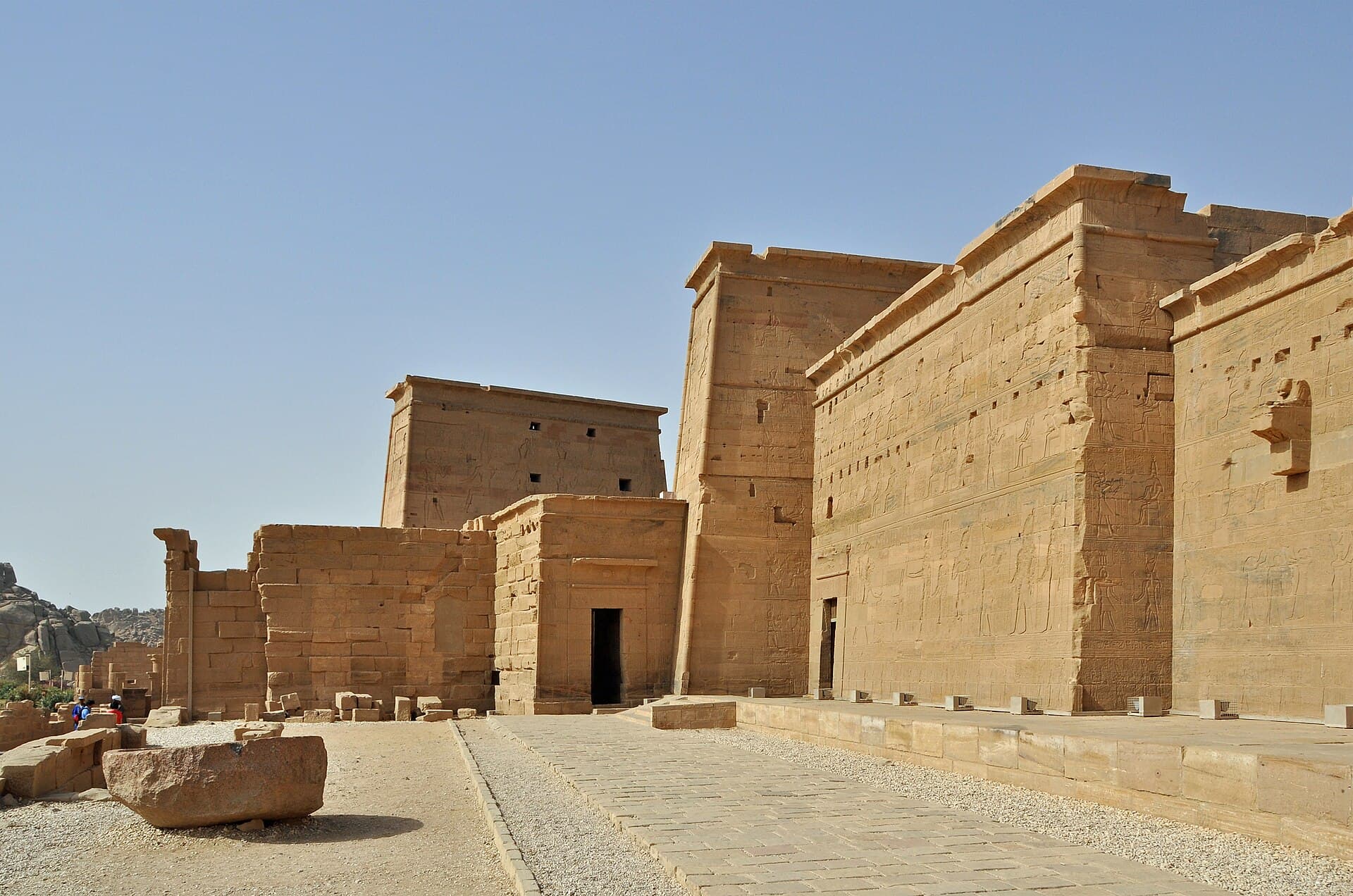
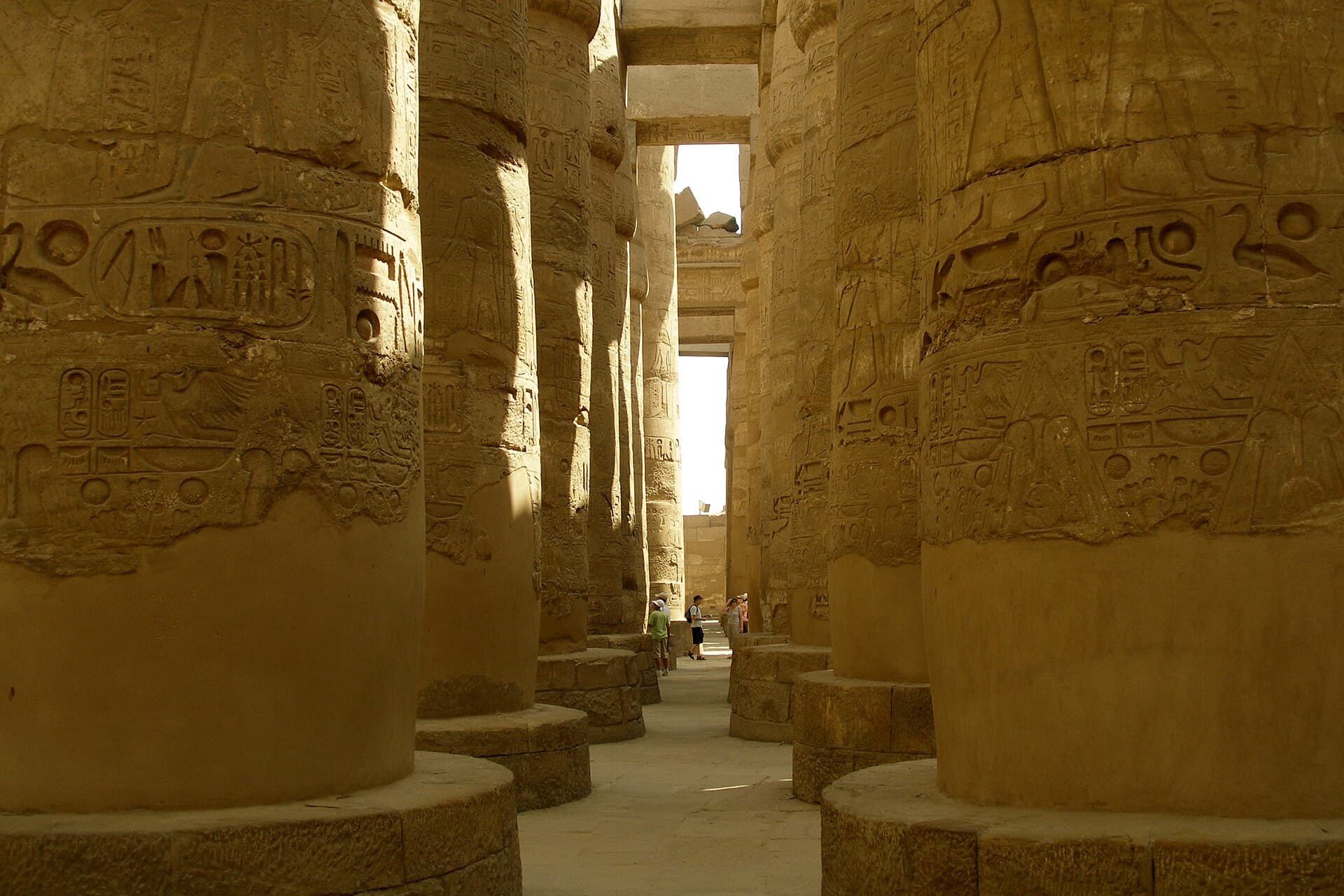
One hall. A roofed hypostyle hall of columns, and that is the visit. The rest of the temple is not ruined so much as unavailable: it lies under the modern town, which grew over it and is still living on top of it. You cannot excavate a town that people are using, so what you get is the room that happened to survive intact and the acceptance that the rest stays where it is.
The other thing everyone notices is the level. Ground in a Nile town rises over centuries — silt, rubble, one building put up on the flattened remains of the last — and the hall did not rise with it. It now sits in a pit, and you look down onto it from street level before descending. Our cruise pages describe it the same way: Esna, sunk below the level of the modern town. Arriving at a temple by going downwards is unusual enough to be worth the walk on its own.
The practical consequence of being one room is that this is a short visit with nothing to pace. There is no processional approach, no pylon to walk through, no sacred lake, no side chapels to argue about. Twenty minutes covers the floor. An hour covers the ceiling, which is the only part that needs an hour.
The soot, and the cleaning
The hall was never abandoned to the desert. It was used, built against and lived in, and fires were lit inside it. Over a very long time that left the ceiling and the upper parts of the columns under a thick black crust. The painted decoration was still there underneath the whole time; nobody could see it.
A conservation programme has been removing that crust, and colour has come back — registers across the ceiling, painted capitals, detail on the column shafts that had been invisible within living memory. This page carries no dates, no percentages, no funding figures and no names of the teams involved, because we have no source of our own for any of it and inventing them would be worse than leaving a gap. The Egyptian Ministry of Tourism and Antiquities, linked at the foot of this page, is where that information belongs.
There is a precedent on this site worth reading first. At Dendera, north of Luxor, the same problem was solved: a long programme took off the black left by fires lit inside the temple, and what came out from underneath was original paint. If Dendera's ceiling is the sort of thing that moves you, Esna is doing it again in one small room. If it is not, Esna will not convert you.
Why colour is the whole point here
Most Egyptian temple interiors reach you as grey stone. You learn to read the carving by shadow, and after four days of it in Luxor you get quite good at it and also quite tired. Paint changes what you are looking at entirely: registers separate out, figures come forward from their backgrounds, and a decorated ceiling stops being texture overhead and becomes a design you can follow.
Esna's advantage is geometry. The cleaned work is on a ceiling directly above you in a small, still-roofed room, at a height where you can actually study it. Nothing is a hundred metres away behind a rope. The instruction for this site is the same one as at Dendera and it is not a joke: look up, and keep looking up. Visitors who walk the floor at eye level see a dark room with columns in it and leave puzzled about the fuss.
Do not expect Dendera's scale, though. This is one hall against a whole temple complex, and anyone arriving straight from Dendera will find Esna modest. Arriving from a week of bare stone at Karnak is the order that flatters it.
A note on what this page does not do: guides at the site will tell you which god the hall was built for, what the columns show and what the inscriptions say. We have not repeated that here, because we do not have a source of our own we can stand behind for it, and a monument page that invents its own scholarship is worth less than one with a hole in it. Ask your guide, and check the Ministry's own account.
The town you walk through to reach it
The temple does not sit on a clean archaeological plateau with a ticket booth and a car park. It sits at the bottom of a living town, and the walk from the mooring goes through that town and along a market street before it drops you at the edge of the pit. For a lot of visitors this is the only time on a whole cruise that they are set down in an ordinary Egyptian working place rather than at a monument or inside a hotel. That is the quiet value of the stop, and it is easy to miss if you are only counting temples.
The market street is the part people remember, for better or worse. Reactions divide sharply and predictably. Some rate the walk above the temple, precisely because it is real life rather than a restored set-piece: a street of shops and stalls going about a normal day, with the tourist trade layered on top. Others find the selling relentless and arrive at the hall already worn down by it, with no appetite left for a ceiling. Both reactions are common, and knowing in advance which of the two you tend to be is worth more than any amount of reading about the temple itself.
It is worth holding on to the oddity of the geography while you walk. The town is not next to the temple; it is on top of it. The houses, the shops and the street you are on stand at the level the ground rose to over many centuries, and the hall you are about to descend into is the floor that everything else was built up from. You are, in a literal sense, walking across the roof of the thing you came to see.
Practically, treat the walk as part of the excursion rather than a transfer to endure. It is short, it is flat until the steps down into the pit, and it is busiest when several boats have moored together and emptied their passengers onto the same street at once — which, on this stretch, is most of the time in high season.
The lock, and why your boat is sitting there anyway
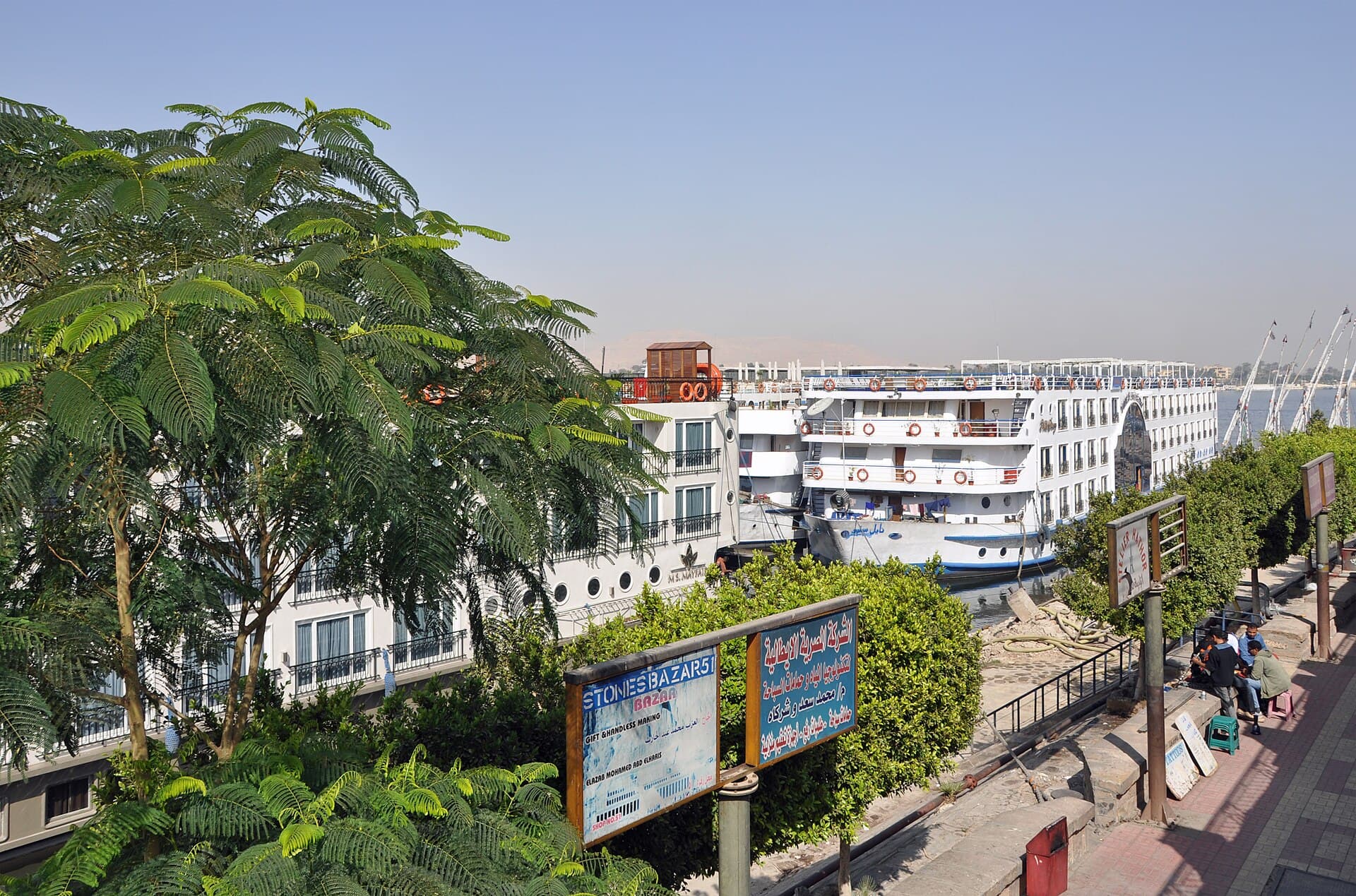
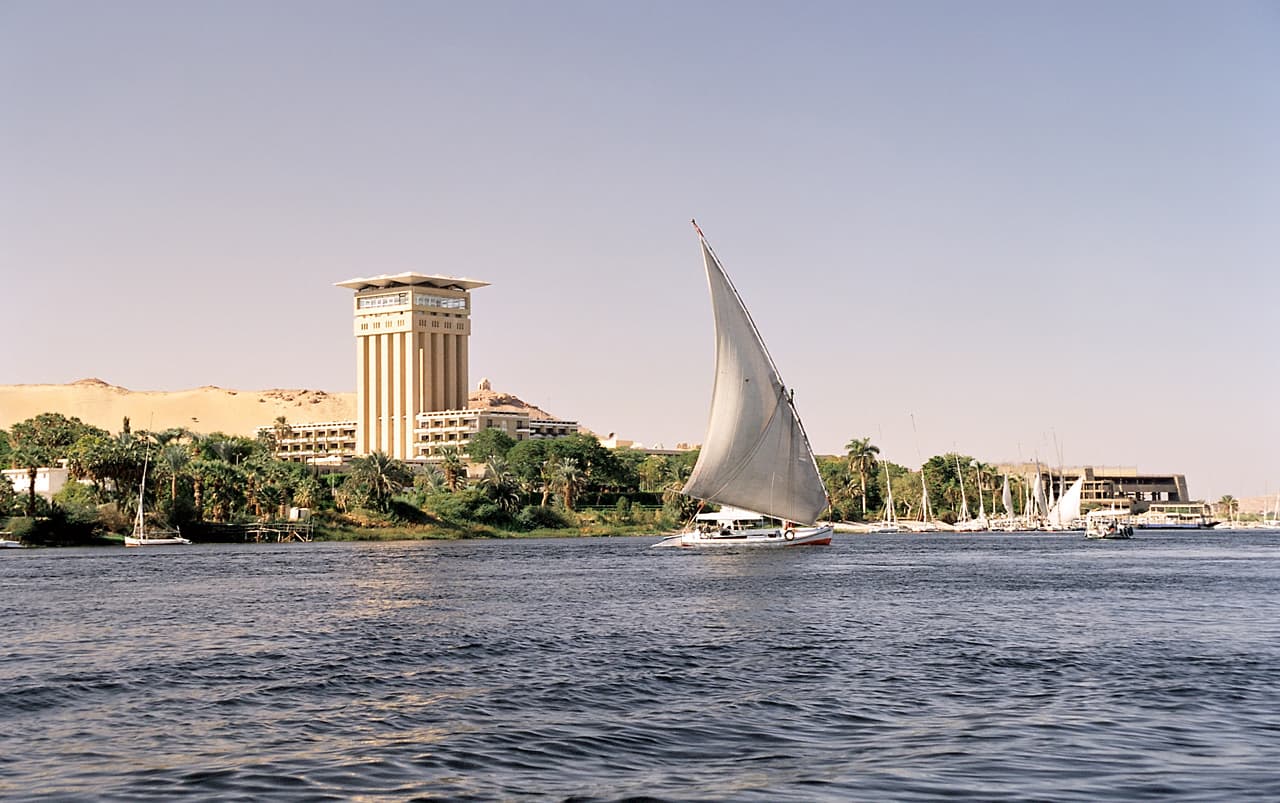
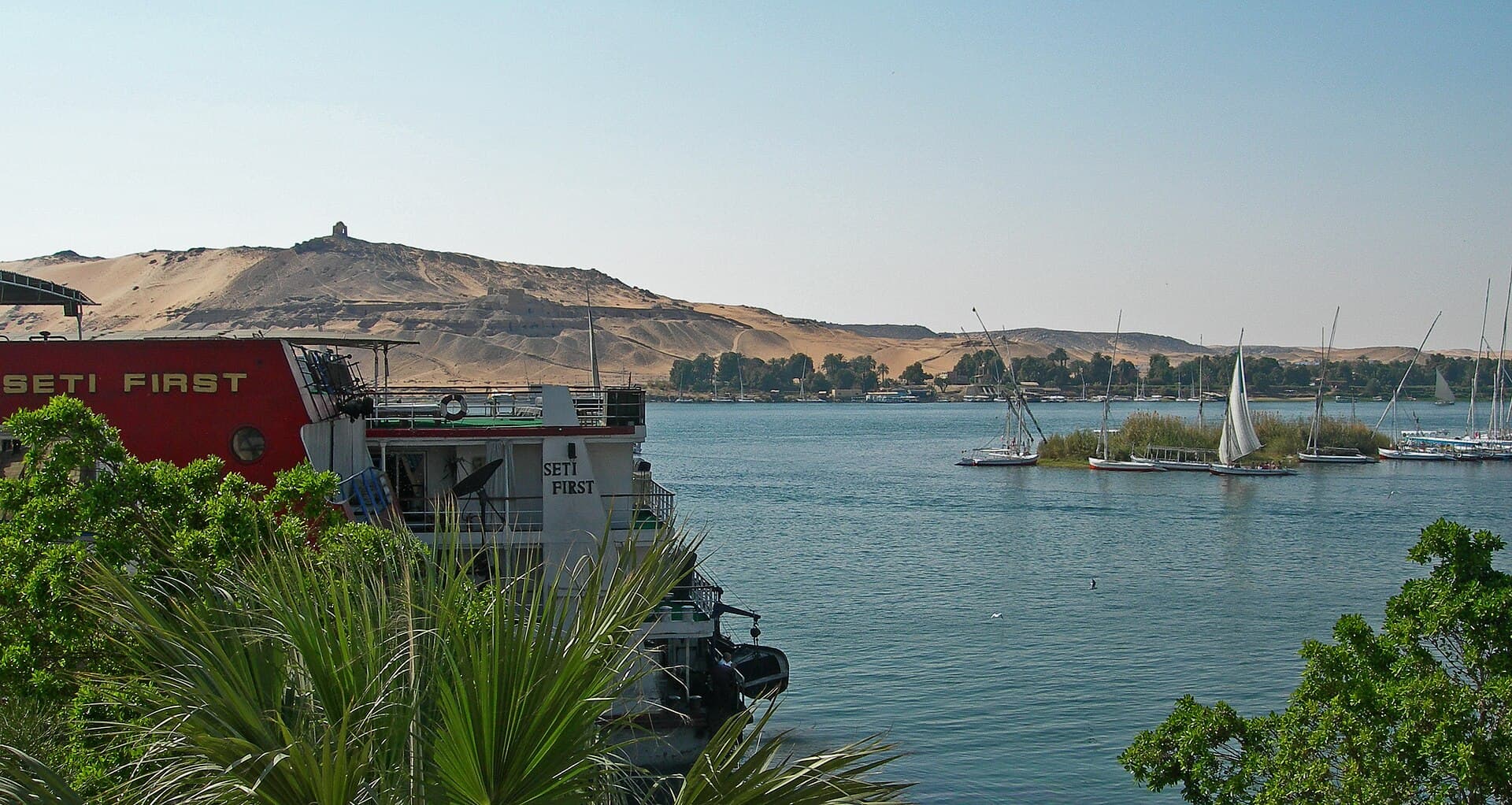
Between Luxor and Edfu, Nile boats pass through the lock at Esna, and traffic queues there. The wait can run to an hour or swallow an entire evening, depending on how many vessels are ahead of you. Nobody can schedule around it, and no operator can promise otherwise.
The mechanism is the reason the queue forms. A lock is a single gated chamber that raises or lowers boats between two levels of water, and only so many hulls fit in it at a time. When a whole fleet is working the same short stretch of river and arriving in the same window — which is exactly what happens between Luxor and Aswan — they reach the lock together and have to go through in turns. There is no overtaking a queue of cruise boats, so you wait your place. It is the one point on the route where the sheer number of boats on the river turns into time you can feel.
That changes the arithmetic of going ashore more than anything about the temple itself. If your boat is going to sit for three hours in a line of other boats, a short walk to a hall you can see properly in under an hour is an excellent use of an afternoon that was otherwise going to be spent on the sun deck watching a queue. If the stop lands in the middle of a tight day, the same walk costs you something real.
One warning: many itineraries do not include Esna as a call at all. Boats pass it, and pausing at the lock is not the same as visiting the temple. Do not assume the temple is on your programme just because the boat has stopped moving. Ask before you book if it matters to you, and ask again on board.
Esna as a place to begin: dahabiyas and small sailing boats
Esna is not only a place cruises pass — for a whole category of boat it is where the trip starts. Many dahabiyas, the small sailing boats that carry only a handful of cabins, begin from Esna rather than Luxor. The reasons are practical rather than romantic, and the effect on your itinerary is real: you lose a little of the river to a road transfer at the Luxor end, because the first stretch of water is done by coach rather than under sail.
If you are weighing a small sailing boat against a standard cruise ship, this is part of the trade. A dahabiya moors where the big boats cannot and sails quietly past fields the motor boats motor past, but its schedule bends to the wind and it often asks you to join it at Esna instead of stepping aboard in Luxor. On a longer trip — a fortnight, say — a small sailing boat between Esna and Aswan is one of the additions that opens up, and because these boats have so few cabins they need booking well ahead and sit in a price bracket of their own.
There is a related reason a boat can find itself at Esna unexpectedly. Occasionally a cruise does not sail the full stretch at all — low water, a long queue at the lock, or a mechanical problem can leave a boat where it is — and the operator then moves the group to the temples by road instead. The itinerary survives; the sailing does not. It is uncommon, but it is another way Esna turns from a place you glide past into a place you actually set foot in. The temples, on this route, are the guaranteed part of the week. The river is not.
When it is worth going ashore
It is worth it if you have already done Karnak and Luxor temple and found them magnificent but monochrome; if you like painted decoration enough to spend forty minutes with your head tilted back; if the stop falls at a civilised hour; and, most of all, if the alternative is waiting at the lock.
It is not worth it if you are being marched through in twenty minutes as a paid extra, at the same time as something you would rather do, or at the end of a week when everybody in your group is templed out. Esna is small, and a tired visitor sees one dark room and shrugs. There is no shame in skipping a stop that will not land.
The walk itself is part of the transaction. The route from the mooring goes through the town and along a market street, and reactions divide sharply. Some people rate that walk above the temple, because it is one of the few times on a cruise you are in an ordinary Egyptian working town rather than at a monument. Others find the selling relentless and arrive at the temple already worn down. Both reactions are common, and knowing which of the two you are saves you an argument.
How it compares with Edfu and Kom Ombo
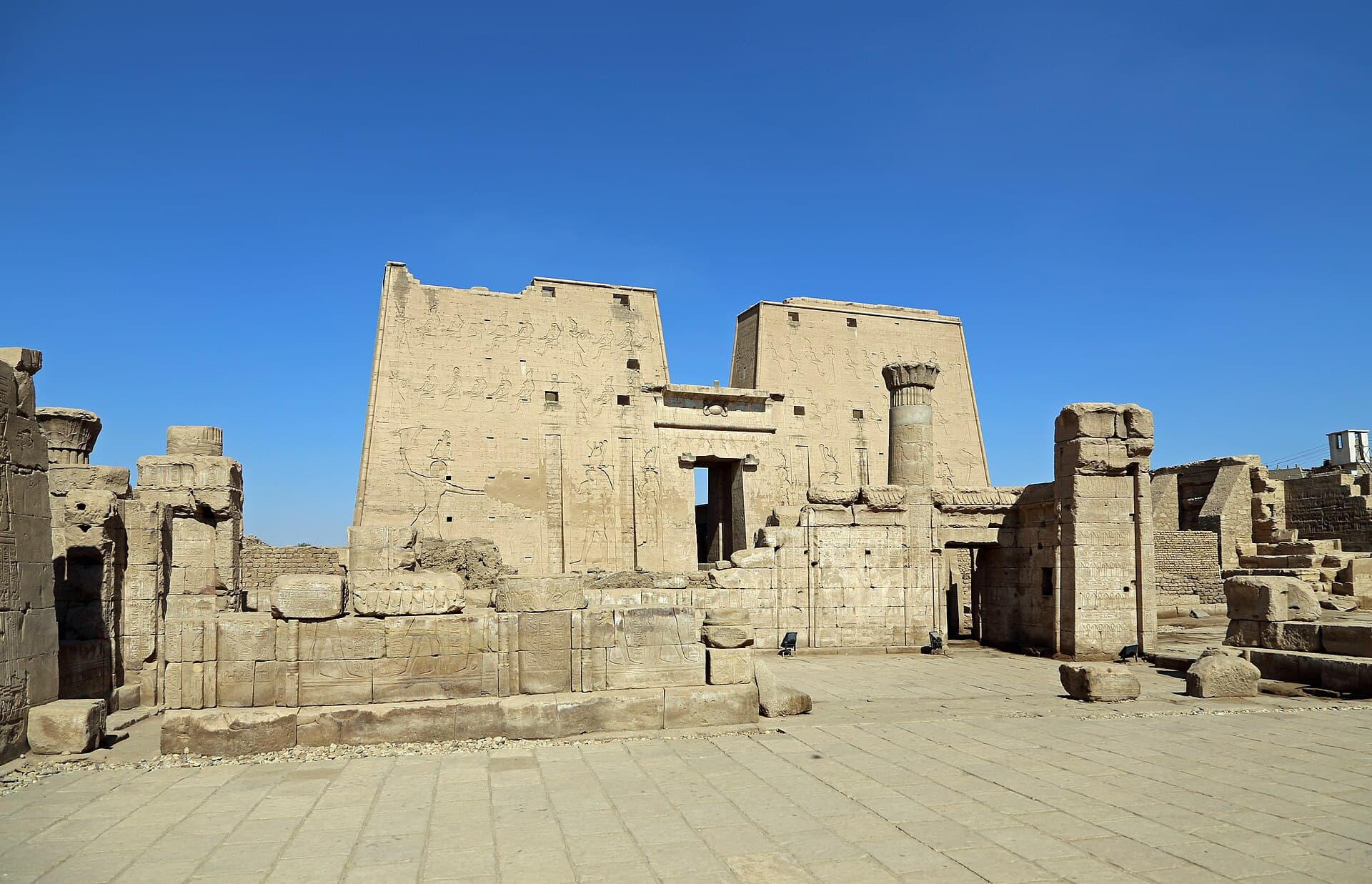
Edfu is the complete one: roof on, pylon standing, a dark interior you walk through and come out the other side of. Kom Ombo is the strange one, dedicated to two gods at once and moored so close to the river that you walk off the gangway and up the steps to it. Esna is neither. Esna is a ceiling.
If you can only take one of the three seriously on a short sailing, take Edfu, which does the most to show what a Ptolemaic temple was. Kom Ombo is the easiest of the three to reach and the quickest to see. Esna is the one that rewards you if you have the appetite for a fourth temple in a week — and the one that will underwhelm you if you do not.
None of the three needs half a day. Anyone quoting you one is padding.
Visiting from Luxor by road
Esna lies south of Luxor on the way to Edfu, so a road day with a car and driver can take in both temples at your own hours rather than a boat's. That is the version that suits anyone who wants time in the hall instead of a group slot, and it is the only way to arrive when the light and the crowds suit you rather than when the schedule does.
It is also the fallback if your cruise passes Esna without stopping and you decide you want to see it anyway. Pairing it with Edfu makes the driving worthwhile; on its own it is a lot of road for one room.
The road version also sidesteps the lock entirely, which is its own quiet argument. Nothing you do by car is held up by a queue of boats, so the time you spend is time you chose to spend. Against that, you give up the river — and on this stretch the river, not the temples, is the thing a cruise is really selling. Which way that balance falls depends on whether you came to Egypt for the monuments or for the water between them.
What to check locally
Whether the stop is in your cruise programme, at what hour, and whether it costs extra. Ticket arrangements and whether a separate photography ticket applies. Opening hours, which are not something to take from a guidebook or from this page.
Above all, whether any part of the hall is closed while conservation work is underway. A cleaning programme means scaffolding, and scaffolding means a section of ceiling you will not see. That is not a reason to stay away — it is the reason there is anything worth seeing — but it is worth asking about before you pay for an excursion sold on the ceiling.
Access is down into the pit, so there are steps and no level route. If someone in your group is unsteady, this is a stop to think about rather than assume.
Common questions
Where is Esna?+
Esna sits on the Nile south of Luxor, on the way to Edfu, along the Luxor-to-Aswan stretch that every Nile cruise works. Sailing south it is usually the first temple town after Luxor, with Edfu and Kom Ombo beyond it. It is close enough to Luxor that a road day with a car and driver is a realistic alternative to the boat.
What is there to see in Esna, Egypt?+
Three things under one name: the town, a working Egyptian place you walk through on a market street; the lock, where Nile boats queue; and the temple, a single roofed hall sunk below the streets, with a painted ceiling being cleaned. The temple is what guides sell, but the walk through the town is the part that divides opinion most.
Is Esna temple worth visiting?+
It is worth an hour if you like painted decoration and your schedule has the room — the cleaned ceiling is genuinely unusual and you can study it at close range in a small roofed hall. It is not worth a rushed twenty-minute march at extra cost at the end of a temple-heavy week. The single best case for going is a long wait at the lock, when the time was going spare anyway.
What is the Esna lock, and why do boats queue there?+
A lock is a single gated chamber that raises or lowers boats between two levels of water, and only a few fit at a time. On the busy Luxor-to-Aswan stretch the boats arrive in the same window and have to pass through in turns, so a queue forms. The wait is unpredictable: under an hour on a quiet day, an entire evening when the line is long. No operator can schedule around it.
Why is Esna temple below street level?+
Because the town rose and the temple did not. Ground level in a Nile town climbs over centuries as silt arrives and buildings go up on the remains of older ones. The hall stayed where it was built, so it now sits in a pit with the modern town around and above it. You look down onto it from the street and descend to the entrance.
How much of the temple survives?+
The hypostyle hall, and effectively nothing else that you can visit. The rest lies beneath the modern town, which is inhabited, so it is not going to be excavated. That is why the visit is short: there is one room, and the ceiling in it is the reason to be there.
Do any Nile cruises start from Esna?+
Yes. Many dahabiyas — the small sailing boats with only a handful of cabins — begin from Esna rather than Luxor, which means a road transfer at the Luxor end and a little of the river done by coach rather than under sail. A small sailing boat between Esna and Aswan is also one of the additions that opens up on a longer trip, and because these boats are small they book up well ahead.
Do all Nile cruises stop at Esna?+
No. Many boats pass it, and queuing at the Esna lock is not the same as calling at the temple. If seeing Esna matters to you, confirm it is on the itinerary before you book rather than assuming, and check again on board. Boats on this stretch reliably call at Edfu and Kom Ombo; Esna is the variable one.
How long is the wait at the Esna lock?+
Unpredictable. It can be under an hour or it can take an evening, depending on how many boats are in the queue ahead of you. No operator can schedule around it and none should promise to. Treat it as time you may or may not get back, and have something to do with it — which is one reason the temple stop makes sense when it is offered.
Has the whole ceiling been cleaned?+
We do not have a source of our own for how far the work has reached, so this page will not put a figure on it. Conservation of this kind runs in stages over years, and sections can be under scaffolding when you visit. Ask on the day, and check the Egyptian Ministry of Tourism and Antiquities for the official position rather than a news article of unknown age.
Can you visit Esna without being on a cruise?+
Yes. It sits south of Luxor on the road towards Edfu, so a car and driver can take in both temples in a day at hours that suit you rather than a boat's schedule. That is also the better option if you want longer in the hall than a group slot allows, and it sidesteps the lock queue entirely. On its own it is a lot of driving for one room, so pair it with Edfu.
Official sources
Entry rules, opening hours, security advice and exchange rates all move. Check them at the source, not here.
Written and checked by the Nile Trip Guide editorial team · Last reviewed . Entry rules, prices and opening hours change — check anything critical against the official sources linked on this page.
Plan this trip
Tell us your dates and we will price it
A real itinerary with real prices, usually within 24 hours. Nothing is booked and nothing is charged until you say yes.
The route most people take first, at the length it was built for: Giza and the Grand Egyptian Museum, then a flight to Luxor and four nights sailing down to Aswan.
No boat on this one. Giza and the Grand Egyptian Museum, a night in Luxor for both banks, two nights on the Red Sea, then back to Cairo for the Citadel, Coptic Cairo and the Royal Mummies.
Five nights in Cairo either side of a four-night sail from Luxor to Aswan. The Cairo days are private, just your party and a guide; the sightseeing off the boat is shared with a small group.