Dendera is the temple most people skip and then wish they had not. The Temple of Hathor sits on the west bank of the Nile north of Luxor, and it holds ceiling paintings in better condition than anything at Karnak or Luxor. Colour survives here at a scale you will not see elsewhere, and it is worth the long day it takes to reach.
What is Dendera, exactly?
Dendera is a temple complex about 60km north of Luxor, near the town of Qena. Its centrepiece is the Temple of Hathor, goddess of love, music, motherhood and drunkenness. The temple's own inscriptions claim a shrine on this spot as far back as the Old Kingdom, a claim Egyptologists treat with caution, but the building you walk through is late. Construction began under the last Ptolemies and continued under Roman emperors, which makes it roughly 2,000 years old rather than 4,000. It was built to much older conventions and reads as thoroughly Egyptian.
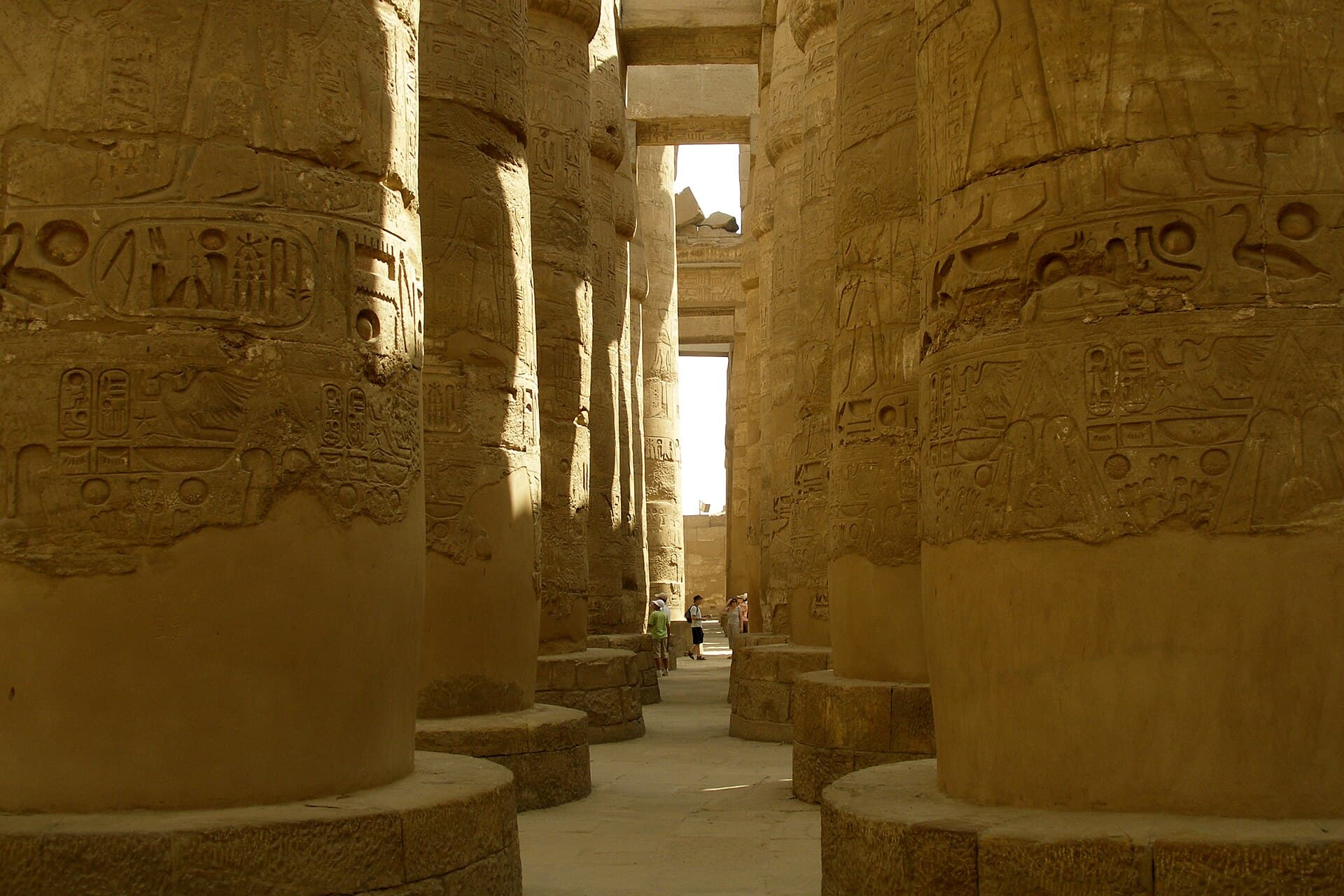
The complex includes a sacred lake, a Roman-era birth house, the remains of a Coptic basilica, and a small temple of Isis. The Hathor temple dominates everything. Its outer hypostyle hall has 24 Hathor-headed columns in four rows of six, each carved with the same face: human features, cow ears, a heavy wig. Many of those faces have been hacked away, damage usually attributed to early Christians and later iconoclasts. It is obvious the moment you walk in, and it is part of the site's history.
The name is worth a note, because it moves around in the literature. Greek writers called the place Tentyra, which is why older books, older maps and a good deal of nineteenth-century travel writing use that name rather than the Arabic one. Modern spelling in English wobbles between Dendera, Dendara and Denderah, and all three refer to this site. If you are searching for reading material before you go, try more than one spelling.
The other thing worth fixing in your head early is that this is a walled enclosure rather than a single building. A mudbrick wall, much of it still standing, rings the whole precinct, and you enter through a monumental stone gateway that is later than the temple behind it. Inside there are several buildings of several periods, spread across an area big enough to take a quarter of an hour to walk properly. Most people see the Hathor temple, glance at the birth house on the way past, and never register the rest. That is a defensible choice on a tight schedule, but it is a choice, and it is better made knowingly.
Who Hathor was, and why she got a temple this size
Hathor is one of the oldest and most widely worshipped goddesses in Egypt, and one of the hardest to reduce to a single job. She is a goddess of love and sexuality, of music and dance, of motherhood and nursing, of drunkenness and festivity, and, in a darker register, of the violence that follows when a benign goddess is provoked. The Greeks, looking for the nearest equivalent in their own pantheon, identified her with Aphrodite. That comparison catches part of her and misses most of it.
Her usual forms are a cow, a woman with cow's horns framing a sun disc, or the face you see everywhere at Dendera: a woman with human features and the ears of a cow. Dendera was her principal cult centre, which is why the building is on this scale in what is otherwise a modest stretch of the valley. The temple is not a regional chapel to a minor deity. It is the home of a major goddess, funded as such, and the ambition of the decoration follows from that.
The detail that explains the architecture is the sistrum, the metal rattle shaken in Hathor's rites. The columns of the great hall are built to look like one: the head of the goddess sits where the handle meets the frame, and the block above it is carved as the rattle's shrine-shaped top. Twenty-four sistra, in stone, holding up the roof of the hall. Once you have been told that, the hall stops being a grid of columns and becomes a room full of instruments, which is much closer to what the builders intended.
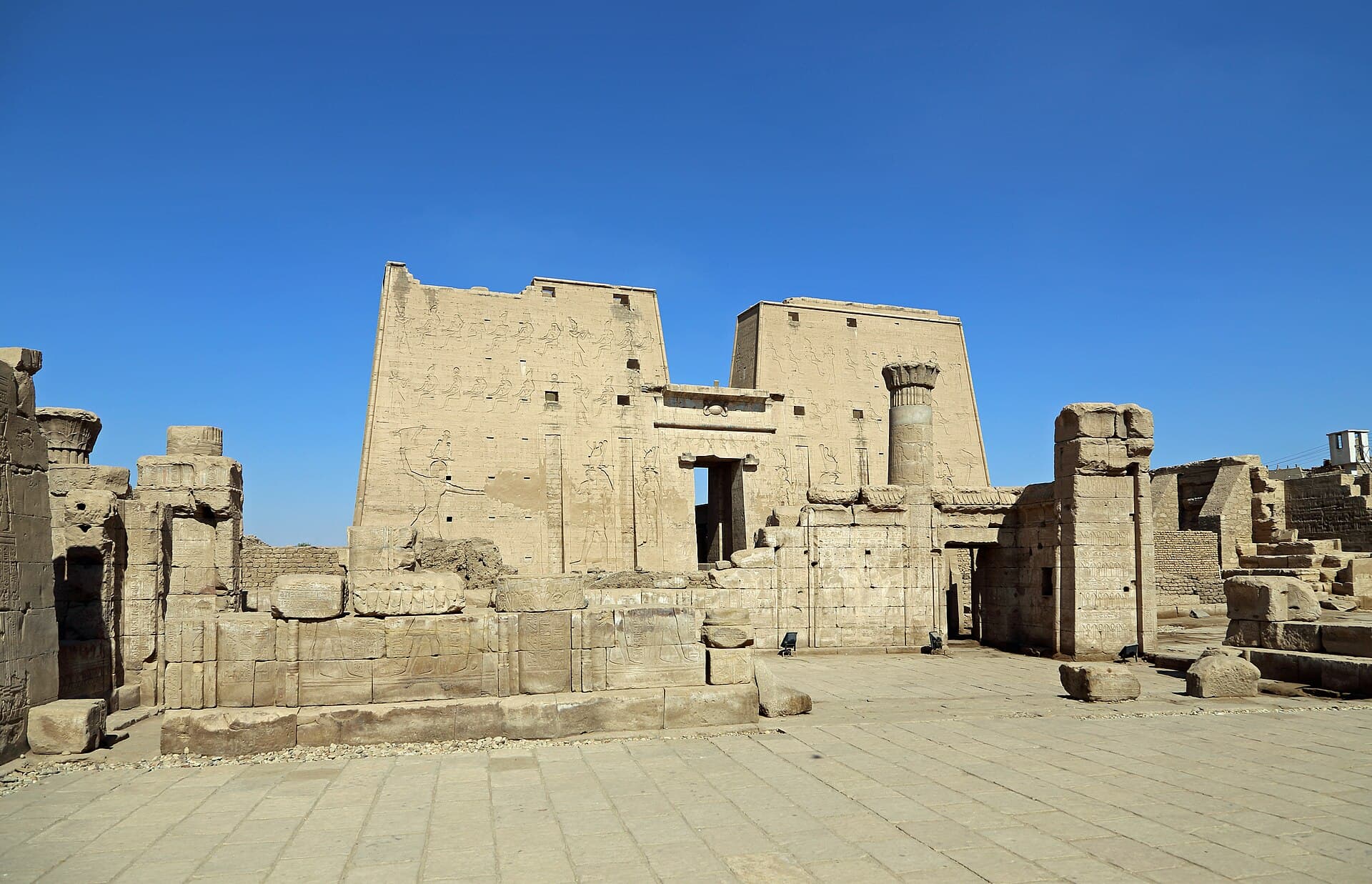
Hathor also had a husband, in the theology of this period, and he lived down the river. Horus of Edfu, whose own temple is the most complete in Egypt, was paired with Hathor of Dendera, and the temple's festival texts describe her image travelling south by boat each year to meet him. The journey took days, with stops, crowds and river processions along the way. It is a useful thing to know when you visit both, because Dendera and Edfu are not two unrelated temples that happen to be Ptolemaic. They were two ends of the same annual event.
Why the ceiling changes everything
Most Egyptian temples reach you as bare stone. Colour has burned off, washed away, or been buried under centuries of soot. At Dendera the roof stayed on, and the soot problem was solved. A long conservation programme removed layers of black grime left by fires lit by people living in the temple, and what came out from underneath was original paint.
The result is unusual. Deep blue ceilings, gold-yellow stars, the sky goddess Nut arched across the length of the hall, swallowing the sun each evening and giving birth to it each dawn. Astronomical registers run in bands with the zodiac signs, the decans that divided the night into hours, and processions of divine boats. Very little of Egypt looks like this. If you have seen Karnak and found it grand but monochrome, Dendera is the correction.
The columns and walls carry colour too, though less completely. Reds, greens and blues survive in patches at capital height and in the upper registers, where hands and weather could not reach. Lower down the stone has been rubbed back to grey by centuries of contact. The practical lesson is simple: at Dendera you should spend more time looking up than looking ahead.
It is worth being clear about what the cleaning did and did not do, because the site is sometimes described as though the paint were new. Nothing was repainted. The work was subtractive: centuries of black crust taken off the surface, and the original pigment beneath it left to be seen. That is why the colour is uneven, why some registers are far brighter than their neighbours, and why the effect is closer to a very old painting than to a restoration. The same approach has since been applied at Esna, on a much smaller scale, with the same kind of result.
How the temple is laid out, room by room
Dendera has no pylon. Where Edfu presents you with two great towers, Dendera presents a flat screen wall with a doorway in it, and the hall behind starts immediately. The effect at the entrance is therefore much less theatrical than at Edfu or Karnak, and first-time visitors sometimes register the building as smaller than it is. The drama here is entirely interior.
Past the doorway is the outer hypostyle hall, the big one, with the twenty-four Hathor columns and the astronomical ceiling. Beyond it the building narrows into a smaller pillared hall, then a sequence of offering rooms and antechambers, and finally the sanctuary at the dead centre, where the cult statue lived and where the barque used in processions was kept. The floor rises slightly and the ceiling drops as you go in, so each room is a little lower, a little darker and a little more restricted than the one before. That narrowing is the logic of every major Egyptian temple, and at Dendera the roof is still on to enforce it.
A corridor runs around the sanctuary, lined with small chapels, and this is the part visitors most often walk past in the gloom. It is dark, cramped, and thick with relief, and it is where a torch would help if the rules on the day allow one. If you have twenty spare minutes after the ceiling, spend them walking this circuit slowly rather than going back out into the hall.
Off the eastern side there is a small chapel with its own open court, usually identified as the room where the statue was prepared for the New Year procession. It is easy to miss and it explains the staircases, so it is worth asking your guide to point it out. The overall shape to hold in your head is straightforward: one great hall, a shrinking sequence of rooms behind it, a ring of chapels around the sanctuary, staircases going up on both sides, and crypts going down.
Where is the Dendera zodiac?
The famous circular zodiac is not here. It was cut out of the ceiling of a roof chapel in 1821 by a French collector, using saws and gunpowder, and it has been in the Louvre in Paris ever since. What you see in the chapel today is a painted cast. It is a fair stand-in and clearly labelled, but do not travel here expecting the original, and bear in mind that the roof chapels are not always open to visitors.
The zodiac matters because it mixes Egyptian decans with Babylonian and Greek constellation signs, which shows how ideas moved around the eastern Mediterranean by the first century BC. Ram, bull, scorpion, crab: recognisable signs, in an Egyptian temple, on an Egyptian ceiling. Egypt has asked for its return more than once. Those requests have not succeeded.
The circular one is not the only astronomical ceiling on the site, and this is the part that gets lost in the argument about the Louvre. The great hall overhead carries long rectangular astronomical registers of its own, in place, cleaned, and still painted, including a second and less famous zodiac worked into the scheme. Visitors who arrive fixated on the missing disc frequently walk underneath better material than the thing they came for. Look up in the hall before you go hunting on the roof.
Are the crypts worth it?
Twelve crypts, by the usual count, are built into the thickness of the temple walls and beneath the floor. They stored cult equipment and sacred objects, brought out for festivals and locked away the rest of the year. One crypt is usually open to visitors, reached by a narrow stair and a low passage. Access to it, and to the roof chapels, can change without notice, so confirm on the day rather than building your whole visit around it.
It is a tight squeeze. If you are claustrophobic or unsteady on stairs, skip it without regret. If you go, the reward is dense, sharp relief carving at close range, including the panels that the internet insists show electric light bulbs. They are not light bulbs, and no Egyptologist reads them that way. They show a lotus flower with a snake emerging from it, a standard Egyptian creation image that appears elsewhere in plainer form. Guides at the site are thoroughly used to being asked.
What makes the crypt carving so crisp is exactly what makes it awkward to visit. These rooms were sealed, unlit, unused for most of the year and never weathered, so the surfaces come to you in a condition the open walls cannot match. They were also never meant to be looked at by anyone but the priests who fetched and returned the equipment, which is why the passages are sized for a person carrying something rather than for a queue of visitors. Expect to wait, expect to go in single file, and expect to be asked to keep moving.
The roof, the mammisi and the rest of the complex
The roof is one of the best parts of Dendera and the part visitors most often miss. Stairs on both sides of the temple carry ritual processions carved into the walls, priests climbing one way and descending the other. On top there are open kiosks, the Osiris chapels, and a clear view across the fields.
At ground level, the Roman-era mammisi, or birth house, sits near the entrance. It celebrates the birth of Hathor's child and, by extension, the legitimacy of the ruler. The Roman emperors here are shown as pharaohs in traditional dress, making offerings to Egyptian gods, with their names written in cartouches. Roman rule kept the local religious machinery running rather than replacing it. Behind it stand an earlier birth house from the reign of Nectanebo I and the ruined shell of a Coptic basilica, so you get three religious phases within a short walk.
Birth houses of this period tend to carry images of Bes, the dwarf god who protected women in childbirth, and he is hard to mistake for anything else: front-facing, squat, tongue out, entirely unlike the profile figures on every other wall you will have seen that week. Egyptian art almost never shows a face straight on. When it does, it is usually doing something deliberate, and Bes is the clearest example of it in the country.
The Osiris chapels on the roof are a separate proposition from the view. They were used in rites connected with the death and revival of Osiris, and their ceilings and walls carry some of the site's more unusual material, including the chapel where the circular zodiac was cut out. Whether you can get into them depends on the day. The staircases themselves are worth climbing regardless, because the carved processions on the walls are at arm's length and lit by daylight from the stairwell, which is more than can be said for most reliefs at this site.
The New Year procession, and why there are two staircases
The two staircases are not a convenience. They are the route of a ritual, and the reliefs carved along them show the procession in motion: priests carrying standards and cult objects climbing in one direction on one flight, and coming back down on the other. You are walking through a scene of what used to happen on the steps you are standing on, which is rarer than it sounds and is the main reason to take the stairs slowly rather than treating them as a means of reaching the view.
The event they served was the New Year. The temple texts describe the goddess's image being brought up from the dark interior to an open kiosk on the roof, where it was exposed to the sun at dawn and, in the language of the rites, renewed by contact with the solar disc. Then it went back down, by the other stair, to the sanctuary. The architecture is built around that single annual journey: a dark room at the centre, a lit kiosk at the top, and two routes between them so that the procession never has to double back on itself.
This is also the best answer to a question visitors ask constantly, which is what all these rooms were actually for. An Egyptian temple of this period was not a place of congregation. Ordinary people did not go in. It was a machine for housing, feeding, clothing and periodically parading a god, staffed by a professional priesthood, and the festivals were the points at which the public saw anything at all. Hold that in mind and the layout stops being a maze and becomes a sequence of service rooms around a single occupant.
Cleopatra, the Ptolemies and a temple paid for by foreigners
The most-asked-about carving at Dendera is on the outside, at the back. The rear exterior wall of the temple carries a large relief of Cleopatra VII, the last Ptolemaic ruler, with her son Caesarion, both shown in full Egyptian regalia making offerings to the gods. It is worn, it is high, and it is photographed constantly. It is also not a portrait in any modern sense: the figures are carved to a formula that had been in use for many centuries, and anyone hoping to see what Cleopatra looked like will be disappointed.
What the relief does show is the political logic of the whole building. The Ptolemies were a Macedonian Greek dynasty ruling Egypt, and the Roman emperors who followed them ruled it from further away still. Neither had any ancestral claim to be pharaoh. Both spent heavily on Egyptian temples, in Egyptian style, with themselves depicted as Egyptian kings performing Egyptian rites, because that was the accepted way of demonstrating a right to rule to the Egyptian priesthood and the population it served.
That is why the date of Dendera confuses people. The building looks archaic and behaves archaically, and it was going up while Rome was fighting its civil wars. Nothing about it is a revival or a pastiche, either. The conventions had never lapsed; the priests who designed the decoration were working inside a living tradition with a continuous history behind it. What changed was who signed the cheques.
It also explains the cartouches. Walk the walls with a guide and you will be shown royal name-rings left blank, or filled with a generic formula rather than a personal name, because the ruler of the moment changed often enough that the masons sometimes did not bother, or did not know. For a country whose monuments are usually a record of one king shouting his name at posterity, that detail says a great deal about the period.
The damaged faces, and the layers that came after
The hacked-out Hathor faces are the first thing most visitors notice and the thing they ask about immediately. The damage is systematic rather than random: the faces are gone, and much else is intact. It is usually attributed to early Christians, and later hands, working on the principle that the images were inhabited by something that had to be disabled. Whatever the exact sequence, it was not vandalism in the modern sense of thoughtless destruction. It was targeted at what the images were believed to do.
Christianity is present on the site in a more constructive form too. The shell of a Coptic basilica stands within the enclosure, one of the earlier church buildings in the country and built from the materials to hand. It is a ruin now, with little left above waist height in places, and most visitors walk past it without knowing what it is. Knowing what it is turns the enclosure into a sequence rather than a single monument: pharaonic tradition, Ptolemaic and Roman patronage, then Christian Egypt, on the same ground.
Then came a long occupation by ordinary life. People lived in and around the temple for centuries, which is how the ceiling got its coating of soot in the first place: fires lit for cooking and warmth in a room that happened to be a hypostyle hall. The black crust that conservation removed is a direct record of that period. It is one of the small ironies of the site that the same occupation which blackened the paint also sheltered it, because a covered, inhabited building does not lose its pigment to sun and rain.
The sacred lake, the enclosure and the quieter corners
The sacred lake sits to the south-west of the temple: a rectangular stone basin sunk into the ground, with staircases descending at the corners, once filled with water drawn from the groundwater table and used for purification and for the rites that needed a body of water. It holds no water now. Palms have grown up out of the bottom of it, which makes it one of the more photogenic things in the enclosure and, for most people, the only garden they will see at an Egyptian temple.
Near the lake stands a small building usually identified as a sanatorium, where pilgrims seeking cures are thought to have stayed. Hathor was a healing goddess among her other roles, and water that had run over inscribed surfaces was believed to carry the power of the text with it. The identification is an interpretation rather than a certainty, and it is presented that way in the serious literature, but it is a reasonable one and it makes sense of a structure that otherwise looks like an odd set of rooms in a field.
The small temple of Isis stands behind the main building and is badly ruined. Taken together with the two birth houses, the basilica, the lake and the gateway, these are the parts that turn a temple visit into a site visit. None of them will take more than a few minutes each. The reason to do them is that they are almost always empty: the coaches go in the front door of the Hathor temple and come out of it again, and the rest of the enclosure belongs to whoever bothered to walk round.
How do you actually get there from Luxor?
Almost everyone visits Dendera on a road trip from Luxor, and almost everyone pairs it with Abydos. Dendera lies north of Luxor and Abydos further north again, so the two sit on the same road and make a natural pair. Dendera alone is a little over an hour's drive; Abydos is closer to three. Expect a full day for both. Convoy rules and permit requirements on this road have changed repeatedly over the years, so let your operator confirm the current position rather than assuming.
It is a long day and a hard one in high summer. Some people prefer to do Dendera on its own and skip Abydos, which cuts the driving sharply and gives you time to do the temple properly rather than at pace. That is a reasonable choice if you want one great temple rather than two, and Dendera is the better one for colour. Abydos has the better reliefs and the famous king list.
The practical form this takes is a private car with a driver, usually with a guide, arranged through your hotel or a ground operator in Luxor. There is no useful public transport option for a visitor working to a schedule, and the site is not walkable from anywhere you would be staying. Agree the day's shape and the finishing time before you set off rather than in the car park, because the cost of the day is the driver's time and the temptation at the far end is always to cut the temple short rather than the driving.
A workable plan for the day
If you are doing Dendera and Abydos together, the order that works is Abydos first. Leave Luxor early, drive the full three hours while you are fresh, do the harder and more detailed site in the morning, and take Dendera on the way back. That puts the longer drive at the start of the day and the shorter one at the end, and it means the temple you reach tired is the one where the main attraction is lying on your back looking at a ceiling rather than reading fine relief.
If you are doing Dendera alone, reverse the priority and go as early as the site opens. You will get the hypostyle hall to yourself for a while, and you will be finished and back in Luxor with an afternoon still in hand, which is enough for Luxor Temple after dark or an hour in the museum. Treated this way Dendera is a half-day, not a full one, and it stops competing with the rest of your Luxor plans.
Inside the temple, a sequence that works: the great hall first and slowly, with your head back; then straight through to the sanctuary and the ring of chapels around it while your eyes are still adjusted to the dark; then the crypt, if it is open and you want it; then the stairs to the roof; then, on the way out, the birth houses, the basilica and the lake. Leaving the roof until after the interior matters in warm weather, because there is no shade up there and you will not want to go back down.
When is the best time to visit Dendera?
Go early. Arrive as close to opening as your driver can manage and you will have the hypostyle hall close to empty, which is when the ceiling is at its best. Coach groups build through the middle of the morning, and the hall turns noisy and crowded quickly once they arrive.
October to April is the comfortable window for both the drive and the walking. May to September is genuinely hot, and the roof, which has no shade, becomes unpleasant well before midday. The interior stays cooler than outside but it is not air-conditioned, and the crypt is warmer still. In summer, front-load your visit: temple interior first, roof second, and be back in the car before the worst of the afternoon.
Light inside the temple is dim and uneven. The ceiling paintings are lit, but photographing them without a steady hand is difficult, and your phone will not capture what your eyes see. Rules on cameras, flash and tripods vary between sites and change from year to year, so check at the ticket office on the day rather than relying on what you read online.
One further point about timing that applies across the Nile Valley: the sites are busiest when the cruise fleet is in. Dendera is off the standard cruise route, which helps, but the road traffic from Luxor still follows the same daily rhythm as everything else, and a temple that is quiet at eight is a different place at eleven. If your driver tells you an early start is not necessary, politely insist. It is the single decision that most changes how this particular temple feels.
Tickets, facilities and what to bring
Tickets are bought at the entrance to the enclosure. We do not publish prices on this page, because entry fees in Egypt are revised regularly and a figure written down once is a figure that will be wrong within a year or two; ask your operator for the current cost when you book, or check the official ministry source. The same applies to separate charges that may or may not apply to photography, and to whether the roof and crypt are covered by the standard ticket on the day you turn up.
Facilities are modest. There is shade near the entrance, and the walk from the car park into the enclosure is short and flat, but there is nothing inside the temple in the way of seating or refreshment, and nothing at all on the roof. Take more water than you think you need, particularly if you are combining the site with Abydos and will be out of Luxor for eight or nine hours. Small notes for tips are worth having, as at every site in the country.
Practical kit: shoes with grip, because the stone floors inside have been polished smooth by two thousand years of feet and the staircases are worn; a hat for the roof; and, if the rules allow it on the day, a torch for the sanctuary corridor and the crypt. A phone torch will do. Avoid pointing any light directly at painted surfaces, and be ready to be told to put it away, which is a reasonable instruction at a site where conservation has already had to undo one round of human damage.
Dendera compared with Egypt's other late temples
Dendera belongs to a group of four temples built or completed in the Ptolemaic and Roman centuries that between them are the best-preserved large buildings in the country: Dendera, Edfu, Kom Ombo and Philae, with Esna as a smaller fifth. They are late, they are stylistically consistent, and they show you far more of what an Egyptian temple actually was than the older and more famous ruins do, because more of them is still standing.
Edfu wins on completeness. The roof is on, the pylon still rises to near its full height, and you can walk the whole sequence from the front door to the sanctuary as a priest would have done. Kom Ombo wins on setting, standing on a bend of the river, but it has lost its roof and much of its river side. Philae wins on approach, since you reach it by boat. Dendera wins on colour, and it is not close: the cleaned astronomical ceilings have no real competition anywhere in Egypt.
Esna is the interesting comparison, because it is the same story in miniature. One hall, sunk below a modern town, its ceiling under centuries of the same black crust, and the same patient subtractive cleaning giving the paint back. If Dendera moves you, Esna is worth the short stop. If you see Esna first, Dendera is what it looks like at full scale.
Against the older monuments the comparison is different in kind rather than degree. Karnak is vastly larger and two thousand years in the making. The Valley of the Kings holds painted tomb chambers that rival anything here for colour, but they are tombs, not working temples, and they are underground. Dendera's particular claim is that it is a temple interior, above ground, roofed, decorated and legible. There is nothing else quite in that category.
Where Dendera fits into a Luxor trip
On a first trip to Egypt with a week to spend, Dendera is not the thing to cut Karnak or the Valley of the Kings for. The famous sites are famous for defensible reasons, and a first visit that skips them to drive two hours north is a strange first visit. Luxor needs two full days at a minimum and three to be comfortable, and Dendera sits on top of that rather than inside it.
On a second trip, or on a longer first one, it moves up the list quickly. It is the obvious answer to the question of what to do with a spare day in Luxor once the headline sites are done, it is far quieter than anything on the west bank, and it shows you something the standard circuit genuinely does not. The same is true of Abydos, which is why the two are usually spoken of in the same breath.
It is also the strongest argument for staying in a hotel rather than on a boat, if the choice is open to you. Nile cruises work the Luxor-to-Aswan stretch, which runs in the opposite direction; Dendera and Abydos are north, and standard boats do not sail there. Anyone whose trip is built entirely around a cruise will need a land day at either end to reach them, and most people who plan that in are glad they did.
What most visitors get wrong
The most common mistake is rushing. Dendera gets treated as the warm-up act for Abydos, and people give it forty minutes before being called back to the car. The temple deserves ninety at minimum, more if you go up to the roof and down into a crypt. Build the day around the temple rather than the driving, and tell your driver at the start how long you intend to be inside.
The second is looking only at eye level. The wall reliefs at head height are competent late-period work, repetitive offering scenes carved to a formula, and if that is all you see you will leave wondering what the fuss was about. The ceilings are the reason to be here, and they reward standing still with your head back for longer than feels natural.
The third is arriving with alternative-history expectations, mostly about the crypt reliefs, and spending the visit hunting for evidence of something that is not there. Related to it: expecting the original zodiac and feeling cheated by the cast. Both are avoidable by knowing in advance what the temple actually is, which is a Greek and Roman administration paying for Egyptian religion, in Egyptian style, long after the pharaohs whose look it copies.
The fourth, and the most easily fixed, is treating the enclosure as though the Hathor temple were all of it. The birth houses, the basilica, the lake and the small temple of Isis add perhaps twenty minutes to the visit and they are the part almost nobody walks. If you have come this far for one building, you may as well see the four others standing around it.
Common questions
Is Dendera suitable for someone with limited mobility?+
There are steps up into the temple, but the main floor is level once you are inside, and the hypostyle hall with its painted ceiling is on that level, so the main reason to come is reachable. The roof means climbing a stone staircase and the crypt means bending through a low passage. Both are optional. You can have a good visit without either.
Do I need a guide at Dendera?+
The ceiling astronomy, the crypt reliefs and the Roman cartouches all make far more sense with someone explaining them, and there is very little interpretive signage on site. If you are already travelling with a guide, they will earn their keep here. If not, read up on the astronomical ceiling beforehand so you know what you are looking at.
How does Dendera compare with Karnak or Abu Simbel?+
Different things. Karnak wins on scale, Abu Simbel on drama and setting. Dendera wins on preservation and colour. If you have limited time in Egypt and only want the largest and most famous monuments, Dendera is not essential. If you want to know what an Egyptian temple interior actually looked like when it was in use, nothing else comes close.
Do Nile cruises stop at Dendera?+
Some do. Dendera sits close to the river near Qena and certain itineraries moor there, but plenty of Luxor to Aswan cruises never go north at all, since Qena is in the opposite direction. Check the specific itinerary before booking a cruise on that basis, and check whether the stop is included or sold as a paid extra.
How long should I allow at the site itself?+
Ninety minutes minimum for the temple interior and a proper look at the ceilings. Add thirty minutes for the roof, and fifteen for the crypt if it is open and you want to do it. Two hours covers a thorough visit. Anything under an hour and you will be walking past the best material without registering it.
Is the drive to Dendera safe?+
Dendera is a routine stop for tour traffic out of Luxor and the road is well used. That said, security arrangements for the Qena road, including any convoy or permit requirements, have changed more than once over the years. Check your own government's current travel advice before you book, and let your ground operator confirm the position on the day.
Can you do Dendera and Abydos in the same day?+
Yes, and that is how most people do it. Abydos is roughly three hours north of Luxor and Dendera a little over an hour, on the same road, so the standard shape is Abydos in the morning and Dendera on the way back. It makes for a long day, eight or nine hours door to door, and it is hard work between May and September.
How old is the Temple of Hathor?+
The standing building is roughly 2,000 years old. Construction began under the last Ptolemies and continued under Roman emperors, so it is late by Egyptian standards, despite looking archaic. The temple's own inscriptions claim a shrine on the site as far back as the Old Kingdom, which would be far older again, but Egyptologists treat that claim with caution.
Are the roof and the crypt always open?+
No. Access to the roof chapels and to the crypt changes, sometimes at short notice, for conservation and for practical reasons on the day. Both are worth doing and neither is guaranteed, so ask when you buy your ticket rather than planning the visit around them. The painted ceiling of the great hall, which is the main reason to come, is on the main floor and does not depend on either.
Why do some books call it Tentyra or Dendara?+
Tentyra is the Greek name for the place, so it turns up in classical sources and in older travel writing and maps. Dendera, Dendara and Denderah are all transliterations of the modern Arabic name and all refer to the same site. If you are searching for further reading or older photographs, it is worth trying more than one spelling.
Is there really a carving of Cleopatra at Dendera?+
Yes, on the rear exterior wall of the temple, showing Cleopatra VII with her son Caesarion in Egyptian dress, making offerings. It is genuine and it is one of the few surviving monumental depictions of her. It is not a likeness in any modern sense, though: the figures follow a carving convention many centuries old, so do not expect to learn what she looked like from it.
Is Dendera a good site to take children to?+
Better than most, on the whole. The visit is short, the main hall is a single impressive space rather than a long trudge, and the roof and the empty sacred lake give children something to do that is not another wall of offering scenes. The crypt is a poor idea for anyone nervous in small spaces, and there is very little shade, so summer visits with young children need an early start.
Official sources
Entry rules, opening hours, security advice and exchange rates all move. Check them at the source, not here.
Written and checked by the Nile Trip Guide editorial team · Last reviewed . Entry rules, prices and opening hours change — check anything critical against the official sources linked on this page.
The route most people take first, at the length it was built for: Giza and the Grand Egyptian Museum, then a flight to Luxor and four nights sailing down to Aswan.
No boat on this one. Giza and the Grand Egyptian Museum, a night in Luxor for both banks, two nights on the Red Sea, then back to Cairo for the Citadel, Coptic Cairo and the Royal Mummies.
Five nights in Cairo either side of a four-night sail from Luxor to Aswan. The Cairo days are private, just your party and a guide; the sightseeing off the boat is shared with a small group.