Kom Ombo: Visiting Egypt's Double Temple on the Nile
Kom Ombo is the strangest temple on the Nile between Luxor and Aswan, and the quickest to see. It was built for two gods at once, so everything inside it comes in pairs: two entrances, two sanctuaries, two of almost everything. Cruise boats moor at the foot of it. You walk up, spend under an hour, and walk back down.
What is Kom Ombo, exactly?
Kom Ombo is a Ptolemaic temple on the east bank of the Nile, roughly 45 kilometres north of Aswan. Building work ran mainly through the last two centuries BC, with Roman additions afterwards, so it is young by Egyptian standards. The pyramids at Giza were already more than two thousand years old when the masons started here. There was earlier religious building on the site, but what you walk through today is late.
The unusual part is the dedication. Most Egyptian temples serve one god and one divine family. Kom Ombo serves two: Sobek, the crocodile god, with his own consort and child; and Haroeris, a form of Horus the Elder, with his. The two cults were housed under one roof and given equal treatment, right down to the plan. Why is not settled. Some read it as two long-established local cults given equal standing, others as a political balancing act. Nobody can show which is right.
A riverside temple on a bend of the Nile
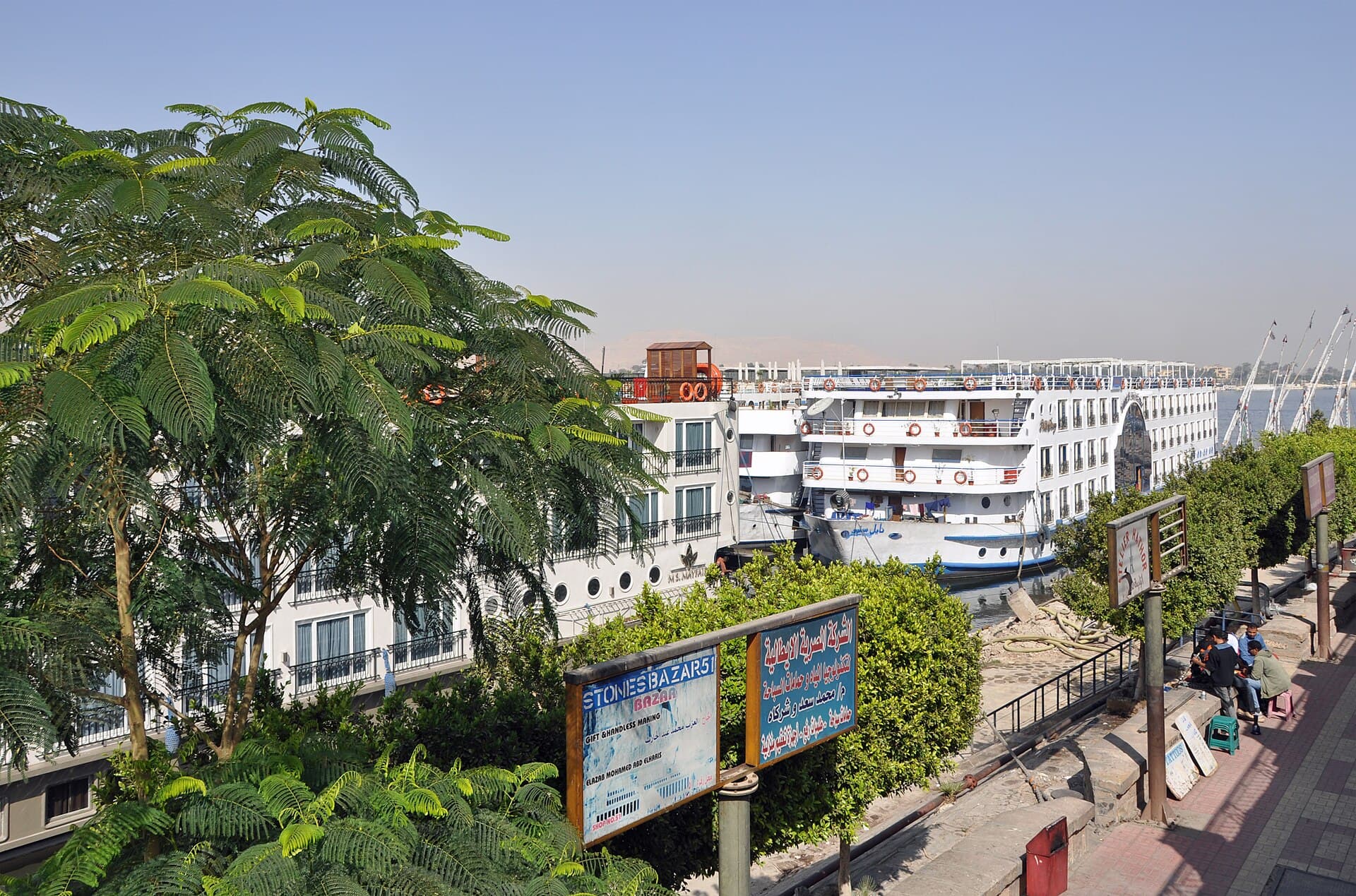
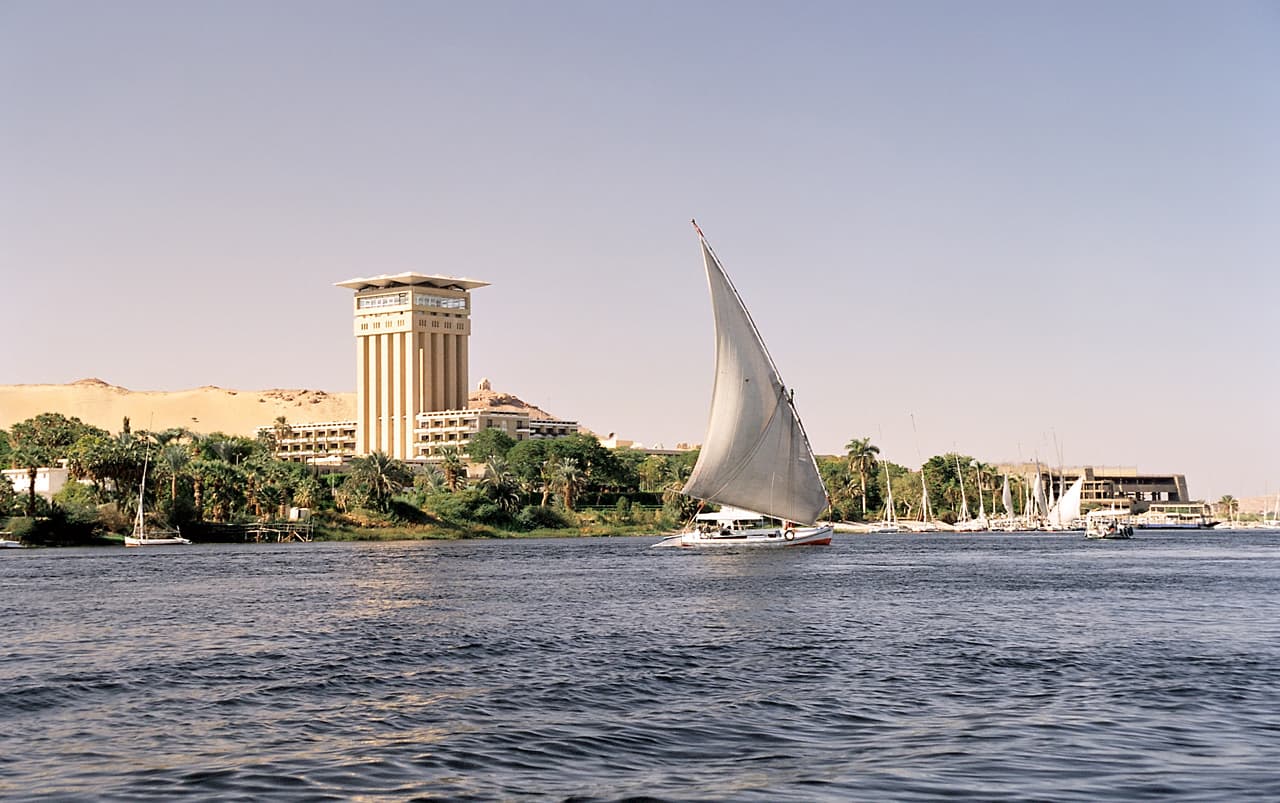
The setting is half the point of Kom Ombo, and it is the thing photographs never quite convey. The temple stands on a low mound on a bend of the river, with the water directly at its feet. There is no town between it and the Nile, no approach road, no forecourt of coaches. You see it from the deck of a boat before you see it from the ground, a pale block of columns lifted slightly above the palms, and then you are moored at the bottom of it.
That closeness to the water is also why the temple is as damaged as it is. The side nearest the river has been eaten away over the centuries, partly by the Nile itself and partly by earthquakes, and a good deal of the stone that once stood on that flank is simply gone. The building you walk through is the surviving half of something larger, tilted towards the water it was built to overlook.
For a visitor this produces one of the easiest arrivals in Egypt. Most great sites make you work for them: a drive out, a car park, a ticket hall, a long processional walk before anything begins. Kom Ombo asks for a short climb from the mooring and nothing else. The reward for the lack of effort is modest in scale but genuine, and the frontage seen from the river as you approach or pull away is a better picture than anything you will take on the ground.
Why the double dedication makes it worth seeing
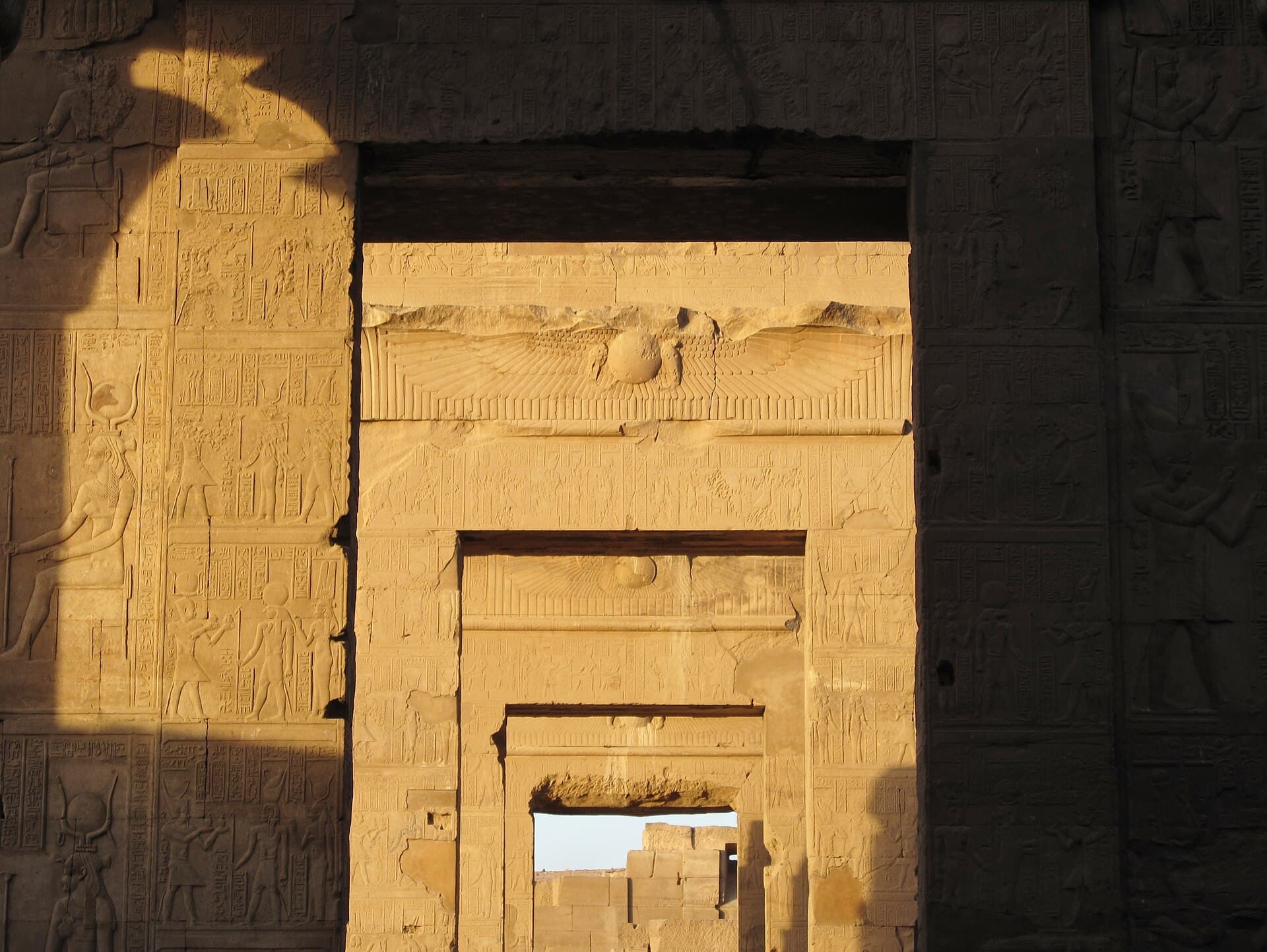
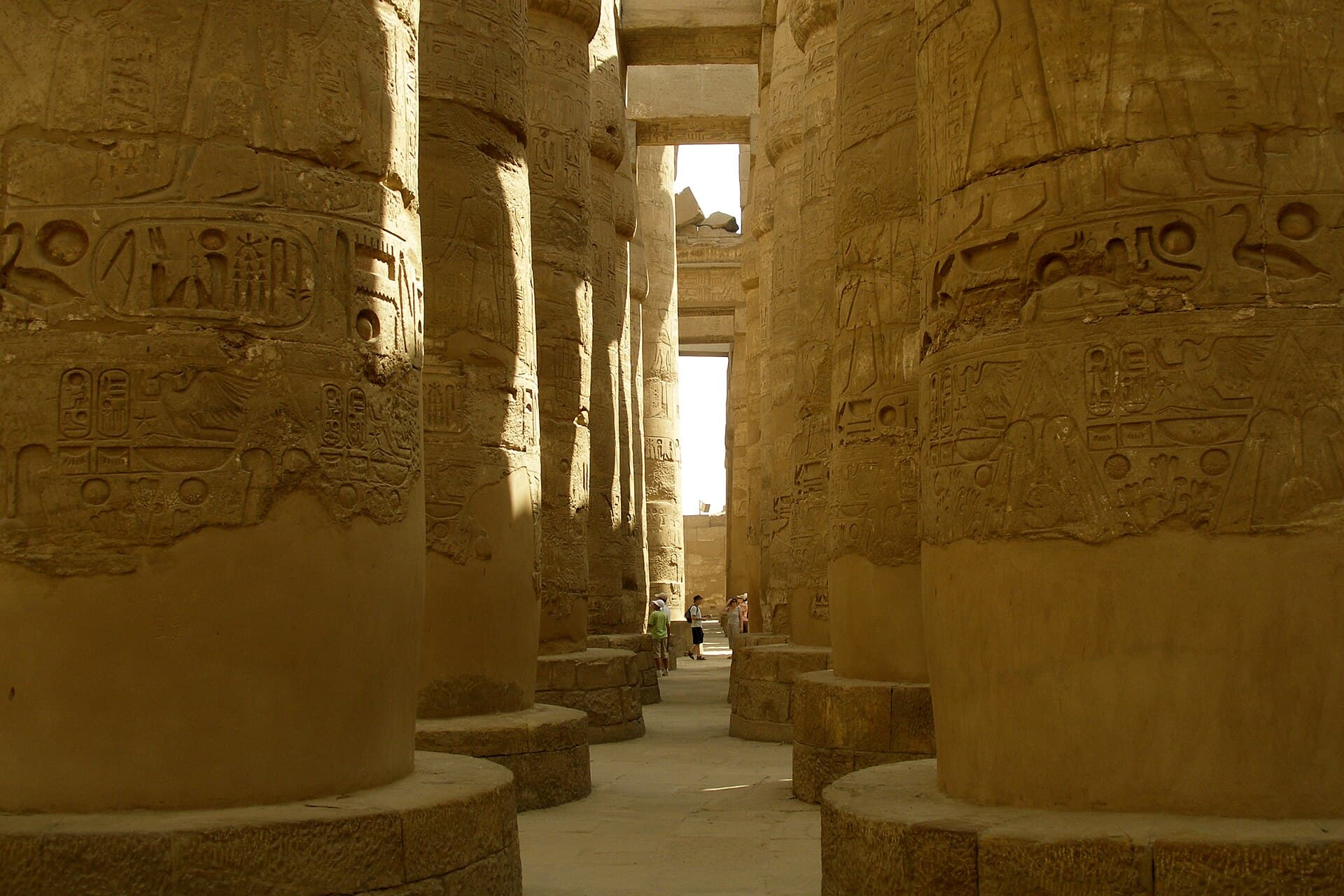
The doubling is not a detail. It governs the whole building. There is a central axis running down the middle, and everything to the left belongs to Haroeris while everything to the right belongs to Sobek. Two main doorways in the facade. Two parallel routes through the hypostyle halls. Two sanctuaries side by side at the back, of matching size, with a concealed space behind them that is usually explained as somewhere priests could speak as the god.
You can see the symmetry from the entrance if you stand in the middle and look. That single view is the reason to come. It is also the reason the temple photographs oddly: most Egyptian temples pull your eye down one line, and this one splits it in two.
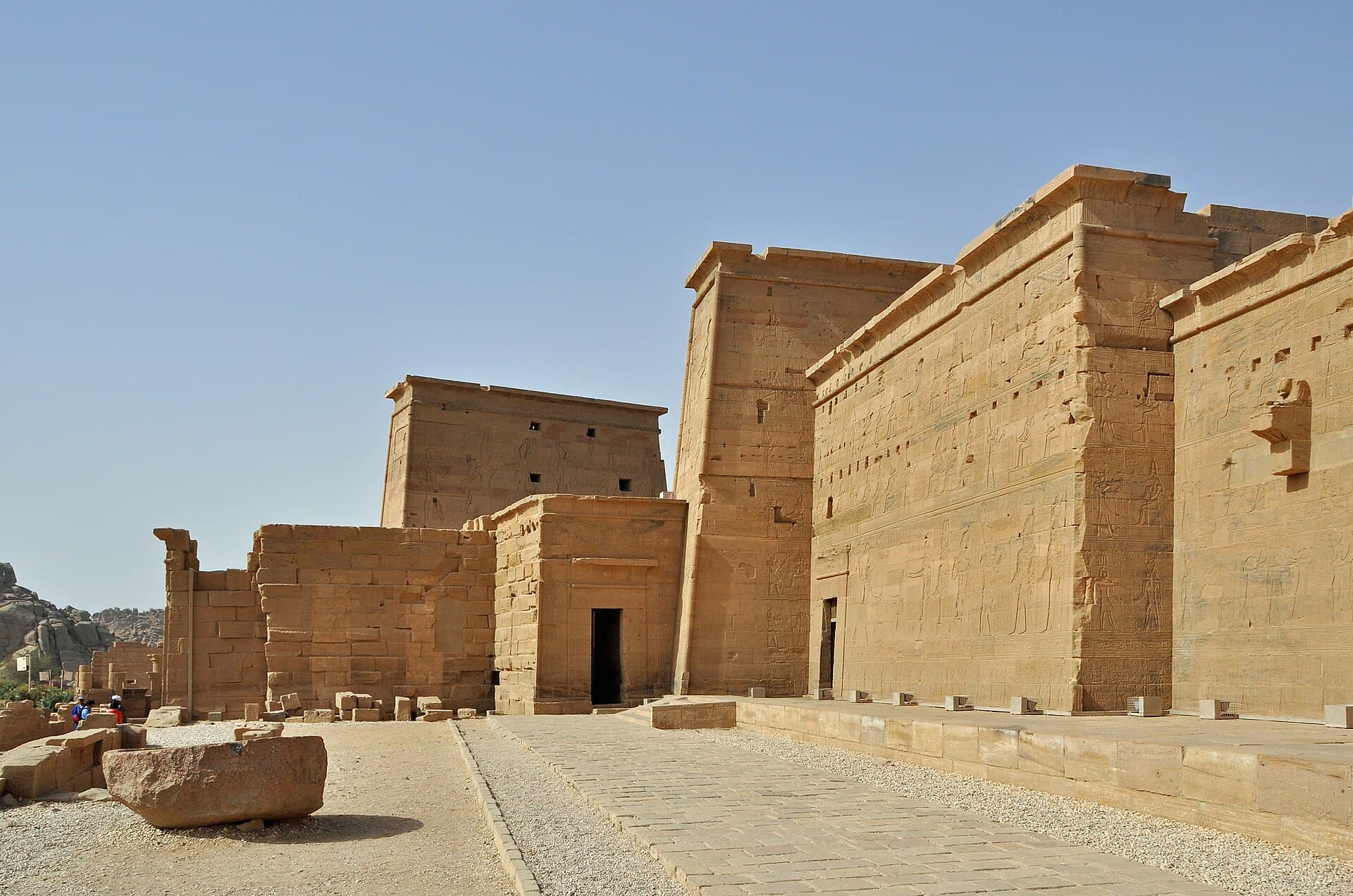
The building is more ruined than Edfu, an hour or so north by road. The roof is largely gone, little of the pylon survives, and the river and earthquakes have taken parts of the side nearest the water. That damage has an upside. Sunlight reaches into rooms that would otherwise be dark, and you can read the layout from ground level in a way you cannot in an intact temple.
The two gods, and the matching triads
The pairing works because each god came with a family. Sobek, the crocodile god, is shown with a consort and a child, a divine triad of the kind Egyptian religion used everywhere: father, mother, son. Haroeris, the elder form of Horus and a falcon rather than a reptile, has his own triad on the other side of the axis. The temple is, in effect, two households given the same floor plan and told to share a wall.
This is why the symmetry goes deeper than two doors. If a chamber exists on the Sobek side, its twin tends to exist on the Haroeris side, because each triad needed the same rooms to be served in the same way. Offerings, processions and daily ritual were mirrored. Standing on the central line, you are standing on the seam between two parallel religions that agreed to occupy one building without merging.
It is worth resisting the neat story that one god is the sunny one and the other the sinister one because crocodiles are frightening. Sobek was a serious deity with a long history on this stretch of the river, bound up with the Nile, fertility and the water itself. The crocodiles embalmed in the museum next door were not kept as monsters but as the living form of a god. The temple treats both cults as equals, and so should the visitor.
The medical reliefs and the calendar
The best-known carving at Kom Ombo is a panel on the back outer wall showing what are usually described as surgical instruments: scalpels, forceps, hooks, scales, a set of small bottles. It is genuinely striking, and guides make a lot of it. Be a little sceptical about the interpretation. Some of the objects are clearly instruments, others may be ritual equipment, and the label "the world's first medical textbook" is a tour-guide flourish rather than a scholarly position.
Less famous but more useful is the calendar carved on the temple walls, listing festival dates and offerings through the Egyptian year. It tells you what the building was actually for: a working schedule of ritual, not a museum. There are also reliefs of Ptolemaic rulers presenting to the gods, with Roman emperors later carved in the same poses, which is a neat demonstration of how the new administration simply stepped into the old religious costume.
A short history: Ptolemaic, Roman, and what the river took
Put the dates in order and Kom Ombo stops looking like a classic pharaonic temple and starts looking like what it is: a late building, raised by a Greek-descended dynasty running Egypt long after the pyramid age had ended. The main work belongs to the last two centuries BC, under the Ptolemies, with the Romans adding to it once they took over. When the carving here was fresh, Cleopatra's Egypt was recent history, not ancient.
That lateness is not a mark against it. It is why the reliefs are so complete in their programme, why the calendar and the offering scenes read as a functioning system rather than fragments, and why you can watch the politics of occupation written straight onto the walls, Roman emperors slotting themselves into the poses the Ptolemies had used. The temple records a handover of power as a change of faces in the same ritual.
What the river and the earthquakes removed is the other half of the story. The pylon is mostly gone, the roof with it, and the flank nearest the water has collapsed. The mud-brick town that once surrounded the temple has largely vanished too. What survives is the stone core, standing on its mound with the modern agricultural town behind it, a place built on sugar cane and home to a large Nubian population resettled in this area after Lake Nasser flooded their villages in the 1960s.
The crocodile museum
A small museum sits beside the temple, holding mummified crocodiles recovered from a burial ground nearby, along with coffins, crocodile eggs and votive material. Sobek's cult kept sacred crocodiles here, and the animals were embalmed after death much as people were. The building itself is recent, put up specifically to house the mummies, so do not expect dusty Victorian cases.
It is worth twenty minutes, and it is the single best reason to slow down at Kom Ombo. The presentation is simple: a dim room, crocodiles laid out in a line, a few explanatory panels. Some of the animals are very large. Others are hatchlings. Seeing them together makes the temple's dedication concrete in a way the reliefs do not.
Entry to the museum may be a separate ticket from the temple. Confirm that locally when you arrive rather than assuming it is included in whatever your cruise or driver has already paid for.
Where Kom Ombo falls on a Nile cruise
On the standard Luxor-to-Aswan route, Kom Ombo is one of the last temples before the boats reach Aswan. The usual running order southbound is Luxor and Karnak, then a sailing day, then Edfu, then Kom Ombo, and finally Aswan and Philae. Northbound it runs the other way. Either way, Kom Ombo is the stop that comes after Edfu and signals that the cruising part of the trip is nearly over.
Because it sits so late in the sequence, it is easy to undersell in your own head. By the time most passengers reach it they have already seen Karnak, the Valley of the Kings and a complete temple at Edfu, and a small, partly collapsed building at dusk can feel like a footnote. It is the opposite. Kom Ombo is the one stop on the river that does something none of the others do, and arriving tired is not a reason to skip it.
If you are weighing a cruise against a land trip, this is one of the arguments for the boat. Kom Ombo off a mooring is effortless; Kom Ombo by road means a drive up from Aswan or down from Luxor for a site you will finish in under an hour. On the water it costs you a short walk and an evening you were going to spend on deck anyway.
How to visit it well
Almost everyone arrives by Nile cruise. The temple sits directly on a bend of the river, on a low mound with the water at its feet, and boats moor at the bottom of the steps. You walk off the gangway, up a short slope, and you are there. There is no transfer, no coach, no queue for parking. For that reason alone it is the easiest site on the whole river.
If you are travelling by road between Luxor and Aswan, Kom Ombo pairs naturally with Edfu. The two temples together make a good full day with a driver, and doing them on the same day helps: Edfu shows you what a complete Ptolemaic temple looks like, and Kom Ombo shows you what happens when the same builders are asked to do it twice over.
Plan for 45 minutes to an hour at the site, including the museum. That is not a criticism. The temple is compact, there is no long processional approach, and the interior is small. Anyone telling you to allow half a day is padding.
Combining Kom Ombo with Edfu
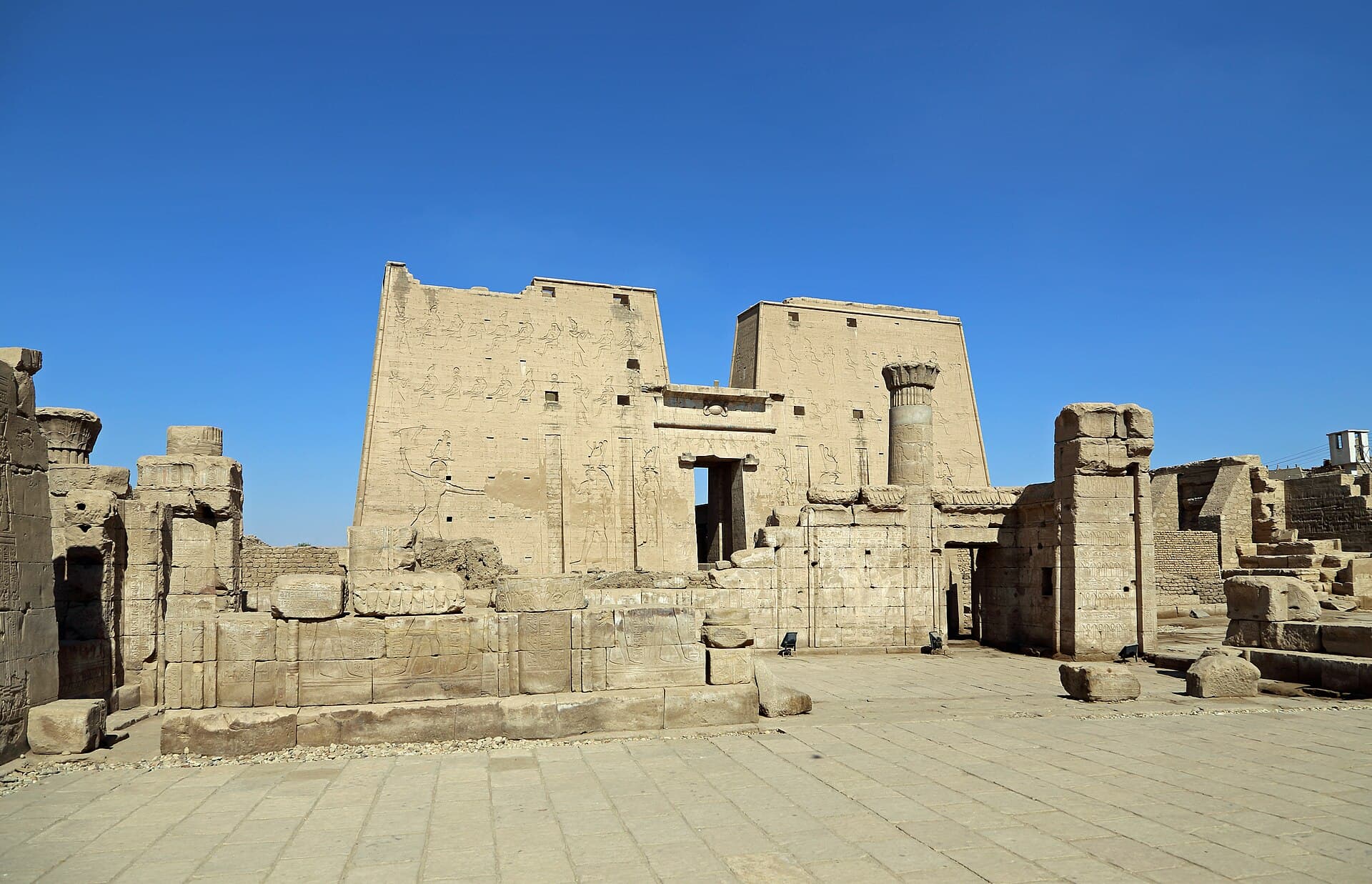
The two temples are a natural pair and most itineraries treat them as one, whether you are on a boat or in a car. Edfu is the Temple of Horus, the best-preserved temple in Egypt: roof intact, pylon standing, a dark interior you actually walk through. It is the complete version of the thing Kom Ombo is a ruined, doubled variation on. Seeing them close together is the point; each one makes the other legible.
The practical difference at the mooring is small but worth knowing. Edfu needs a short transfer from the boat to the temple, which sits back from the river, whereas Kom Ombo needs nothing at all beyond the walk up the bank. On a cruise this is handled for you. By road, budget the drive between the two, allow a full morning or a full day with a driver, and agree the order before you set off.
If your schedule is tight and one of the two has to go, keep Edfu and drop Kom Ombo. Edfu wins on first impression and on completeness, and it is the one a first-time visitor is more likely to regret missing. Kom Ombo is the connoisseur's stop: smaller, stranger, and more rewarding to think about afterwards than to stand in.
When to go, and why dusk suits it
Cruise schedules usually put Kom Ombo in the late afternoon or early evening, and this is one case where the standard timing is the right timing. The site is normally lit once it is dark, and the columns and reliefs take artificial light well because the carving is shallow and side-lighting brings it out. In flat midday sun the same surfaces look washed and dull.
The other advantage of dusk is heat. There is very little shade on the site. Between roughly May and September the middle of the day here is punishing, and an open temple with no roof gives you nowhere to retreat to.
Season matters as much as time of day. November to March is comfortable. April and October are warm but manageable. High summer is hard work on this stretch of the river, and if you are visiting then, an evening arrival is not a preference but a sensible precaution.
What most visitors get wrong
The commonest mistake is walking straight in without stopping in the middle. If you follow your guide up one side, you will see a fairly ordinary ruined temple and wonder what the fuss is about. Stand on the central axis first, look down both sides, and the building explains itself.
The second mistake is expecting Karnak. Kom Ombo is small and partly collapsed. Visitors who arrive after four days of Luxor sometimes find it underwhelming, and they are not wrong on scale. Judge it on what it does that nothing else does, which is the doubling.
Third: rushing the museum to buy trinkets. The stalls on the walk back to the boat are persistent, prices are negotiable and nothing sold there is unique to Kom Ombo. You will see the same goods in Aswan and Luxor. If you have limited patience for haggling, spend it elsewhere and keep your last ten minutes for the crocodiles.
Practical points to check locally
Ticket arrangements, opening times and whether the crocodile museum is included all change, and they change more often than published guides update. Ask at the gate or have your guide confirm on the day. The same applies to photography rules inside the museum, which have varied.
Footing on the site is uneven, with loose stone and a slope up from the mooring. It is a short walk and manageable for most people, but not level ground. If mobility is a concern, say so before you book a cruise, because the approach here is a stair-and-slope arrangement rather than a smooth path.
There is not much at the site beyond the temple, the museum and the stalls. Bring water. Do not plan to eat there, and do not count on shade while you wait for the rest of your group.
Common questions
Is Kom Ombo worth visiting if I am not on a cruise?+
Yes, but it works best combined with Edfu on the drive between Luxor and Aswan. On its own it is a long way to go for a short temple. As part of a road day it costs you very little extra time and breaks up an otherwise dull stretch. If your itinerary is tight and you must drop one temple, drop this one rather than Edfu.
Who were the two gods Kom Ombo was built for?+
Sobek, the crocodile god, and Haroeris, a form of Horus the Elder. Each came with a divine family, a triad of father, mother and child, and the temple gives the two households equal standing. Everything to the right of the central axis belongs to Sobek; everything to the left belongs to Haroeris. That even-handed pairing of two separate cults under one roof is what makes Kom Ombo unusual among Egyptian temples.
Are there really crocodiles in the Nile here now?+
Not below the High Dam. Crocodiles were hunted out of this stretch of the Egyptian Nile well before the dam was finished, and Lake Nasser upstream is where they survive in numbers today. The crocodiles at Kom Ombo are the mummified ones in the museum. Nobody at the temple is going to show you a live one, whatever a tout suggests.
Why is Kom Ombo so ruined compared with Edfu?+
Its position is the reason. The temple stands right on a bend of the Nile, and the side nearest the water has been worn away over the centuries by the river and by earthquakes. The roof is largely gone and little of the pylon survives. Edfu sits back from the water and kept its roof and pylon, which is why it feels like a complete building and Kom Ombo feels like the surviving half of one.
How does Kom Ombo compare with Edfu?+
Edfu is far more complete: roof intact, pylon standing, a dark interior you walk through. Kom Ombo is more ruined but more interesting to read, because the doubling is visible everywhere once you know to look. Edfu usually wins on first impression; Kom Ombo is the one that repays thinking about afterwards. Seeing both on the same day makes each one clearer.
Does every Nile cruise stop at Kom Ombo?+
It is a standard stop on the Luxor-to-Aswan route and appears on our cruise itineraries between Edfu and Aswan, usually in the late afternoon. It is not guaranteed on every boat or every schedule, though, so check that it is listed before you book rather than assuming it. If seeing it matters to you, say so when you are choosing a cruise.
How far is Kom Ombo from Aswan?+
Roughly 45 kilometres north, on the east bank. By boat it is the last major temple before Aswan on the southbound run. By road it is a manageable drive up from the city, which is how independent travellers usually reach it, often pairing it with Edfu further north on the same day.
Can I visit Kom Ombo independently by public transport?+
It is possible from Aswan by service taxi, or by train to Kom Ombo town and then a short local ride to the temple. In practice it eats most of a day, and the convoy and permit situation on this road has changed repeatedly over the years. Check the current position locally before committing. Most independent travellers hire a car with driver for the Edfu and Kom Ombo run instead.
Is there anything to do in Kom Ombo town itself?+
Not for visitors, no. It is an agricultural town built on sugar cane, with a large Nubian population resettled in this area after Lake Nasser flooded their villages in the 1960s. That history is genuinely interesting, but there is nothing set up for you to see. Do not plan time in the town expecting sights.
How much time should I allow if I want to take photographs?+
An hour rather than forty minutes, and go at the end of the day. The reliefs are shallow and low-contrast, so flat midday light flattens them further. Low sun raking across the surface is what makes them readable. The riverside frontage from the water is the other shot worth waiting for, best from a boat deck as you approach or pull away.
Official sources
Entry rules, opening hours, security advice and exchange rates all move. Check them at the source, not here.
Written and checked by the Nile Trip Guide editorial team · Last reviewed . Entry rules, prices and opening hours change — check anything critical against the official sources linked on this page.
Plan this trip
Tell us your dates and we will price it
A real itinerary with real prices, usually within 24 hours. Nothing is booked and nothing is charged until you say yes.
The route most people take first, at the length it was built for: Giza and the Grand Egyptian Museum, then a flight to Luxor and four nights sailing down to Aswan.
No boat on this one. Giza and the Grand Egyptian Museum, a night in Luxor for both banks, two nights on the Red Sea, then back to Cairo for the Citadel, Coptic Cairo and the Royal Mummies.
Five nights in Cairo either side of a four-night sail from Luxor to Aswan. The Cairo days are private, just your party and a guide; the sightseeing off the boat is shared with a small group.