The White Desert, Egypt: Chalk, Sand and a Night Camping Out
The White Desert, Egypt, is a field of wind-carved chalk standing in open sand, a couple of hours beyond Bahariya oasis, which is itself about four hours southwest of Cairo. There is no temple here, no coach park and no town. The point of the trip is to drive into it and sleep out.
What is the White Desert, Egypt, and why does it look like that?
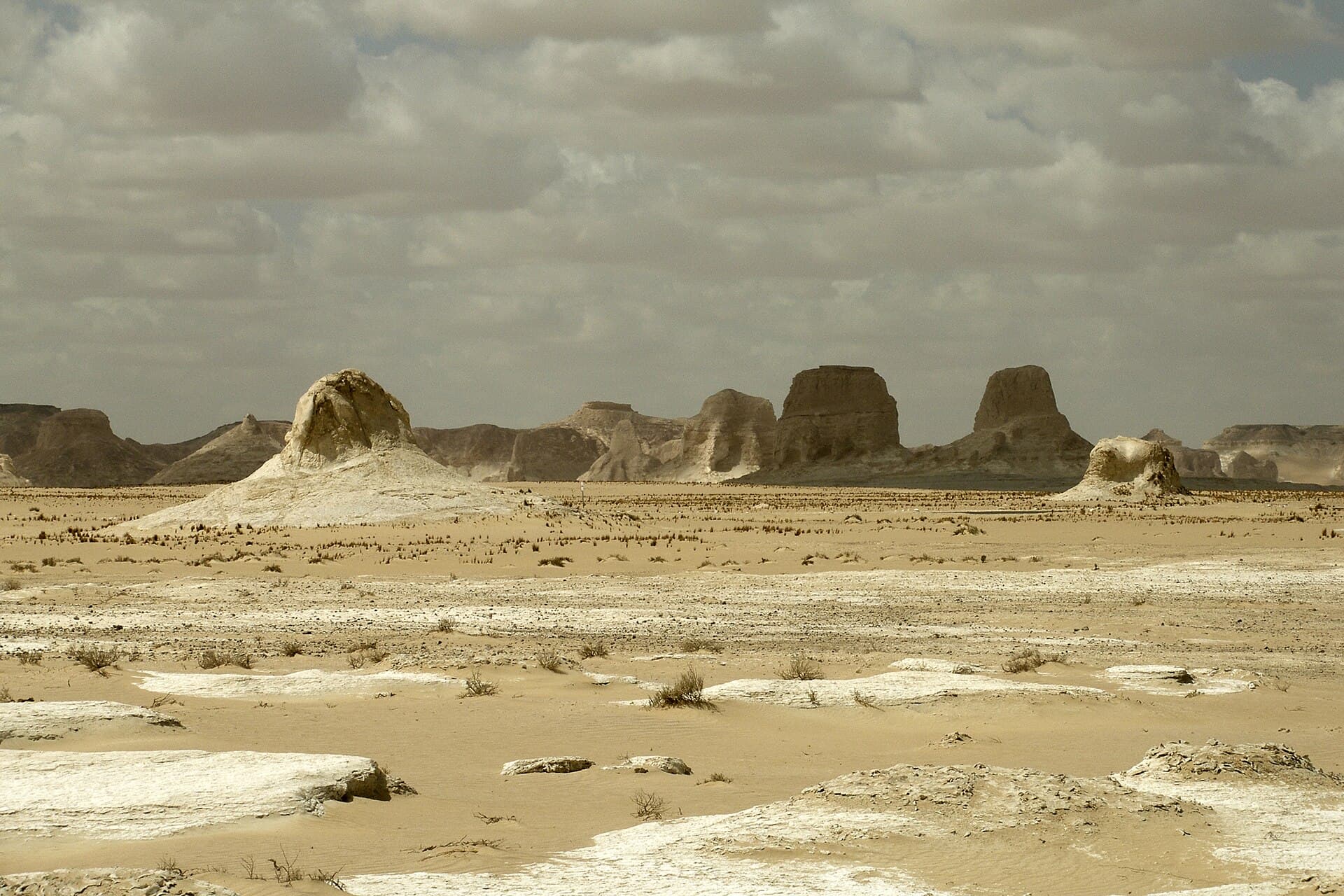
The white rock is chalk, laid down when this part of Egypt was a shallow sea. Wind carrying sand cuts at the softer stone near the ground and leaves the harder cap above it, so the formations stand on stems: mushrooms, towers, anvils. They run from knee height to several metres. Look closely at the loose chalk and you find fossil shells in it.
It is not a viewpoint you pull up at. The formations are scattered across a wide basin and you drive through them for an hour or more. The older northern section is thinner and more spread out. The denser part further south, closer to Farafra, is where the shapes stand thickest and where most camps go.
Light does most of the work. At midday the chalk is flat, glaring and disappointing in photographs. An hour before sunset it turns cream, then orange, then pink, and it holds the light after the sun has gone. Under a full moon it is bright enough to walk between the formations without a torch.
What are you actually standing on?
The chalk is soft enough to mark with a fingernail, and that softness is the entire reason the landscape exists. Sand travels in the first metre or so above the ground, so the wind files hardest at ankle and knee height and barely touches the stone above it. Geologists call wind-cut ridges of this kind yardangs. Drivers and visitors call them mushrooms, chickens, camels and rabbits, and the names attached to individual formations change depending on who is pointing.
The floor between them is not uniform sand. In places it is a crust of broken chalk that crunches underfoot, in others a scatter of dark flint nodules weathered out of the same rock, and in others a proper sheet of orange sand blown in from somewhere else entirely. That mix is why the desert photographs as white, cream and rust within the same frame rather than as a single colour.
Walk a couple of hundred metres from the camp and the ground repays attention. Fossil shells lie loose where the wind has cleaned them out of the chalk, and now and then the flattened plate of a sea urchin. You may also come across worked flint: flakes and blades left by people who lived out here when the Sahara was wetter and these basins held standing water. They are not especially rare and they are not yours. Look, photograph, and put them back exactly where they lay, because a scatter of tools still in position tells an archaeologist something and the same tools in a pocket tell nobody anything at all.
How do you get there from Cairo?
One tarmac road runs southwest across the Western Desert to Bawiti, the main town of Bahariya oasis, about 360 kilometres and four hours in a normal vehicle. The same road carries on south to Farafra. You change to a 4x4 in Bawiti, drive on for another couple of hours, then turn off the tarmac and the driver lets air out of the tyres for the sand.
There are military checkpoints on the road and drivers register the vehicle and its passengers, so carry your passport. Access to parts of the Western Desert has been restricted at various times, so confirm it when you plan rather than assume. Off the road there is no phone signal, no fuel and no one to call, which is why this is done with a local operator rather than improvised.
Day trips from Cairo are sold. They mean leaving at five in the morning, four hours out, a fast loop, and four hours back in the dark. Fourteen hours of your life for two hours among the formations, and you miss the only part that matters. If you cannot give it a night, spend the days somewhere else.
Are the Black Desert and Crystal Mountain worth stopping for?
Briefly: the Black Desert is a thirty-minute stop, and Crystal Mountain needs five minutes. Wadi el-Agabat, just before the White Desert, deserves an hour; our Bahariya Oasis guide covers all three stops.
What does the trip actually look like, hour by hour?
Take the standard two-day, one-night version from Cairo. Day one is a morning on the desert road, arriving in Bawiti around lunchtime, then a change of vehicle and the run south: the Black Desert, Crystal Mountain, Agabat, and into the White Desert in the middle of the afternoon. You drive among the formations for an hour or more while the guide looks for somewhere to stop. The camp goes up roughly an hour before sunset, which is deliberate: it leaves you free and standing outside at exactly the time the light is worth having.
Dinner is cooked after dark and most people are asleep by ten, partly because there is nothing else to do and partly because the cold discourages sitting up. Day two starts before you want it to. Dawn is the second good hour of the trip and the one most people sleep through, and the chalk takes colour going up much as it does going down. Camp comes down after breakfast, you drive back out to the tarmac, and you are in Bawiti by late morning and Cairo by evening.
The three-day, two-night version changes the shape of it more than the extra day suggests. The first night is usually in or near the popular part of the park. The second lets the driver take you somewhere a one-night trip has no time to reach, and that is the night when the camp is genuinely alone. It also buys you an unhurried afternoon in Bahariya at one end, which is the difference between seeing an oasis and driving through one.
What is camping out actually like?
In the late afternoon the driver picks a spot among the formations and the camp goes up in about twenty minutes: mats and blankets on the sand, a low cloth windbreak, a fire. Some operators carry small tents, though most people sleep in the open anyway. Dinner is cooked on the fire, usually chicken or vegetables with rice, bread and salad, eaten sitting on the ground.
There is no water beyond what the vehicle carries, no toilet, no shower and no power. A lavatory is a shovel and a walk behind a rock. Everything, including the rubbish, goes back in the vehicle. Fennec foxes come in after dark looking for scraps, small and quick and no trouble, but keep food packed away rather than encouraging them.
Where the camp goes matters more than anything else on the trip. On winter weekends and Egyptian public holidays, vehicles cluster in the same photogenic corner and you will see other fires and hear other people's music. Ask beforehand for a camp well away from the usual spots. It costs a little more driving, and it is the difference between the desert and a car park.
How cold does it actually get at night?
Colder than people expect from a hot country. The air is dry and the sky is clear, so the ground loses its heat within an hour of sunset. Between December and February, nights in the open drop into single figures Celsius and can sit close to freezing before dawn, after a day in the low twenties. Wind adds to that, and there is nothing to break it.
Ask what the operator actually provides. Blankets over a foam mat is common; sleeping bags vary a lot and nobody quotes a temperature rating unless asked. Rooms in Bahariya are usually unheated too, so the cold is not only a camping problem. The trap is the afternoon, which feels warm in a t-shirt, so the warm layer stays in the hotel.
What is the night sky like, and how do you get the most from it?
Darkness is something you have to wait for rather than something that arrives. Give your eyes twenty minutes away from the fire and away from phone screens and the sky fills in properly: not a few hundred points of light but a wash of them, with satellites crossing steadily and the occasional aircraft high overhead on a long-haul route. There is no settlement of any size for hundreds of kilometres in most directions, which is a rarer condition than it sounds and the reason the sky here is worth planning around.
Two avoidable things spoil it. White torches destroy everyone's night vision for a quarter of an hour at a time, so bring a head torch with a red mode and ask the rest of the group to use theirs sparingly. And the camp fire, pleasant as it is, blinds you to everything beyond it. Walk a couple of hundred metres out, sit or lie down, and let the sky come back.
Dress for it before you go out rather than after you get cold. Lying still on a mat in the open at two in the morning in January is a different proposition from standing near the fire at nine, and most people underestimate it by one full layer. A blanket taken out with you costs nothing and buys you another half hour under the stars.
When is the best time to go?
October to April. Summer daytime temperatures in the Western Desert run past 40C with no shade anywhere, and camping trips largely stop. Given a free choice, take December to February: the air is clearest, the days sit comfortably in the low twenties, and cold at night is easier to solve with layers than haze is to solve at all. October and March are the fallback if you truly hate being cold.
Spring brings the khamsin, hot winds that lift sand for days at a time and cut visibility to a few hundred metres. Camping through one is unpleasant and pointless, since you cannot see the thing you came for. Trips do get moved or cancelled for it between roughly March and May, and that is a genuine reason rather than an excuse.
Moon phase matters here more than the month. There is effectively no light pollution for hundreds of kilometres, so a new moon gives you the Milky Way properly, the sort of sky most people have never seen. A full moon trades that for white, lit-up rock. If you have to choose, take the new moon: the stars are the part you cannot get at home. Pick the phase first and set the dates around it.
One more thing worth checking before you fix dates: Egyptian weekends and public holidays fill the accessible part of the park with domestic trips. Midweek in the cool season is the quietest combination, and it costs nothing to ask for. Avoiding a Friday night in the popular corner does more for the experience than almost any upgrade you could pay for.
How do you photograph it without wasting the light?
The usable window is short and it sits at both ends of the night. From roughly an hour before sunset until the colour goes, and again from the first grey of dawn until the sun is properly up, the chalk takes on colour and the low sun gives every formation an edge and a shadow. Between about nine in the morning and four in the afternoon you are photographing white lumps on a white floor, and nothing done afterwards on a computer rescues that.
Put something in the frame for scale. The formations read as far larger in person than in a picture, because there is no tree, building or road to measure them against and the eye has nothing to work with. A person standing at the base, the vehicle parked off to one side, or your own long shadow thrown across the floor does more for the photograph than a wider lens ever will.
For stars you need a tripod, a lens that opens wide, and a camera you can set manually. A recent phone in night mode will produce something, but not much. Fifteen to twenty seconds at a wide aperture and a high sensitivity is the usual starting point, adjusted by trial. Frame a lit formation against the sky rather than pointing straight up, or you will come home with a hundred near-identical star fields and nothing that says where you were standing.
Protect the equipment. Blown chalk dust is fine and abrasive, and it works its way into zoom barrels and onto sensors. Change lenses inside the vehicle or under a jacket, use a bag that zips rather than an open tote, and expect to be cleaning things for a week afterwards. Carry spare batteries too: cold nights flatten them faster than you expect and there is no power out there to charge from.
How do you choose an operator, and what should you ask?
Out here the driver is the safety equipment. There is no signal, no fuel, no second road and nobody passing by. What you are paying for is judgement, which is to say knowing where the soft sand is, when the light says turn back, and how to recover a vehicle that has dug itself in. None of that shows up in a price, which is why booking on price alone is the common mistake.
Five questions do most of the work. Is the operator licensed to run trips in the national park, and is the park entry for each person and each vehicle included rather than collected at the gate as a surprise. What recovery equipment is in the vehicle, and what is the plan if it breaks down. What sleeping kit is actually provided, and how warm is it. Where exactly will the camp be, and how far from the usual cluster. And how much drinking water per person per day is loaded before you leave the tarmac.
Two more are worth asking and tell you a great deal. Group size, because eight people in a vehicle travelling with two other vehicles is a completely different trip from four people on their own. And what happens to the rubbish, the fire and the human waste. An operator who answers that one clearly and without irritation is almost always the one who handles everything else properly too.
Is the White Desert being damaged?
In places, yes, and you do not have to look hard. Around the popular camping spots there are fire scars on the chalk, blackened stones, tins pushed into the sand, and fresh tyre tracks cut across the pale floor where a driver went around an obstacle rather than through it. Those tracks last for years. There is effectively no rain to erase them and no traffic to blur them, so every shortcut stays visible for the next decade.
The formations themselves are more fragile than they look. Chalk this soft breaks under a hand, and the narrow stems holding up the larger shapes are the first thing to go. Climbing onto one for a photograph is exactly how something shaped by thousands of years of wind ends up as rubble, and the well-known formations nearest the popular camping areas already show the wear.
None of this is an argument against going. It is an argument for going with someone who behaves, and for behaving yourself. Keep to tracks that already exist, keep the fire in one place and carry the ash out, take every scrap of rubbish back to Bawiti, and leave the chalk, the calcite and the flint where they lie. The park has protection on paper and very little enforcement on the ground, so in practice what happens out there comes down to the operator you chose and the group you are with.
Who does it suit, and how does it fit a trip?
Two days and one night is the working minimum from Cairo. Three days and two nights is the version worth doing, because the second night is when you get properly away from other camps. It suits people on a second trip to Egypt, or a first trip of twelve days or more, who like empty landscape and do not need a bathroom every night.
Skip it if you have seven days and have not seen Luxor or Aswan yet. The pharaonic sites are the stronger buy on a short first visit, and the desert is a poor trade for them. Skip it too if you have a bad back, because hours of off-road driving over corrugated sand is genuinely rough, or if you are travelling with small children who already hate car journeys.
People often ask about carrying on west to Siwa across the sand rather than doubling back to Cairo. That crossing does exist, but it needs permits, more than one vehicle and a plan made weeks in advance, so it is not something to arrange in Bawiti. Almost everyone drives back to Cairo and starts again from there.
What if you want to keep going south?
The road does not stop at the White Desert. Farafra, a little further on, is the smallest and quietest of the Western Desert oases: palm gardens, hot springs, mud-brick walls and very few visitors. Most White Desert trips touch it briefly or not at all. Staying a night there is a different experience from Bawiti, which has traffic, ore lorries and a working tourism trade of its own.
Beyond Farafra the chain carries on to Dakhla and Kharga. Dakhla has the best surviving mud-brick architecture of the group, including a medieval village you can walk through street by street. Kharga holds a Persian-period temple of Amun and an early Christian cemetery of domed mud-brick chapels, and both see almost nobody. From Kharga a road runs east to the Nile valley and brings you out near Luxor, which turns the oases into a one-way route rather than an out-and-back from Cairo.
Be clear about the cost of that. It is roughly a week of driving, and it buys emptiness and landscape rather than monuments, so it competes directly with days you could spend at the strongest sites in the country. It also needs the current access position checked rather than assumed, since permissions for parts of the Western Desert change. Deeper again, out towards the Great Sand Sea and the Gilf Kebir, is proper expedition territory: permits, several vehicles, fuel and water carried in, and planning done months ahead rather than arranged from a lodge in Bawiti.
Common questions
Can you drive out there in a hire car?+
No. Past the tarmac you need a 4x4, deflated tyres and a driver who knows where the soft sand is. Getting stuck is routine and recovery means a second vehicle, not a phone call. The road from Cairo to Bahariya and on to Farafra is fine in an ordinary car, but that road only shows you the edge of it.
Do you need a permit, and what happens at the checkpoints?+
No individual permit for the standard route. The White Desert is a national park, and the entry fee per person and per vehicle at the gate is something licensed operators handle as part of the trip. Deeper Western Desert routes, such as the Great Sand Sea, are the ones that need paperwork. At checkpoints the driver records passport and vehicle details, so keep your passport out of your suitcase.
Is there anything to see in Bahariya itself?+
Enough for an afternoon. Bawiti has hot springs, a salt lake, deep palm groves and a small museum holding a few of the gilded Roman-era mummies found in a cemetery nearby in the 1990s. Most trips sleep there on one side of the desert or both. It is a working oasis town rather than a resort, and it goes quiet after dark.
Can you take a piece of chalk or crystal home?+
No. It is a protected area, and the chalk is soft enough that a hand can snap a formation. What is standing took thousands of years of wind to shape, and enough people pass through now that one souvenir each would strip it within a generation. The same applies to climbing on the formations for photographs.
Is it suitable for children?+
Older children usually take to it: sand, a fire, and a night sleeping outside. Under about seven it is a hard sell, with four hours in a car to Bahariya, more off-road after that, no bathroom and a cold night at the end. Ask what the driving day actually looks like hour by hour before you commit to it.
What should you pack that you would not pack for the rest of Egypt?+
A fleece or down layer, a hat and socks to sleep in, something windproof, a head torch, and wet wipes in place of a shower. Sunglasses that sit close to the face help when sand is moving. Take cash in small notes: there is nothing to spend it on in the desert, and card payment is scarce in the oasis.
Is there any mobile signal or internet in the White Desert?+
No. Signal thins out as soon as you leave Bawiti and disappears entirely once you turn off the tarmac, and it does not come back until the return drive. Tell anyone expecting to hear from you that you will be unreachable overnight. Download offline maps and anything you want to read before you go, and treat a power bank as essential rather than optional, since the camp has no electricity.
What happens if someone is ill or injured out there?+
You are several hours from a clinic, most of it off-road, so the answer is that the group drives you out. That is the honest reason to ask an operator about the vehicle, the recovery gear and whether they carry a first aid kit before you book. Bring any medication you take with you rather than relying on buying it, because pharmacy stock in Bawiti is limited and there is nothing at all beyond it.
Can you do this as a solo traveller?+
Yes, and plenty do. The practical issue is cost, because the 4x4 and driver are priced per vehicle rather than per person, so going alone means carrying the whole vehicle yourself. Joining a small group trip out of Cairo or Bawiti solves that and is how most independent travellers handle it. Ask how many people will be sharing the vehicle before you agree, since that number shapes the whole trip.
Is it worth it if you have already seen the Sahara elsewhere?+
Usually yes, because it is not a dune landscape and does not compete with one. Morocco, Tunisia and the Egyptian sand seas offer dunes; the White Desert offers eroded chalk sculpture standing on an open floor, which is a different thing to look at. If what you enjoyed elsewhere was specifically the dunes, though, the nearby sand areas around Siwa or Bahariya may serve you better than the park itself.
Official sources
Entry rules, opening hours, security advice and exchange rates all move. Check them at the source, not here.
Written and checked by the Nile Trip Guide editorial team · Last reviewed . Entry rules, prices and opening hours change — check anything critical against the official sources linked on this page.
Fourteen days that add the Western Desert to the usual route: Cairo, two days of Luxor on land, four nights sailing to Aswan, then a drive west to Bahariya and a night out among the white chalk formations.