Edfu: the Temple of Horus, Egypt’s most complete temple
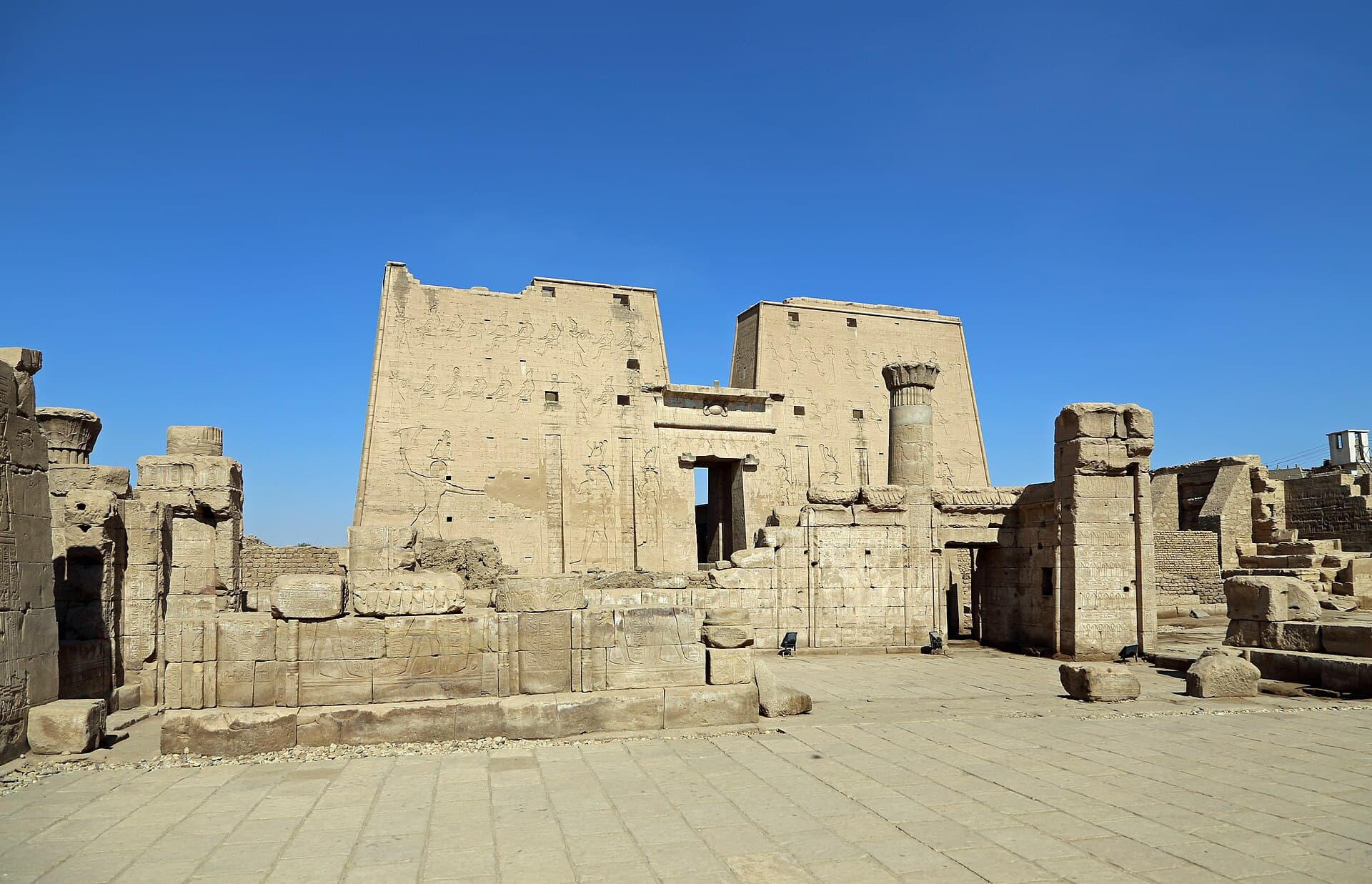
Edfu holds a title no other site in Egypt can claim: it is the most complete large temple left standing. The roof is on, the great twin-towered front still rises to near its full height, and you walk through hall after hall into the dark heart of the building much as a priest would have done. Almost everyone arrives the same way — by Nile cruise, moored at the edge of town, then up to the temple by pony-trap. The visit itself is short. The temple is the reason the whole Luxor-to-Aswan stretch is worth sailing.
What Edfu is, and where it sits on the river
Edfu is a town on the west bank of the Nile, roughly halfway between Luxor and Aswan, and its one monument of international importance is the Temple of Horus. On the river it falls between two other cruise-stop temples: Esna, to the north towards Luxor, with its single cleaned-up painted hall; and Kom Ombo, to the south towards Aswan, the double temple moored almost in the water. Edfu is the heavyweight of the three. It is the one worth rearranging a day around.
The temple is Ptolemaic, which makes it young by Egyptian standards. Construction ran over roughly two centuries, finishing in the last decades BC, so the masons here were working while Rome was turning into an empire — long after the pyramids, long after the great pharaohs of Luxor. That lateness is exactly why it survives so well. It had less time to fall down, and it was built to a mature, confident plan by people who had two thousand years of temple-building behind them.
There was a much older sanctuary on the same ground. Edfu — ancient Djeba, later Apollinopolis Magna to the Greeks — had been sacred to the falcon god since deep antiquity, and the Ptolemaic builders put their new temple up where the old one had stood. What you walk through today, though, is the late building: a single coherent design rather than the usual Egyptian palimpsest of additions by a dozen different reigns.
For most of the modern era the temple was half-buried. Desert sand and the rubble of the growing town had filled it to well above head height, with houses built on top of the roof, before it was dug out in the nineteenth century. That burial is the other half of the survival story: sand protected the walls and the colour on them while comparable temples stood open to the weather. The town still presses right up to the enclosure, which is why the approach from the river runs through streets rather than across open archaeological ground.
The Temple of Horus: what actually survives
The short answer is: nearly all of it. Edfu is the benchmark against which the ruin of every other temple on the river is measured. Where Kom Ombo has lost its roof and much of its river side, and Esna is down to one hall beneath a town, Edfu still reads as a complete building — front to back, floor to ceiling, in sequence. You can stand at the entrance and understand at a glance what a major Egyptian temple was meant to be.
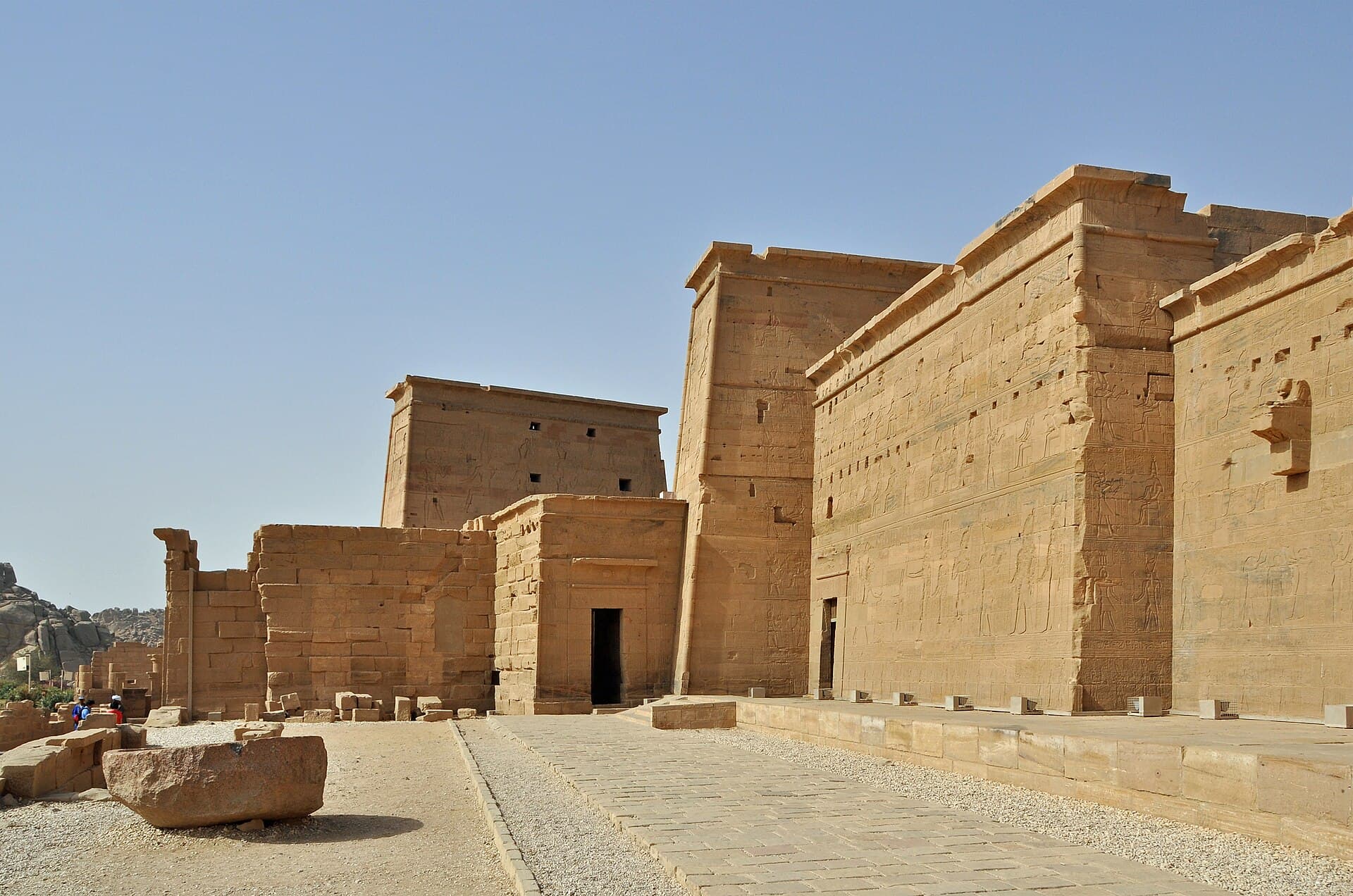
The front is a pylon: two massive tapering towers flanking the doorway, their outer faces carved with colossal figures of a king smiting enemies before the gods. It still stands to close to its original height, which is rare, and it is the first thing you see as you come up from the town. Behind it is a broad open court ringed with columns, the last part of the temple ordinary people were allowed into, and the only part that is fully open to the sky.
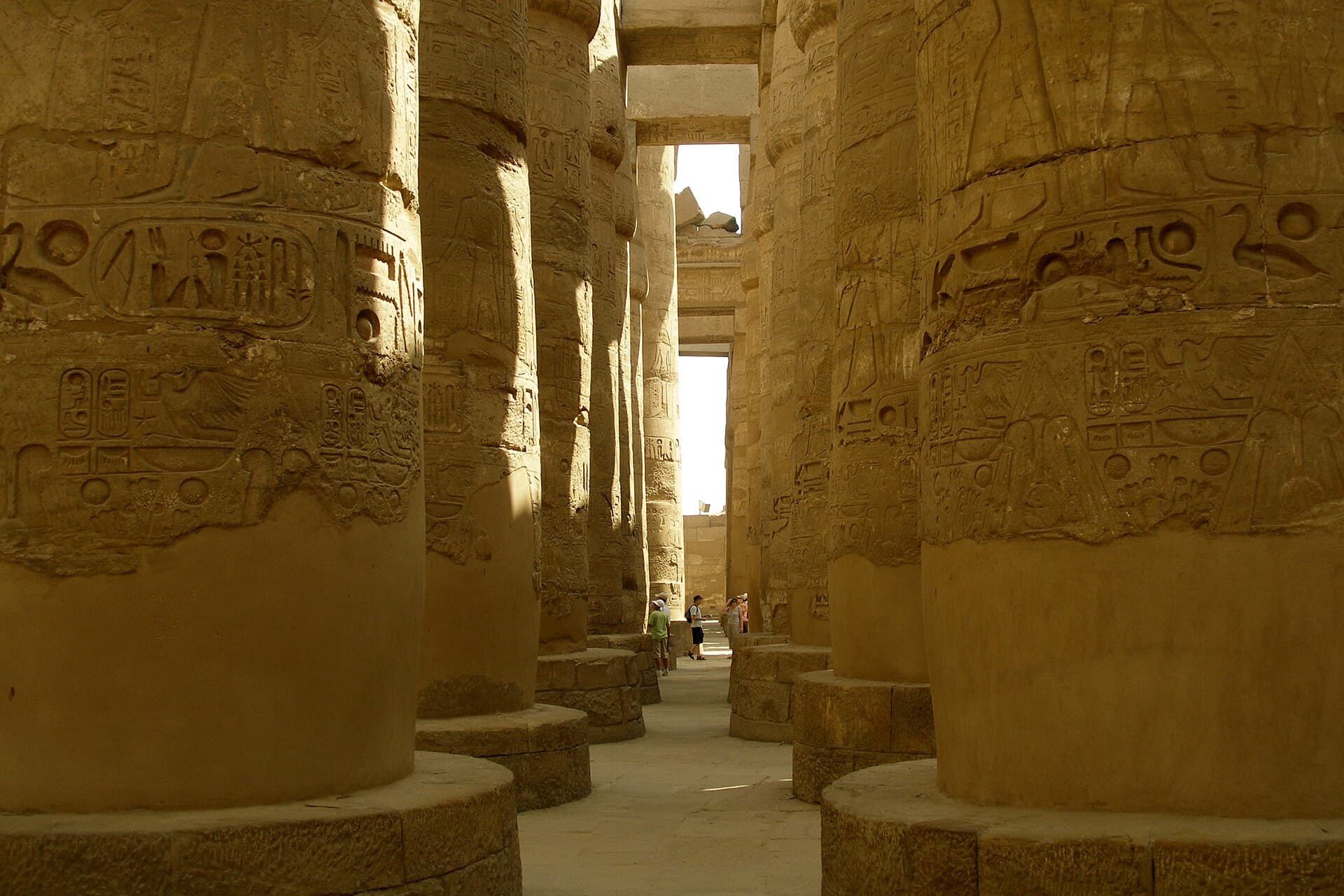
Past the court the building goes dark and roofed. You pass through a first pillared hall, then a second, then a series of smaller offering rooms and antechambers, each a step further in and a step lower in light, until you reach the sanctuary at the very centre. This narrowing, darkening progression is the whole logic of the place, and at Edfu you can still feel it because the roof is there to do the darkening. In a roofless temple the drama is gone; here it is intact.
Two famous statues of Horus as a falcon stand in the temple, carved in dark stone, wearing the double crown of Upper and Lower Egypt. The one near the entrance, guarding the doorway, is the single most photographed object on the site and the image most people carry away from Edfu. It is worth walking past it slowly in both directions rather than only pausing for the photograph everyone else is taking.
Inside: the falcon god, the sanctuary and the sacred barque
Edfu belongs to Horus — specifically Horus of Behdet, the falcon, one of the oldest gods in Egypt and the divine model of kingship. The living king was understood as Horus on earth, so a temple to Horus is also, in a sense, a temple to the idea of the pharaoh. That is why the reliefs are so thick with royal figures making offerings: the king feeding, clothing and honouring the god is the whole transaction the building was built to stage.
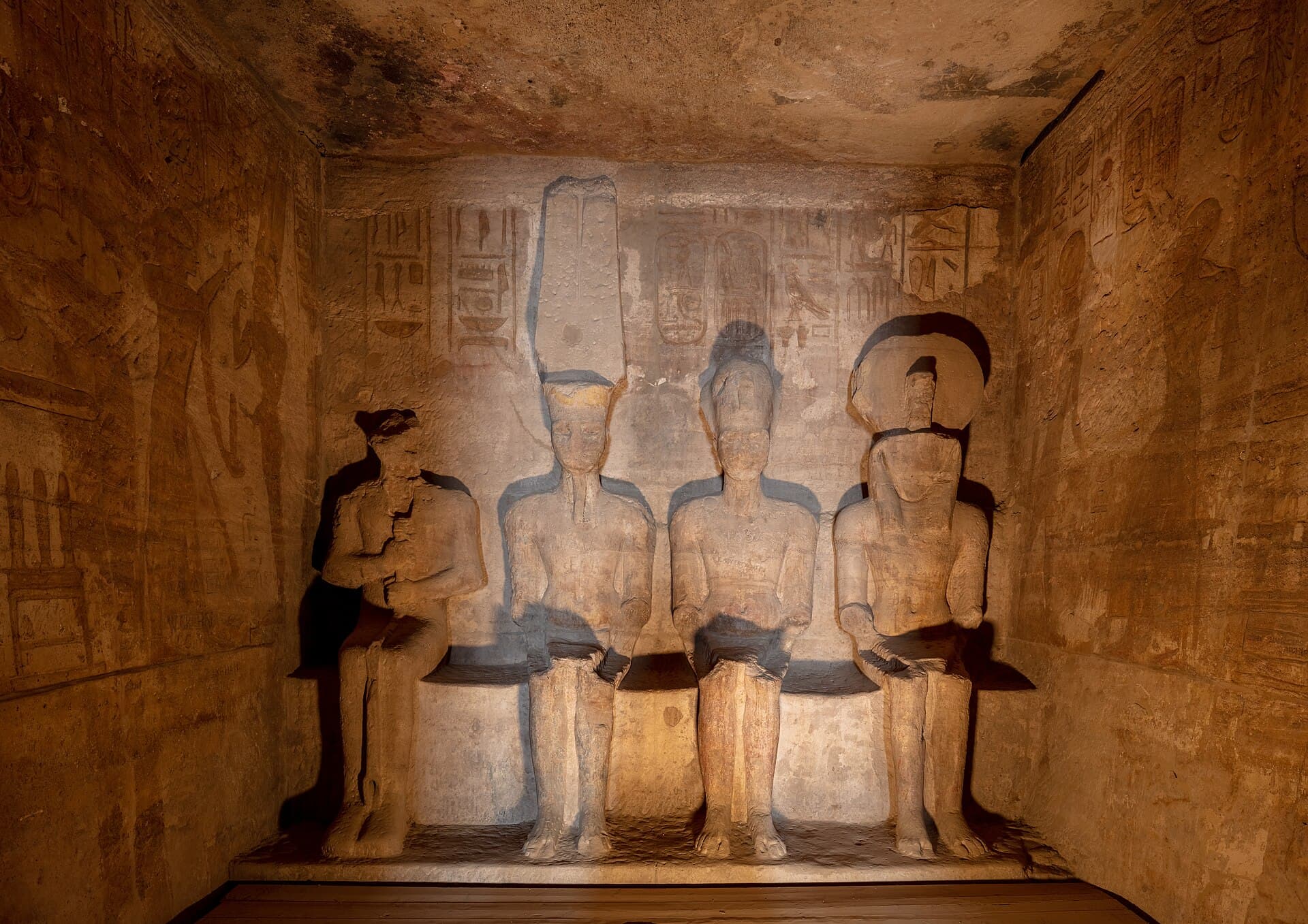
At the centre sits the sanctuary, the holiest and darkest room, where the cult statue of the god lived. Standing in it is a monolithic shrine of polished dark stone, a single carved block that held the image, and in front of it — unusually — a reconstruction of the sacred barque, the model boat on which the god travelled in procession. Most temples lost these long ago. Having the shrine and a barque together in the room they belonged in is one of the things that makes Edfu feel inhabited rather than excavated.
The decoration covers almost every surface, and at Edfu much of it is legible because the walls are intact and sheltered. The texts carved here are among the fullest records we have of how an Egyptian temple was founded, built and run: the dimensions, the rituals, the festival calendar, the names of the chambers. Scholars read Edfu not just as a building but as a manual for the whole institution, because the priests effectively wrote the instructions on the walls.
A word of caution about what you will be told on site. Guides at Edfu give confident, detailed accounts of which chamber did what and which scene shows which rite, and much of it is sound — the temple really does document itself. But the interpretation of individual scenes can be firmer in the telling than in the scholarship. Enjoy the commentary; treat the more elaborate stories as one reading rather than settled fact.
The outer walls, the Horus drama and the mammisi
Some of the best carving at Edfu is on the outside, on the walls of the corridor that runs around the temple between the building and its enclosure wall. The most celebrated sequence here shows the mythical conflict between Horus and Seth — the god avenging his father Osiris — rendered as a series of scenes in which Seth appears as a hippopotamus and is speared. It was carved to be read as a kind of sacred drama, and it is one of the few places where an Egyptian temple tells a continuous story rather than repeating the same offering scene.
This outer corridor is easy to skip, because the tour pressure is always towards the dark interior and the falcon statue, and because a cruise group on a schedule rarely has time to walk the full circuit. If you have any say over your own pace, give it ten minutes. The light is better out here than inside, the carving is deep enough to read without a torch, and you are usually alone with it while everyone else queues at the sanctuary.
In front of the main temple, to one side, stands the mammisi, or birth house: a small separate shrine associated with the birth of the god's child and, by extension, the renewal of the king. It was the setting for rituals celebrating the divine birth, and its columns carry images of the god Bes, the dwarf protector of childbirth, which are hard to mistake. It is a modest building next to the great temple, and many visitors pass it without a glance, but it is part of the same complex and worth the short detour on the way in.
None of this needs to be learned in advance. But knowing that there are three distinct things to see — the dark axis to the sanctuary, the carved outer corridor, and the birth house in the forecourt — helps you spend a short visit well, rather than following the crowd straight in and straight out past two-thirds of the site.
Arriving as a cruise stop: the mooring and the caleche ride
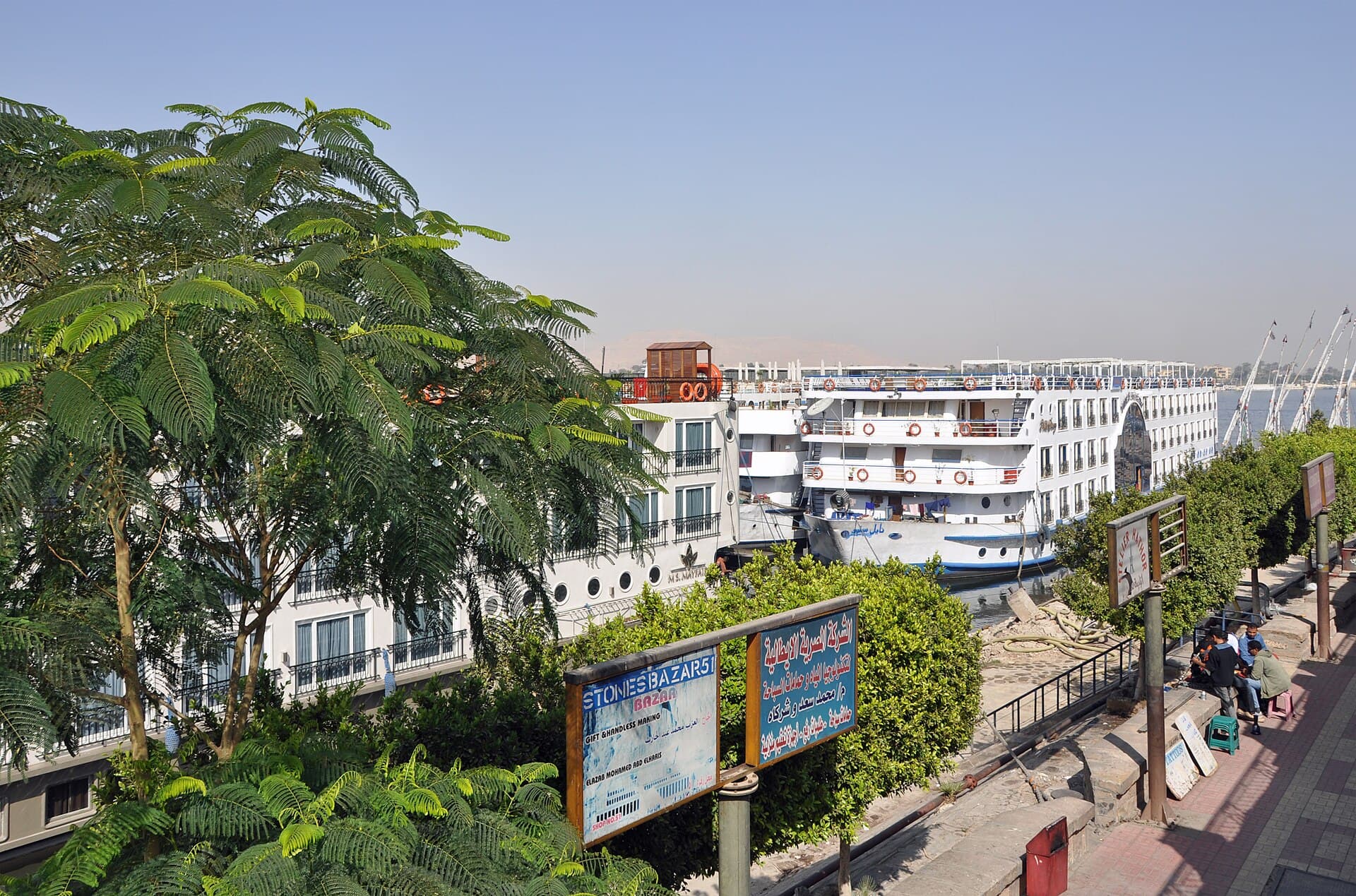
Almost everyone sees Edfu from a Nile cruise. Every boat sailing the Luxor-to-Aswan stretch calls here; it is one of the two fixed temple stops on that leg, alongside Kom Ombo, and far more itineraries include Edfu than include Esna. If you are booked on the river between those two cities, you are almost certainly going to Edfu whether or not it is named on your programme.
Unlike Kom Ombo, which sits right at the top of its mooring steps, the temple at Edfu is not on the river. It is set back in the town, a short distance inland, so there is a transfer between the boat and the gate. The traditional way to cover it — and the one built into most cruise excursions — is the caleche, a horse-drawn carriage, which lines up at the mooring to carry passengers up through the streets to the temple and back. For many people the clatter through an ordinary working town is half the memory of Edfu.
The caleche ride is also the part of the stop most worth thinking about before you go. The horses' condition varies, the drivers press hard for tips and often harder on the return, and some visitors are uncomfortable with the whole arrangement. None of that is a reason to invent a rule about it here. If it matters to you, ask your cruise director what the alternatives are: a minibus or taxi transfer is sometimes available, and the distance is walkable for the able-bodied if you would rather not take a carriage at all. Decide before you are standing on the quay being hurried into one.
However you cross the town, the stop usually falls in the morning, before the heat builds — several cruise itineraries put Edfu early and leave a long, slow afternoon on deck as the boat sails on. That early timing suits the temple: the interior is dark and cool whatever the hour, but the open court and the outer walls are far pleasanter before midday.
How long you need at Edfu
Budget an hour to an hour and a half at the temple itself, plus the transfer each way. That is enough to walk the full axis to the sanctuary, come back out, take in the outer corridor and glance at the birth house without rushing. A group tour will often do it in less, because the schedule is built around the carriage transfer and the boat's sailing time rather than around you.
As with the other river temples, be sceptical of anyone selling you half a day here. Edfu is large and it is complete, but it is not vast in the way Karnak is, and there is no long outer precinct to wander. The building rewards attention, not endurance. An unhurried ninety minutes sees everything that matters; three hours is padding unless you are a specialist.
If you are the sort of visitor who likes to read walls, the limiting factor is light rather than time. The deep interior is genuinely dark, and a small torch earns its place here more than at any other stop on the river. Much of the finest detail is carved in low relief in rooms the sun never reaches, and without a light you will walk past it.
Combining Edfu with Kom Ombo the same day
On a cruise the two are handled for you: the boat calls at Edfu, sails on through the day, and reaches Kom Ombo later, usually at dusk. You do not have to plan the pairing — the itinerary does it — but it is worth understanding why the order works. Edfu, seen first, shows you what a complete Ptolemaic temple is: roofed, sequenced, dark, whole. Kom Ombo, seen after, shows you what the same builders did when asked to serve two gods at once, and its ruin lets the light in so you can read the plan. The pair teaches you more together than either does alone.
If you are travelling by road rather than water, the same pairing is the natural shape of a day. Edfu and Kom Ombo sit on the same stretch between Luxor and Aswan, and a car with a driver can take in both at your own hours instead of a boat's. Doing them on one day is the efficient choice: it turns an otherwise dull drive into two good stops and saves you a second long run on the same road.
If a tight itinerary forces you to drop one of the two, drop Kom Ombo and keep Edfu. Kom Ombo is the easier and quicker to see, and it is the more interesting to puzzle over afterwards, but Edfu is the one that shows you what these temples were. Of everything between Luxor and Aswan, it is the single building least worth missing.
Visiting Edfu from Luxor or Aswan by road
You do not have to be on a cruise to see Edfu. It lies on the main road between Luxor and Aswan, so a car and driver from either city can reach it, usually paired with Kom Ombo to make the driving worthwhile. From Luxor it is the more distant of the two temples; from Aswan, Kom Ombo comes first and Edfu is the further stop. Either way it is a full day out once you allow for the driving.
The road version has one real advantage over the cruise: you arrive on your own schedule, not a group slot, and you can linger in the outer corridor or wait for the light without a carriage driver tapping his watch. It suits anyone who found the river temples too rushed, and anyone whose cruise, for whatever reason, skipped a stop they wanted.
The convoy and permit arrangements on this road have changed repeatedly over the years, and what was required one season is sometimes dropped the next. Do not take a guidebook's account of it as current. Have your driver or operator confirm the present position before the day, and agree the order of the stops and which tickets are already paid for before you set off.
Practical notes to check locally
Ticket prices, opening hours and whether anything is included in your cruise excursion all change, and they change faster than published guides update. This page carries no prices and no times on purpose: confirm them at the gate or have your guide settle them on the day rather than trusting a figure of unknown age. The same goes for any separate photography ticket, which has come and gone at Egyptian sites over the years.
Bring a torch for the dark interior, water for the open court and the walk, and sun cover for the transfer and the unshaded forecourt. Between roughly May and September the middle of the day on this stretch of the river is punishing, which is part of why cruises schedule Edfu early. Even in the cooler months the interior and the exterior are two different climates: cool and dark inside, hot and bright in the court.
The ground is uneven in places and there are steps, though far less of a scramble than the slope at Kom Ombo. The bigger access question is the transfer from the mooring: the standard carriage is a climb up into a high trap, which does not suit everyone. If mobility is a concern, raise it with your cruise director before the stop so an alternative transfer can be arranged rather than assumed.
Expect selling. The route between the mooring and the temple, and the stretch around the gate, is lined with stalls and persistent traders, and the caleche drivers themselves press for tips over and above the agreed fare. Prices are negotiable and nothing on offer is unique to Edfu — you will see the same goods in Luxor and Aswan. Keep your attention for the temple and your patience for the things worth haggling over elsewhere.
Common questions
Why is Edfu called the best-preserved temple in Egypt?+
Because it survives almost entire: the roof is on, the twin-towered pylon still stands close to full height, and you can walk the complete sequence of halls from the open court to the dark sanctuary at the centre. Most Egyptian temples have lost their roofs, their fronts or their interiors. Edfu kept all three, largely because it was built late and then buried in sand and town rubble for centuries, which protected it until it was dug out in the nineteenth century.
Which god is Edfu temple dedicated to?+
Horus, the falcon god, in his local form as Horus of Behdet. Horus was the divine model of kingship — the living pharaoh was understood as Horus on earth — so the temple is thick with scenes of the king making offerings to the god. Two dark-stone statues of Horus as a falcon in the double crown stand in the temple, and the one guarding the entrance is the most photographed object on the site.
How do you get from the cruise mooring to the temple?+
The temple sits back in the town rather than on the river, so there is a short transfer each way. The traditional way, built into most cruise excursions, is the caleche — a horse-drawn carriage that runs up through the streets to the gate. A minibus or taxi is sometimes available, and the able-bodied can walk it. If the carriages concern you, ask your cruise director about alternatives before you are on the quay rather than after.
How long do you need at Edfu?+
An hour to an hour and a half at the temple, plus the transfer each way. That covers the full walk to the sanctuary, the carved outer corridor and the birth house without rushing. Group tours often do it in less because the schedule is built around the carriage and the boat's departure. Anyone quoting you half a day is padding — Edfu rewards attention, not endurance.
Should I see Edfu or Kom Ombo if I can only manage one?+
Edfu. Kom Ombo is easier to reach and quicker to see, and it is the more intriguing to think about afterwards, but Edfu is the one that shows you what a complete Ptolemaic temple actually was. On a cruise you normally get both on the same day and do not have to choose. If a tight road itinerary forces the decision, keep Edfu and drop Kom Ombo.
Can I visit Edfu without being on a Nile cruise?+
Yes. It sits on the main road between Luxor and Aswan, so a car and driver from either city can reach it, usually paired with Kom Ombo to make the drive worthwhile. Going by road lets you arrive on your own schedule instead of a group slot, which suits anyone who found the river temples rushed. It is a full day out once you allow for the driving, and the convoy and permit rules on that road change, so confirm the current position locally first.
Do all Nile cruises stop at Edfu?+
Effectively yes, on the Luxor-to-Aswan leg. Edfu is one of the two fixed temple stops on that stretch, alongside Kom Ombo, and far more itineraries include it than include Esna. If you are sailing between those two cities you are almost certainly calling at Edfu. Confirm it is named on your programme if it matters to you, and check again on board, but it is the reliable one rather than the variable one.
Is there anything to see at Edfu besides the main temple?+
Three things beyond the dark axis to the sanctuary. The outer corridor between the temple and its enclosure wall carries the carved sequence of the conflict between Horus and Seth, readable in good light and usually quiet. The mammisi, or birth house, stands in the forecourt with its images of the god Bes. And the great pylon itself, with its colossal smiting scenes, repays a look from the court before you go in. A short visit is much better spent once you know all three are there.
Official sources
Entry rules, opening hours, security advice and exchange rates all move. Check them at the source, not here.
Written and checked by the Nile Trip Guide editorial team · Last reviewed . Entry rules, prices and opening hours change — check anything critical against the official sources linked on this page.
Plan this trip
Tell us your dates and we will price it
A real itinerary with real prices, usually within 24 hours. Nothing is booked and nothing is charged until you say yes.
The route most people take first, at the length it was built for: Giza and the Grand Egyptian Museum, then a flight to Luxor and four nights sailing down to Aswan.
No boat on this one. Giza and the Grand Egyptian Museum, a night in Luxor for both banks, two nights on the Red Sea, then back to Cairo for the Citadel, Coptic Cairo and the Royal Mummies.
Five nights in Cairo either side of a four-night sail from Luxor to Aswan. The Cairo days are private, just your party and a guide; the sightseeing off the boat is shared with a small group.