Karnak Temple: What to See and How to Visit It Well
Karnak Temple is the largest religious complex the ancient world built, and roughly 2,000 years of pharaohs added to it. That long construction is the point and the problem: it is not one building but dozens, layered over each other. Know what you are looking at and it becomes the best thing in Luxor. Walk in cold and it is mostly hot stone.
What makes Karnak different from every other Egyptian temple?
Scale, and the fact that nobody finished it. Most Egyptian temples were built by one ruler with one plan. Karnak was added to by pharaoh after pharaoh from the Middle Kingdom through to the Roman period. Each wanted their name on the most important religious site in Egypt, so each built outwards, or knocked something down and rebuilt it larger.
The result is a site of about 100 hectares containing several separate temple precincts. Most visitors see only the Precinct of Amun-Re, which is the central one and by far the largest. That is a reasonable choice. The Precinct of Mut to the south is largely ruined and closed in parts, and unless you have a specific interest it will not add much to your day.
It is worth being blunt about what this means on the ground. There is no single moment at Karnak that resolves the place for you, no view from which the whole thing makes sense. You walk through a sequence of courts and halls built centuries apart by people with different ideas about what a temple should look like, and the joins are visible everywhere. Visitors who expect one grand building are usually disappointed for the first twenty minutes and then won over by the Hypostyle Hall. Visitors who understand they are walking through two millennia of additions tend to enjoy the whole site.
Who built Karnak, and over what period?
The short answer is around thirty pharaohs across roughly two thousand years, which is longer than the gap between us and the Roman empire. The oldest surviving core belongs to the Middle Kingdom, when the temple was a modest affair for a then-minor local god. Amun rose with Thebes, and when Thebes ran Egypt, its god got the country's building budget.
The New Kingdom did most of what you see. Hatshepsut and Thutmose III raised obelisks and halls in the middle of the site. Amenhotep III built the third pylon. Seti I and Ramesses II built and decorated the Great Hypostyle Hall. Later dynasties, including Nubian and Libyan rulers of Egypt, kept extending westwards towards the river, and the Ptolemies and Romans were still adding gates and repairs at the very end.
Two practical consequences follow. First, Karnak is the best single place in Egypt to see how pharaonic art changed over time, because the styles sit next to each other rather than in separate museums. Second, almost nothing here is pure: walls were recut, names replaced, blocks from demolished buildings reused inside later ones. A guide who can tell you which century you are standing in is worth more at Karnak than at any other site in the country.
How the site is laid out: two axes and ten pylons
The Precinct of Amun-Re has two arms. The main axis runs roughly east to west, from the innermost sanctuary out towards the Nile, and it is the route every visitor walks. A second axis runs south from the middle of the first, towards the Precinct of Mut, and most people never set foot on it. Understanding that the plan is a cross rather than a corridor is most of the battle.
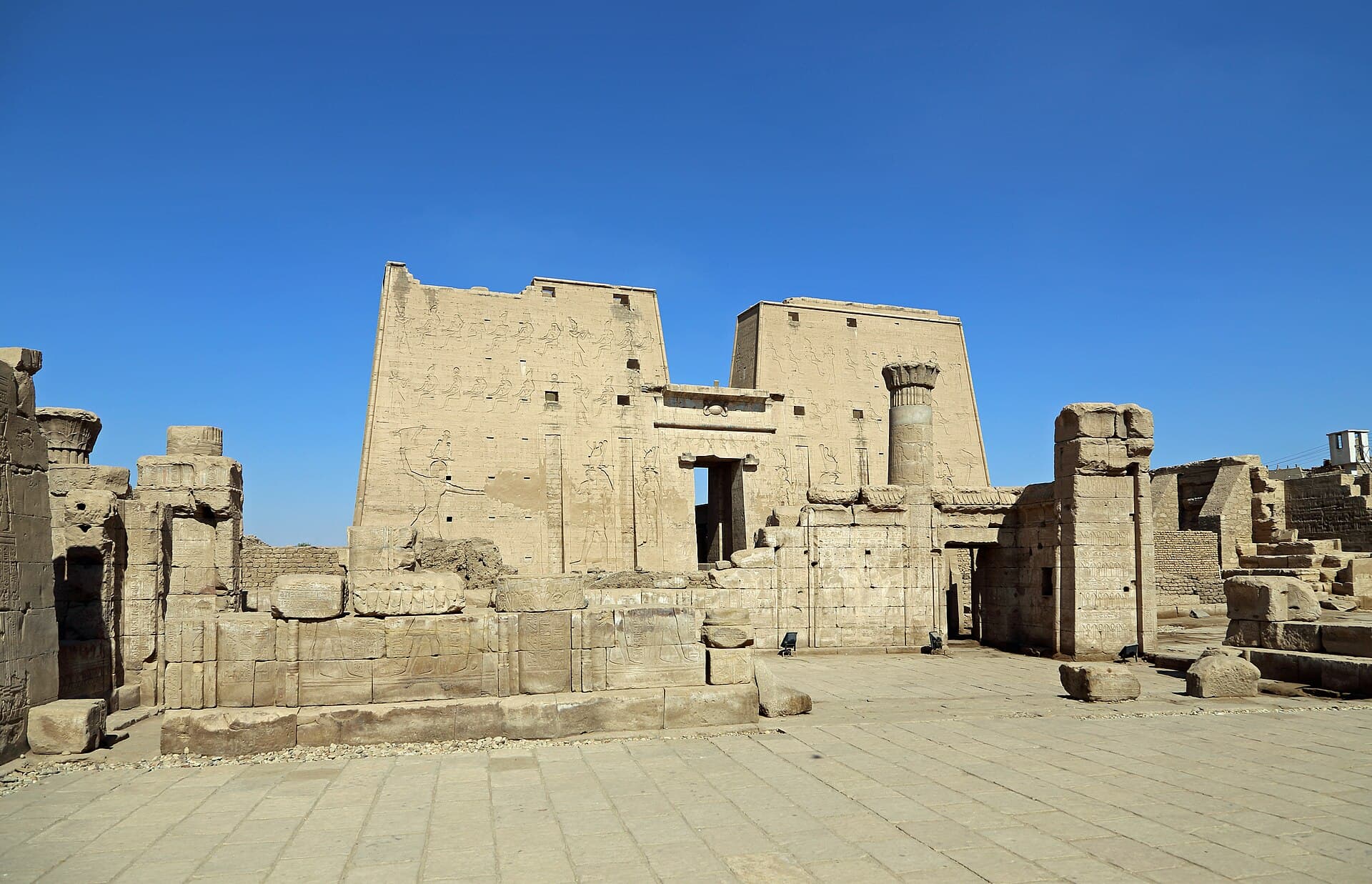
Each stage along an axis is marked by a pylon, the pair of sloping stone towers that form a monumental gateway. There are ten in the precinct. The counter-intuitive part is that they get older as you walk inwards: the first pylon, the one you enter through, is the last to have been built, and the sanctuary at the far end sits on the oldest ground. You are walking backwards in time with every gate you pass.
Look at the first pylon before you go through it. It was never finished, the top is uneven, and behind the inner face a mass of mudbrick survives from the construction ramp that was used to raise the stone. It is the clearest evidence anywhere in Egypt of how these things were actually built, and it takes two minutes to look at. Nearly every group walks straight past it on the way to the Hypostyle Hall.
The Hypostyle Hall, the obelisks and the sacred lake
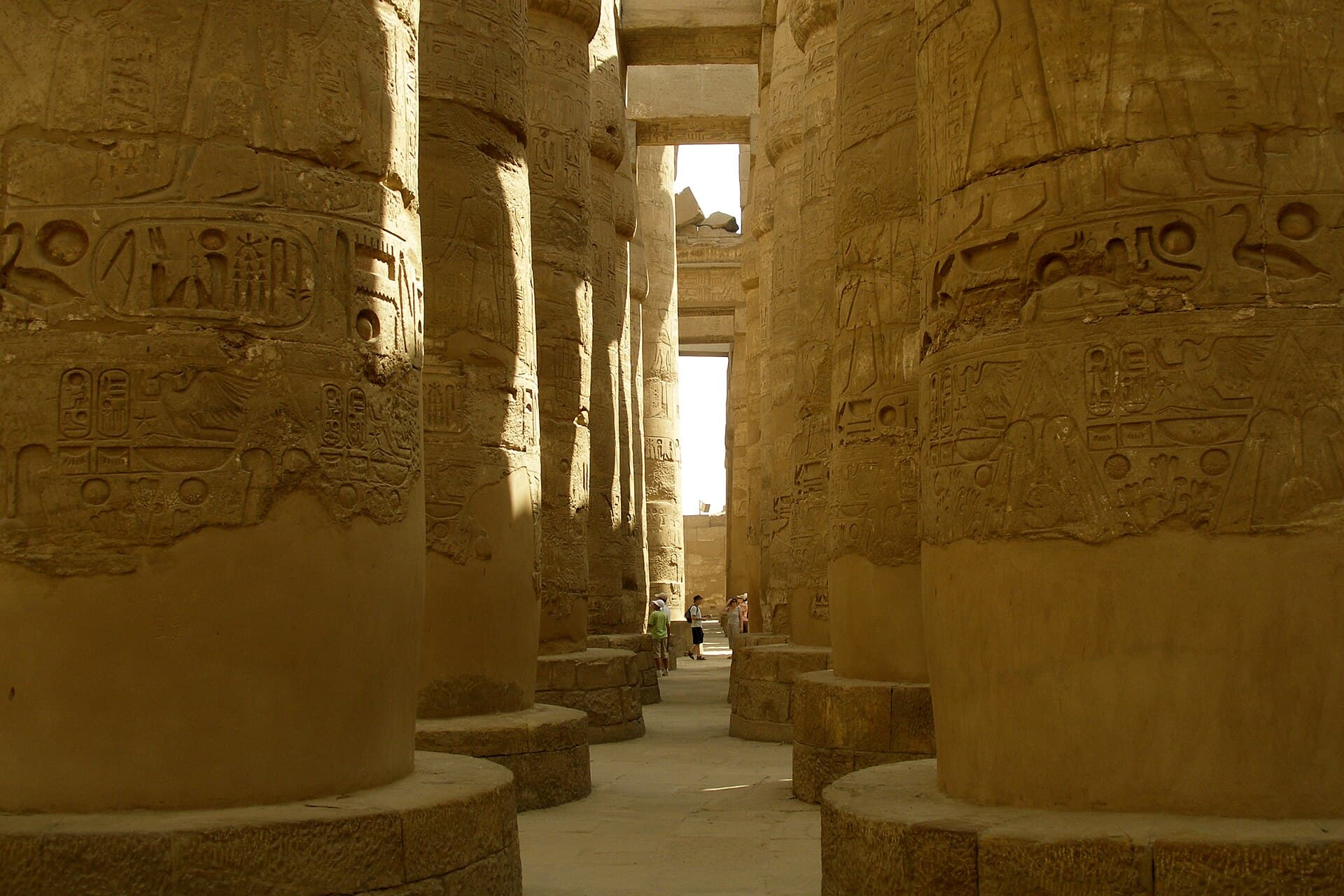
The Great Hypostyle Hall is the reason people come. It is a forest of 134 columns covering roughly 5,000 square metres, the tallest of them around 21 metres high, with papyrus-shaped capitals wide enough to hold a small group of people standing. Traces of original paint survive high up where the roof once protected them. Look for the blues and reds near the tops of the central columns.
Hatshepsut raised obelisks here. One still stands, at about 29 metres, cut from a single piece of Aswan granite and the tallest still upright in Egypt. Her successor Thutmose III walled part of it in rather than pull it down, which is why the lower carvings are unusually crisp. The fallen upper section of a second one lies near the sacred lake and lets you read the inscriptions at eye level.
The sacred lake is a rectangular basin the priests used for ritual washing. It is quieter than the main axis and the light on the water is good late in the day. Nearby sits a large granite scarab raised by Amenhotep III. You will see people walking circles around it for luck. Harmless, but it is a modern habit, not an ancient one.
One detail in the Hypostyle Hall repays a slow look. The northern half was decorated under Seti I and the southern half under Ramesses II, and the two used different techniques: the older work is carved in raised relief, standing proud of the wall, and much of the later work is cut into it. Stand in the middle, look one way and then the other, and you can see a change in fashion happening across a single room. It is the kind of thing a good Egyptologist points out and a guidebook rarely does.
The hall also has a modern history worth knowing. A group of its columns collapsed in 1899, and what you walk through today includes decades of careful re-erection and consolidation by archaeologists. That is not a criticism of the site; it is why the hall is still standing. It does mean that the perfectly aligned stone you photograph is in places the result of patient twentieth-century work rather than untouched survival.
A route through Karnak that works
Start outside. In front of the first pylon there is a short avenue of ram-headed sphinxes and, beyond it, the ancient quay where boats once tied up. Approaching the temple from the river side, even for a minute, gives you the arrival that the building was designed for, which the modern ticket gate does not.
Through the pylon you are in the Great Court, the largest open space on the site. One tall column stands in the middle of it, the survivor of a kiosk built by the Nubian pharaoh Taharqa. Off the south side of the court is a small, complete temple of Ramesses III, easy to walk into and a good miniature of the standard temple plan you are about to meet at full size. Give the court ten minutes rather than crossing it.
Then the second pylon, the Hypostyle Hall, and the obelisks between the pylons beyond it. Past the sanctuary area at the far end sits the Festival Hall of Thutmose III, and that is where the day is either won or lost, because most people turn round before they reach it. Finish at the sacred lake, which is the right place to sit down, and leave the Open Air Museum near the entrance for last if you still have energy and interest.
If you want the south axis, take it from the middle of the site after the Hypostyle Hall, walk down past the pylons towards the Mut precinct, and come back. It adds half an hour and it is the quietest ground inside the enclosure. On a first visit in serious heat, skip it without guilt.
The Festival Hall and the Open Air Museum
The Festival Hall of Thutmose III, built behind the main temple, is the most architecturally odd building at Karnak. Its columns are not the usual papyrus or lotus forms: they are shaped like tent poles, narrower at the base than at the top, apparently a stone version of the campaign tents the king spent much of his reign in. Nothing else in Egypt looks like it.
In a side room off the hall is a chamber usually called the Botanical Garden, its walls carved with plants, birds and animals recorded on Thutmose III's campaigns abroad. It is a strange, almost scientific piece of decoration in a building otherwise devoted to gods and kingship, and it is one of the few places at Karnak where you can see the ancient Egyptians looking outward at the wider world rather than inward at their own ritual.
The Open Air Museum, a walled section near the entrance, holds reconstructed shrines including Hatshepsut's Red Chapel and the White Chapel of Senusret I, both rebuilt from blocks found reused inside later pylons. The White Chapel is Middle Kingdom work of a quality that makes the Ramesside carving outside look coarse. As noted below, it is a separate ticket, and for anyone with genuine interest it is the best value on the site.
The other precincts: Mut, Montu and the temple of Khonsu
Inside the Amun enclosure, towards its south-west corner, stands the temple of Khonsu, dedicated to the son in the Theban divine family of Amun, Mut and Khonsu. It is a complete, compact temple of the later New Kingdom and after, with its roof largely intact, and it is almost always empty. If you want to understand the standard Egyptian temple plan without the confusion of Karnak's additions, this is the building to walk through. A Ptolemaic gateway stands in front of it.
The Precinct of Mut lies south of the main enclosure, at the end of the south axis. Its sacred lake is crescent-shaped rather than rectangular, and the site has produced very large numbers of statues of the lion-headed goddess Sekhmet. It is ruinous, excavation there is ongoing, and public access has varied over the years. Ask locally rather than assuming you can walk in.
The Precinct of Montu, the smallest of the three, sits to the north and is not generally open to visitors. None of this should trouble a first-time visitor. It matters only as context: when you read that Karnak covers about 100 hectares and then spend two hours inside it, the arithmetic only makes sense once you know how much of the site you were never in.
Karnak, Luxor Temple and the avenue of sphinxes
Karnak was not a destination on its own. Once a year, in the Opet festival, the cult statue of Amun travelled from here to Luxor Temple, by water or along the processional road depending on the period, in rites read as a renewal of the king's divine status. The two temples are halves of one religious machine, and seeing both makes each more interesting.
The paved processional way between them runs roughly 2.7 kilometres and is lined with sphinxes. The ones at the Karnak end have rams' heads; the Luxor stretch has human heads. It was excavated in stages over decades and formally reopened in 2021. Walking the whole thing is less romantic than it sounds: a sunken corridor below street level, no shade, the same sphinx several hundred times over, and few exits. Early, in cool weather, it is a fine walk of well under an hour. In heat it is a slog, and access points have changed since it reopened, so check which gates are open before committing to it on foot.
The erasures: Hatshepsut, Akhenaten and the reused blocks
Karnak records its own arguments. Hatshepsut's name and image were attacked after her death, and you can see the chiselled patches where they were removed. Later, under Akhenaten, the name of Amun himself was cut out of walls across the site, and after that reign it was cut back in again by rulers restoring the old religion. Three phases of politics on the same square metre of wall.
Akhenaten built his own temples to the Aten east of Karnak. They were dismantled after his death, and their small, easily handled blocks, known as talatat, were used as rubble fill inside later pylons here. Thousands have been recovered, and a reconstructed wall of them is displayed in the Luxor Museum in town, which is small, well arranged and badly under-visited. It is the natural follow-up to a morning at Karnak if the heat has driven you indoors.
The same habit of reuse produced the Open Air Museum's shrines, and it produced the Karnak Cachette: a great deposit of statues and stelae found buried in a court on the south axis from 1903, thousands of pieces cleared over several seasons and dispersed to museums. The point for a visitor is simple. Empty space at Karnak is not always empty. Much of what once stood here is now in Cairo, in Luxor, or in the walls you are walking past.
How long should you allow at Karnak Temple?
Two to three hours is right for the Amun-Re precinct at a proper pace. Under 90 minutes and you are walking the main axis without stopping, which is what most cruise groups do and why so many people remember Karnak as a blur of columns. The extra hour is what buys you the side chapels, the reliefs and somewhere to sit in the shade.
Add another hour if you want the Open Air Museum, a walled section near the entrance holding reconstructed shrines including Hatshepsut's Red Chapel and the White Chapel of Senusret I. It costs a separate ticket, it is nearly empty, and for anyone with real interest in the site it is the best value at Karnak. For a first-time visitor with limited time and heat tolerance, skip it without regret.
If you are the sort of traveller who reads walls, four hours is not excessive, and a second visit is better still: one morning for the main axis and the Hypostyle Hall, one for the Festival Hall, the Khonsu temple, the south axis and the museum. Ask at the gate whether your ticket allows re-entry on the same day before you plan around it, because that varies.
When is the best time and light?
Arrive at opening, which is around 6am for most of the year. You get the first hour before the coaches from the cruise ships, and the low sun comes straight down the main axis and picks out the relief carving in the Hypostyle Hall. By mid-morning the light is flat and the crowds are heavy, and the queue at the ticket office is at its worst.
Late afternoon is the second-best option and better for photographs of the sacred lake and the west-facing first pylon, which catches the setting sun. It is not better for crowds. Summer is genuinely punishing, with afternoon temperatures around 40C and higher, and Karnak has very little shade. October to April is far more comfortable. If you must visit in July or August, go at opening and be finished by ten.
Hours shift with the season and during Ramadan, and the evening show affects how late the site stays open to ordinary ticket holders. None of that is reliably published in English, so confirm the day's hours locally rather than trusting a schedule found online. If your visit falls in the middle of the day because a tour has decided so, the Hypostyle Hall is still the best shade on the site, and the small Ramesses III temple in the Great Court is roofed.
Getting to Karnak from Luxor
Karnak sits about three kilometres north of central Luxor along the corniche, on the same side of the river as the town, the station and nearly every hotel. A taxi takes a few minutes and is the sensible default; agree the fare before you get in, which removes the only argument likely to arise. Horse-drawn caleches work the same route and the same rule applies twice over.
Walking it is pleasant in winter, early or late, and unpleasant otherwise, because the corniche has limited shade and steady traffic. Cycling is possible for the confident. If you are staying on the west bank, add the river crossing: the local ferry takes a few minutes and lands you near Luxor Temple, and the road bridge is several kilometres south of the centre and costs twenty to thirty minutes each way.
Coming from further afield, Luxor is an hour's flight from Cairo or about ten hours on the overnight sleeper train. Most visitors reach Karnak as part of two or three days in Luxor rather than as a trip in its own right, which is the right way round.
Is the Karnak sound and light show worth it?
Honestly, for most people, no. The show runs in the evening in several languages and walks you along the main axis with coloured lighting and a recorded narration. The script is theatrical in a dated way, the walking sections are slow, and you spend the last third seated by the sacred lake listening rather than looking. Check which language is scheduled on the night you want.
What it does offer is the temple at night, largely to yourself, which is a real thing that daytime cannot give you. If atmosphere matters more to you than information, and you have a spare evening in Luxor, it is a fair way to spend the hour and a half it takes. If your time in Luxor is tight, put the evening into the West Bank or an early night before the tombs instead.
There is a better version of an evening in Luxor for most people, and it costs less: Luxor Temple after dark. It is floodlit, it is in the middle of town, the carving reads far better under angled light than under midday sun, and an hour there is enough. Do the show if the idea of standing in Karnak at night appeals to you specifically. Otherwise, spend the evening at the other temple.
Visiting Karnak on a Nile cruise
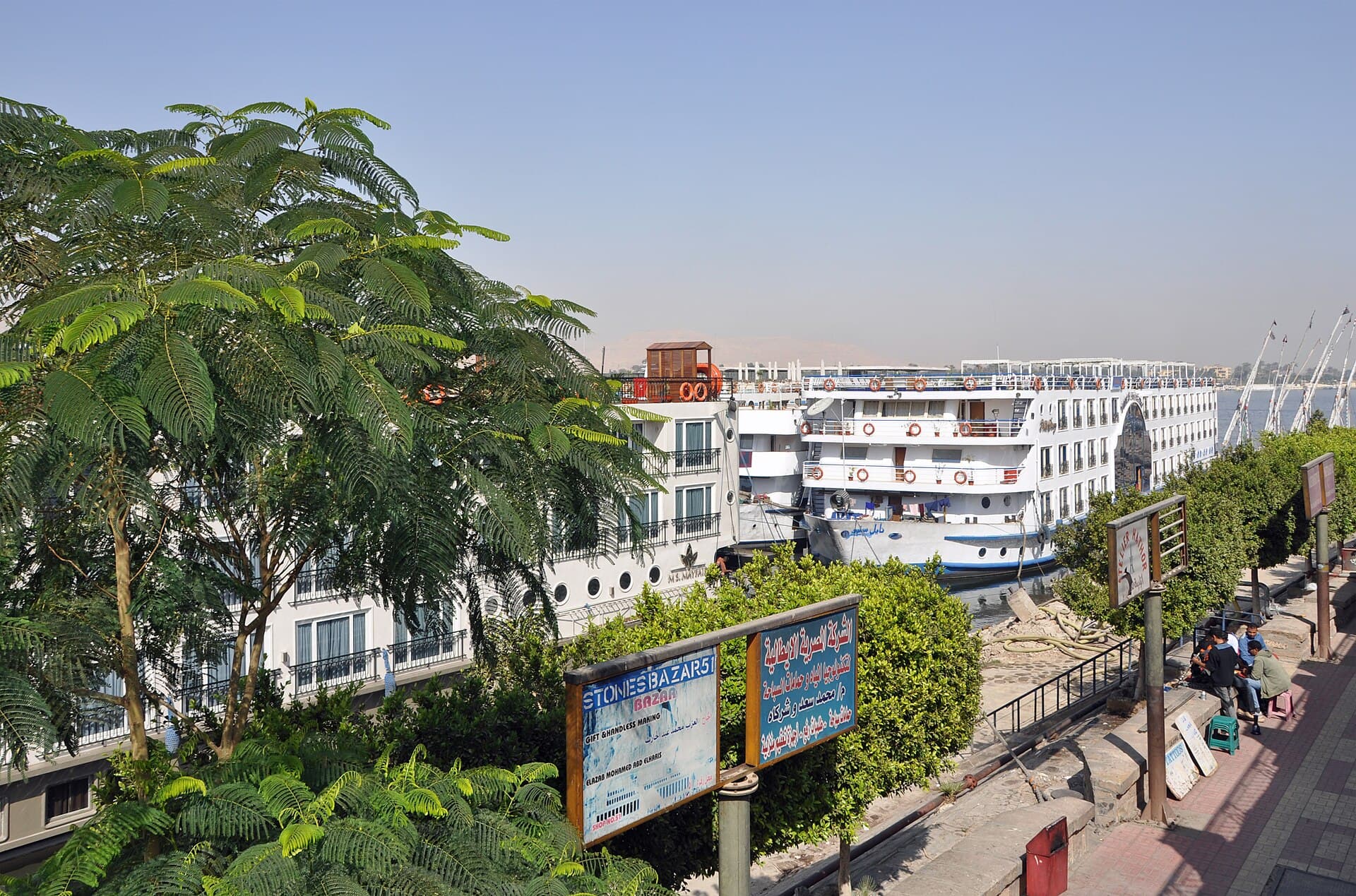
Nearly every Nile cruise includes Karnak, because Luxor is either the first stop or the last on the Luxor to Aswan run. What differs is the time of day and the size of the group. Boats moor on the east bank, often rafted several deep, and coaches leave at set times, which typically means arriving at Karnak in the middle of the morning alongside several other boats doing exactly the same thing.
The usual allowance is about 90 minutes, which covers the central axis and almost nothing to either side of it. If that is your situation, spend the time deliberately: the first pylon and its mudbrick ramp, the Great Court, a slow half hour in the Hypostyle Hall, the standing obelisk, and the sacred lake. Do not try to add the Festival Hall or the Open Air Museum; you will simply walk faster and see less.
The way round it is nights on land. A short cruise with a hotel night at either end in Luxor buys you the hour before the coaches and the evening after they have gone, which is when both Karnak and Luxor Temple are at their best. That compromise costs a little more and changes the trip considerably.
Karnak with children, and in the heat
Karnak is enormous and mostly unshaded, which makes it one of the harder Egyptian sites with young children. It is still worth doing. Go at opening, plan for well under two hours, and treat the Hypostyle Hall as the destination rather than working methodically through the site. Children tend to respond to the columns, the ram-headed sphinxes and the scarab, and not at all to chronology.
Heat management is the whole of the practical problem here. There is no meaningful shade on the main axis, the stone radiates, and the walk from the gate to the sacred lake and back is longer than it looks. Carry more water than seems reasonable, take the shade in the Hypostyle Hall when you need it, and accept that a shorter, earlier visit beats a thorough one at eleven in the morning.
For anyone travelling with someone who tires easily, plan the route in advance rather than wandering. Straight down the main axis to the lake, sit, and come back is roughly a kilometre of walking and takes in most of what people remember. Everything else on this page is optional.
Practical notes before you go
Tickets are sold at the gate, with the main precinct and the Open Air Museum charged separately. Prices change with the Egyptian pound, so treat any figure you read online as approximate rather than current. Egypt has been moving its major sites towards card payment, but terminals fail and machines go offline, so carry a card and enough cash to cover both tickets.
Bring more water than you think you need, a hat and covered shoulders. The ground is uneven stone throughout, so wear shoes you can walk on rubble in. Photography is permitted, and tripods usually need a permit. Vendors mostly work the approach to the entrance, and a firm, polite no is enough. Guides can be hired at the gate, though arranging one in advance through your operator gets you a better Egyptologist and a plan for the day rather than a lap of the main axis.
There is a visitor centre and shop near the entrance and facilities there rather than deep inside the site, so use them before you walk in. Small notes are useful for guards who offer to point a torch at a detail or unlock a gate; you are free to decline, politely, and nothing happens. A multi-site pass covering Luxor's monuments exists and can make sense if you are entering many sites over several days, but the sums change whenever prices do, so check the current terms in Luxor rather than from an old blog post.
What most visitors get wrong at Karnak
Four mistakes account for most disappointed visits. Coming in the middle of the day, which is both the hottest and the most crowded hour. Coming without a guide or any reading, so the site becomes an undifferentiated field of stone. Allowing 90 minutes because someone else's schedule said so. And walking the main axis only, then leaving without seeing the sacred lake, the Festival Hall or the Khonsu temple, which is where the quiet is.
The fifth is subtler: trying to see everything. Karnak punishes completists in a way that Luxor Temple does not. Choose five things before you go in, look at them properly, and let the rest be background. A visitor who spends half an hour in the Hypostyle Hall watching the light move across the carving takes away more than one who has covered every court at speed.
Set against the rest of Luxor, Karnak is the site that most rewards preparation and most punishes the lack of it. The Valley of the Kings works on anyone who turns up. Karnak needs you to know roughly what you are looking at. An hour with this page, a decent guide on the day, and an early start are the whole difference between the best thing in Luxor and a lot of hot stone.
Common questions
Is Karnak better than Luxor Temple?+
They are different rather than ranked. Karnak is bigger and more confusing, and rewards a guide. Luxor Temple is smaller, easier to read as a single building, and better after dark when it is lit. If you only have time for one, take Karnak in the morning. Most people do both and find they suit different moods.
Can I visit Karnak on a day trip from Hurghada or Sharm el Sheikh?+
You can from Hurghada, at a cost. It is roughly four hours each way by road, so you leave before dawn and get back late, and you see Karnak in the hottest part of the day alongside every other coach. Sharm el Sheikh is on the Sinai side, so a day trip means flying, usually via Cairo. Two nights in Luxor is a far better trade.
Is the site accessible for someone with limited mobility?+
Partly. The main route is flat but the surface is uneven stone and loose grit, and there is no shade for long stretches. Wheelchair users manage the approach and the Hypostyle Hall with help. The outer temples and the raised ground around the sacred lake are harder. Tell your operator in advance so the pacing is planned.
Do I need a guide, or is the signage enough?+
The signage is thin and the site is not laid out to explain itself. Without a guide you will see impressive stone and miss why any of it was built. A good Egyptologist turns two hours into something you remember. If you are travelling independently, hire one at the gate rather than skipping it.
How does Karnak fit into a wider Egypt itinerary?+
It sits naturally on the first or second morning in Luxor, usually paired with the West Bank tombs on the other day. Most itineraries put Cairo first, then fly south. If you are joining a Nile cruise, Karnak is normally included at the Luxor end. Two full days in Luxor covers the essentials without rushing.
How far is Karnak from Luxor Temple, and can you walk between them?+
About 2.7 kilometres along the ancient processional avenue, which was formally reopened in 2021. You can walk it, and in cool weather early in the day it takes well under an hour. It is a sunken route with no shade and few exits, so it is a poor idea in heat, and open access points have changed more than once. A taxi along the corniche takes a few minutes.
What is the best thing to see at Karnak if you only have an hour?+
The Great Hypostyle Hall, without question, and the standing obelisk of Hatshepsut just beyond it. Walk in through the first pylon, cross the Great Court without stopping, and give the hall as much of your hour as you can. Everything else at Karnak is a reason to come back rather than something to cram in.
Are the other precincts at Karnak open to visitors?+
Not reliably. Most visitors see only the Precinct of Amun-Re, which contains the Hypostyle Hall, the obelisks, the sacred lake and the temple of Khonsu. The Precinct of Mut to the south is ruinous and access has varied, and the Precinct of Montu to the north is not generally open. Ask at the gate on the day rather than planning around them.
Is Karnak worth visiting twice?+
For anyone with a real interest, yes, and it is cheaper than most people assume relative to what a second morning adds. The first visit is the main axis and the Hypostyle Hall; the second is the Festival Hall, the Khonsu temple, the south axis and the Open Air Museum, all of which are quiet. Check whether re-entry is allowed on one ticket before you rely on it.
Official sources
Entry rules, opening hours, security advice and exchange rates all move. Check them at the source, not here.
Written and checked by the Nile Trip Guide editorial team · Last reviewed . Entry rules, prices and opening hours change — check anything critical against the official sources linked on this page.
The route most people take first, at the length it was built for: Giza and the Grand Egyptian Museum, then a flight to Luxor and four nights sailing down to Aswan.
No boat on this one. Giza and the Grand Egyptian Museum, a night in Luxor for both banks, two nights on the Red Sea, then back to Cairo for the Citadel, Coptic Cairo and the Royal Mummies.
Five nights in Cairo either side of a four-night sail from Luxor to Aswan. The Cairo days are private, just your party and a guide; the sightseeing off the boat is shared with a small group.