Valley of the Kings: Which Tombs Are Worth Your Ticket
The Valley of the Kings is a dry side valley on Luxor's west bank holding more than sixty rock-cut tombs, most of them New Kingdom pharaohs and their families. Your standard ticket covers three of them, and the ones most people have heard of are not included. This page sets out what you get, what costs extra, and what is worth paying for.
What does the standard ticket cover?
The general entry ticket is sold at the visitor centre by the car park. It admits you to the site and to three tombs of your choice from those open that day, which usually means around eight to ten. The selection rotates for conservation, so nobody can promise you a particular tomb in advance. A small electric train runs the last stretch to the entrance; walking it takes about ten minutes in full sun.
Which tombs open on the day is posted at the ticket office. Ramesses IV (KV2), Ramesses IX (KV6), Merenptah (KV8) and Ramesses III (KV11) are among the ones most often available. Ramesses III is the pick if it is open: a long descending corridor with side chambers of painted scenes, including the two blind harpers that gave it its old name, the Tomb of the Harpers.
Which tombs need a separate ticket?
Three of the famous ones sit outside the general ticket. Tutankhamun (KV62), Seti I (KV17) and Ramesses V/VI (KV9) each need their own ticket, bought at the same office. Nefertari is not here at all: her tomb is in the Valley of the Queens, a separate site about ten minutes away by car, with its own entry fee and its own extra ticket.
Prices for these change often, so treat any figure you read online as out of date and check at the window. Of the three, Ramesses V/VI gives the most for the money: a wide, bright tomb with an astronomical ceiling showing the sky goddess Nut. Seti I is the longest and deepest in the valley and the finest, and priced accordingly. Tutankhamun is small, with only the burial chamber painted; the mummy is there, the treasures are in Cairo, and many visitors come out feeling short-changed.
Nefertari's tomb is the one genuine exception to our usual advice about paid extras. The colour is better preserved than anything else on the west bank, and the visit is time-limited, in practice about ten minutes. It is expensive and it is short. If painted decoration is the reason you came to Luxor, it is worth the money; if you are ticking off sites, it is not.
Tomb of Ramesses V/VI (KV9)
KV9 belongs to two kings of the Twentieth Dynasty. Ramesses V began it. His uncle, Ramesses VI, enlarged it and was buried in it. Egypt's Ministry of Tourism and Antiquities says it is uncertain whether Ramesses V was buried here as well. The plan is simple: one straight line of corridors running down to the burial chamber. The painted sunk relief on the walls is very well preserved.
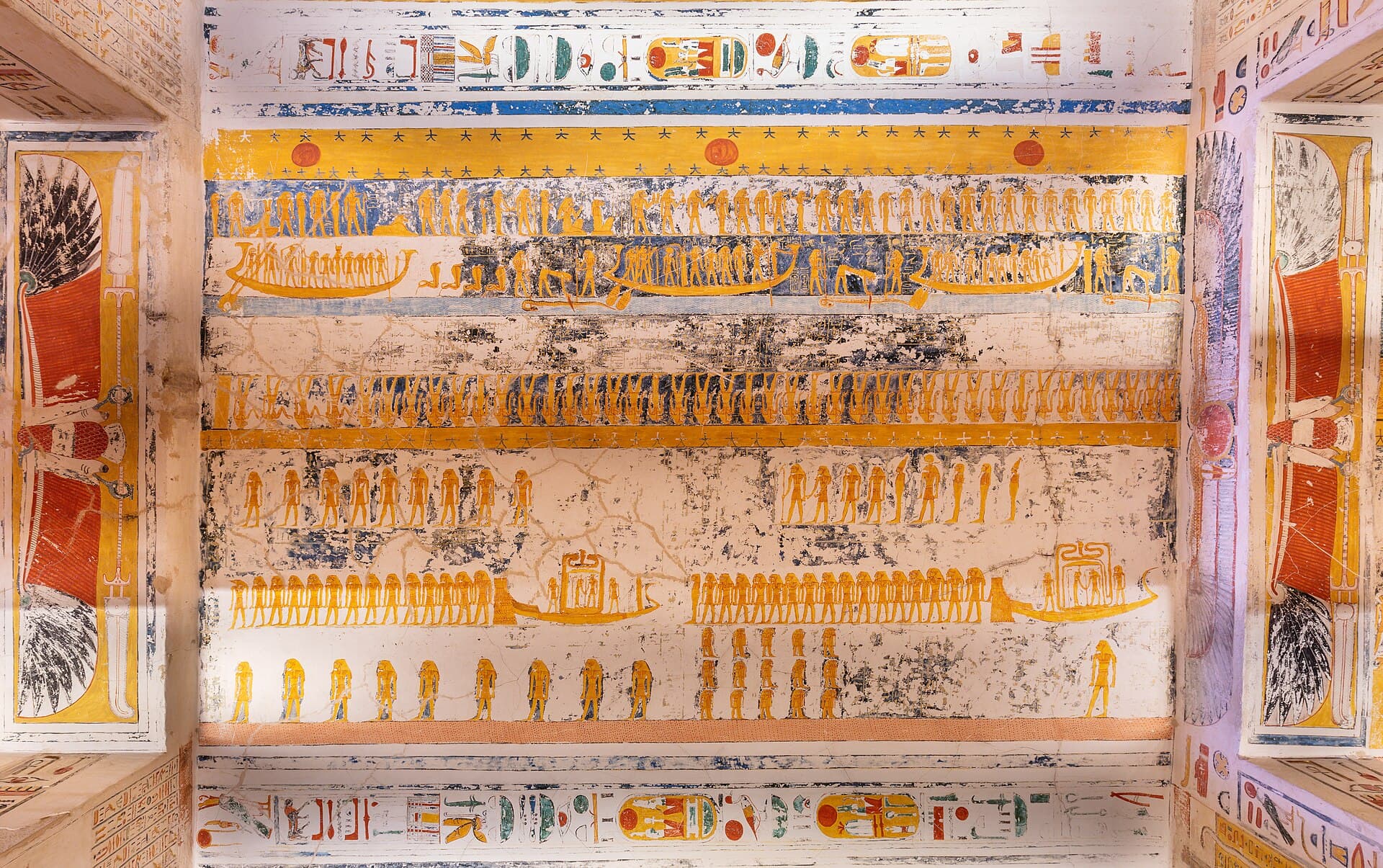
The walls follow the sun god through the night to his rebirth at dawn. The first corridors carry the Book of Gates, the Book of Caverns and the Books of the Heavens. Further in come scenes from the Amduat and the Book of the Dead. Scenes from the Book of the Earth cover the burial chamber. Every ceiling has astronomical scenes and texts. Save time for the burial chamber ceiling. Two figures of the sky goddess Nut lie back to back there, framing the Book of the Day and the Book of the Night.
KV9 needs its own ticket on top of the general entry. The ministry's page for the tomb lists EGP 220 for foreign adults and EGP 110 for foreign students (egymonuments.gov.eg, checked October 2026). Prices change, so confirm the figure at the ticket window. The decoration details above come from the ministry and the Theban Mapping Project.
Can you take photographs inside the tombs?
Yes, in most tombs, with a photography ticket bought at the entrance. The rules on what needs a ticket have changed more than once, so ask at the window whether your phone is covered or only cameras. No flash, no tripods, and nothing resting on the walls or the glass. Seti I, Tutankhamun and Nefertari are handled separately and have at times banned photography outright or charged their own permit.
Tomb guards will sometimes lift a rope, point a torch at a detail, or offer to take your picture in a spot you are not meant to stand in. They expect a tip for it. You are free to say no, politely and firmly, and nothing bad happens. If you accept, small notes are the norm; carry some.
Why does going early matter so much?
Heat and coaches. The site opens early, around 6am, and the first tour groups arrive from roughly 8. The tombs are cut into rock with no airflow. Inside, they are hotter and closer than the open valley, which itself reaches around 40C on a summer afternoon. A corridor that is pleasant at 6.30 is unpleasant by 10.
Walk past the first tombs and start at the far end of the valley, then work back. Everyone else does the opposite, so you get the deep tombs to yourself for half an hour. Three tombs plus one paid extra takes about two and a half hours. Most people pair the morning with Hatshepsut's temple and either Medinet Habu or the Ramesseum, and are back for lunch.
Is a guide worth paying for in the Valley of the Kings?
Guides are not allowed to give commentary inside the tombs. They brief you outside, at the shaded panels near the entrance, then you go in alone. That surprises people who have paid for one. It still helps: a good Egyptologist guide will tell you what to look for in each corridor and steer you away from the tombs that are not worth your three choices that day.
What a guide cannot do is get you in faster or cheaper. Tickets are fixed price at the window, and there is no queue-jumping. If you are on a trip we arrange, the guide and the west bank driver are booked for you, and the tickets are bought on the morning by whoever is with you.
Why did the pharaohs bury themselves here?
The valley is the answer to a problem the pyramids created. A pyramid is a signpost: it tells every robber in the country exactly where the treasure is, and the Old Kingdom royal tombs were emptied within a few generations of being sealed. The New Kingdom kings, from around the sixteenth century BC onward, tried the opposite approach. They cut their tombs into a remote desert valley behind the Theban cliffs, out of sight, and hid the entrances rather than marking them.
It did not work either, but the setting explains a great deal about what you see. A natural, roughly pyramid-shaped peak stands over the valley, which some read as the reason this particular bay was chosen: the pharaohs got their pyramid symbol without having to build one. The valley sits directly over the ridge from Hatshepsut's mortuary temple at Deir el-Bahari, close enough that the two are a short drive apart but sealed off from each other by rock.
The men who did the work lived over the next ridge, at Deir el-Medina, a purpose-built village of tomb-cutters, draughtsmen and painters. The same hands worked the Valley of the Kings and the Valley of the Queens, generation after generation, and their own tombs and records survive well enough that we know their names, their pay disputes and their days off. The tombs carry KV numbers, assigned roughly in the order they were recorded, which is why a low number like KV2 sits beside a high one on the same path.
What is actually painted on the walls?
Not decoration in the ordinary sense. The walls are covered with funerary texts: hour-by-hour accounts of the sun's journey through the twelve hours of the night and the king's passage alongside it, back to sunrise and rebirth. They are dense, repetitive and were never meant to be looked at by the living. Read a corridor as a sequence rather than a gallery and it starts to make sense; treat it as a picture book and it will not.
The medium changes what survives. Where the limestone is good, as in much of the Valley of the Kings, the scenes are cut in relief and then painted, so the outline holds even where the colour has gone. That is the main difference from the Valley of the Queens across the ridge, where poorer rock forced the craftsmen to plaster and paint flat, and where the painting is the whole of it. Ceilings are the thing most people miss: several tombs carry a deep-blue night sky studded with yellow stars, and Ramesses V/VI has a full astronomical ceiling with the sky goddess Nut arched over the chamber, swallowing the sun each evening and giving birth to it each morning.
Colour is not evenly spread. Some corridors are bright and legible; others are soot-blackened, salt-damaged or simply unfinished, because a king who died early got the tomb his workmen had reached, not the one they had planned. This is why the day's open list matters more than the famous name attached to it. A well-preserved lesser king can be a better twenty minutes than a celebrated one whose walls are half bare.
How were the tombs found, and where did everything go?
Almost every tomb here was robbed in antiquity, often within decades of the burial and sometimes by the same community that built it. The priests of a later period gave up defending individual tombs and instead gathered the royal mummies into a couple of hidden caches, rewrapped and relabelled, where they lay until the nineteenth century. That is why the valley today is architecture and painting rather than treasure: the gold left long ago, most of it stolen and melted, the rest recovered piecemeal.
The exception is the one everybody knows. Tutankhamun's tomb, KV62, was found nearly intact by Howard Carter in 1922 because it was small, quickly sealed, and buried under the spoil of a later tomb cut above it. It is the reason the valley is a household name, and also the reason so many visitors are let down by it: the tomb itself is modest, and the thousands of objects that made it famous are no longer in it.
Where those objects are now is worth knowing before you go, so you do not travel expecting them here. Most of the royal mummies are in the National Museum of Egyptian Civilisation in Cairo. Tutankhamun's grave goods have moved to the Grand Egyptian Museum near Giza. His own mummy remains in KV62. In short, the tombs are a day's travel south of the objects that came out of them, and the visit is about the walls and the spaces, not the contents.
Getting there and moving around the site
The valley is on the west bank, reached from the east-bank hotels in about 30 to 45 minutes by road over the bridge south of town. The passenger ferry across the Nile plus a taxi on the far side is cheaper and slower. There is no useful public transport between the west bank sites, which are spread across several kilometres of desert edge, so nearly everyone goes by car with a driver for the morning.
At the site itself, a large car park and a modern visitor centre sit at the mouth of the valley. Tickets and photography permits are bought here, and a scale model under glass is the one place you get an overview of how the tombs honeycomb the rock. From the centre a small electric train shuttles the last stretch up to the tomb area for a few pounds; the walk is about ten minutes and shadeless, which is a real consideration in the middle of the day.
Facilities are basic. There are toilets, for which you want small notes, and a few sellers near the entrance; there is nothing worth eating on site. The ground between tombs is uneven and dusty, most tomb entrances mean a ramp or steps down and the same climb back, and the deeper tombs are a genuine descent. Sensible shoes matter more here than at the temples.
How does it fit into a West Bank day?
Heat sets the order, not distance. Start at the Valley of the Kings the moment it opens, before the coaches and before the tombs warm up. Go to Hatshepsut's temple second, understanding that its cliff-backed terraces are the hottest place on the west bank and only get worse as the morning builds. The Colossi of Memnon, two seated statues of Amenhotep III at the roadside, are a five-minute stop you pass anyway rather than a site to plan around.
After those three, the west bank rewards whatever you have appetite left for. Medinet Habu, the great walled temple of Ramesses III, keeps colour on its ceilings and gives you shade the open sites do not. The Ramesseum, the Valley of the Queens, Deir el-Medina and the tombs of the nobles are all within a five- to fifteen-minute drive. The honest limit is attention, not opening hours: by the fourth temple most people have stopped looking, and two sites seen properly beat four glanced at.
If a Nefertari ticket for the Valley of the Queens is on your list, go there early too, because the daily allocation can be gone by mid-morning. Otherwise, build the day around the Kings and Hatshepsut, keep the middle of the day for lunch and rest, and treat anything after noon in summer as optional. A hot-air balloon flight over the west bank, if you are doing one, comes before all of it, at dawn, and lands in time to start the tombs.
When in the year should you visit?
Season matters as much as the hour of the morning. November to February is comfortable, with warm days and cool starts, and this is when the west bank is most pleasant to walk. March and October are manageable if you begin early and are finished by late morning. May to September is severe: the open valley passes 40C in the afternoon, and the sealed tombs are hotter and closer still, so in high summer the early start stops being about avoiding crowds and becomes about not making yourself ill.
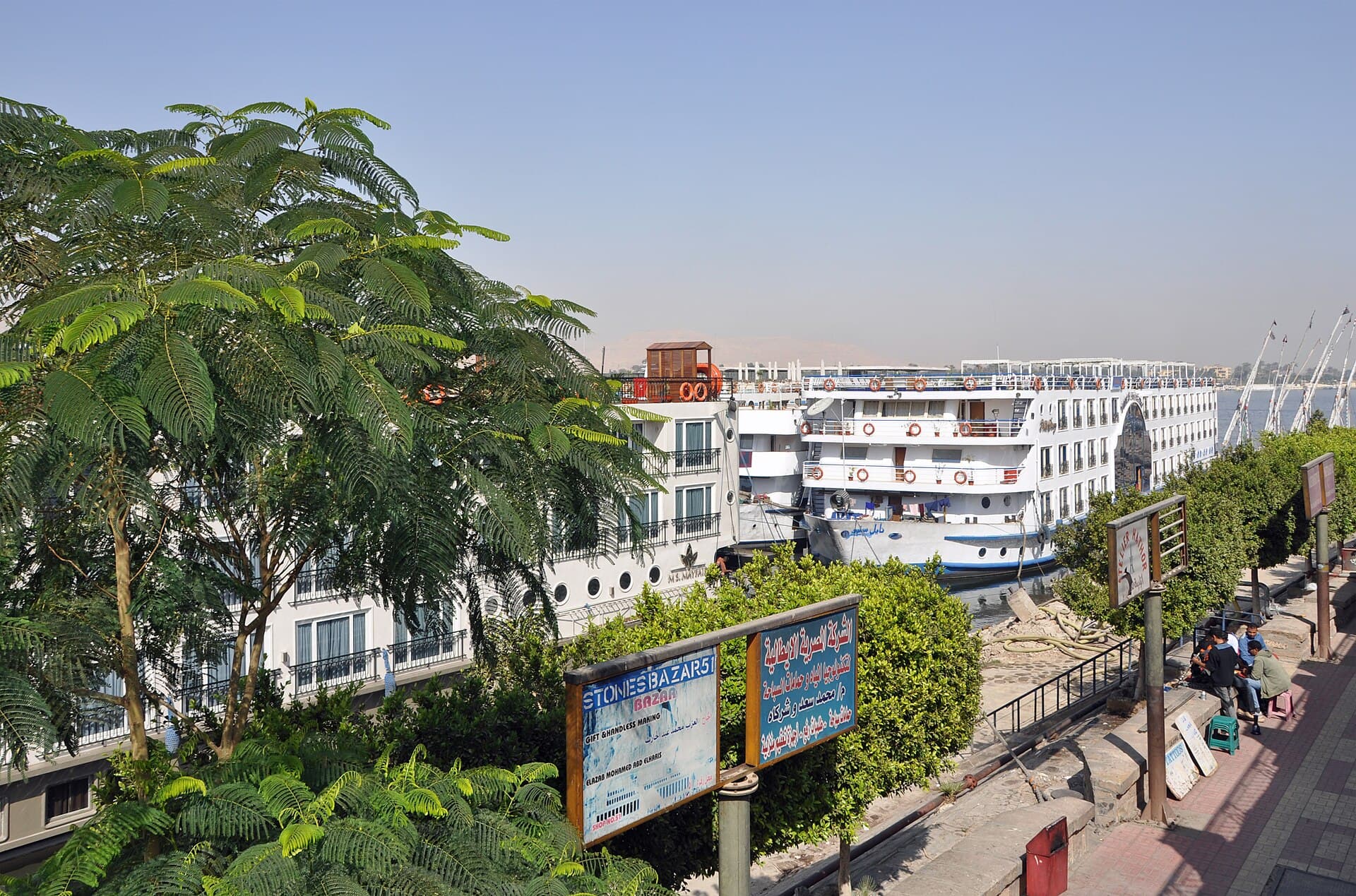
Crowds track the Nile cruise schedule more than the calendar. When several boats are moored at Luxor at once, the valley and Hatshepsut fill by mid-morning regardless of season, and when few are in you can have deep tombs almost to yourself. There is no published timetable you can plan around, which is another argument for arriving at opening: the first hour is quiet whatever the boats are doing. If you land in peak winter weeks around the turn of the year, expect company and get there earliest of all.
What do most visitors get wrong?
They arrive late, and it costs them the site. By mid-morning the tombs are hot, the walk from the visitor centre is punishing, and the good light that rakes across the carving has gone flat. The single change that most improves a visit is being at the gate when it opens, not an hour or two after.
They also come expecting treasure and leave disappointed, because the gold and the grave goods left the valley long ago; what remains is architecture and painted text, and it rewards a reader more than a treasure-hunter. And they spend their three tombs on the famous names without checking condition, when the day's best-preserved tomb is often a lesser king. Ask what is in good order that morning, spend your choices there, and add one paid tomb only if a specific wall or ceiling is the reason you came.
Common questions
Where are the mummies and the Tutankhamun treasures now?+
Almost all of the royal mummies were moved to the National Museum of Egyptian Civilisation in Cairo, and Tutankhamun's grave goods are at the Grand Egyptian Museum near Giza. His own mummy stays in KV62. So the tombs at Luxor are architecture and wall painting; the objects are a day's travel north.
Do you need to book tickets in advance?+
No. Everything is sold on the day at the site, and it does not sell out. The risk is not availability but closure: individual tombs shut for conservation without notice, sometimes for months. If one specific tomb is the reason you are going, check its status a few days before rather than assuming.
How hard is it if you have limited mobility or claustrophobia?+
Harder than most sites. The ground is uneven, and every tomb means a sloping ramp or steps down and the same climb back. Ramesses IV is short and close to level, which makes it the usual choice. Seti I is a long, steep descent. The corridors are wide but airless, which bothers some people more than the depth.
How long does it take to get there from Luxor?+
About 30 to 45 minutes by road from the east bank hotels, crossing at the bridge south of town. The passenger ferry plus a taxi on the other side is cheaper and takes longer. Almost everyone goes by car with a driver, because the west bank sites are spread out and there is no useful public transport between them.
Which tomb should you choose if only the standard ones are open?+
Ramesses III (KV11) if it is on the day's list: it is long, richly painted and the most rewarding of the tombs the general ticket covers. Failing that, Ramesses IX and Merenptah are both worth a choice. Ramesses IV is the fallback for anyone who wants a short, near-level tomb rather than a deep descent. Ask at the window which of your options are best preserved that day, because condition varies more than fame.
Is the Valley of the Kings suitable for children?+
In the cool months and in short bursts, yes, but manage expectations. The tombs are dark corridors of religious text, not a museum with objects, and small children tire of them quickly. Heat, steps and dust are the real limits. Bring water, go early, and plan on two or three tombs rather than a full morning underground.
Can you visit independently, or do you need a tour?+
You can visit independently; there is no requirement to be with a guide, and tickets are bought by anyone at the window. What you cannot easily do is get around without transport, since the west bank sites are far apart and buses do not serve them usefully. Most independent visitors hire a car and driver for the morning and buy their own tickets, which keeps costs down while solving the logistics.
How does it compare with the Valley of the Queens?+
The Kings has long, deep, relief-carved tombs of pharaohs; the Queens has smaller, plaster-painted tombs of royal wives and children. If you can fit only one valley into a trip, go to the Kings. The Queens is the better visit only if you hold a Nefertari ticket, whose painted walls are the finest on the west bank and priced to match.
What is the tomb of Ramses VI (KV9), and is it worth the extra ticket?+
KV9 was begun by Ramesses V and enlarged by his uncle Ramesses VI, who was buried in it. Its corridors carry the Book of Gates and other books of the afterlife. On the burial chamber ceiling, two figures of the sky goddess Nut lie back to back. It needs its own ticket: the Ministry of Tourism and Antiquities lists EGP 220 for foreign adults (checked October 2026). Of the three paid extras, it gives the most for the money.
Official sources
Entry rules, opening hours, security advice and exchange rates all move. Check them at the source, not here.
Written and checked by the Nile Trip Guide editorial team · Last reviewed . Entry rules, prices and opening hours change — check anything critical against the official sources linked on this page.
The route most people take first, at the length it was built for: Giza and the Grand Egyptian Museum, then a flight to Luxor and four nights sailing down to Aswan.
No boat on this one. Giza and the Grand Egyptian Museum, a night in Luxor for both banks, two nights on the Red Sea, then back to Cairo for the Citadel, Coptic Cairo and the Royal Mummies.
Five nights in Cairo either side of a four-night sail from Luxor to Aswan. The Cairo days are private, just your party and a guide; the sightseeing off the boat is shared with a small group.