Luxor Temple sits in the middle of a working Egyptian town, a short walk from the corniche, and it is the one major pharaonic site you can reach on foot after dinner. It is smaller than Karnak and far easier to read in a single visit. It is also one of the few ancient sites in Egypt that is genuinely better after dark.
What is Luxor Temple?
Luxor Temple is a New Kingdom temple on the east bank of the Nile, begun under Amenhotep III around 3,400 years ago and extended by Ramesses II roughly a century later. It stands in the centre of modern Luxor, hemmed in by the corniche on one side and the town on the other. It was dedicated to Amun in a particular local form, Amenemopet, but what shaped the building was less the daily cult than a single annual festival.
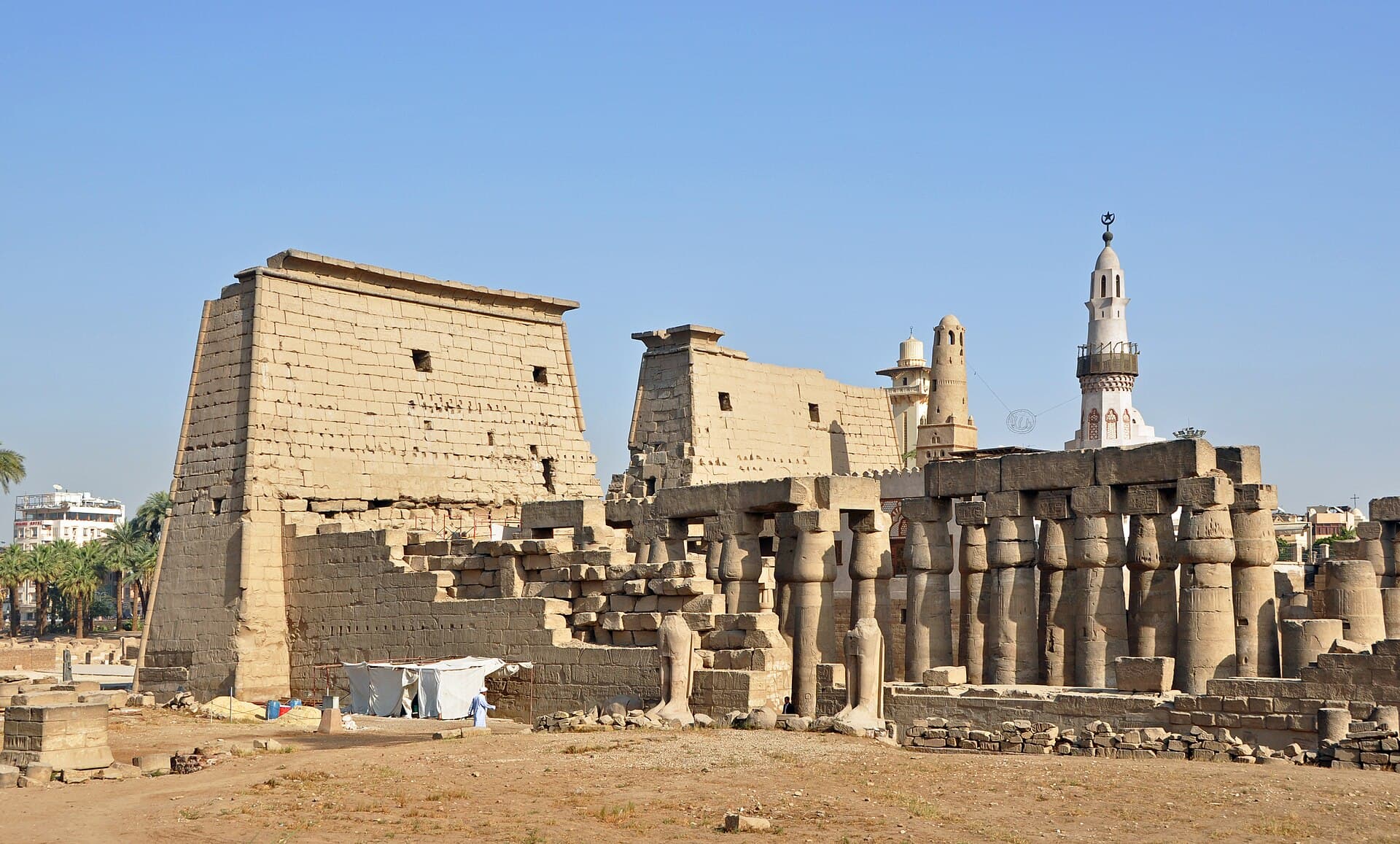
The layout is straightforward and that is part of its appeal. You enter through the pylon of Ramesses II into his open court, pass down a colonnade of enormous columns, cross the sunlit court of Amenhotep III, and end in a cluster of dim inner rooms. One axis, one direction, no maze. After Karnak, where visitors routinely get lost and give up, the clarity is a relief.
The ancient name for the place translates as something like the southern sanctuary, and that is the most useful thing to hold in your head. It was the southern counterpart to Karnak, two and a bit kilometres up the road, and it was never meant to be understood on its own. The two buildings were a pair, joined by a road and by a procession, and a visitor who sees one without the other has read half a sentence.
Where it is, and how to reach it
The temple sits directly behind the corniche in the centre of town, with the Nile on one side and the souq and the main hotel strip on the other. Almost every east bank hotel is within a fifteen-minute walk, and that is the point of it. Unlike every other major site around Luxor, you do not need a driver, a guide or a departure time. You need shoes.
If you are staying on the west bank, the local ferry crosses in a few minutes for the price of a coffee and lands you close to the temple, which makes an evening visit realistic even from over the river. Private motorboats do the same crossing on demand for more. The road bridge is several kilometres south of the centre, so crossing by car costs twenty to thirty minutes each way and is worth avoiding for a short evening trip.
Caleche drivers work the corniche hard and will offer to take you the short distance from the hotels to the gate. It is a pleasant enough way to arrive if the horse looks well kept. Agree the price and the route before you get in, and be clear whether the figure is per person or for the carriage, because that ambiguity is where nearly every argument starts. Walking is usually faster anyway.
Who built what, and why the front half is crooked
Two kings account for nearly everything you see. Amenhotep III built the back of the temple: the inner sanctuaries, the hall in front of them, the elegant sun court with its double rows of columns, and the great colonnade that leads to it. That is the older, better-proportioned half, and it is the half most visitors walk through fastest because it comes after the drama at the front.
Ramesses II built the front: the pylon, the colossi, the obelisks and the large open court behind them. His work is bigger, louder and less refined, which is a fair summary of his building programme everywhere in Egypt. He also had his own name cut deeply into stone across the site, a habit that makes Ramesside work easy to identify and hard to like.
Stand in the middle of the temple and look back along the axis and you will notice the front court is not square to the rest of the building. It bends. The usual explanation, and the one most Egyptologists accept, is that the earlier shrine standing in the north-west corner of that court was already there and was not to be moved, so the new court was set at an angle around it. That small triple chapel is a way-station, a place where the sacred barques rested during the procession, and it is older than everything Ramesses put around it.
It is worth ten seconds of your attention because it tells you something true about Egyptian building: these were not monuments raised once and left alone, but working religious machines, adapted, extended and worked around for centuries by people who had to keep the rituals running while the builders were in.
What was it actually for?
It was built around the Opet festival. Once a year the cult statue of Amun left Karnak for Luxor Temple, by water or along the processional road depending on the period, in rites that most Egyptologists read as a renewal of the king's divine aspect and so of his right to rule. That changes what you look at. The reliefs along the great colonnade are not decoration but a frame-by-frame record of the procession, crowds and musicians included.
The festival grew as Egypt's confidence in it grew. In the earlier New Kingdom it ran for a matter of days; by the Ramesside period it had stretched to weeks, with bread and beer distributed to the crowds at royal expense. This was the state advertising itself. A king whose rule was renewed in public, in front of a city that had been fed for the occasion, was a king who had been seen to be legitimate.
That also explains the shape of the building. A temple built for a once-a-year arrival needs a processional route more than it needs working space, which is why Luxor Temple reads as a long corridor with rooms at the end rather than as the sprawling institution Karnak became. The great colonnade is not a hallway between two parts of a temple. It is the point of the temple.
A walk through, front to back
From the entrance you come first to the pylon of Ramesses II, with the Kadesh reliefs across it and the colossi and the surviving obelisk in front. Give it five minutes from a distance before you go through, because the facade is designed to be seen from further back than the modern path allows.
Through the gate you are in the Ramesses court, a rectangle of double columns with statues of the king between them, the mosque high in the eastern wall, and the older barque shrine tucked into the far corner. This is the busiest part of the site and the part group tours stop in longest, so if it is crowded, walk on and come back to it later.
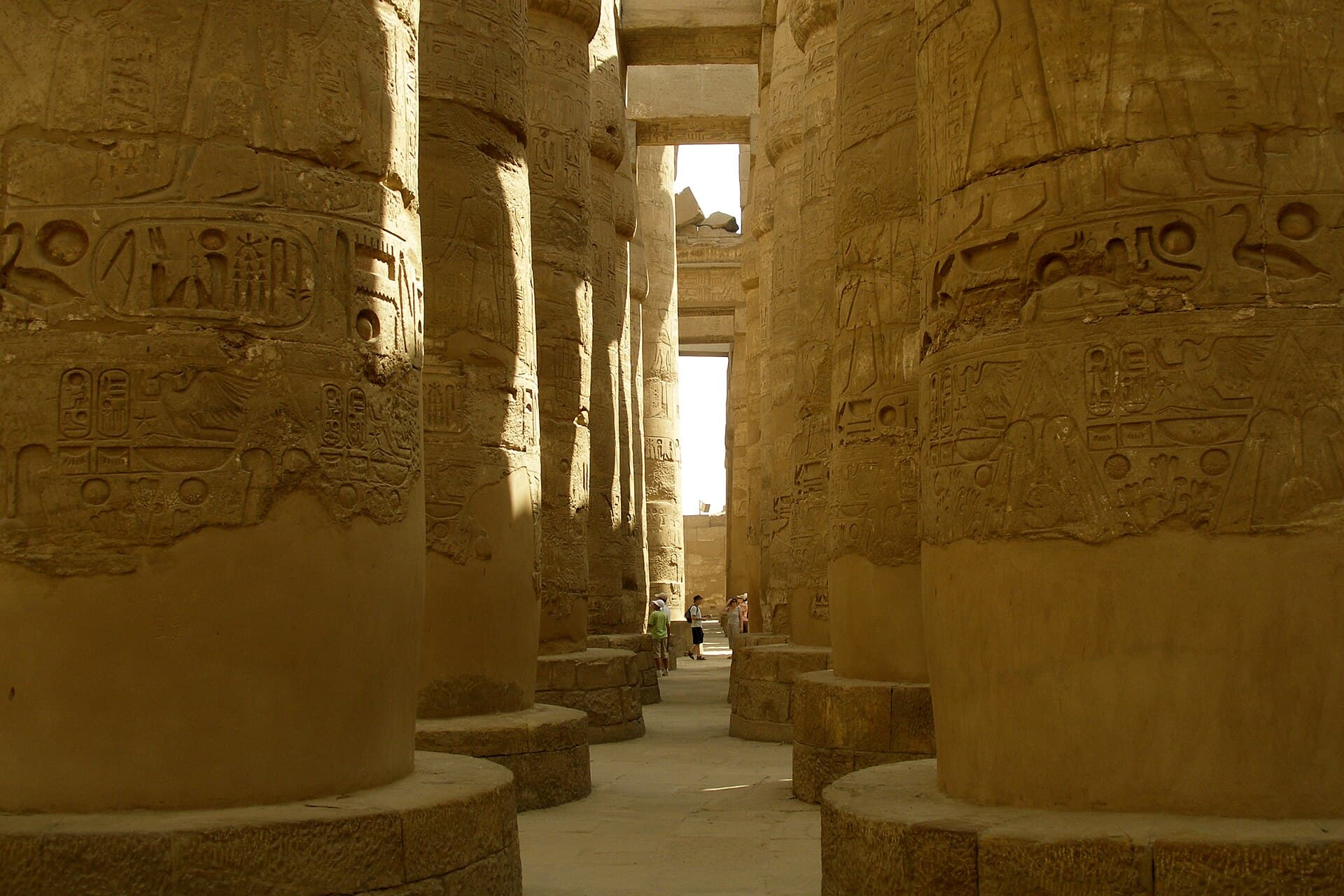
Next is the great colonnade: fourteen columns in two rows, roughly twenty metres tall, with open papyrus capitals. Look at the walls on either side rather than up at the columns. The Opet procession runs along them in both directions, out to Luxor on one wall and back to Karnak on the other, with boats, soldiers, dancers, acrobats and cattle being driven to sacrifice. It is the liveliest carving in Luxor and most people walk through it in ninety seconds.
Beyond that is the sun court of Amenhotep III, open to the sky and ringed on three sides by columns, the best-proportioned space in the building and the best place to sit. Then a hall of columns, then the inner rooms: the offering chapel, the barque shrine rebuilt in the time of Alexander the Great with its own free-standing chamber inside the older sanctuary, the birth room to one side, and the Roman chamber with its painted plaster.
That is the whole route. There are no wings and no detours, which is why the site suits people who dislike being managed around a monument. If you lose the thread, walk back to the centre line and carry on in the direction you were going.
The birth room, and why a king needed one
Off the inner part of the temple is a room carved with the divine birth of Amenhotep III: the god Amun visiting the queen, the child being formed, the newborn presented to the gods and nursed. It is a claim, not a memory. The king is asserting that he was fathered by the god himself and was therefore not merely appointed to the throne but born to it.
That claim is the reason the room is in this particular building. Luxor Temple was where kingship was renewed each year, so the argument for the king's divine origin belonged here rather than at Karnak. It also explains why later rulers kept adding their names to the temple. Whoever controlled the Opet procession controlled the ceremony that made a pharaoh legitimate, and nobody gave that up willingly.
The carving is fine but the room is small, dim and easy to miss, and it comes at the end of the visit when attention is usually gone. If it matters to you, do the inner rooms first and work backwards against the flow. The site is small enough that reversing the route costs you nothing.
How is it connected to Karnak?
By a paved processional way lined with sphinxes, running roughly 2.7 kilometres between the two temples. Most of the sphinxes you see date from the reign of Nectanebo I, around a thousand years after building first began at Luxor, though the route itself is far older. The ones along the Luxor stretch have human heads; the rams' heads belong to the Karnak end. The avenue was excavated in stages over decades and formally reopened in 2021.
Walking the whole avenue sounds better than it is. It is a sunken corridor below street level with no shade, the same sphinx repeated several hundred times, and few exits. In cool weather, early, it is a fine walk of well under an hour. In anything above mild heat it is a slog. Access points have changed since it reopened, so check locally which gates are open before you commit to it on foot.
There is a middle option most people do not consider. Walk the first two or three hundred metres from the Luxor Temple end, which is where the avenue is best preserved and where you get the sense of approach the ancient route was built for, then turn round. That takes ten minutes, costs nothing and gives you nine tenths of what the full walk gives you.
Why is there only one obelisk?
The front of the temple is Ramesses II announcing himself. A huge pylon carved with his account of the battle of Kadesh, a stalemate he presented everywhere as a triumph, seated and standing colossi of the king, and originally a matched pair of obelisks. Only one still stands, around 25 metres of pink granite. The other was taken down in the 1830s, a gift to France from Egypt's Ottoman viceroy Muhammad Ali, and re-erected in the Place de la Concorde in Paris. France gave up its claim to the remaining one in 1981.
Look at ground level while you are here. The pair were not quite the same height, and the way they were set up compensated for that, so they read as equals from the approach. It is a small piece of stagecraft that most people walk straight past. Stand back on the corniche side too, for something closer to the view an ancient visitor got arriving from the river rather than through a ticket gate.
The Kadesh reliefs on the pylon repay a few minutes as well, provided you read them as propaganda rather than reporting. The battle was fought against the Hittites in what is now Syria, it ended without a clear winner, and it produced one of the earliest surviving peace treaties between two states. None of that appears on the wall. What appears is the king alone in his chariot, enormous, scattering enemies. It is the oldest kind of press release.
Why is there a mosque inside the temple?
The Mosque of Abu al-Haggag sits on top of the Ramesses court, its door hanging in mid-air several metres above the paving. That is not a design choice. For centuries the temple was buried in the debris of the town built over it, and the mosque was constructed at what was then ground level. When archaeologists dug the court out in the nineteenth and twentieth centuries, they left the mosque where it stood.
This is the most interesting thing about the site and the thing tour groups skip. The same building has been a pharaonic temple, a Roman military headquarters with a painted imperial cult chamber, a Christian church, and a mosque that is still in use. You can see traces of all of it. Look for the Roman wall paintings in the chamber beyond the sun court, and the Christian and later reuse around the first court. Few places anywhere carry that much religious history in one footprint.
The mosque honours a medieval holy man buried there, and it is not a museum piece. People pray in it daily and have done so for something like eight hundred years, which is longer than most European cathedrals have been standing. Clearance of the temple below began in the 1880s and went on in stages for decades, and at every stage someone had to decide what to keep. Leaving the mosque suspended over the excavated court was, on any reading, the right call.
The Roman chamber most visitors walk past
In the late Roman period the temple was enclosed within a legionary fortress, and the army converted a hall near the sanctuary into a chamber for the imperial cult. The Egyptian reliefs on the walls were plastered over and painted with figures of the emperors, and a niche was cut at the end of the room. For a long time the paintings were barely visible under grime and later damage; conservation work has since made them legible again.
It is a strange thing to stand in. On one wall you can see Roman paint and, where it has fallen away, pharaonic carving underneath, separated by well over a thousand years and occupying the same square metre of stone. Nowhere else in Luxor puts the layers of Egypt's history quite so bluntly in front of you.
It is also the single easiest thing to miss, because it sits past the point where most guided groups turn round and because it does not look like much at a glance. Ask specifically to be shown it. If you are visiting without a guide, work through the inner rooms slowly and look for painted plaster rather than carving.
The statues found under the floor
In 1989 a cache of statues was found buried beneath the paving of the sun court: more than twenty pieces, laid down in antiquity in a pit and left there, in remarkable condition because they had never been exposed. The best of them is a quartzite figure of Amenhotep III, and it is one of the finest New Kingdom sculptures anywhere.
Why they were buried is not fully settled. The likeliest reading is housekeeping rather than crisis: temples accumulated votive statues over centuries, they could not be thrown away because they were sacred, and so they were buried respectfully on site. Whatever the reason, it means the temple was still yielding major finds within living memory, which is worth remembering when a guide tells you everything here has been known for two hundred years.
The statues are not in the temple. They are in the Luxor Museum, a short walk north along the corniche, which is small, well arranged, properly lit and under-visited, and which takes about an hour. Pairing the two makes a good late afternoon: the museum while the heat is still up, the temple once the lights come on. It is the most sensible use of an afternoon in Luxor that almost nobody plans.
Is Luxor Temple better after dark?
Yes, and it is not close. The floodlighting is low and angled, so carving that reads as grey noise under a midday sun becomes legible after dark. The columns of the great colonnade, roughly twenty metres tall, finally look like what they were built to be. The town noise drops away. In summer, night is also the difference between a pleasant hour and real discomfort.
Two honest caveats. There is no sound-and-light show here; that is at Karnak, and it divides people. And closing times shift with the season and with Ramadan, so confirm the evening hours locally on the day rather than trusting a schedule you found online. Photography is also harder at night than most people expect. Bring something that handles low light, or accept what a phone gives you.
A third, smaller point. The inner rooms are dim in daylight and dimmer at night, and the painted Roman chamber in particular loses detail once the sun is off it. If those matter to you, go once in the late afternoon and once after dark, or accept that the evening visit is about the big spaces rather than the fine work at the back.
How long should you allow?
Ninety minutes is right for most people. An hour if you are moving briskly and not reading much. Two hours if you want the reliefs, the mosque, the Roman chamber and time to sit. It is a compact site with one route through it, so there is little risk of missing a wing. Beyond two and a half hours you are looking at the same stone twice, unless you are photographing seriously.
For comparison, Karnak needs two to three hours to be done properly and rewards three. That difference is the whole reason the two temples belong at opposite ends of the same day rather than side by side in the same morning. Luxor Temple is the short, sharp one. Treat it as the evening's entertainment rather than another item on a sightseeing list and it works far better.
Tickets, hours and money
Tickets are sold at the gate. Prices in Egypt move with the pound and with periodic official increases, so treat any figure you find online, including on the operator sites, as approximate rather than current. Egypt has been pushing its major sites towards card payment, but terminals fail and machines go offline, so carry a card and enough cash to cover entry for everyone in your party.
Opening hours are long, typically from early morning until well into the evening, but the closing time changes with the season and during Ramadan, when much of the country's schedule shifts. Confirm the evening hours on the day, at the gate or through your hotel, rather than relying on a printed schedule. Arriving at half past eight for a nine o'clock closing is not an evening visit.
Photography is permitted and phones are fine. Tripods generally need a permit, and drones are not something to attempt anywhere near a site of this kind. Vendors work the approach to the gate rather than the inside, and a firm, polite no ends the conversation. There is no useful cafe inside, so bring water in daylight hours.
Karnak and Luxor Temple on the same day, or split them?
Do both on the same day, but not back to back. Karnak in the early morning when the light is low and the coaches have not arrived, then a long break through the heat of the day, then Luxor Temple in the evening. That is the best-value day in Luxor and it costs nothing extra. The common mistake is Karnak at nine and Luxor Temple at eleven, which gives you two hot hours and temple fatigue by the second gate.
If you have three or more days on the east bank, splitting them is defensible. Karnak deserves a slow morning of its own, and visiting Luxor Temple twice, once in daylight to read the plan clearly and once at night, is a better use of an afternoon than most of the day trips on offer. Whether a single ticket allows re-entry is worth asking at the gate before you plan on it.
The order matters more than the gap. Karnak first gives you the enormous, confusing version of an Egyptian temple, and Luxor Temple afterwards reads as the clear, legible one. Do it the other way round and Luxor Temple looks modest, because you have not yet seen the thing it is a smaller and better-organised answer to.
If you are arriving on a Nile cruise
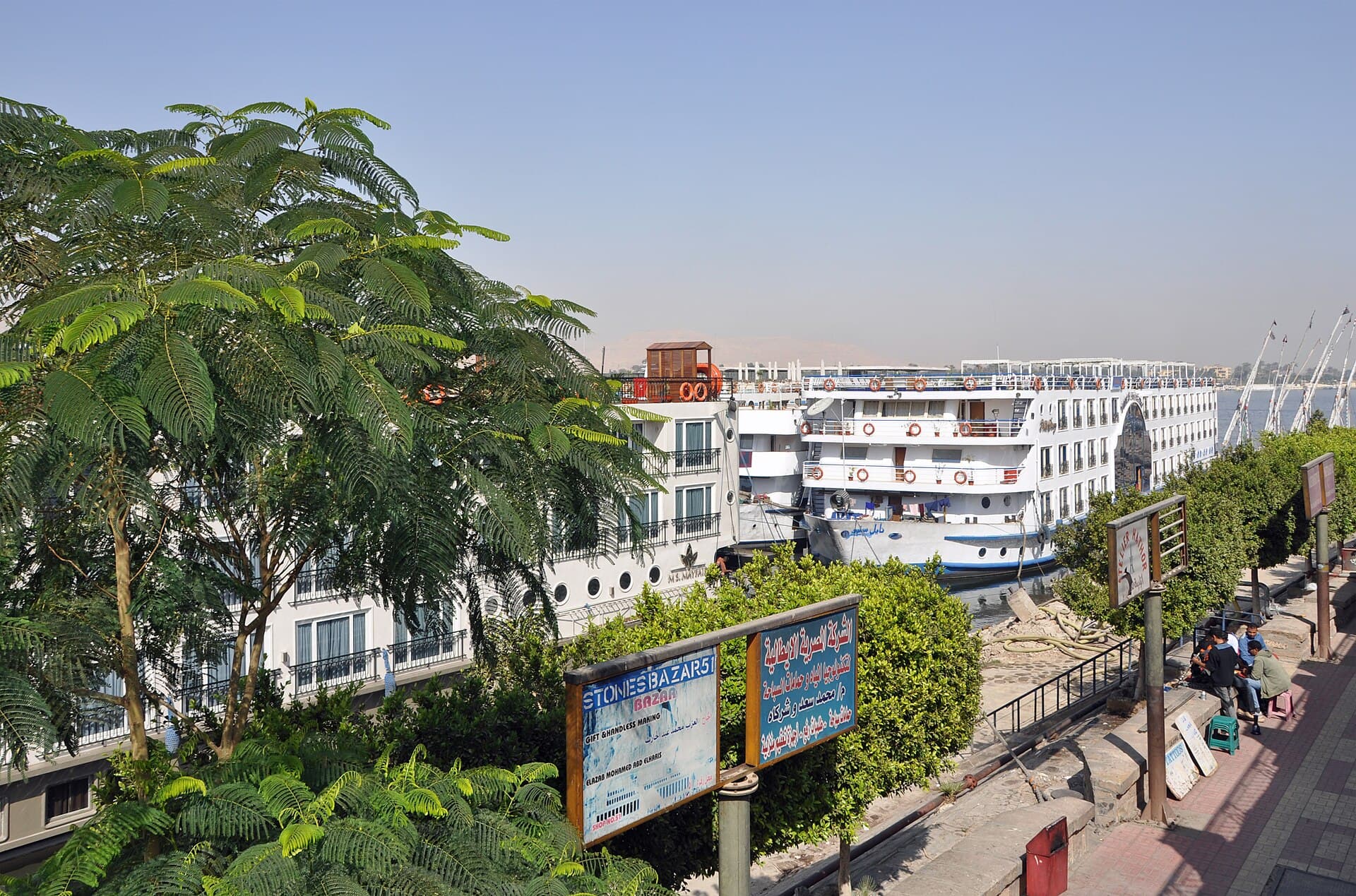
Cruise boats moor on the east bank, often rafted several deep, and Luxor is either the first stop of the itinerary or the last. That usually means one compressed west bank morning, Karnak with a group and a departure time, and evenings on board. Luxor Temple tends to be the item that gets dropped, or squeezed into forty minutes in the heat between two other things.
It does not have to be. The temple is within walking distance of most moorings, it is open in the evening, and the boat is not going anywhere overnight. Skipping the on-board entertainment and walking ten minutes to a floodlit temple is the single best decision available to a cruise passenger in Luxor, and it costs the price of one entry ticket.
The one thing to check before you plan on it is your boat's own schedule for the evening in question, particularly on an arrival or departure night when there may be a briefing, a set dinner time or an early start the next morning. Ask the cruise manager rather than assuming, and confirm the temple's closing time separately.
Where it fits in two or three days in Luxor
Two full days is the working minimum for Luxor: one west bank morning for the tombs and Hatshepsut, one east bank afternoon and evening for Karnak and Luxor Temple. On that plan Luxor Temple is the last thing you do on the second day, after dark, which is exactly where it belongs. It is also the right thing to do on an arrival evening if you get in late and have energy left.
Three days is the comfortable number and gives Luxor Temple room to be visited twice. The extra day usually buys the Valley of the Queens or Deir el-Medina, an hour in the Luxor Museum, and a slower pace through the heat. Medinet Habu is the west bank temple most worth adding if you have the appetite for one more.
One day in Luxor means choosing ruthlessly, and the honest answer is that Luxor Temple survives that cut better than most things do. Three tombs and Hatshepsut before nine, a long break, Karnak in the late afternoon, Luxor Temple after dark. It is a hard day, but it is a coherent one, and it ends with the best hour of it.
When to go, and what most visitors get wrong
November to February is the comfortable season and the busy one. March and October are workable. June to August is brutal in daylight, which is exactly when the evening visit stops being a nice idea and becomes the only sensible one. Ramadan shifts opening patterns across the country, so check the dates before you build an evening around them. Cruise-boat schedules also bunch arrivals, so a temple that is quiet at eight can fill by ten.
The mistakes are predictable. Treating it as a forty-minute stop between Karnak and lunch. Going only in daylight. Missing the mosque entirely because it sits above your eyeline. Being hurried through the inner rooms, where the barque shrine rebuilt under Alexander the Great and the Roman paintings are, because the guide is already walking back. And taking a caleche along the corniche without agreeing the price first, which is a small thing that reliably becomes an argument.
One more, less often named: reading nothing before you go. Luxor Temple explains itself less than its scale suggests, the signage is thin, and the parts that make it remarkable are the parts that look ordinary. Twenty minutes of preparation, or one good guide, is the difference between a floodlit hour you remember and a pleasant walk among large columns.
Common questions
Can you go inside the mosque of Abu al-Haggag?+
It is a working mosque with its own entrance from the street outside the temple, not from the excavated court, so a temple ticket does not get you in. Non-Muslim visitors are sometimes welcomed outside prayer times, dressed modestly, and sometimes not. Ask at the door rather than assuming either way, and accept the answer you get.
Do you need a guide at Luxor Temple?+
Less than at Karnak. There is one route and you cannot really lose it. But the Opet reliefs in the colonnade and the Roman chamber mean very little without someone to explain them, and most visitors walk past both. A good guide is worth more here for the meaning than the navigation, which is the opposite of how guides are usually sold.
Is the site manageable with limited mobility?+
Partly. The ground is ancient paving, uneven in places, and there are steps between levels as you move towards the inner rooms. The first court and the great colonnade are reachable with care and hold most of what matters. Ramping is limited. If distance rather than steps is the problem, the site is small, which helps. Ask your operator to check current arrangements before you go.
What is the moulid of Abu al-Haggag?+
An annual festival for the saint whose mosque sits in the temple. Boats are carried through the streets around the site. Scholars have long noticed how closely that resembles the ancient Opet procession, in which sacred barques travelled the same ground, though whether there is any real line of descent between the two is argued rather than settled. Dates follow the Islamic calendar, so check the year you are travelling.
Is the multi-site Luxor Pass worth buying?+
It depends entirely on how many sites you plan to enter and how long you are staying, and the sums change whenever prices do. It tends to make sense for people doing several west bank tombs as well as the east bank temples, and not for a two-day stop. Confirm the current price and conditions in Luxor rather than from an old blog post.
Which is older, Luxor Temple or Karnak?+
Karnak, by a long way. Building at Karnak began in the Middle Kingdom and carried on into the Roman period, while the standing parts of Luxor Temple are essentially New Kingdom, begun under Amenhotep III. Luxor Temple is the more coherent building precisely because it was built over centuries rather than millennia.
Can you see Luxor Temple from outside without paying?+
You can see the pylon, the colossi and the standing obelisk from the corniche side, and at night they are lit, so a free look at the front is genuinely worth ten minutes. What you cannot see from outside is the colonnade, the sun court, the inner rooms or the mosque door suspended above the paving, which is most of the reason to come.
Is Luxor Temple suitable for children?+
Better than most Egyptian sites. It is small, there is one route, it takes an hour rather than three, and the evening visit avoids the heat that ruins daytime sightseeing for younger children. The colossi and the obelisk hold attention; the inner rooms do not. Watch the uneven paving and the unfenced drops at the edges of the excavated court.
Is there a dress code?+
Not for the temple itself, beyond ordinary good sense in a provincial Egyptian town: covered shoulders and knees attract less attention and less comment. The mosque is a different matter and requires modest dress, with heads covered for women, if you are admitted at all. Comfortable shoes matter more than anything else, because the ground is uneven stone throughout.
How much time should you leave between Karnak and Luxor Temple?+
Several hours, and ideally the hottest part of the day. Karnak at opening and Luxor Temple after dark is the pattern that works, with lunch and a long break in between. Two big temples back to back is how people end up remembering neither, and it is the single commonest planning mistake made in Luxor.
Official sources
Entry rules, opening hours, security advice and exchange rates all move. Check them at the source, not here.
Written and checked by the Nile Trip Guide editorial team · Last reviewed . Entry rules, prices and opening hours change — check anything critical against the official sources linked on this page.
The route most people take first, at the length it was built for: Giza and the Grand Egyptian Museum, then a flight to Luxor and four nights sailing down to Aswan.
No boat on this one. Giza and the Grand Egyptian Museum, a night in Luxor for both banks, two nights on the Red Sea, then back to Cairo for the Citadel, Coptic Cairo and the Royal Mummies.
Five nights in Cairo either side of a four-night sail from Luxor to Aswan. The Cairo days are private, just your party and a guide; the sightseeing off the boat is shared with a small group.