A hot air balloon Luxor flight begins long before sunrise. A minibus collects you from your hotel or your moored cruise boat in the dark. You cross the Nile to the West Bank, usually by road bridge or short ferry transfer, and arrive at a launch field while the crew are still inflating the envelopes. There is tea, some standing about, a short briefing, and then you climb in.
What a hot air balloon Luxor flight actually involves
A hot air balloon Luxor flight begins long before sunrise. A minibus collects you from your hotel or your moored cruise boat in the dark. You cross the Nile to the West Bank, usually by road bridge or short ferry transfer, and arrive at a launch field while the crew are still inflating the envelopes. There is tea, some standing about, a short briefing, and then you climb in.
The flight itself usually lasts around an hour, though it depends on wind and how quickly the pilot finds a landing spot. You rise as the sun comes up over the east bank. Below you is the Theban necropolis: mortuary temples, the sharp line where irrigated fields stop and desert begins, villages, sugar cane, and the hills above the Valley of the Kings.
One thing operators rarely say plainly: you go where the wind takes you. The pilot controls height, not direction, and chooses a level where the wind is heading somewhere useful. Some mornings that means a long run over the temples. Other mornings you drift over farmland and see the necropolis from further off. Nobody can promise you a particular view, and anyone who does is guessing.
It is worth being clear about the arithmetic of the morning before you book it. The flight is the short part. Everything around it, the pickup, the river crossing, the wait at the field, the landing and the retrieval drive back, takes considerably longer than the hour in the air. Treat the balloon as the first half of a morning rather than as a one-hour excursion you can slot between other things.
The flight is also not a scenic route with fixed stops. Balloons have no steering, so an operator selling you a named list of monuments is describing a good morning rather than a guaranteed one. The honest version is this: you will see the Theban west bank laid out from a few hundred metres up, and which parts of it pass directly beneath you is settled on the day by whatever the wind is doing at the height your pilot chooses to sit at.
The shape of the morning, start to finish
The first thing that happens is a phone call or a message the night before confirming your pickup and, in effect, confirming that a flight is still planned at all. Take that call seriously. It is the operator telling you what the forecast looks like, and it is also the point at which a cancellation is cheapest for everyone. If nobody contacts you the evening before, that is a small warning sign about how the booking has been handled.
Pickup is from your hotel reception or your moored boat in the dark. Minibuses do a circuit rather than a direct run, so you may collect other passengers on the way and you may wait at a meeting point while the group assembles. Then you cross the river. If you go by road, the bridge sits several kilometres south of the centre and the crossing takes twenty to thirty minutes each way. Some operators use a short boat transfer instead, which is quicker and, in the dark, rather more atmospheric.
At the launch field you will find several balloons being prepared at once, laid out on their sides while fans force cold air into the envelopes. It is loud, bright with burner flame, and busier than most people expect at that hour. There is usually tea or coffee, a certain amount of standing about, and a safety briefing that covers the landing position and where to put your hands. Listen to that briefing even if you have flown before, because the landing instructions are the only part of the flight where you have a job to do.
Boarding is done in groups, over the side, with a step or a crew member's knee for leverage. Once everyone is in, the envelope comes upright, the burners run hard for a moment and the basket lifts with almost no sensation of leaving the ground. That is the part most first-timers remark on afterwards: there is no lurch and no rush of speed, just the ground quietly getting further away.
After the landing a retrieval crew arrives with a truck to collect the envelope and the passengers. Depending on where you came down, that can mean a short walk to a track across a field. You are driven back to the river and on to your hotel or your boat. Many operators hand out a flight certificate at this point, which is a souvenir rather than a document, and there is usually a moment where tips are expected. Our guide to how much to tip in Egypt covers the general etiquette.
Why every flight goes at sunrise
Balloons fly at first light because that is the only part of the day the air behaves. Overnight the ground cools, the air settles, and winds are light and predictable. Once the sun warms the desert, thermals build and the wind picks up, which makes both flying and landing harder. So dawn is not a romantic choice. It is the operating window, and it closes quickly.
In practice that means a brutal alarm. Pickups are in the small hours, and you will be standing in a field in the dark for a while. From late autumn to early spring it is genuinely cold before dawn, so bring a fleece you can take off later. In summer the pre-dawn air is mild, and a shirt is usually enough. Closed shoes matter more than you think, because landing fields are rough and often ploughed. Ask your hotel for a breakfast box.
The window also explains why the schedule moves through the year. Sunrise in Luxor is roughly an hour and a half later in midwinter than it is at midsummer, and pickup times shift with it, so the time you were quoted when you booked in advance is provisional until the operator confirms it the night before. Nobody is being disorganised when this changes; they are following the sun.
It explains something else too, which is why a second flight later in the morning is not on offer. The air that makes ballooning straightforward at first light is gone by mid-morning, and the desert on either side of the valley heats fast. If a flight is scrubbed for wind, you are not waiting two hours for it to calm down. You are waiting until tomorrow.
What you actually see from the air
The single thing a balloon over Luxor does better than anything on the ground is show you the geography. Egypt is a river with a thin green margin and nothing either side, and from a few hundred metres up that is not a description, it is simply what is in front of you. The cultivated strip ends in a line you could draw with a ruler, and beyond it the desert starts immediately, with the Theban cliffs standing above the whole arrangement. Every temple and tomb on the west bank is positioned in relation to that line.
In among it are the monuments themselves, seen from an angle no ground visit gives you. Hatshepsut's terraces at Deir el-Bahari read as three steps set into a bay of cliff, which is exactly how the architecture was meant to work and is oddly hard to grasp from the coach park. Medinet Habu shows as a walled rectangle with its enclosure intact. The Ramesseum sits in its own patch of green, and the Colossi of Memnon stand in fields with nothing behind them, which makes the point that the enormous temple they once fronted has gone.
Behind the cliffs are the wadis leading to the Valley of the Kings and the Valley of the Queens. You will see the shape of the valleys and the hills that hide them, and that is all there is to see, because the tombs are cut downwards into rock. Deir el-Medina, the workmen's village over the ridge, is a grid of low stone foundations if you pass close enough. It is worth knowing in advance what is visible and what is not, so the morning is not spent waiting for a reveal that never comes.
Look east as well as down. The sun comes up over the far bank, and behind it lies the modern city, the moored cruise boats along the corniche and, further north, Karnak. On a clear morning the whole of ancient Thebes is in one view: the temples of the living on one side of the river, the necropolis of the dead on the other, which is the arrangement the Egyptians chose deliberately and the one thing the site's layout is genuinely about.
The best of it lasts about fifteen minutes. Low sun rakes across the fields and the ruins, shadows are long, and the cliffs go from grey to orange. After that the light flattens and the view becomes merely good. If you are choosing between an inside and an outside spot in the basket, that quarter of an hour is what you are choosing for.
What it is like standing in the basket
The baskets are big. You share with a fairly large group, split into compartments around a central section where the pilot works the burners. Everyone stands. There are no seats, no straps, and no window to look through, just a padded rail at roughly chest height. There is a bit of polite jostling for a spot on the outside edge, so board early if you want one.
People who are frightened of heights are often fine, which surprises them. The basket is deep, the sides come up high, and there is no sense of speed because you move with the air rather than through it. It feels less exposed than a glass lift or a cliff path. That said, it varies. If heights make you freeze rather than just nervous, do not book because someone told you it would be fine.
Landings are the part nobody warns you about. Depending on the ground and the breeze, the basket can come down firmly and drag or tip before it settles. The crew will tell you to face a particular way, hold the rope handles and bend your knees. Do exactly that. Anyone with a bad back, a recent operation or limited mobility should think twice, and should say so before booking rather than at the field.
The other thing worth knowing is what it sounds like. Between burns it is almost completely silent, which is the part people remember, and then the burner goes off directly above your head and it is very loud indeed for a few seconds. There is heat with it, felt on the top of the head rather than uncomfortably. Small children sometimes find the burner more alarming than the height, and it is not something you can warn them about convincingly in advance.
An hour standing still is longer than it sounds if your knees or hips are not up to it. There is nothing to lean against except the rail, no room to sit down, and no way to step outside for a moment. That is the honest limiting factor for older travellers, far more than any fear of heights, and it is worth a frank conversation at home rather than a hopeful one at the launch field.
Safety: what to ask before you book
Ballooning at Luxor has had serious accidents in the past. That is a matter of public record, and pretending otherwise would be dishonest. What followed was tighter regulation and closer oversight of operators, pilots and maintenance. Flying is now more tightly controlled than it once was. It is still an outdoor activity with weather risk, run by human beings, and it is fair to want reassurance before you get in.
Ask three plain questions before you pay. Is the operator currently licensed by the Egyptian civil aviation authority, and is the flight insured? What happens to your money if the flight is cancelled, and is that in writing? And who decides whether to fly? Book through a company that will answer all three without going vague. A booking made in a hotel lobby the night before rarely comes with any of that.
The last part is on you. If the pilot or ground crew calls off the morning, accept it without argument. Travellers who have one shot at this push hard to go up anyway, and that pressure is exactly what you do not want in the decision. A refund or a second attempt is a far better outcome than flying in wind that a professional was unhappy about.
Check your own travel insurance as well, because this is the commonest gap. A number of policies list ballooning among excluded activities, or cover it only under an add-on for adventure sports. Read the wording rather than assuming, and if you cannot find ballooning mentioned either way, ask the insurer directly and keep the answer. This costs you ten minutes at home and is not something you can fix at the launch field.
Two smaller signals are worth noticing on the day. The first is whether anyone asked for your name and weight when you booked: passenger manifests and load calculations are not bureaucracy, they are how the aircraft is flown within limits. The second is how the briefing is delivered. A crew that runs through the landing position properly, in a language everyone in the basket understands, is telling you something about how the rest of their operation is run.
Cancellations are common, so book your first morning
Flights get cancelled, and it is not unusual. Wind is almost always the reason, sometimes decided the evening before, sometimes at the field with the balloon half inflated. Occasionally the weather looks fine from your hotel window and the flight is still off, because conditions at ground level tell you little about conditions a few hundred metres up. Take the decision as a good sign about the operator.
This is the single most useful piece of planning advice on this page. Book the balloon for the first morning of your time in Luxor, not the last. If it blows out, you still have another morning or two to try again. Book it for your final morning and a cancellation is the end of it, usually with a refund but no flight. Cruise passengers should ask about this before boarding.
Cruise itineraries make this harder than land stays, and it is worth doing the arithmetic before you pay. A boat that is moored at Luxor for two consecutive mornings gives you a second attempt. A boat that arrives in the evening and sails the next day does not, and no amount of goodwill from the operator can invent a morning that your itinerary does not contain. If the balloon matters to you, choose the cruise around it rather than the other way round.
The refund itself is usually straightforward, but the mechanism depends on who took your money. Paid through your tour operator, it comes back through them and you may not see it for a few days. Paid in cash to an agent in a lobby, you are relying on finding that agent again on a morning when he has no particular reason to be found. This is the practical argument for booking a balloon the same way you booked everything else.
Which months give you the best chance of flying
The flight itself is the same in every season. What changes is the weather on the ground, the odds of a cancellation and how unpleasant the wait before dawn is. Luxor daytime highs run at roughly 23C in January, 25C in February, 29C in March, 35C in April and 39C in May, then around 41C through June, July and August, easing to 38C in September, 34C in October, 28C in November and 24C in December. Those are afternoon figures, and they say nothing about the small hours, which is when you will actually be standing in a field.
That gap is the point. In midwinter Luxor can be pleasant at two in the afternoon and cold enough for a jumper well before sunrise, so the fleece is not optional between late autumn and early spring. In high summer the pre-dawn air is mild and a shirt is enough, which is the one thing summer has going for it here. Whatever the month, the balloon is finished and you are back on the ground before the heat becomes the problem.
For the odds of actually flying, March is the month we would pick, because calm mornings arrive more often than at other times of year. The qualifier is the khamsin, the spring wind that can take a day or two off anyone's plans and tends to arrive late in March rather than early. November is the other strong month, sitting at around 28C with settled conditions and no khamsin risk.
Summer is a genuine option for the balloon specifically, which is unusual advice for Upper Egypt. The flight happens in the coolest part of the day, Luxor and Aswan are as empty as they ever get in August, and the balloon is done before the temperature becomes a reason to stay indoors. The catch is everything else: at 41C the rest of the day is not usable for sightseeing without a dawn start and a long afternoon indoors, so the balloon ends up as the whole of your morning rather than the opening act.
What to wear and what to take
Closed shoes with a proper sole, and nothing you would mind getting dusty. Landing fields are working farmland: ploughed, rutted, sometimes damp from irrigation, and you may walk a few hundred metres to the retrieval truck. Sandals and anything with a heel are the wrong choice, and this is the one item on the list that is not negotiable.
Layers, chosen for the hour before dawn rather than for the afternoon you remember. A fleece or a light jacket from late autumn to early spring, something you can take off and carry once the sun is up. Trousers rather than shorts, for the same reason as the shoes. A scarf is useful for women visiting the west bank villages afterwards, though nothing about the flight itself requires particular dress.
Take less than you think. There is no locker, no storage and nowhere to put a bag down in the basket, so anything you bring you hold or wear. A hat is more trouble than it is worth in an open basket and you will not need it before sunrise anyway. Sunglasses are useful for the last part of the flight when the sun is properly up. Keep your hands free for the rail.
Small cash in Egyptian pounds is worth having, for tips to the ground crew and for the tea and trinkets that appear around the launch field and the landing site. A breakfast box from your hotel is the other thing to arrange the night before, because you will leave long before the dining room opens and you will be hungry by the time you are back on the ground.
Photographing the flight without ruining it
The light does most of the work and it does not last. The fifteen minutes either side of sunrise are what you are there for: low sun across the fields, long shadows off the temple walls, the cliffs changing colour. After that the contrast flattens and the pictures get progressively less interesting, which is the reverse of what people expect and the reason the schedule is what it is.
Practically, shoot wide rather than long. You are photographing a landscape and the relationship between the river, the green strip and the desert, not distant details, and a long lens in a moving basket with other passengers pressed alongside is difficult to hold steady. A phone does this job perfectly well. Whatever you carry, put a strap on it and around your wrist, because anything dropped from the basket is gone and may land on somebody.
There is no tripod and there is nowhere to put one, and the same goes for changing lenses mid-flight. Drones are not something to assume you can fly in Egypt, and the launch field is the wrong place to find out. Deal with all of this before you board rather than while the best light is passing.
The advice we would actually give is to put the camera down for the run over the temples. Photographs from a balloon rarely carry what the hour felt like, and the view is one of the few things in Egypt that is genuinely better seen than recorded. Take your pictures early, when the burners are running in the dark and the envelopes are lit from inside, and then watch the sunrise with your own eyes.
How it fits a Nile cruise or a hotel stay
On a Nile cruise, ballooning is usually sold as an optional extra for the morning your boat is moored at Luxor. You leave the boat in the dark, fly, and are normally back on board for breakfast or straight on to the West Bank sites. It does mean doing the balloon and the Valley of the Kings on the same morning, which is a long stretch in the heat.
Staying in a Luxor hotel gives you more room to move. Pickup is from reception, you are usually back by mid-morning, and you can go to sleep for an hour before doing anything else. That flexibility is worth something, because the early start does cost you the rest of your morning. Plan a slow lunch and an afternoon site rather than a full day of temples.
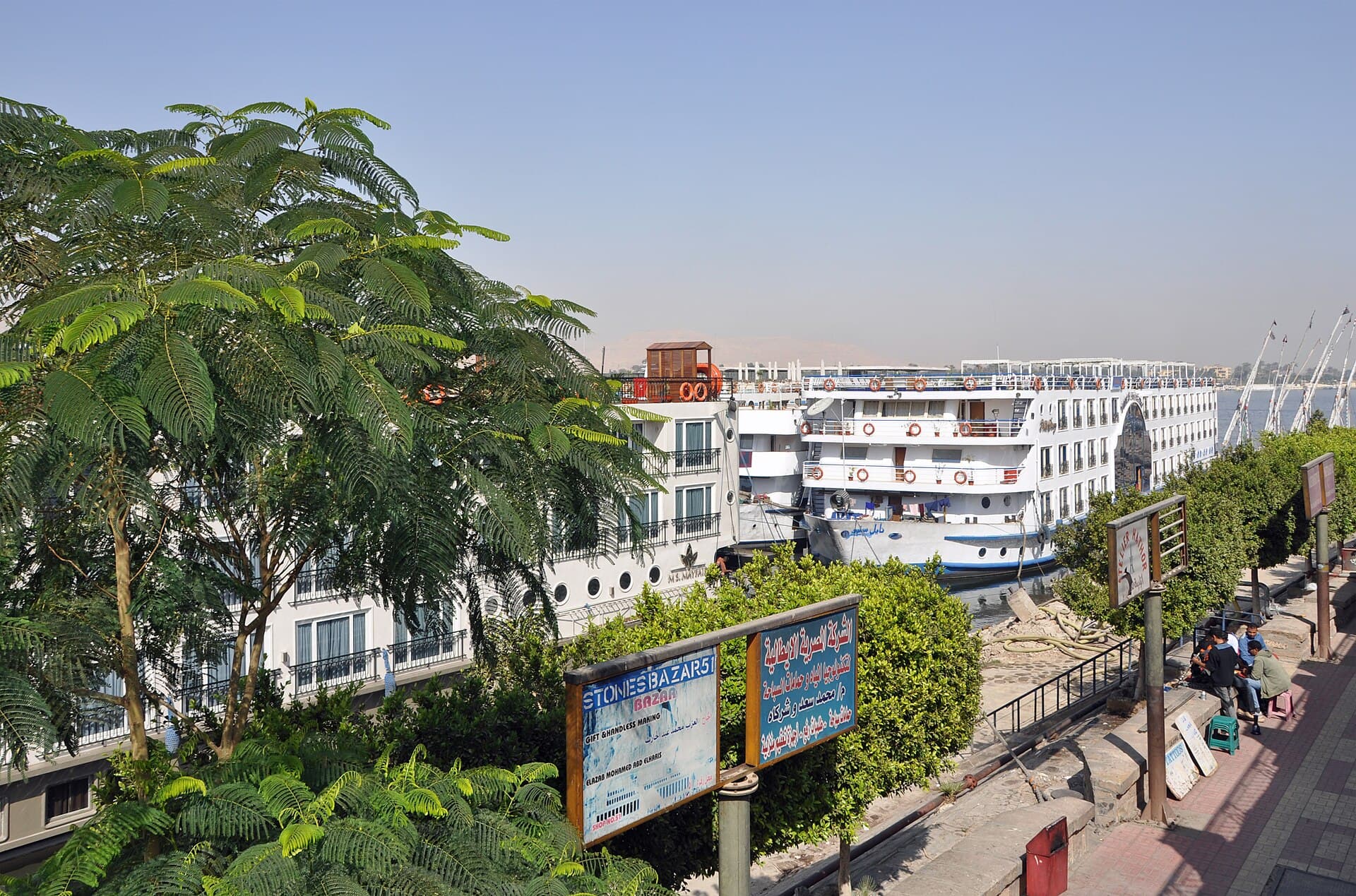
The crossing is the hidden cost on a cruise morning. Boats moor on the east bank, often rafted several deep, so you may cross another vessel's lounge to reach the quay before you have even started. Then there is the river itself, and the bridge that sits several kilometres south of the centre. Ask your operator which crossing they use, because a road transfer at both ends adds up to the better part of an hour that a boat transfer does not.
For anyone still deciding between a boat and a hotel, the balloon is a minor argument rather than a decisive one, but it points the same way as most of the others. A cruise is the efficient way to reach Edfu and Kom Ombo and a compressed way to see Luxor. A hotel buys you the early hour and the second chance at a cancelled flight. The usual compromise, a short cruise with nights on land at either end, handles the balloon neatly.
Planning the rest of the west bank day around it
The temptation is to treat the balloon as a bonus and keep the rest of the day as planned. That is the version most people regret. You have been awake since the small hours, you have stood for an hour, and the heat is still ahead of you. Something has to come out of the itinerary, and it is better to decide which thing at home than at eleven in the morning in a car park with no shade.
If you are going straight on to the west bank sites, the order matters more than usual. Heat sets it, not distance. The Valley of the Kings first, because the tombs have no airflow and hold the heat of every group that has walked through them. Hatshepsut's temple second, understanding that its cliff-backed terraces are the hottest place on the west bank and only get worse as the morning builds. The Colossi of Memnon are a five-minute roadside stop you pass anyway. Medinet Habu, if you still have appetite, gives you high walls, shade and colour that the open sites do not.
The realistic version of a balloon morning is two sites, not four. Three tombs plus one paid extra at the Valley of the Kings takes about two and a half hours on its own, and by the fourth temple most people have stopped looking. Two sites seen properly beat four glanced at, and that is true even on a morning you did not start at four.
The alternative, and the better one if your schedule allows, is to do nothing at all afterwards. Go back, sleep for an hour, have a proper lunch, and put a single site in the late afternoon when the light is low. Karnak takes low afternoon light far better than noon, and Luxor Temple is the one major site that improves after dark. A balloon at dawn and Luxor Temple floodlit at night is a good day. A balloon at dawn and a full programme of temples in between is an endurance test.
Booking: what you are actually paying for
Quoted prices for the same stretch of sky vary more than most people expect, and the difference is rarely the flying. It is the number of passengers sharing the basket, whether the transfer at both ends is included, whether the price is per person or has a private supplement attached, and what the refund terms say. Compare those four things rather than the headline figure, because a cheaper flight with no written cancellation policy is not cheaper at all on the morning it is called off.
The lowest prices in Luxor come from agents selling in hotel lobbies and on the corniche the evening before. Some of those bookings are perfectly sound, and they are also the ones with no paper trail, no clear operator and nobody to pursue for a refund. If you take that route, at least establish which company is actually flying you, get the cancellation terms in writing, and do not pay in full in cash to somebody whose only address is a street corner.
A private or smaller basket is available at a premium. It buys elbow room, a guaranteed position at the rail and a less regimented morning; it does not buy a better view, a different route or a lower chance of cancellation, because the wind does not care what you paid. Whether that is worth the money depends on how much the crowded basket bothers you, which is a personal question rather than a value one.
Whatever you book, get the confirmation in writing with the operator's name on it, and treat the night-before phone call as part of the service rather than a courtesy. Those two things separate a booking you can hold somebody to from a verbal arrangement made at a desk.
The 2027 eclipse week is a special case
On Monday 2 August 2027 a total solar eclipse crosses Upper Egypt, with Luxor sitting very close to the centreline and totality running a little over six minutes. Greatest eclipse falls at roughly 10:06 UTC, which works out at around one in the afternoon in Luxor. Balloon flights go at first light, so the two do not clash. What they do is land on the same few days, in the hottest month of the Egyptian year, in a city that will be fuller than it has ever been.
Anyone hoping to combine them should book both a long way out and expect the balloon to be the part that gives way. Dawn flights that week will be heavily oversubscribed, and the usual advice applies with more force than usual: take the first morning you can, not the last, and do not build the trip around a flight that wind can remove. Our guide to the 2027 eclipse covers the date, the path and the cloud odds in detail.
One thing to put out of your mind is watching totality from a balloon. The flight is hours earlier, the air is unusable by mid-morning, and at maximum the Sun will be roughly 82 degrees above the horizon, which is almost straight overhead. You do not need altitude or a clear western horizon for this eclipse. A courtyard, a deck or a patch of desert will do.
If you decide against it
The balloon is not the only way to get the shape of the place, and it is worth saying so rather than pretending the alternative is nothing. The top terrace at Deir el-Bahari gives you the Nile valley, the cultivated strip and the desert edge in a single view, which is the same lesson at ground level and costs the price of a temple ticket. Walking out to the edge of the cultivation anywhere on the west bank does much the same thing for free.
For the river itself, a felucca at Aswan does more than any balloon can, and the local ferry crossing at Luxor takes a few minutes for the price of a coffee and puts you on the water twice a day if you want it. For the monuments, the honest truth is that they are better from the ground: from the air you get the arrangement, not the carving.
And if the reason you are hesitating is the money rather than the standing or the dawn, that is a perfectly good reason. The cost of a balloon flight buys a private driver and guide for a west bank day, or the separately ticketed tombs at the Valley of the Kings, or a night at a considerably better hotel. None of those is a worse morning. They are simply a different one.
So is it worth doing?
Yes, for most people. Watching the sun come up over the Nile with the temples laid out below is one of the genuinely memorable hours in Egypt, and photographs do not really carry it. Very few things in the country give you the shape of the place: the river, the thin green band either side of it, and the dead ground beyond where the tombs are.
It is not for everyone, though. Skip it if you sleep badly and have a heavy sightseeing day after, if standing for an hour in a crowded basket sounds unpleasant, or if a firm landing would be a real problem for your back or knees. Families with small children often find the timing harder than the flying. And if the budget is tight, the money buys a lot of other things in Luxor.
If you do go, the three decisions that matter are all made before you leave home. Book it for your first morning in Luxor rather than your last. Book it through somebody who will put the cancellation terms in writing. And clear the rest of that day so the flight is not the reason the Valley of the Kings was a blur. Get those three right and the odds are strongly in your favour.
Common questions
How early does a Luxor balloon flight start?+
Pickup is in the small hours, well before first light, because the balloon has to be up and down before the air heats up. Exact times shift with the season and with sunrise, so your operator will confirm the night before. Expect to be awake for a couple of hours before you leave the ground.
How long are you actually in the air?+
Usually around an hour, though treat that as a guide rather than a promise. The pilot decides when and where to land based on the wind and the ground below, so some flights are shorter and a few run longer. Counting the transfer, the wait at the launch field and the drive back, the whole morning takes considerably more than the flight itself.
Will I see the Valley of the Kings from the balloon?+
You will fly over that side of the river and see the hills and wadis around it, but the tombs themselves are underground and there is nothing to look at from above. You also cannot choose the route. Wind decides where the balloon drifts, so one morning gives you a long run over the mortuary temples and the next gives you farmland and the desert edge.
What happens if my flight is cancelled?+
Most cancellations are for wind, and they are common enough that you should plan for one. Reputable operators either reschedule you for another morning or refund the booking, but the terms vary, so get them in writing before you pay. This is why the first morning of your Luxor stay is the right slot to book. A cancellation then still leaves you a second chance.
Is it suitable for children, older travellers or nervous flyers?+
It depends more on standing and landing than on height. You are on your feet for the whole flight in a shared basket, and landings can be firm enough that the crew ask you to brace. That rules it out for some people with back, hip or knee problems. Nervous flyers are often fine, because the basket is enclosed and there is no sense of speed. Operators usually set a minimum age, so ask.
What is the best month for a balloon flight over Luxor?+
March, if you want the best combination of calm mornings and bearable daytime temperatures, with November a close second at around 28C. The one thing to watch in spring is the khamsin, the wind that can remove a day or two and usually arrives late in March. Midwinter flies well but is genuinely cold before dawn, so take a fleece.
Do balloons fly over Luxor in summer?+
They do, and summer suits the balloon better than it suits anything else in Upper Egypt. The flight happens in the coolest part of the day and is finished before the heat arrives, and Luxor is at its emptiest in August. The problem is the rest of the day: at around 41C the middle of the day is not usable for sightseeing, so the balloon becomes your whole morning rather than the start of it.
Why do quoted prices differ so much?+
Rarely because of the flying. The variables are how many people share the basket, whether transfers at both ends are included, whether you are paying a private supplement, and what the cancellation terms say. A flight that looks cheap because nobody has written down what happens when the wind blows is not cheap. Compare those four things rather than the headline figure.
Can I book a balloon flight after I arrive in Luxor?+
Usually yes, and it is how a lot of people do it, but the lowest prices in a hotel lobby the night before tend to come with no paper trail, no named operator and nobody to chase for a refund. If you book locally, establish which company is actually flying you and get the cancellation terms in writing. In busy periods, and especially around the 2027 eclipse, booking ahead is the safer plan.
Does my travel insurance cover ballooning?+
Check rather than assume. A number of policies list ballooning as an excluded activity or cover it only under an adventure sports add-on, and that is not something you can resolve at the launch field. Read the wording, and if ballooning is not mentioned either way, ask the insurer directly and keep the reply.
What should I wear and take?+
Closed shoes with a proper sole, because landing fields are rough farmland and you may walk to the retrieval truck. Layers chosen for the hour before dawn, with a fleece from late autumn to early spring. Take as little as possible, since there is nowhere to put a bag down in the basket, and keep your hands free for the rail. Small cash for tips and a breakfast box arranged the night before are the other two useful items.
Can I watch the 2027 solar eclipse from a balloon?+
No, and you do not need to. Balloons fly at first light, while greatest eclipse falls at roughly 10:06 UTC, which is around one in the afternoon in Luxor. At maximum the Sun will be roughly 82 degrees above the horizon, so altitude and a clear horizon add nothing. Expect dawn flights that week to be heavily oversubscribed and book both parts of the trip a long way ahead.
Official sources
Entry rules, opening hours, security advice and exchange rates all move. Check them at the source, not here.
Written and checked by the Nile Trip Guide editorial team · Last reviewed . Entry rules, prices and opening hours change — check anything critical against the official sources linked on this page.
Plan this trip
Tell us your dates and we will price it
A real itinerary with real prices, usually within 24 hours. Nothing is booked and nothing is charged until you say yes.
The route most people take first, at the length it was built for: Giza and the Grand Egyptian Museum, then a flight to Luxor and four nights sailing down to Aswan.
No boat on this one. Giza and the Grand Egyptian Museum, a night in Luxor for both banks, two nights on the Red Sea, then back to Cairo for the Citadel, Coptic Cairo and the Royal Mummies.
Five nights in Cairo either side of a four-night sail from Luxor to Aswan. The Cairo days are private, just your party and a guide; the sightseeing off the boat is shared with a small group.