Hatshepsut Temple at Deir el-Bahari: What to Expect
Hatshepsut Temple is the three-tiered mortuary temple cut into the cliffs at Deir el-Bahari, on the West Bank at Luxor. It looks like nothing else that survives from ancient Egypt, and it is also one of the hottest places you will ever stand. Both facts matter equally when you plan a visit. This page covers what the temple is, what to look at inside it, and when to be there.
What is Hatshepsut Temple, exactly?
It is a mortuary temple, not a tomb. Hatshepsut was buried in the Valley of the Kings, over the ridge behind the building. The temple was where her cult was maintained after death: offerings, ritual, remembrance. Its ancient name, Djeser-Djeseru, is usually rendered as "Holy of Holies" or "Sacred of Sacreds". Deir el-Bahari, the Arabic name used today, means "the northern monastery" and comes from a Coptic community that occupied the site far later, long after the original function had been forgotten.
The design is unlike anything else from the period. Three colonnaded terraces rise on a single axis, linked by long ramps, set against a semicircular bay of limestone cliff. The architect is generally credited as Senenmut, a senior official close to Hatshepsut, though the attribution rests on inference rather than a building inscription. The temple dates from the Eighteenth Dynasty, roughly three and a half thousand years ago, when Egypt was wealthy and confident enough to experiment.
A great deal of what you see is reconstruction. Polish and Egyptian teams have worked here for decades, re-erecting columns and rebuilding walls from fallen blocks scattered across the site. This is not a fault, but it is worth knowing before you arrive. The clean geometry that photographs so well is partly a modern achievement, built on solid ancient evidence but assembled in living memory rather than surviving intact.
The distinction between temple and tomb is worth holding on to, because it explains why the building is where it is. A mortuary temple had to be visible, reachable and staffed: priests came daily, offerings arrived, festivals brought processions across the river. A royal tomb had to be hidden. Hatshepsut got both by putting the public half of her funerary arrangements on the east face of the cliff, facing the Nile and the temples of Amun at Karnak, and the private half on the other side of the same rock. Two structures, one ridge, entirely opposite design problems.
It also sat inside a larger ritual geography rather than standing alone. Once a year the image of Amun crossed from Karnak to visit the west bank temples in what is known as the Beautiful Festival of the Valley, and Djeser-Djeseru was one of its destinations. That is the audience the architecture was built for: a procession arriving along a causeway from the cultivation, seeing the terraces stacked up against the cliff from a long way off. Nothing about the building makes sense if you imagine it as a private monument.
Why the architecture is the point
Most Egyptian temples are enclosed, dark and inward-facing. This one is open, horizontal and designed to be seen from a distance. The terraces echo the horizontal strata of the cliff behind them, so the building reads as an extension of the rock rather than an object placed in front of it. The supports are plain square piers and sixteen-sided columns, restrained where later Ramesside building is heavy and repetitive.
The effect is strongest from the approach, not from inside. Walk up slowly and look back. From the top terrace you get the Nile valley, the cultivated green strip, and the desert edge in one view. That contrast is the whole geography of ancient Egypt in a single glance, and it explains why the site was chosen when there was an entire cliff line to pick from.
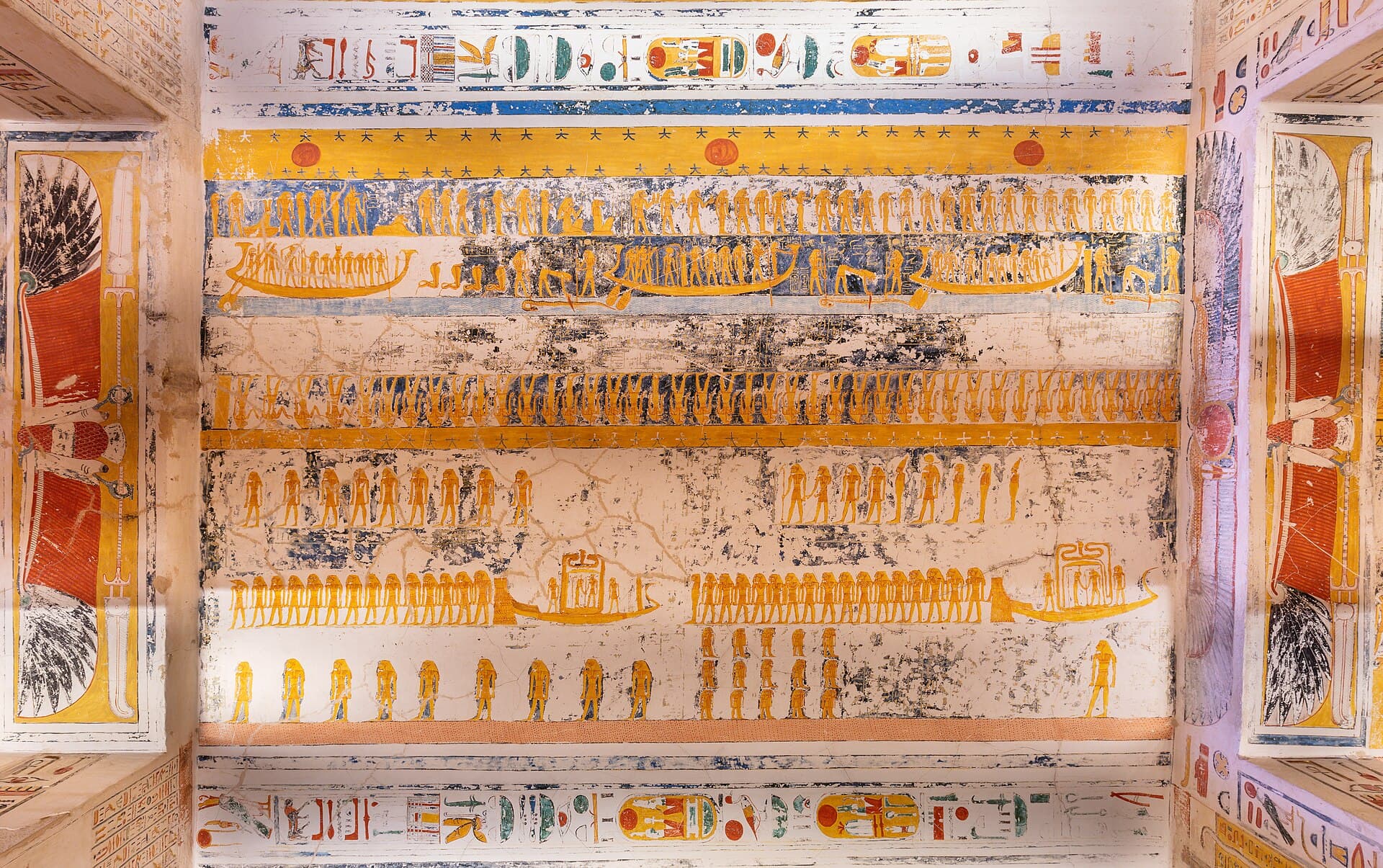
Inside, the individual chapels are modest. The chapel of Anubis, at the northern end of the middle terrace, keeps some of the best-preserved colour on the site, with deep reds and blues still legible on the ceiling. The chapel of Hathor sits at the opposite, southern end, its columns carrying the goddess's distinctive cow-eared capitals. Neither space takes long to see, and both reward a proper look rather than a glance through the doorway.
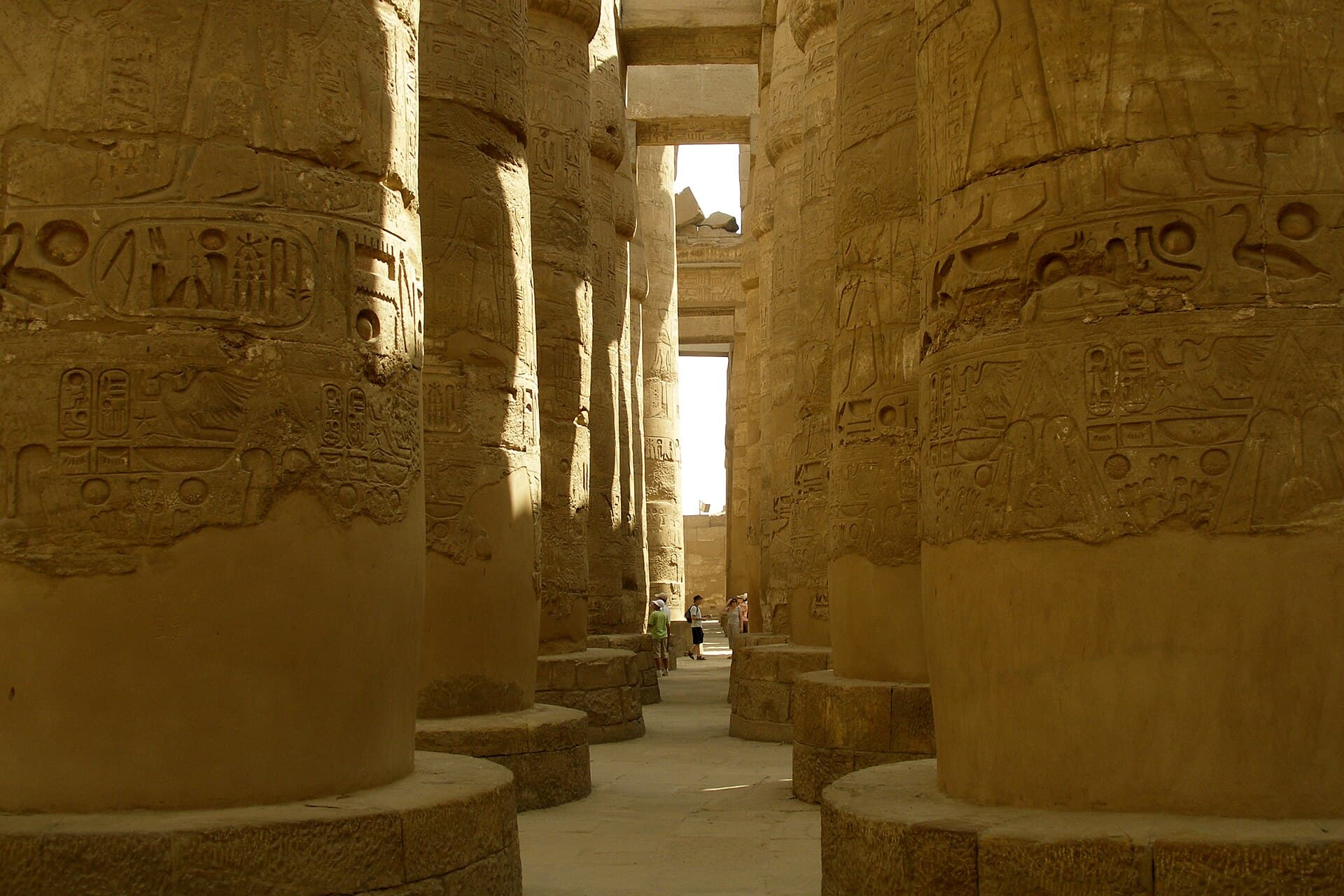
There is a restraint here that is easy to miss if you arrive from Karnak. Karnak works by accumulation: bigger columns, more of them, each king outbuilding the last. Deir el-Bahari works by proportion, and it is the rarer instinct in Egyptian architecture. The ramps are set on the centre line, the terraces are the same idea repeated at three scales, and nothing competes with the cliff. Whoever drew it understood that the most impressive object on the site was the rock, and designed a building that borrowed from it rather than argued with it.
Terrace by terrace: how to actually walk it
Start in the forecourt at the bottom, which is now an empty rectangle of sand and stone and looks like nothing. It was not empty. Excavation found pits for trees cut into the ground here, so the front of the temple was planted rather than bare, and the approach ran up a processional causeway from a valley temple down near the cultivation. Almost none of the causeway survives, and you arrive by road and shuttle instead. Knowing what has gone makes the surviving building easier to read, because the version you see begins halfway through the original sequence.
Take the first ramp to the middle terrace, then stop before you take the second. This is the level that holds the content, and it is the one groups cross fastest. Facing the cliff, the Punt colonnade is on your left at the southern end, the divine birth colonnade on your right at the northern end. The chapel of Hathor sits beyond the Punt scenes, the chapel of Anubis beyond the birth scenes. Four things worth seeing, all of them off the axis you are walking up, which is precisely why most visitors miss all four.
The upper terrace is reached by the second ramp and fronted by a portico of square piers with standing figures of Hatshepsut against them, carved in mummiform dress in the manner of Osiris. These are the statues that took the worst of the later destruction, and much of what stands there now has been reassembled. Behind the portico is a courtyard with chapels off it, including spaces for the royal cult and an open court for the sun, and at the back the sanctuary of Amun cut directly into the cliff. The sanctuary is the deepest and by a long way the coolest room on the site.
The building has one axis and no maze, so you cannot get lost. What you can do, easily, is walk straight up and straight back down and see none of the decoration. The fix costs nothing: at each terrace, turn left and right and go to both ends before climbing. Ninety minutes done in that order is a completely different visit from ninety minutes spent photographing ramps.
Who was Hatshepsut, and why were her images erased?
Hatshepsut ruled as pharaoh in her own right, not as a regent in name only. She came to power on behalf of her young stepson Thutmose III and then took the full royal titulary. Her reign lasted roughly two decades and was, by the evidence we have, prosperous and stable, with heavy building work across Thebes and trading expeditions abroad.
In official art she is shown as a king: male dress, the false beard, the standard royal poses. This was not disguise so much as protocol. Kingship had a fixed visual language and she used it, because there was no established way of depicting a female pharaoh. Texts about her sometimes switch between masculine and feminine grammatical forms within the same passage, which suggests scribes were improvising.
Her images and cartouches were systematically hacked out, here and elsewhere, and the damage is easy to see on the upper terrace. The old story was personal revenge by Thutmose III. The evidence now points to the erasures starting late in his reign, some twenty years after her death, which makes political calculation a better explanation than grudge: most likely securing the succession for his own line by removing an irregular ruler from the record. Motive cannot be proved, and scholars still disagree. Treat any guide who tells you exactly why with mild scepticism.
The erasure was thorough but not total, which is itself informative. Her name survives in places that were hard to reach or already hidden, and the pattern of what was destroyed against what was left suggests a job done by work gangs following instructions rather than a frenzy. Statues of her were broken up and dumped in a pit near the temple, where excavators found the pieces in the 1920s and reassembled a number of them. Several of the best are now in museum collections in Cairo and New York, which is why some of the finest sculpture from this temple is not at this temple.
The editing continued after the chisels stopped. She is missing from the king list carved at Abydos, along with Akhenaten, Tutankhamun and the other rulers the New Kingdom decided to forget, and the official record simply ran Thutmose II into Thutmose III as though nothing had happened in between. What broke the silence was archaeology, not tradition: the temple was cleared, the erasures were noticed, and a reign that the state had tried to delete turned out to be one of the best documented of the dynasty. Her own tomb in the Valley of the Kings, KV20, is not open to visitors, and the identification of her mummy rests on a contested chain of evidence rather than an inscription.
What are the Punt reliefs, and are they worth finding?
Yes, if you know where to look. On the middle terrace, the southern colonnade carries scenes of a trading expedition to Punt, a land somewhere on the Red Sea coast or the Horn of Africa. Its exact location is still argued over, with cases made for Eritrea, eastern Sudan, the Somali coast and Yemen. The expedition brought back incense, ebony, ivory and live animals, and the temple treats it as one of the defining achievements of the reign.
What makes the reliefs unusual is the observation in them. There are ships under sail, loaded with incense trees in baskets for transplanting. There are fish rendered accurately enough that individual species have been identified by biologists. There is the Puntite ruler's wife, drawn with a body shape so far outside Egyptian artistic convention that Egyptologists have argued about a medical explanation for over a century.
The carvings are damaged and faded, and casual visitors walk past them entirely. They are shallow work in poor light, so they photograph badly and read slowly. Give them ten minutes and they become the most interesting thing at the site. Opposite them, the northern colonnade shows Hatshepsut's divine birth, the claim that the god Amun fathered her, which was the theological argument underpinning her right to rule.
The two colonnades are a matched pair and should be read as one argument rather than two subjects. The birth scenes establish the right to rule by descent from Amun; the Punt scenes demonstrate what that rule delivered, which is wealth arriving from the edge of the known world and being presented to the same god. Egyptian temple decoration is rarely decorative. It is a case being made on a wall, and this is one of the clearest surviving examples of a monarch arguing for their own legitimacy in pictures.
The incense trees are the detail worth carrying away. They were not brought back as cargo but as living plants in baskets, to be replanted in Egypt so that the raw material of temple ritual could be grown at home rather than bought. The tree pits found in the forecourt are usually connected to exactly that. Whether the planting succeeded for any length of time is unknown, and nobody should tell you otherwise, but the ambition is legible on the wall: not a trading trip, an attempt at import substitution three and a half thousand years ago.
Senenmut, and who actually built it
Senenmut is the name attached to this building, and the attachment is weaker than most guides admit. He was a senior official with an unusual stack of titles, steward of Amun among them, and tutor to Hatshepsut's daughter Neferure. He was close to the throne, he was prominent during the years the temple went up, and no other candidate is on the table. What does not exist is a foundation text saying he designed it. The credit is a reasonable inference and it is repeated as a fact, which are different things.
He did get himself into the fabric of the building, though. Small images of him were cut into the temple in positions where an open door would conceal them, tucked away in the upper chapels rather than displayed. You can read that as private devotion, as the act of a man securing a share in the offerings, or as an official quietly smuggling himself into a royal monument. All three readings are guesses. What is not a guess is that a commoner was put in a position to do it at all, which says something about how this court worked.
He also began a tomb for himself underneath the forecourt of the temple, which for a non-royal is an extraordinary piece of positioning. It was never finished, it is not open, and there is nothing of it to see above ground. Senenmut then disappears from the record before the end of the reign, without explanation. The love affair with the queen that turns up on tours is an invention with no evidence behind it, and it survives because it is a better story than an unexplained silence.
Behind the named official was a state apparatus: quarries, ramps, sledges, statuary workshops, and a workforce housed, fed and paid in grain. The clearest surviving evidence of how that was organised is not here but at Deir el-Medina, a short drive south, the village of the artisans who cut and decorated the royal tombs. If the logistics interest you more than the iconography, that village is the site on the west bank that answers the question, and almost nobody visits it.
What the temple became after the pharaohs
The cult did not run forever, and the building had a long second life. In Ptolemaic times part of the upper sanctuary was reworked, and the site acquired a reputation for healing. Pilgrims came to consult two deified figures associated with medicine and wisdom, Imhotep and Amenhotep son of Hapu, and they left their names and requests scratched into the walls in Greek and in demotic. Some of the graffiti you are looking at is ancient tourism, which puts a certain perspective on the modern kind.
Later still, a Coptic monastic community established itself on the upper terrace. That occupation is the origin of the name everyone uses today, and it accounts for a share of the damage to the ancient decoration. Monks removed blocks, cut through walls and defaced figures, and not all of the destruction on this site belongs to the Eighteenth Dynasty political quarrel it is usually blamed on. Disentangling one layer of damage from another is a large part of what excavators here have had to do.
Serious clearance began in the 1890s, when an expedition working for the Egypt Exploration Fund dug out the terraces and published the reliefs. An American museum expedition worked the site in the 1920s and recovered the smashed statuary from its pit. Since the early 1960s a Polish mission, working with the Egyptian antiquities authorities, has carried out the reconstruction that produced the temple you walk through. That is more than a century of continuous work on one building.
This is the context for the honest caveat about restoration. The re-erected columns and rebuilt walls are not inventions; they are original blocks put back where the evidence says they stood, with modern material used where a gap had to be bridged. But the crisp, complete silhouette in the photographs is the product of that programme, and the temple as it was found was a ruin half buried in its own debris with a monastery on top. Both facts are true at once, and knowing the second one makes the first more impressive rather than less.
The rest of the bay: Mentuhotep II and Thutmose III
Immediately beside Hatshepsut's temple stand the ruins of the temple of Mentuhotep II, older by something like five and a half centuries. It was a terraced building with a colonnade and a central ramp, and the resemblance is not a coincidence: her architects plainly knew it and adapted the idea at a larger scale and with better proportions. It survives as low walls and stumps of columns, it takes a few minutes to walk over to, and it is nearly always empty.
Between the two, on the slope, the Polish mission found the remains of a third temple, built by Thutmose III. Rockfall destroyed most of it and there is very little to look at. It matters for a different reason: the king who is supposed to have spent his reign erasing Hatshepsut chose to build his own monument in the same bay, wedged between hers and the ancient one. That does not fit the revenge story neatly, and it is one of the reasons the revenge story has lost ground.
The wider cliff is worked all over. The Theban hills here are honeycombed with shafts and rock-cut tombs of officials from several periods, most of them closed, some of them famous among Egyptologists and unknown to everyone else. You are not looking at three temples in a natural amphitheatre; you are looking at the most heavily used piece of funerary landscape in ancient Egypt, of which the standing terraces are the surviving fraction.
Ten minutes spent on Mentuhotep's ruin is the single best-value addition to this visit. Seeing the rough prototype next to the finished idea tells you more about what Hatshepsut's architects achieved than another photograph of the ramps will, and it costs nothing but the walk. Most people are already back at the car park by the time you get there.
How bad is the heat?
Worse than anywhere else on the West Bank. The cliffs form a natural amphitheatre that catches the sun and blocks air movement almost completely. Stone and sand radiate heat back at you from every direction, so you are warmed from below and from the sides as well as from above. There is almost no shade on the terraces, and the ramps are long, exposed and reflective.
In summer, the middle of the day here is genuinely dangerous for anyone who is unfit, elderly or badly hydrated. Even in winter it can be uncomfortable by late morning. Heat exhaustion is a routine problem on the Luxor West Bank in the hot months, and this is the site where it tends to catch people out. That is not a reason to skip the temple, but it is a reason to take timing seriously rather than treating it as a preference.
Bring more water than you think you need, cover your head, and wear something over your shoulders rather than nothing. There is a shuttle from the car park to the temple forecourt for a small charge. It is not a long walk, but on a hot day it is a sensible way to save your energy for the ramps. Confirm the current arrangement locally, since it changes.
The shade that does exist is worth knowing about in advance, because you will want it. The colonnades on the middle terrace are covered and noticeably cooler than the open ramps, and the rock-cut sanctuary at the back of the upper terrace is the coldest place on the site by some margin. Both are also where the decoration is. If you are struggling, the right move is not to sit on the steps in the sun but to go into the Punt colonnade or the Anubis chapel, which is where you should have been spending your time anyway.
When should you go?
First thing, before anything else on the West Bank. The site opens early, though the exact hour shifts with the season, so check locally the day before. Being there in the first hour buys you two things: tolerable temperature and low-angle light that rakes across the reliefs and makes the carving readable. By mid-morning the sun is overhead, the pale stone glares, and the detail flattens out into something you can barely photograph or even see properly.
Season matters as much as time of day. November to February is comfortable. March and October are manageable if you start early. May to September is severe, and in those months the argument for an early start stops being about comfort and becomes about safety. If you are travelling in high summer, build your whole West Bank plan around being finished before midday.
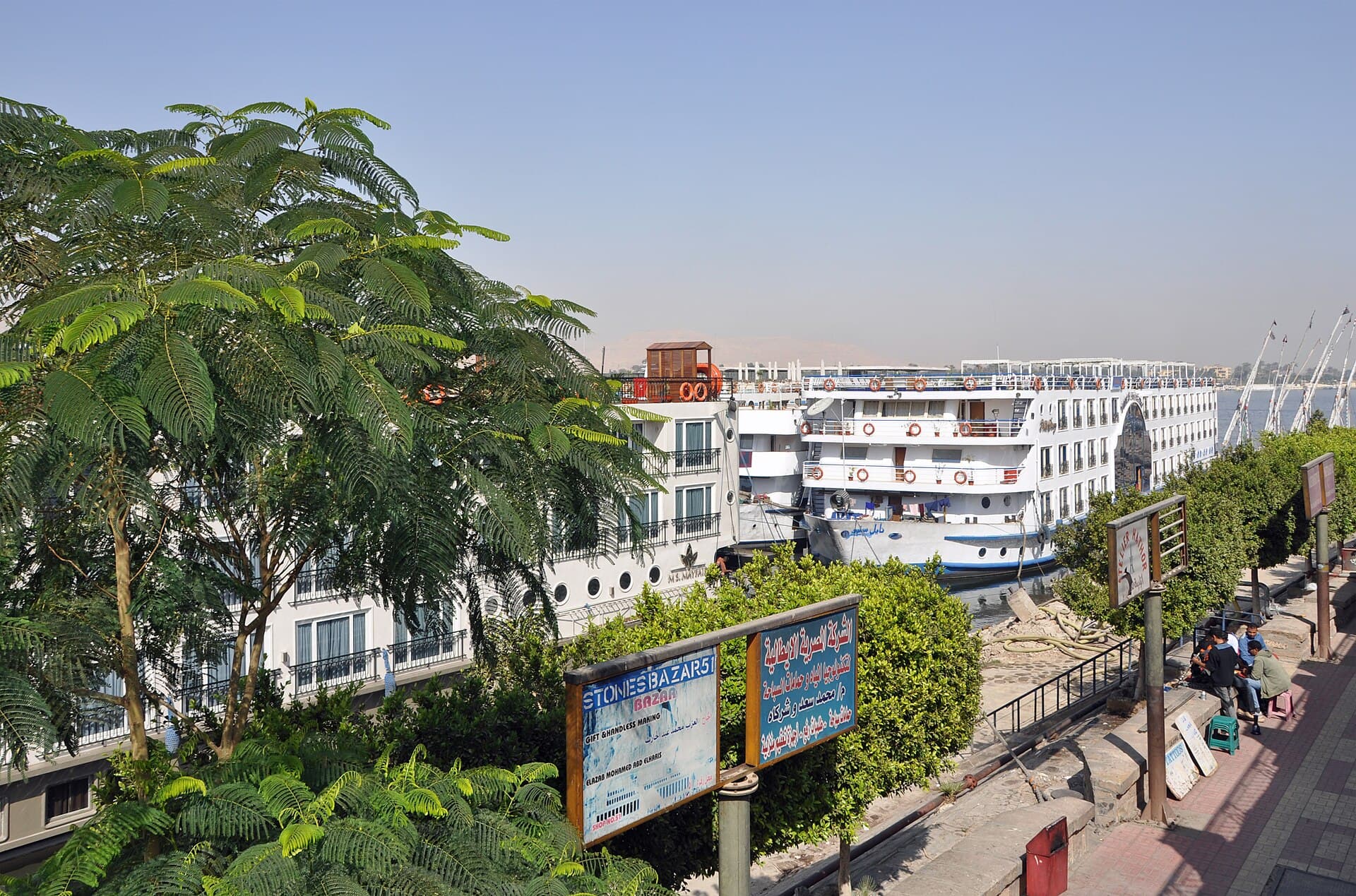
Crowds follow the Nile cruise schedule rather than the clock in any predictable way. When several boats are moored at Luxor, the middle terrace can be shoulder to shoulder by nine. If you arrive to find the ramps full, go straight to the top terrace and work back down against the flow. Most groups move through in order, so going backwards gives you empty rooms.
There is one genuine argument for a late visit rather than an early one, and it is about light rather than comfort. The temple faces east, so the sun is behind you and full on the façade in the morning, which is what you want for the building and for the shallow relief carving. By late afternoon the cliff has thrown the whole bay into shade and the terraces go flat and grey. If you want the front of the temple lit, morning is not merely preferable, it is the only option. Late afternoon is for Karnak and for Luxor Temple, which are both better then.
Getting there, tickets and what to expect at the gate
The temple is on the west bank, and crossing the river takes longer than the map suggests. The road bridge is several kilometres south of the centre of Luxor, so a car crossing runs twenty to thirty minutes each way and quietly removes an hour from your day. The passenger ferry crosses in a few minutes for the price of a coffee and lands you near Luxor Temple, but it leaves you needing transport on the far side. West bank sites are spread across several kilometres of desert edge with no shade and no useful public transport between them, so a car and driver for the morning is the practical answer however you cross.
Tickets are bought on the day at the office by the car park. There is no advance booking and no need for it. Prices at Egyptian sites are revised regularly and often upwards, so treat any figure you find online, including on other pages of this site, as a rough indication rather than a quote, and check at the window. Separate charges sometimes apply to cameras or to particular interiors, and the rules are not applied identically everywhere.
Between the ticket office and the temple there is a line of stalls selling alabaster, scarves and carved figures, and the selling is persistent rather than aggressive. A firm, friendly refusal works and nothing follows from it. Carry small notes: for the shuttle, for the attendants who unlock or light a chapel, and for the driver. Change is chronically short in Egypt and arriving with only large notes makes every small transaction harder than it needs to be.
On security, since visitors ask: this temple was the scene of an attack on tourists in 1997, and the protection of Egypt's archaeological sites was overhauled afterwards. A visible police presence at west bank sites and checks at entrances are normal now. It is recorded here because it is part of the site's history and because people search for it, not as a reason to weigh the visit differently. For current official guidance, read your own government's travel advice rather than a travel company's assurance, ours included.
Combining it with the Valley of the Kings and the Colossi
These three sit close together and make one coherent morning. The usual order is Valley of the Kings first, then Hatshepsut, then the Colossi of Memnon on the way back to the river. The valley tombs are underground and get hot and airless as the day builds, so they deserve the earliest slot in most people's plans.
There is a real case for reversing the first two. If you want Hatshepsut without crowds and with good light, go there at opening and accept a warmer valley afterwards. Neither order is wrong. Decide based on whether you care more about photographs and space, or about comfort inside the tombs, and tell your operator which you have chosen rather than leaving it to the default.
Three sites is a full morning, roughly four to five hours with transfers. Adding Medinet Habu or the Ramesseum makes it a long day, and by the fourth temple most people have stopped looking properly. Two well-seen sites beat four glanced at. The Colossi take fifteen minutes at most: two seated statues of Amenhotep III beside the road, worth stopping for, not worth planning around.
If you are doing a sunrise balloon flight, it comes before all of this and changes nothing else about the plan. Pick-up is in the dark, the flight lasts something like three quarters of an hour, and you are back on the ground in time to start the tombs. What the flight shows best is the geography the temple is built into: the hard line where irrigated green stops and desert begins, with the Theban cliffs standing over the whole necropolis. Book it for your first Luxor morning rather than your last, because flights are cancelled for wind often enough to matter and a cancellation usually means a refund rather than a second attempt.
Cruise passengers get a compressed version of this morning and should plan accordingly. Boats moor on the east bank and the west bank excursion runs to the boat's departure time, not yours, which typically means the Valley of the Kings, Hatshepsut and the Colossi at a brisk pace with the group. If the temple matters to you, the way to get more of it is a night on land at either end of the cruise rather than a negotiation with the excursion schedule.
Hatshepsut's other monuments around Thebes
Deir el-Bahari is the set piece, but her building programme is spread across both banks and some of it is easier to appreciate than the temple itself. At Karnak she raised obelisks, and one still stands at about twenty-nine metres, cut from a single piece of Aswan granite and the tallest still upright in Egypt. Thutmose III walled part of it in rather than pull it down, which is why the lower carvings are unusually crisp. The fallen upper section of a second one lies near the sacred lake and lets you read the inscriptions at eye level.
Also at Karnak, in the walled Open Air Museum near the entrance, stands her Red Chapel, a barque shrine reassembled from scattered blocks. It needs a separate ticket, it is almost always empty, and for anyone who has taken an interest in her at Deir el-Bahari it is the best value on the site. A first-time visitor short on time and heat tolerance can skip it without regret; anyone who came for Hatshepsut should not.
In the granite quarries at Aswan lies the unfinished obelisk, a single abandoned block close to forty-two metres long that cracked before it could be freed. It is the clearest surviving evidence anywhere of how the Egyptians cut stone. The connection to Hatshepsut is routinely asserted on tours; the block carries no inscription, so the attribution is inference rather than proof, and it is worth hearing it that way.
Her tomb, KV20, lies over the ridge in the Valley of the Kings and is not open to visitors, so the two halves of her funerary arrangement cannot both be seen. And at Abydos, the king list carved on a temple wall omits her entirely, along with Akhenaten and Tutankhamun. Taken together, these places make a better itinerary around one ruler than most sites in Egypt can offer: the monument, the propaganda, the engineering and the erasure, all within a few days of each other.
What do most visitors get wrong?
They photograph the outside and skip the inside. The terraces are the famous view, so people shoot them from the forecourt, climb, shoot again from the top and leave. The chapel of Anubis, the chapel of Hathor and the Punt colonnade hold the actual content, and all three are easy to miss because they sit off to the sides rather than on the main axis you walk up.
They also arrive at eleven, which is the single most common error and the one that ruins the site: bad light, hard heat, full terraces and no appetite left for detail. And they expect an intact ancient interior. This is a shell with fragments of decoration, not a furnished building. Approach it as architecture first and decoration second and it works. Approach it expecting Abu Simbel and you will be disappointed.
The last mistake is ignoring the wider bay. Immediately beside Hatshepsut's temple stand the ruins of the temple of Mentuhotep II, older by something like five and a half centuries, which her architects plainly knew and adapted. It is right there, largely ignored by everyone, and takes a few minutes to walk over to. Seeing the model next to the finished idea tells you more about the building than another photograph of the ramps will.
A subtler error is treating the restoration as a disappointment once somebody points it out. Visitors who learn that the columns were re-erected sometimes decide the whole thing is a replica and stop looking. It is not a replica. The blocks are ancient, their positions are evidenced, and the reliefs on them were cut in the Eighteenth Dynasty. What is modern is the assembly, not the material. Knowing which parts of a monument are reconstruction is part of understanding it, not a reason to discount it.
Common questions
How much time should I allow at the temple?+
Ninety minutes is comfortable for a proper visit, including the ramps, both side chapels and the Punt reliefs. An hour is enough if you move with purpose. Groups often do it in forty minutes, which covers the view and not much else. Add time for the shuttle and the walk back to the car park.
Is the site accessible for someone with limited mobility?+
Partly. The forecourt and lower terrace are reachable on the level, and the shuttle drops you close to them. The upper terraces are reached by long stone ramps with no handrails, which are manageable slowly but tiring in heat. There is no lift. Anyone who cannot manage sustained inclines will still see the building well from below, since the architecture reads best from a distance anyway.
Can I photograph inside the chapels?+
Photography rules at Egyptian sites change and are enforced unevenly, with separate charges sometimes applying to cameras or to specific interiors. Flash is generally forbidden anywhere with painted decoration, and rightly so. Ask at the ticket office on the day rather than relying on what you have read online, including here.
Is Deir el-Bahari the same as the Valley of the Kings?+
No, though they are separated by a single ridge. Hatshepsut's mortuary temple is on the eastern side of the cliff, facing the Nile. Her tomb is in the Valley of the Kings on the other side. There is a footpath over the ridge between them, but the road route is what vehicles use and it takes considerably longer than the map distance suggests.
Is a guide worth paying for here?+
More than at most sites. The interest of this temple lies in the reliefs and in the political story behind the erasures, and neither is self-explanatory from the signage. A good Egyptologist guide changes the visit substantially. A weak one recites dates and invented drama. Ask about qualifications before booking, and stay sceptical of anyone who sounds certain about motive.
What should I wear and carry?+
Covered shoulders, light long sleeves if you burn easily, a hat, and closed shoes with grip for the ramps. Sunglasses matter here more than at most sites because of the glare off pale stone. Carry at least a litre and a half of water per person in warm months. Small notes are useful for the shuttle and for tips at the chapels.
Is Hatshepsut Temple worth visiting, or is the outside all there is?+
It is worth visiting, but on the right terms. The building itself is the attraction and it has no rival in Egypt for setting or for proportion. The interior is a shell with fragments of decoration rather than a furnished temple, so anyone expecting painted chambers like the royal tombs will be let down. Go for the architecture, find the Punt and birth colonnades and the two side chapels, and it earns its place in a west bank morning.
Can I visit independently without joining a tour?+
Yes. Tickets are sold at the window to anyone and there is no requirement to be accompanied. The obstacle is transport rather than access, because the west bank sites are kilometres apart with no useful bus service. Most independent visitors hire a car and driver for the morning and buy their own tickets, which keeps the cost well below a packaged excursion while solving the logistics.
Can I see Hatshepsut's tomb?+
No. KV20, her tomb in the Valley of the Kings, is not open to visitors, and it is a long, steep and poorly cut descent that was never an easy visit even when access was possible. What you can see of her at the valley is nothing; what you can see of her at Deir el-Bahari, at Karnak and in the museums is a great deal.
Is there shade, water or a café at the temple?+
Not on the terraces. The colonnades and the rock-cut sanctuary are the only meaningful shade on the monument itself, and there is nothing to buy once you are past the entrance. Facilities and drink stalls are down at the car park end, along with the toilets. Fill up and use them before you go up, because coming back down for a bottle of water in the heat is a miserable use of energy.
When is the best light for photographing the temple?+
The first hour or two after opening. The temple faces east, so early sun lights the façade directly and rakes across the shallow relief carving inside the colonnades, which is the only time the Punt scenes read properly. By the middle of the day the pale stone glares and the detail flattens. By late afternoon the cliff puts the entire bay in shade.
How does it compare with Karnak or Medinet Habu?+
They are answering different questions. Karnak overwhelms by scale and accumulation and needs two or three hours. Medinet Habu keeps colour on its walls and gives you shade, and it sees a fraction of the crowds. Deir el-Bahari has neither the surviving decoration of one nor the mass of the other, and beats both on siting and design. If you see only one west bank temple after the tombs, this is still the one.
Official sources
Entry rules, opening hours, security advice and exchange rates all move. Check them at the source, not here.
Written and checked by the Nile Trip Guide editorial team · Last reviewed . Entry rules, prices and opening hours change — check anything critical against the official sources linked on this page.
The route most people take first, at the length it was built for: Giza and the Grand Egyptian Museum, then a flight to Luxor and four nights sailing down to Aswan.
No boat on this one. Giza and the Grand Egyptian Museum, a night in Luxor for both banks, two nights on the Red Sea, then back to Cairo for the Citadel, Coptic Cairo and the Royal Mummies.
Five nights in Cairo either side of a four-night sail from Luxor to Aswan. The Cairo days are private, just your party and a guide; the sightseeing off the boat is shared with a small group.