Valley of the Queens: An Honest Guide to Luxor's Other Royal Valley
The Valley of the Queens sits in a dead-end bay of desert on the Luxor West Bank, across the ridge from the Valley of the Kings and a short drive south. It holds the tombs of royal wives, princes and princesses, most of them Ramesside. Three modest tombs are usually open, plus Nefertari's, which is ticketed separately and costs far more.
What is the Valley of the Queens?
The valley's Egyptian name was Ta-Set-Neferu, usually read as the place of beauty or the place of the royal children. Eighteenth-dynasty burials here belonged mostly to princesses and court officials, in plain shafts. It became the main burial ground for royal wives and sons under the Ramesside kings of the nineteenth and twentieth dynasties. Close to a hundred tombs have been numbered, and most are undecorated shafts, unfinished, or emptied long ago.
The location was not random. Over the ridge lies Deir el-Medina, the village of the craftsmen who cut and painted these tombs, and the same hands worked both valleys. A cave at the head of the valley, associated with Hathor, is one likely reason the site was chosen. Near the entrance stand the remains of Deir el-Rumi, a small monastery of the Roman and Byzantine period, so the valley kept being used long after the pharaohs.
What you actually walk into is smaller than the name suggests. The bay is perhaps a few hundred metres deep, closed at the far end by cliffs, with a flat gravel floor and low walls of pale rock on either side. Tomb entrances open off that floor at intervals, most of them sealed behind locked grilles, each with a QV number on a plate. There is no monumental architecture, no colonnade, nothing to photograph from a distance. The whole of the interest here is behind three or four small doors.
Who was buried here, and why sons as well as wives?
The short answer is that this was the burial ground for the king's family rather than the king. Great royal wives, secondary wives, princes and princesses were cut into this rock while their husbands and fathers went over the ridge to the Valley of the Kings. The arrangement is Ramesside: earlier eighteenth-dynasty burials in the valley were modest shafts for princesses and officials, and it is the nineteenth and twentieth dynasties that make the place royal in the way visitors expect.
The presence of sons is the part that surprises people. Several of the decorated tombs open today belong to boys who died before their fathers, and the wall scenes show the king himself leading the child forward and presenting him to the gods. It is a striking piece of imagery. In the Valley of the Kings, the king is the protagonist of his own afterlife; here he appears as an escort, performing the introduction for someone else.
It also explains why the tombs are small. These are not state monuments meant to carry a reign's worth of funerary literature. They are family burials, decorated quickly to a high standard and then sealed, with the emphasis on a named individual meeting named gods. If you come expecting scaled-down pharaonic tombs you will be disappointed; if you come expecting portraits of particular people, you will get them.
How is it different from the Valley of the Kings?
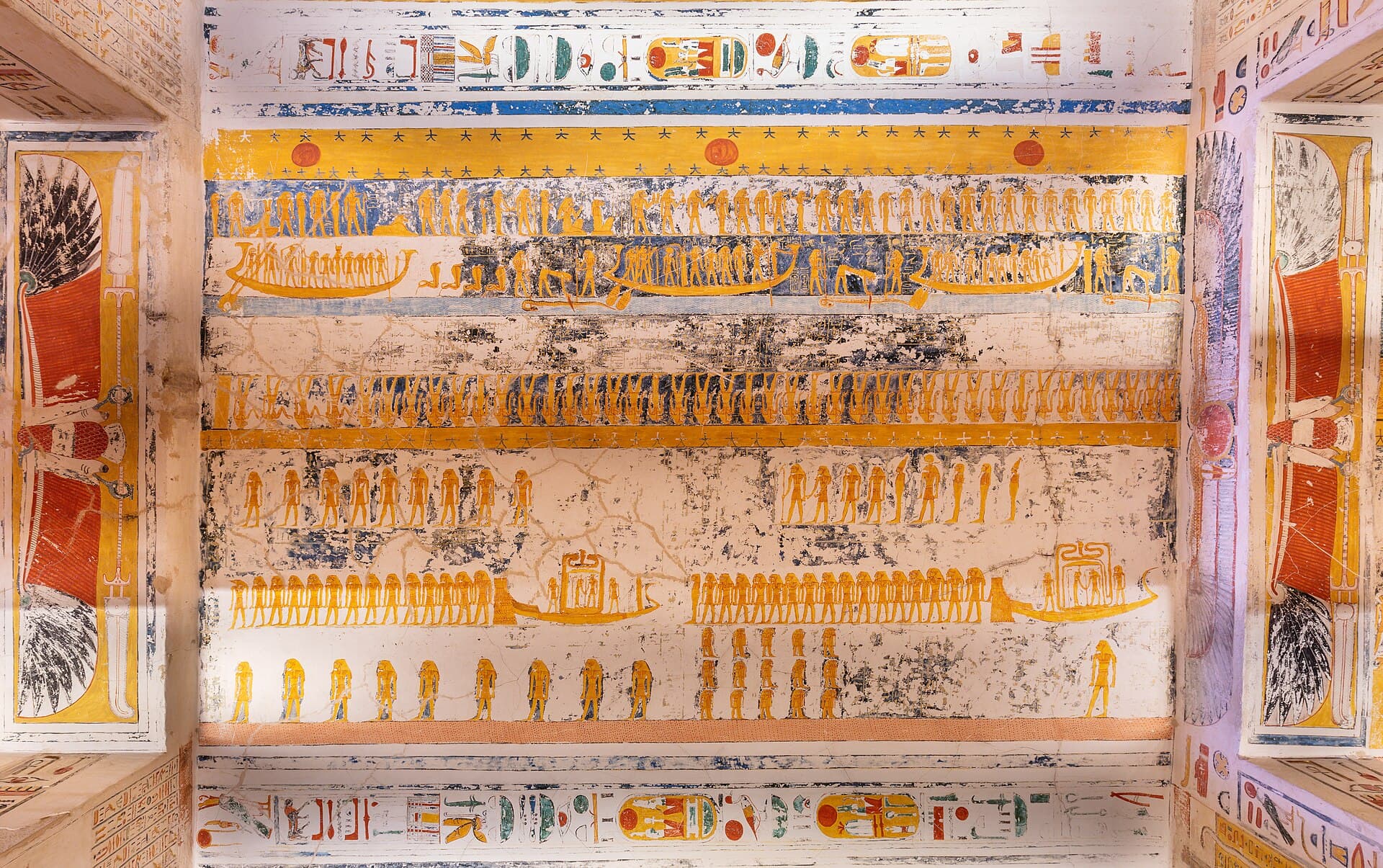
Scale and technique. Tombs in the Valley of the Kings are long corridors driven deep into good limestone, decorated in carved relief, with pillared halls, star ceilings and stone sarcophagi still in place. The Queens' tombs are small: a stair, a short corridor, a chamber or two. The rock here is poorer, so walls were plastered and painted rather than carved. What you look at is picture-making, not architecture.
Crowds differ too. Coach itineraries take the Kings and Hatshepsut, so this valley is often quiet unless Nefertari is open. The subject matter is more personal as well: instead of the dense royal afterlife books that fill the Kings' walls hour by hour, you get one named individual, sometimes a child, being introduced to the gods. If you can fit only one valley into a trip, go to the Kings. The Queens beats it only if you hold a Nefertari ticket.
The ticketing works differently in one respect worth knowing before you arrive. At the Kings, a general ticket admits you to three tombs of your choice from those open that day. Here the standard ticket covers the tombs that are open, which in practice means all three of them, and Nefertari sits entirely outside it on her own ticket with her own daily limit. So there is no choosing to agonise over: you see what is unlocked, and the only real decision is whether to pay for QV66 as well.
Is Nefertari's tomb worth the separate ticket?
QV66 belonged to the chief wife of Ramesses II and was found in 1904 by an Italian expedition. Salt pushing out through the plaster nearly destroyed it. A long conservation programme in the 1980s and 1990s stabilised the paint, and the tomb reopened under tight control. It has its own ticket, sold at the valley, a limit on how many people go in each day, and a short visit timed by a guard at the door. It costs many times an ordinary tomb ticket.
Yes, if painted walls are the reason you came to Luxor: this is the best-preserved painted tomb in Egypt and nothing else comes close. No, if you are working through the big sites on a budget. The visit is short, photography cannot be relied on, and Sennedjem's tomb at Deir el-Medina or a couple of the nobles' tombs give far more painted wall for the money. Access has been suspended before, so treat it as a decision to make in Luxor, not months ahead.
The practical shape of it: the ticket is bought at the valley itself on the morning you go, not online and not in advance, and the daily allocation is finite. That is the single argument for coming here first rather than fitting the valley in around the Kings and Hatshepsut. In practice the visit inside runs around ten minutes, timed from the door, and nobody is going to extend it for you. Prices for premium tickets in Egypt move upward regularly, so treat any figure you have read online as out of date and ask at the window.
Who was Nefertari, and why does she get a tomb like this?
She was the great royal wife of Ramesses II, the senior woman of a court that lasted more than sixty years, and she is the one queen of the period whose name most visitors already know. The reason is not her tomb, which was sealed and lost for three thousand years, but the way her husband put her in stone elsewhere while she was alive.
The clearest evidence is at Abu Simbel, far to the south near the Sudanese border. The smaller of the two rock-cut temples there was built for Nefertari and the goddess Hathor, and six standing figures front it, four of the king and two of the queen, all cut to the same height. Royal wives are normally shown knee-high to their husbands. That equality of scale is the unusual part, and it is the best single indication of what her position was worth.
Her tomb belongs in that context. The quality of QV66 is not a fluke of preservation but a reflection of who was being buried and by whom: the best draughtsmen available, working carefully, on a burial that mattered to the king personally. It is also why the disappointment of the site can be sharp for visitors who pay for the ticket expecting scale. The tomb is not large. It is simply better painted than anything else that survives.
What is actually inside QV66?
A steep flight of steps drops to an upper chamber with a side room, then a second stair reaches the pillared burial chamber. The decoration is raised relief modelled in plaster rather than cut into rock, which gives the figures a soft, rounded surface that carved tombs do not have. Nefertari appears in white linen and gold, led by Isis and by Horus son of Isis, and in one panel plays a board game against an opponent you cannot see. Ceilings are deep blue with yellow stars.
The board game is senet, and the scene is not a picture of leisure. It belongs to the funerary texts, where the dead play a match whose stake is their own passage onward, against an adversary the painters leave out of the frame. Reading it that way changes the room. Much of what looks decorative here is doing the same work as the dense text-covered walls across the ridge, only compressed into a handful of legible images rather than spread over hour-by-hour corridors.
Two things are worth doing with your ten minutes. Look at the colour where it is undamaged, particularly the whites of the linen and the blues of the ceiling, because this is as close as anyone now gets to seeing what New Kingdom painting looked like when it was new. Then look at the surfaces where the plaster has failed, which are still visible in places, and you understand what the conservators were fighting. The tomb is a rescued object, not an untouched one, and that is part of what you are paying to see.
Which other tombs are usually open?
Three, and the selection rotates. Amunherkhepshef and Khaemwaset were sons of Ramesses III who died young. In both, the king takes his son by the hand and presents him to the gods, which is an unusual thing to see on a tomb wall: the father doing the introducing. Amunherkhepshef has the freshest colour and the cleanest cutting, and its burial chamber was left unfinished.
This Khaemwaset is not the famous son of Ramesses II, the high priest who repaired old monuments; the names repeat and guidebooks confuse them. The third tomb belongs to a queen called Titi, whose king cannot be identified with confidence, with softer colour and animal-headed guardians in the burial chamber. Each tomb takes five to ten minutes to see. With the walking between them, the standard ticket fills about three quarters of an hour.
What to look for, if nobody is briefing you: the princes wear the sidelock of youth, the plaited lock of hair that marks a royal child, which is how you tell at a glance that the small figure beside the king is a son and not an official. Then follow the sequence rather than the individual panels. The boy is taken by the hand, moved from one god to the next, and handed on. The walls are a procession with a direction of travel, and they make far more sense walked in order than admired at random.
How the tombs were made, and why the paint is fragile
The workforce lived over the ridge at Deir el-Medina, a purpose-built village of tomb-cutters, draughtsmen and painters whose own records survive well enough that we know their names, their pay disputes and their days off. The same crews worked both valleys, generation after generation. That is why the standard of drawing here is royal even though the tombs are small: these were not provincial painters, they were the men who decorated pharaohs.
The rock forced their method. Limestone in this bay is poorer and more broken than the stone across the ridge, so instead of cutting figures into the wall and painting the relief, they dressed the surface with plaster and painted onto it, modelling the figures in the plaster itself where the finest work was wanted. It is faster and it allows a softness that carving cannot match. It is also far more vulnerable, because the whole image rests on a skin a few millimetres thick that is only as sound as its bond to the rock behind it.
Salt is what nearly destroyed QV66. Moisture moving through the rock carries dissolved salts, which crystallise as it dries and push the plaster off the wall from behind, taking the painting with it. That is the damage the conservation programme of the 1980s and 1990s had to arrest, and it is why entry is now limited, timed and watched. Every visitor brings in heat and breath, and humidity in a sealed chamber is precisely the thing the tomb cannot tolerate. The rules at the door are not theatre.
Getting there, tickets and what the site is like
The valley is on the west bank, about 30 to 45 minutes by road from the east-bank hotels, crossing at the bridge south of town, and roughly ten minutes by car from the Valley of the Kings. The passenger ferry across the Nile plus a taxi on the far side is cheaper and slower. There is no useful public transport between the west bank sites, which are strung out along several kilometres of desert edge, so nearly everyone comes by car with a driver for the morning.
Tickets are sold at the entrance, on the day, in cash. The standard ticket covers the open tombs; the Nefertari ticket is separate, capped daily and bought at the same place. Nothing sells out except the Nefertari allocation, so there is no booking to arrange in advance and no queue-jumping to buy. Opening is early, in line with the other west bank sites, and closing is in the late afternoon, with the exact hours moving by season, which is worth confirming locally rather than trusting a figure online.
Facilities are minimal. There is a car park, a ticket window, toilets for which you want small notes, and a few sellers; there is nothing worth eating on site and nowhere comfortable to wait. The floor of the valley is flat and easy, which makes the distances between tombs short and undemanding, but every tomb entrance means steps or a ramp down and the same climb back up. Dust makes the steps slippery, so shoes with some grip matter more here than footwear does at the temples.
How does it fit into a West Bank morning?
Heat sets the order. Start at the Valley of the Kings when it opens, before the coaches. Go to Hatshepsut second, because the terraces are a sun trap with no shade. Then the Queens, Deir el-Medina, or the tombs of the nobles. Finish at Medinet Habu, where the high walls give shade and colour survives on the ceilings. The Colossi of Memnon are a five-minute stop at the roadside.
Drives between the sites run five to fifteen minutes, so the whole West Bank fits into a morning if you do not linger. If Nefertari matters to you, come to the Queens first, since the daily allocation can go early. If not, slot this valley in between larger things rather than building the day around it.
The real limit on a west bank morning is attention, not opening hours. By the fourth set of painted walls most people have stopped looking properly, and two sites seen slowly beat four glanced at. The Queens is a small site that repays about an hour, an hour and a quarter with Nefertari, and there is no benefit in stretching it. If you are flying a balloon over the west bank, that happens at dawn and lands in time to start the tombs, which makes the morning longer than it looks on paper.
When in the year should you visit?
November to February is the comfortable window, with warm days, cool starts and a valley you can walk without suffering for it. March and October are manageable if you begin early and are finished by late morning. May to September is severe: the open bay passes 40C in the afternoon and the sealed chambers are hotter and closer still, so the early start stops being about crowds and becomes about not making yourself ill.
Crowds here track the Nile cruise schedule rather than the calendar, and less tightly than at the Kings, because most coach itineraries skip this valley altogether. When several boats are moored at Luxor you will meet groups at the famous sites and still find the Queens quiet. The exception is the Nefertari queue, which is driven by the daily cap rather than by how busy Luxor is, and which forms earliest in the peak winter weeks around the turn of the year.
What should you know about heat, rules and comfort?
There is no shade in the valley. The rock is pale and reflective, and the bowl holds heat. West Bank afternoons in summer regularly pass 40°C, so between June and August you want to be finished by mid-morning. From October to March the timing is relaxed. Inside is worse than outside: a sealed rock chamber with people breathing in it turns hot and airless, which matters if you struggle with heat or have weak lungs.
Two rules catch people out. Licensed guides are generally not allowed to speak inside the tombs at Luxor, so you get the explanation outside and go in alone. Ask your questions before you descend. And photography rules change often, with permits appearing and disappearing, so assume nothing. Carry water, a hat, small notes for the toilets, and shoes that grip on dusty steps.
Expect some low-level pressure from the tomb guards, as everywhere on the west bank. A guard may lift a rope, aim a torch at a detail you would otherwise miss, or offer to take your photograph somewhere you are not meant to stand, and a tip is expected for it. You are free to decline, politely and firmly, and nothing happens. If you accept, small notes are the norm, so carry a few. Inside QV66 the supervision is stricter and the timing is not negotiable; do not plan on charming your way to a longer visit.
Queens, Deir el-Medina or the nobles: how to choose
These three sites compete for the same slot in a west bank morning, and they are not interchangeable. The tombs of the nobles, among them Sennefer, Nakht and Menna, are painted with daily life: harvests, banquets, fowling in the marshes, fish and birds. Several are in better condition than the open tombs in the Queens and the tickets are cheaper. If you want painted wall per pound, that is where it is.
Deir el-Medina is the site for anyone interested in how the tombs got made rather than what they depict. It is the village of the workmen themselves, with their own small decorated tombs, and Sennedjem's is among the most likeable painted chambers in Luxor. The Valley of the Queens wins this comparison in exactly one circumstance: when you hold a ticket for Nefertari. Without it, the three open tombs are good rather than exceptional, and the honest advice is that they are an addition to a west bank day, not a reason to build one.
What do most visitors get wrong here?
They treat Nefertari as a decision to make months in advance, then arrive to find the tomb closed, the allocation gone, or the price higher than the figure they budgeted. Access has been suspended before and will be again. The workable approach is to keep it as an option, ask on your first morning in Luxor what is open and what it costs, and come straight here if the answer is favourable.
The second mistake is the opposite one: paying for QV66 while still expecting the Valley of the Kings. This is a small painted tomb reached down a steep stair, seen in about ten minutes under supervision, with no sarcophagus, no treasure and no grand architecture. Judged as a painting it is unmatched in Egypt. Judged as a monument it is modest, and visitors who have not been told that in advance come out feeling cheated by something that was never the problem.
Common questions
Is Nefertari herself buried there?+
No. The tomb was robbed in antiquity and held no intact burial when the Italian expedition entered it in 1904. Fragments survived: parts of the granite sarcophagus lid, pieces of grave goods, and human remains attributed to her. Much of what was recovered went to Turin, so the objects and the paintings now sit in different countries.
Does the Luxor Pass include the Valley of the Queens?+
The pass covers the site, and its higher tier also covers Nefertari's tomb and Seti I in the Valley of the Kings. It only pays off if you are staying several days and visiting heavily. You need your passport and photographs to buy one, and it is sold at a small number of offices, so it is a first-morning errand. Terms change, so check it is still being issued.
Can someone with limited mobility manage the tombs?+
Partly. The valley floor is flat and the distances are short, so reaching the tomb entrances is easy. The tombs themselves are not. Each involves steep steps or a sloping ramp down and back up, floors are uneven, and there is nothing resembling a lift. Nefertari's stair is steep. If steps are a problem, the West Bank temples are a better use of the morning.
Queens or the Tombs of the Nobles, if there is only time for one?+
The nobles, for most people. Tombs such as Sennefer, Nakht and Menna are painted with daily life: harvests, banquets, fowling in the marshes, fish and birds. Several are in better condition than the open tombs in the Queens, and the tickets are cheaper. The Queens wins if you hold a ticket for Nefertari, and loses if you do not.
Is a guide worth paying for if they cannot speak inside?+
Yes, more so on the West Bank than anywhere else in Egypt. Labels are sparse, the wall scenes are not self-explanatory, and the gap between a licensed Egyptologist guide and a general one shows within minutes. The practical value is the briefing outside each tomb, plus knowing which tombs are actually open that day and which ones justify the ticket.
How long should you allow for the Valley of the Queens?+
About 45 minutes for the standard ticket, which covers three small tombs of five to ten minutes each plus the walking between them. Add roughly 20 minutes if you are going into Nefertari's tomb, since the visit itself runs around ten minutes and there is usually a short wait at the door. An hour and a quarter covers the site comfortably, and there is nothing to be gained by allowing more.
Can you book the Nefertari ticket in advance?+
No. It is sold at the valley on the day, in cash, with a cap on how many people go in. That is why we suggest coming here first if QV66 is the reason you are visiting, because the allocation can be gone by mid-morning. It is also why nobody, including us, can promise you access weeks ahead: the tomb has been closed to visitors before and the terms change without notice.
Is the Valley of the Queens included in standard Luxor day tours?+
Usually not. The default west bank itinerary is the Valley of the Kings, Hatshepsut's temple and a stop at the Colossi of Memnon, which is one of the reasons this valley stays quiet. If you want it, say so when the day is being arranged, and say separately whether you want to try for Nefertari, since that changes the order in which the morning is run.
Is it suitable for children?+
The site is short and the walking is easy, which helps, but the tombs are hot, dark, steep-stepped and visually repetitive to a child who does not know who these people were. Small children generally do better at Karnak or Medinet Habu, where there is space to move. If you are bringing older children, give them one thing to find on each wall, such as the sidelock that marks a royal son.
Why does Nefertari's tomb cost so much more than the others?+
Because the visit is rationed rather than simply sold. Entry numbers are capped, visits are timed and supervised, and the price is set high partly to keep the daily total down, since heat and humidity from visitors are what threaten the painted plaster. You are paying for conservation management as much as for a ticket, which is worth knowing before you decide whether it is money well spent.
Where is the tomb of Nefertari?+
The tomb of Nefertari is QV66, in the Valley of the Queens on the Luxor West Bank. It belonged to the chief wife of Ramesses II, and an Italian expedition found it in 1904. The valley is roughly ten minutes by car from the Valley of the Kings. Buy the ticket at the valley entrance on the morning you visit.
Official sources
Entry rules, opening hours, security advice and exchange rates all move. Check them at the source, not here.
Written and checked by the Nile Trip Guide editorial team · Last reviewed . Entry rules, prices and opening hours change — check anything critical against the official sources linked on this page.
The route most people take first, at the length it was built for: Giza and the Grand Egyptian Museum, then a flight to Luxor and four nights sailing down to Aswan.
No boat on this one. Giza and the Grand Egyptian Museum, a night in Luxor for both banks, two nights on the Red Sea, then back to Cairo for the Citadel, Coptic Cairo and the Royal Mummies.
Five nights in Cairo either side of a four-night sail from Luxor to Aswan. The Cairo days are private, just your party and a guide; the sightseeing off the boat is shared with a small group.