The Colossi of Memnon: A Fifteen-Minute Stop on the West Bank
The Colossi of Memnon are two seated stone statues of Amenhotep III beside the road on Luxor's West Bank, and almost every visitor sees them because they are unavoidable rather than because they planned to. That is fine. They are worth stopping for, briefly, and they get far more interesting once you know they are the front gate of something enormous that no longer exists.
What are the Colossi of Memnon, exactly?
Two seated figures of Amenhotep III, carved from quartzite and set facing east towards the Nile. Each stands roughly 18 metres high, taller again with the stone platforms beneath them, and both are weathered to the point where the faces have largely gone. Smaller figures beside the legs represent the king's mother and his wife, Queen Tiye, with Nile symbolism carved on the sides of the thrones.
The name is a Greek mistake. Visitors from the classical world identified the statues with Memnon, a mythical king killed by Achilles at Troy, and the label stuck for two thousand years. The statues have nothing to do with him. They are Egyptian and pharaonic, made for an Eighteenth Dynasty king who ruled around 3,400 years ago, when Egypt was at its wealthiest and least troubled.
Two details are worth carrying with you to the roadside. The figures sit rather than stand, hands flat on the knees, in the formal pose Egyptian sculpture used for a king receiving offerings, which is what these were meant to be doing at the temple gate. And each was cut from a single mass of stone rather than assembled from blocks, which is the fact that makes the whole exercise remarkable: the difficulty here was never the carving, it was the moving.
Who was Amenhotep III, and why build on this scale?
Amenhotep III ruled for something close to four decades in the middle of the Eighteenth Dynasty, and he inherited an empire that his predecessors had already finished fighting for. Egypt controlled trade routes north into the Levant and south into Nubia, tribute arrived rather than being chased, and the reign is one of the few in Egyptian history with very little recorded warfare in it. Money, in other words, and time to spend it.
He spent it on building. Much of Luxor Temple on the east bank is his, the third pylon at Karnak is his, and on the west bank he laid out a palace complex with an artificial harbour large enough to still read as a depression in the ground today. His wife Tiye appears beside him in official art at a scale Egyptian queens rarely got, which is why she stands by his leg on the Colossi rather than being left out.
His son changed the subject entirely. The next reign was Akhenaten's, the move to a new capital and the promotion of a single sun disc above the older gods, and after that came the short reign of Tutankhamun. That sequence is worth holding in mind at the roadside: the statues in front of you were commissioned at the high point of the dynasty, a single generation before it turned into the most disrupted stretch of Egyptian religious history.
How were statues this size made and moved?
Quartzite is the awkward part. It is a very hard sandstone, harder than the limestone and softer sandstones Egyptian builders normally used, and it does not forgive mistakes: you cannot chisel it freely, you grind and pound it into shape. It was chosen anyway, because it takes a polish and because its colour carried solar associations that suited a king increasingly presented in solar terms.
The source is usually identified as the quartzite quarries near modern Cairo, which puts the raw blocks several hundred kilometres downstream of where they ended up. Egyptologists have argued for over a century about how they were brought south, and the argument is not settled. River transport is the obvious answer and the awkward one, since the load runs to hundreds of tonnes a block and the journey runs against the current. Overland haulage on prepared ground has been proposed instead. Nobody has produced a decisive answer.
Whichever it was, the achievement is in the logistics rather than the sculpture. Getting two masses of hard stone this size from quarry to riverbank, upstream or overland for the length of the country, then off the water, across the flood plain and upright on prepared foundations, is an administrative feat as much as an engineering one. It required a state that could feed and organise large numbers of people for years at a stretch. That is the real message the statues were built to send, and it still lands.
What was a mortuary temple actually for?
Not a burial place. This is the single most useful distinction on the West Bank, and it applies to Hatshepsut's terraces at Deir el-Bahari as much as it does here. Kings were buried in rock-cut tombs hidden in the valleys behind the cliffs. Their temples stood out in the open on the flood plain, several kilometres away, doing a completely different job.
That job was maintenance of the royal cult. The Egyptians called these buildings mansions of millions of years, and they were staffed institutions with priests, offerings, land, stores and revenue, designed to keep a dead king present among the gods indefinitely. A temple like this was not a monument to be looked at. It was a going concern with a payroll, and it worked for as long as the endowment held out.
Which is why the ruin behind the Colossi is not simply a collapsed building. When the flood undermined it and later kings carted its stone away, what ended was an institution: the offerings stopped, the staff went, and the cult of Amenhotep III as a living presence on the west bank came to an end centuries before the Greeks arrived to give his gate statues the wrong name.
Why do two statues matter so much?
Because of what stood behind them. The Colossi were the gateway figures of Amenhotep III's mortuary temple, which by most measures was the largest temple complex ever built in Egypt, bigger in footprint than Karnak. It had a succession of pylons, courts, avenues of statues and an open solar court, and it was all sited on the flood plain rather than on higher ground.
That siting killed it. The annual inundation undermined the foundations, an earthquake usually placed around 1200 BC brought down most of what was left, and later pharaohs quarried the ruins for building stone. Within a few centuries almost nothing stood except the two guardians at the front gate. When you look at the statues, you are looking at a doorway into a building that has vanished, which is a more interesting thought than the statues themselves.
What is happening in the field behind them?
An excavation and conservation project has been working the temple site for years, and it has changed what there is to see. Archaeologists have re-erected further colossal statues, including standing figures of the king and sphinxes, recovered hundreds of statues of the lion-headed goddess Sekhmet, and set fragments back up across the open field behind the roadside pair.
You can see a good deal of this from the road and the fence line without paying anything. Whether you can walk into the excavation area, and what it costs if so, changes as the dig progresses. Ask your driver or guide on the day rather than trusting anything you read online, including here. If a section is open, it takes the stop from five minutes to perhaps twenty, and it is the better half of the visit.
The Sekhmet statues, and what they were doing here
Sekhmet is the lion-headed goddess, usually shown seated or standing with a sun disc above her head. She was the dangerous one: associated with plague, burning heat and the violence of the sun, and for exactly that reason also with healing, since the power that sends an affliction is the power that can withdraw it. Statues of her turn up in museums all over the world, and a great many of them came out of the ground on this site and at the Mut precinct across the river.
What makes them notable is the quantity. Amenhotep III commissioned them in numbers that have no parallel in Egyptian sculpture, and the most-repeated explanation is that they formed a kind of litany in stone, a fixed programme of statues corresponding to the days of the year, so that the goddess was addressed continuously rather than on feast days. It is a persuasive theory rather than a proven one, and it is worth saying so.
The point for a visitor is that they are the clearest surviving trace of what this temple was like when it worked. A field of seated black granite lionesses, ranked in rows, is an ordering of space you do not get from a plan drawing. If the excavation area is open on your day and you only have time to look at one thing inside the fence, look at these.
Did the statues really sing?
The northern statue did make a sound, and the Roman world travelled a long way to hear it. After an earthquake, usually dated to 27 BC, cracked the upper part of the figure, it began giving off a noise around dawn, described variously as a lyre string breaking, a struck note, or a groan. The likeliest cause is mundane: overnight moisture trapped in the fractured stone evaporating as the sun hit it and forcing air through the cracks. Ancient sceptics suspected priests with a hammer, and nobody can now prove otherwise.
Greeks and Romans read the noise as Memnon greeting his mother, the goddess of dawn. Hadrian came in AD 130 and waited for it. Visitors cut their names and verses into the legs and base, and around a hundred of those inscriptions survive, the best-known body of tourist graffiti left by the ancient world. The statue was later repaired, usually credited to Septimius Severus at the end of the second century, with the upper body rebuilt in courses of sandstone. The sound stopped and has not been credibly reported since.
Who wrote on the legs, and what did they write?
Roman-era tourists, mostly of the kind who could afford to travel a long way for a noise. The inscriptions are cut in Greek and in Latin, on the legs and base of the northern figure, and they are formulaic in the way visitor books always are: a name, an office, a date, and the crucial claim that the writer heard the sound. Some are prose. Some are verse, because a man who had come this far wanted a better record than his initials.
The most quoted of them were composed by a Greek noblewoman in Hadrian's travelling party, who wrote a set of epigrams on the statue during the imperial visit, and they are among the few surviving poems by a named woman from the Roman world. That is a genuinely unusual thing to be standing next to. Roman officials, soldiers and provincial administrators wrote the rest, and the collected texts give historians a rough attendance record for a tourist attraction eighteen centuries ago.
Two things follow. First, the Colossi have been visited more or less continuously for longer than most monuments have existed, which is part of why the surfaces look the way they do. Second, the graffiti is worth finding but is not a display: it is shallow, weathered, unlabelled, and low down. Walk round the northern statue and look at the stone below knee height in raking light. It reads far better in the first hour after sunrise than at any other time.
Why the stone looks the way it does
Three and a half thousand years of wind-blown sand is the obvious answer, and it is only part of it. The larger problem on the West Bank is water and salt. Groundwater rises through porous stone, carries dissolved salts with it, and as the water evaporates at the surface the salts crystallise and push the outer layer off in flakes. That process works slowly and never stops, and it takes the finest detail first, which is why faces go before torsos.
The site is also low-lying. These statues stood on the flood plain by design, in reach of the annual inundation that eventually destroyed the temple behind them, and the surrounding land is farmed and irrigated today. Agricultural water in the ground around ancient monuments is a recognised conservation problem across the Luxor west bank, and the temple field here has had to be managed for it.
Look for the repair while you are there. The upper body of the northern figure is not the original quartzite but courses of sandstone blocks laid in during the Roman restoration, and once you know that, the join is visible from the ground: different stone, different colour, different surface, horizontal courses where the rest of the figure has none. It is the single most interesting thing you can see with your own eyes in five minutes here.
What to actually look at in fifteen minutes
Start with the throne sides rather than the faces, which are gone. Carved on the flanks of both seats is the standard Egyptian image of the union of the two lands: Nile figures binding the papyrus of the north and the lotus of the south around a central symbol. It is a political statement rather than decoration, and it is the best-preserved carving on either statue.
Then the smaller figures at the legs, which most people walk past. They are the king's mother and his wife Tiye, standing at a fraction of his height, and their scale is the whole point: Egyptian art sized people by status, not by sight. Then walk round the northern statue for the Roman repair and the graffiti, and step back far enough to take in both figures with the Theban hills behind them.
Finally, turn round. Face west, away from the road, and look at the open ground between the statues and the cliffs. That flat field is the footprint of the temple, and the re-erected figures standing in it give you the axis. Two minutes spent looking the other way does more for this stop than any amount of time spent at the base of the statues themselves.
How long should you actually give it?
Fifteen minutes. Possibly less. There is no interior, no reliefs to study at length, no shade, and no vantage point at any distance that improves them. You pull off the road, walk over, look up, go round to find the graffiti and the side carvings, take a photograph, and leave.
Treating this as a destination in its own right will disappoint you. Treating it as a punctuation mark between two bigger sites will not. Nobody comes to Luxor for the Colossi. Everybody sees them, and the ones who get something out of the stop are the ones who spent two minutes beforehand understanding what used to stand behind them.
How does it fit the West Bank circuit?
Naturally, because it sits on the main road in. The standard West Bank day runs the Valley of the Kings, then Hatshepsut's temple at Deir el-Bahari, then Medinet Habu or the Valley of the Queens, with the Colossi taken on the way in or out. Most drivers stop there automatically without being asked.
The order matters more than the stop does. Do the Valley of the Kings first, at opening, while it is coolest and least crowded. Take the Colossi on the way back out, when you are tired and a five-minute leg stretch is welcome. Going the other way round means arriving at the tombs in the hottest, busiest part of the morning to save nothing at all.
Getting there: the crossing and the drive
Everything on the West Bank starts with getting across the river, and the two ways of doing it are not equivalent. The road bridge sits several kilometres south of the centre, so crossing by car takes twenty to thirty minutes each way and quietly removes an hour from the day. The local ferry crosses in a few minutes for the price of a coffee and lands you near Luxor Temple on the east side. Private motorboats do the same crossing on demand for more.
Once you are over, you need a vehicle regardless of how you crossed. The Valley of the Kings, Deir el-Bahari, Medinet Habu and the Colossi are strung across several kilometres of desert edge with no shade and no useful public transport, and the distances are longer on the ground than they look on a map. A car and driver for the morning is the normal arrangement, and the Colossi are on the road in, which is why they cost you nothing in time.
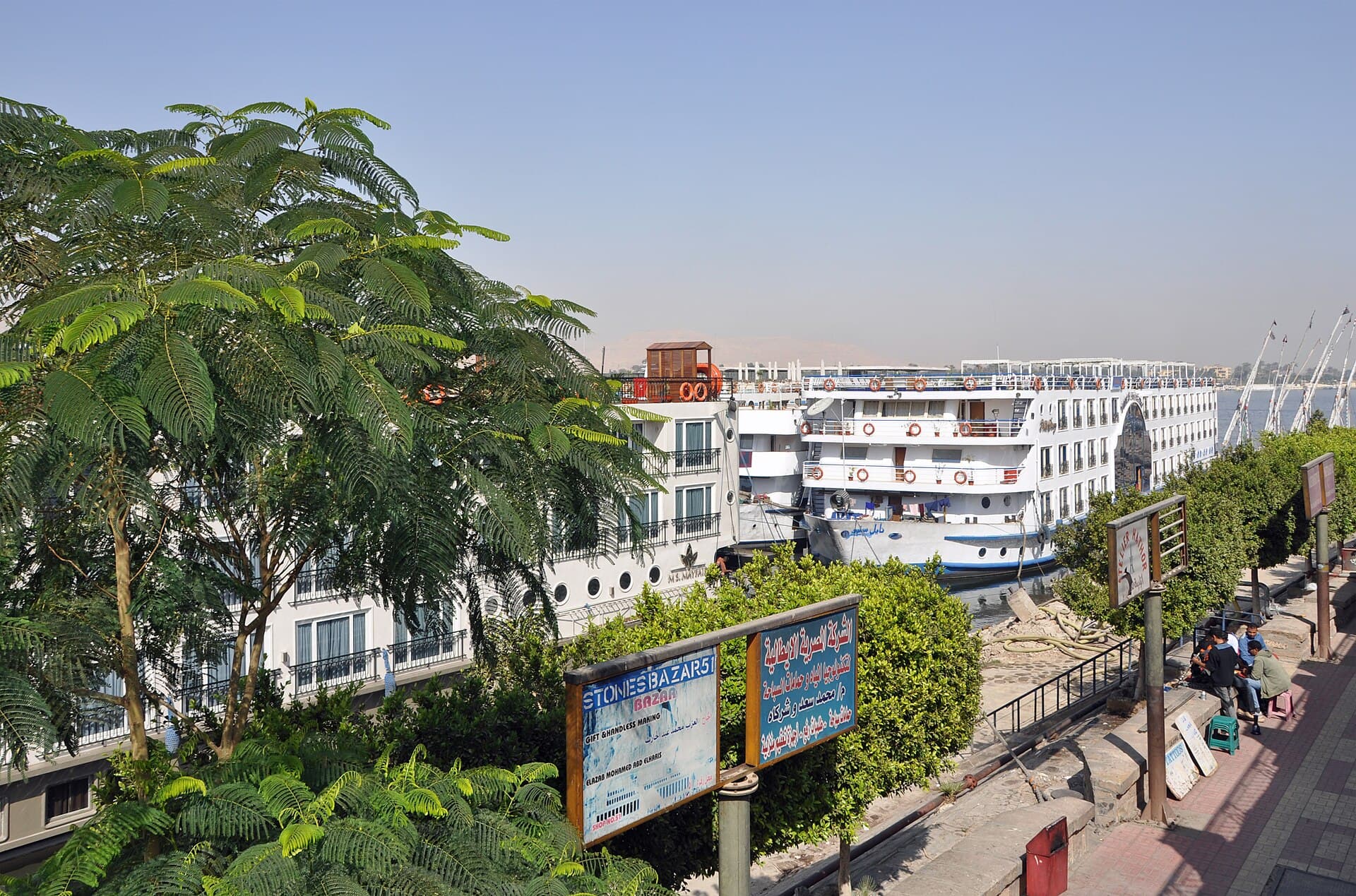
If you are on a Nile cruise, this is mostly decided for you: boats moor on the east bank, the West Bank is a fixed morning excursion, and the Colossi will be on it. If you are staying in a hotel, you are arranging the driver yourself, and the sensible instruction is simply to say you want the Valley of the Kings at opening. The rest of the circuit, including this stop, falls into place behind that.
When is the best time to stop?
Early morning gives you the statues front-lit, since they face east, and the light on the quartzite is genuinely good for the first hour or two after sunrise. It is also when the coach groups pass through, so you trade quiet for light. Late afternoon puts the faces in shadow with the sun behind them, which is harder to photograph but far calmer.
In summer this is a hot, exposed roadside with no shelter of any kind. Between roughly May and September the middle of the day on the West Bank is punishing, and the Colossi offer nowhere to escape it. Winter, from November to February, is the comfortable season and also the busiest. If you are in Luxor in high summer, do the whole West Bank early and be back across the river by late morning.
What do most visitors get wrong?
Three things. They expect a site and find a lay-by, which sours them on it before they have looked properly. They ignore the excavation field behind, which is now the more substantial thing to see. And they let the hawkers and camel handlers by the parking area turn a pleasant stop into an argument.
On the last point, a firm and friendly refusal works, repeated as many times as necessary. Do not accept anything placed in your hand. Do not agree to a photograph with an animal without settling the price first and in full, and expect it to be renegotiated afterwards if you did not. This is normal at roadside stops across Egypt and is not specific to here, but it catches people out on their first West Bank morning.
Is it worth photographing at all?
Yes, and it is one of the easier Egyptian subjects. The statues are large and isolated against open sky and flat farmland, with the Theban hills behind. There are no barriers to shoot around and rarely a queue in the frame. A wide lens from low down exaggerates the scale, which is the point of them.
What does not work is the close-up. The surfaces are heavily eroded, the faces are gone, and detail shots read as blank stone. Shoot the pair together, or one statue against the hills, or a person at the base for scale. Then put the camera away. The ancient graffiti is worth finding with your eyes but rarely photographs legibly without low, direct light falling across it.
What else stands on this stretch of road?
More than most itineraries admit. The temple of Merenptah sits immediately beside the Colossi, built by a later king who took a good deal of his stone from the ruin of Amenhotep III's temple next door, which is a tidy illustration of how the west bank recycled itself. Further along stands the Ramesseum, the memorial temple of Ramesses II, a ruin rather than a standing building and quieter for it.
Medinet Habu is the one to add if you are adding anything. It is the best-preserved of the west bank memorial temples, it still holds colour on the walls and ceilings, its high walls give you shade in the middle of the day, and it takes a fraction of the groups that Hatshepsut does. Deir el-Medina, the village where the men who cut the royal tombs lived, is the other strong candidate, and its small decorated tombs are among the most likeable things in Luxor.
The honest caveat is heat and attention. Three sites is a full west bank morning, four is a long day, and by the fifth almost nobody is still looking properly. If your day already holds the Valley of the Kings and Hatshepsut, do not bolt two more temples onto it for the sake of the list. If you have a second west bank day, this is exactly where it goes.
Seeing the temple field from the air
The sunrise balloon flight is the one way to understand the layout without a plan drawing. From a few hundred metres up, the west bank resolves into its actual geography: the hard line where irrigated green stops and desert begins, the memorial temples strung along that line on the flood plain, and the cliffs behind with the tombs cut into the valleys beyond them. The Colossi and their empty field sit in that band, and the shape of the vanished temple reads far better from above than from the roadside.
Two honest caveats, the same ones that apply to the flight generally. The pilot controls height, not direction, so no operator can promise you a particular monument beneath you on a particular morning. And flights are cancelled for wind often enough that you should book them for your first morning in Luxor rather than your last. Neither is a reason not to go up, but both are reasons not to build the day around a view nobody can guarantee.
Common questions
Do you need a ticket to see the Colossi of Memnon?+
The roadside view of the two statues has traditionally been free, as they sit beside a public road with no enclosure. Access to the excavated temple area behind them is a separate matter and has changed as the dig has progressed. Ticketing on the West Bank is revised periodically, so confirm the current arrangement with your guide or at the Luxor ticket office on the day.
How tall are the Colossi of Memnon?+
Each seated figure is roughly 18 metres high, and taller again measured with the stone platform beneath it. That puts the top of the head somewhere around the height of a six-storey building. Standing close to the base removes any sense of the scale, so step back across the road for a moment before you decide they are underwhelming.
Why are the faces of the Colossi destroyed?+
Weathering rather than vandalism, in the main. Three and a half thousand years of wind-blown sand, plus salt crystallising in the stone as groundwater evaporates at the surface, strip the finest carved detail first. Faces are the finest detail on a figure this size. The northern statue has the added complication of earthquake damage and a Roman rebuild of its upper body.
Are the Colossi of Memnon accessible for wheelchair users?+
Better than most Egyptian sites, since there are no stairs, no tombs to descend into and no long approach on foot. The pull-in is flat and the statues sit close to it. The ground is sand and compacted grit rather than paving, which is manageable but not smooth. There is no shade and no seating, so time the stop for the cooler hours.
Can you go inside or climb the Colossi?+
No. They are solid carved figures with no interior, and climbing on them is not permitted. Barriers keep visitors back from the bases at times, depending on conservation work. This is one reason the stop is short: everything there is to see, you see from the ground in a few minutes of walking around them.
How far are the Colossi from Luxor town?+
They sit on the West Bank a short drive from the river crossing, at the start of the road leading to the Valley of the Kings and the other Theban sites. From central Luxor it is a bridge or ferry crossing plus a brief drive, well under an hour in normal traffic. Every West Bank itinerary passes them, so the journey is never made for their sake alone.
Which of the two statues made the sound?+
The northern one, on your right as you stand on the road and face them. It is the figure cracked by the earthquake and later repaired by the Romans, who rebuilt its upper body in courses of sandstone blocks that you can still pick out today against the original quartzite. The southern statue was never reported to have made any noise at all.
Do the Colossi still make the sound today?+
No, and they have not done since antiquity. The noise is generally understood to have depended on the earthquake cracks in the northern figure, and the Roman repair that rebuilt its upper body closed them. There has been no credible report of the sound since. Anyone who tells you at the roadside that it still happens at dawn is selling you something.
Is a guide worth having for this stop?+
Not for the statues themselves, which take five minutes to look at. A guide earns their fee here by explaining the vanished temple behind them and by knowing whether the excavation area is open that day, which changes. If you are already touring the West Bank with a guide, this stop becomes considerably more interesting. Hiring one specially for it would be absurd.
Is it a good stop with children?+
Briefly, yes. It is short, it is outdoors, there is nothing fragile within reach and nothing to queue for, which makes it an easier proposition than an airless tomb. Two enormous broken statues also need no explanation to land with a child. The limits are heat and shade, of which there is none, so keep it to a few minutes in warm months and keep water to hand.
Is there anything else nearby worth adding to the stop?+
The Colossi sit among several less-visited West Bank sites that most itineraries skip, including the temple of Merenptah beside them and the artisans' village at Deir el-Medina. If your day already holds the Valley of the Kings and Hatshepsut, adding more is a mistake in the heat. If you have a second West Bank day, this is where it goes.
Official sources
Entry rules, opening hours, security advice and exchange rates all move. Check them at the source, not here.
Written and checked by the Nile Trip Guide editorial team · Last reviewed . Entry rules, prices and opening hours change — check anything critical against the official sources linked on this page.
The route most people take first, at the length it was built for: Giza and the Grand Egyptian Museum, then a flight to Luxor and four nights sailing down to Aswan.
No boat on this one. Giza and the Grand Egyptian Museum, a night in Luxor for both banks, two nights on the Red Sea, then back to Cairo for the Citadel, Coptic Cairo and the Royal Mummies.
Five nights in Cairo either side of a four-night sail from Luxor to Aswan. The Cairo days are private, just your party and a guide; the sightseeing off the boat is shared with a small group.