Khan el-Khalili: how to visit Cairo's medieval bazaar
Khan el-Khalili is the medieval trading quarter at the centre of Islamic Cairo, and it is both one of the city's best hours and one of its most oversold. Some of what is sold here is made by hand a few streets away. Much of it was made in a factory and could be bought anywhere in Egypt. Knowing the difference is most of the skill.
What is Khan el-Khalili, and how old is it?
The market takes its name from Emir Jaharkas al-Khalili, who built a khan here in the 1380s under the Mamluk sultan Barquq: a merchants' inn with storerooms below and rooms above. The ground already carried weight, sitting over a Fatimid burial vault on the edge of the caliphs' palace grounds. For centuries this was where long-distance trade landed in Cairo, in spices, textiles, coffee and gold. The oldest fabric visible today, the carved stone gateways and vaulted passages, mostly dates from a rebuilding under Sultan al-Ghuri in the early sixteenth century, with Ottoman and later work on top.
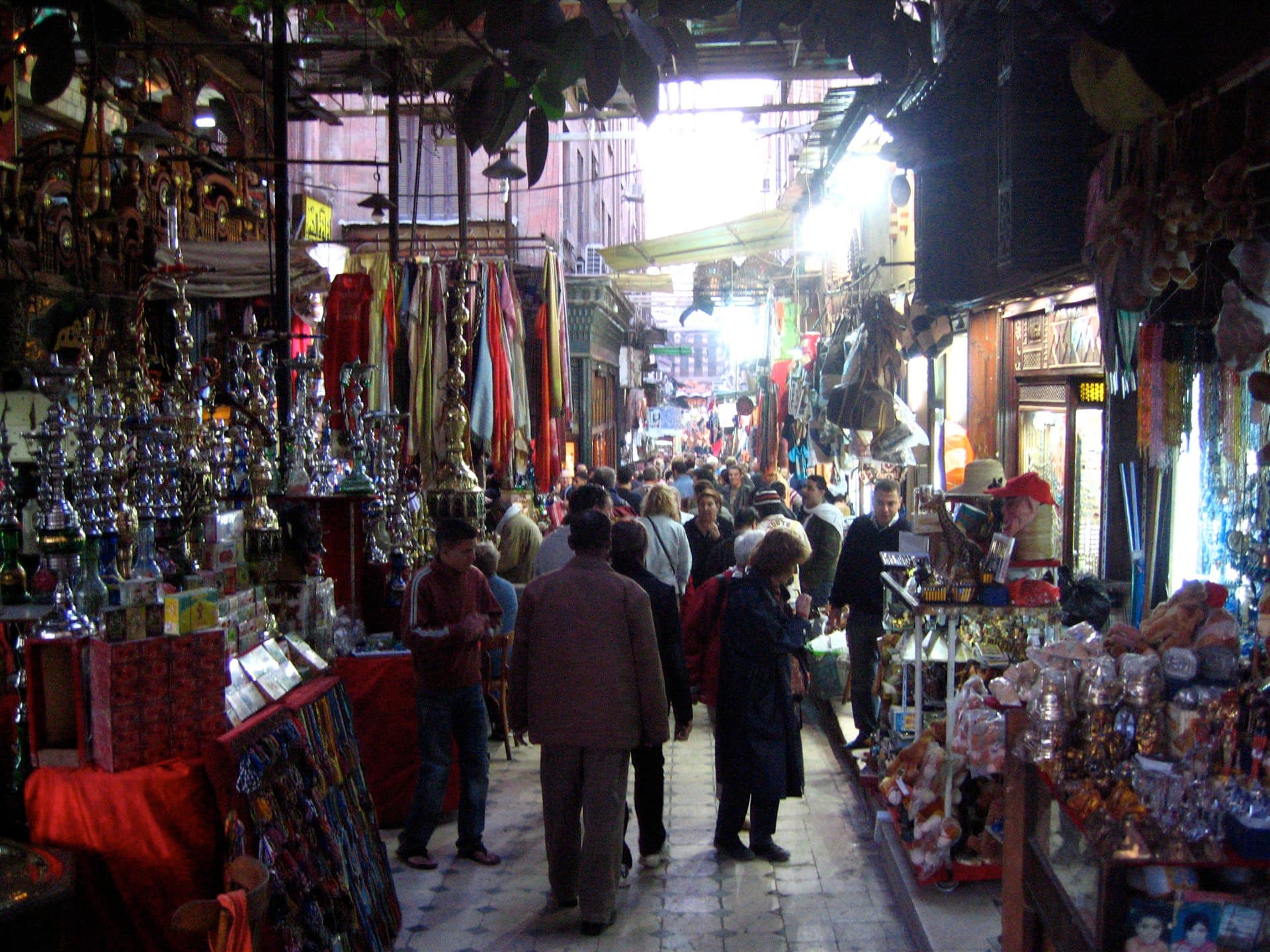
It is not a preserved monument. Khan el-Khalili is a working market that has been continuously rebuilt, and it serves two customers at once. One is the visitor, funnelled into the short run of souvenir stalls near the mosque. The other is Cairo: goldsmiths supplying wedding jewellery, coppersmiths beating trays to order, wholesalers in beads and perfume bottles. Both are real. Only one of them is aimed at you.
Why the quarter is here at all
The market sits inside a city that was founded as a walled royal enclosure rather than a trading town. The Fatimids laid out al-Qahira in the tenth century as a palace city for the caliph and his court, with a processional avenue running through the middle of it and gates at either end. That avenue is al-Muizz Street, named for the caliph under whom the city was founded, and the reason it still reads as a spine eleven centuries later is that everything built afterwards was built along it.
The great stone gates at the northern and southern ends, Bab al-Futuh, Bab al-Nasr and Bab Zuweila, belong to a later rebuilding of the walls in the eleventh century, and they are the clearest surviving evidence of what the enclosure was for. When the palaces came down and the ground was sold off, the merchants moved in, and the khan that gave this market its name was built on part of that former palace ground. The market is what happened to a royal quarter once the royalty left.
One consequence is worth carrying with you. The lanes you walk are not a bazaar laid over a medieval street plan; they are the medieval street plan, narrowed and roofed and rebuilt by eight hundred years of tenants. The awkward angles, the sudden vaulted passage, the courtyard behind a shopfront that turns out to be older than the shop, all of it is the original geometry still in use. Nothing here was designed as an attraction, which is precisely why it is worth an evening.
How is the bazaar laid out?
Al-Azhar Street cuts the district in two. North of it lies Midan Hussein, the open square in front of the al-Hussein Mosque, and behind that the dense knot of covered lanes most people mean when they say Khan el-Khalili. Al-Muizz Street, the old spine of Fatimid Cairo, runs north to south through the middle of it. Muski Street heads west and is where Cairenes shop for clothes, fabric and household goods rather than souvenirs.
The core is compact and you cannot get badly lost, which is fortunate, because phone maps handle the covered lanes poorly. Use the mosque minarets to reorient. The useful rule is depth: the lanes closest to the square are the most heavily worked and the most expensive, and both quality and prices improve two or three turns in. Wear shoes you do not mind ruining, because the ground is uneven and often wet.
It also helps to know that the market is organised by trade rather than by street name, which is how it has always worked. Gold is sold in its own alley, largely by weight. Copper and brass cluster together, and you can hear them before you see them. Spices, dried flowers and loose tea occupy another run, perfume bottles and glass another, fabric and hardware along the Muski. If you cannot find something, the question to ask is not where a shop is but where that trade sits.
A route that gets you past the first three lanes
Start at Midan Hussein, because it is where every taxi and every driver will put you, and because the mosque gives you a fixed point to steer by. Give the souvenir run one pass rather than none: it is worth seeing what the standard offer looks like, and it calibrates you for everything afterwards. Then turn into the covered lanes and keep turning until the shopfronts stop addressing you in English. That happens sooner than most visitors expect, usually within five minutes' walk.
From the middle of the market, come out onto al-Muizz Street and walk north. This is the best street walk in Cairo and it is free, in the sense that the street itself costs nothing even where the individual monuments charge. Go as far as the northern gates if you have the legs, then turn and come back. Southwards from the crossing, the same street runs down to Bab Zuweila and, beyond it, the covered Street of the Tentmakers.
For a half day, the workable order is monuments while it is cool, market as the light goes, and something with a view at the end. Two hours covers the market alone if you are browsing rather than buying. Four to five covers the market plus the al-Muizz monuments at a walk. Anyone trying to do the Giza plateau and this quarter in the same day is planning two trips across Cairo, and the traffic rather than the distance will decide how that goes.
What is genuinely worth buying?
Worth the money: hand-beaten copper and brass, which you can often hear being made a lane away; plain cotton and linen scarves; spices bought by weight from a merchant with local customers; inlaid backgammon boards, provided the inlay is cut wood and shell rather than a printed transfer; old brass lamps and coloured glass; silver sold by weight. Best of the lot is appliqué work from the covered Street of the Tentmakers, south beyond Bab Zuweila, which is genuinely handmade and has no factory equivalent.
There is a simple test that covers most categories, and it is the same test each time: can you see, hear or feel the work in the object? Hammered copper carries the marks of the hammer, unevenly, because a hand made each one. Cut inlay has edges you can catch a fingernail on; a printed transfer is glassy and continuous. Hand-stitched appliqué has stitches on the reverse, and no two panels are identical. Machine work is consistent, and consistency is the thing to be suspicious of here.
Buying where the work is done is the other half of it. The copper lanes, the tentmakers' street and the fabric stretch of the Muski all put the maker and the seller in the same place, which removes a layer of markup and most of the ambiguity about origin. It is also the more interesting hour. Watching a tray being beaten, or a panel being stitched, tells you what the object is worth far more reliably than any conversation about price.
And what is not worth buying?
Skip most of the rest. Much of the papyrus on sale is pressed banana leaf: hold a sheet up to the light and real papyrus shows crossed strips, while the fake looks flat and goes brittle. Alabaster figures arrive by the crate from workshops near Luxor, and the cheapest are pressed stone dust rather than carved. Oils sold as concentrated perfume essence are usually heavily diluted, and those shops run the hardest sell in the market. Scarabs, small pyramids and camel figurines are stock items sold at every stall in the country, at every price.
Treat the word antique with particular scepticism. Exporting genuine antiquities from Egypt is illegal, and anything actually ancient could not lawfully go home in your bag, which means that an object presented as ancient is either not ancient or not something you should be buying. The honest version of this trade does exist: old brass, old glass, second-hand jewellery, none of it claiming to be pharaonic. Buy that on its own merits and ignore any story attached to it.
Cartouches in gold or silver, cut with your name in hieroglyphs, sit in a middle category. They are made to order and often perfectly well made, but they are a tourist product, they are priced as one, and the metal content is the only part of the price you can verify. If you want one, buy it by weight from a dealer in the gold alley rather than by charm from a stall on the square.
How does haggling actually work?
Expect a first price well above what the seller will take, often several times it. Open low, move in small steps, stay friendly, and be ready to stop. Walking away is the only real leverage you have, and it works. If you are called back, your number was workable; if you are not, it was below what the seller can do. Decide what the object is worth to you before you start, and hold there.
Some caveats. Do not haggle over food, tea, or a fare you have already agreed. Accepting tea obliges you to nothing, but do not accept it if you already know you are not buying. Fixed-price shops exist and are frequently fairer than the theatre. Carry small notes, because a shortage of change is a standing excuse for rounding up. Settle the price, the currency and what is included before anything gets wrapped.
The rhythm matters as much as the numbers. The first price is an invitation rather than an insult, and your first offer should sit well below it without being contemptuous. From there it is a conversation, ideally an amused one, and the seller expects you to walk at least once. If the price lands where you decided the object was worth it, take it rather than grinding for the last few pounds: those pounds mean considerably more to the stallholder than to you, and the point was the object rather than the victory.
If the whole ritual leaves you cold, that is a legitimate position and there is a clean answer to it. Buy nothing in the tourist lanes, accept the tea for what it is, and spend your money in fixed-price shops instead. Nobody is obliged to enjoy bargaining, and the market is worth walking through even if you buy not one thing in it.
Money in the market: cash, change and quoted prices
Bring Egyptian pounds in small notes and plenty of them. Most stalls are cash only, cash machines sit on the surrounding streets rather than inside the lanes, and change is the commonest friction in any transaction here. Larger gold, carpet and antique dealers may take a card, often with a surcharge added on top. Dollars and euros are accepted in places, but at a rate set by the person accepting them, which is another way of saying at a price.
You will notice that this page prints no prices, and that is deliberate. The Egyptian pound has moved a great deal in recent years and any figure written down here would be misleading within a season. Ask your guide or your operator what things currently cost before you go in, compare two or three stalls for the same object, and treat any price quoted to you in foreign currency as the least favourable number in the conversation.
Two habits make the money side easier. Keep a small-note float separate from your main wallet so you are never counting out a thick stack in a crowded lane, and carry roughly a day's worth rather than everything you have. The realistic risk in the market is short-changing and opportunistic theft rather than anything more serious, and both are largely defeated by not keeping it all in one pocket.
If you buy something bulky, ask about shipping before you agree a price rather than afterwards. Larger dealers will offer to arrange it, the cost is rarely trivial, and the arrangement is between you and them. The safer purchase in a market like this is the one you can carry home yourself.
Are the cafés worth stopping for?
El Fishawi, on a lane off the main run of stalls, is the famous one: tall spotted mirrors, brass tables, and a long association with the novelist Naguib Mahfouz, who wrote about this quarter. It claims a founding in the late eighteenth century, a date repeated everywhere and evidenced nowhere. Honestly assessed, it is crowded, slow, dearer than an ordinary Cairo ahwa, and sellers will reach your table every few minutes. Worth one glass of tea for the room. Not worth an hour.
Alternatives sit close by. A smarter air-conditioned café named after Mahfouz is a lane away, quieter, with a proper toilet and prices to match. The plain ahwas north of Midan Hussein cost a fraction and are where people actually sit. Order tea with mint, karkade, or Turkish coffee by sweetness: sada, mazbout or ziyada. Sitting still for half an hour is the best thing the Khan offers, and it costs almost nothing.
The ahwa is a real institution rather than a picturesque one. It is where men gather over coffee, tea and a shisha pipe, where the backgammon boards come out, and where a great deal of the quarter's business is actually conducted. Nobody will mind you sitting in one, and nobody will make a fuss of you either. Order, pay when you leave, and let the place get on with its evening around you.
Eating in and around the quarter
The food near the market is cheap, decent and not a destination. Around Midan Hussein and along Al-Azhar Street there are grill places and koshari counters, and the rule for choosing between them is the same one that works across Egypt: go where it is busy and where the food is cooked to order in front of you. Koshari, the one-bowl lunch of rice, lentils, macaroni and fried onion under a tomato sauce, is the reliable cheap meal and costs very little.
Fresh juice stands are everywhere and press whatever is in season, and a glass of mango, guava or orange costs almost nothing. Sugarcane juice, asab, is pressed to order at a busy stand and is a street drink rather than a restaurant one. In winter you will see sahlab, a warm thick milk drink dusted with cinnamon and nuts, which is the right thing to be holding on a cold evening in the lanes.
The famous cafés are for tea and shisha rather than meals, and the hotel restaurants a taxi ride away are priced for the setting rather than the cooking. The sensible plan is to treat the Khan as the hour before dinner rather than dinner itself: a glass of tea in the market, a proper meal somewhere else afterwards. Carry small notes, because street places are cash only and the change problem applies here too.
Is the evening the best time to go?
Usually, yes. After dark the lanes are lit, the mosque is floodlit, the heat has gone and Cairenes come out, so the square works as somewhere to sit rather than somewhere to be sold to. Late morning is the other good window: calm, good light, and some shops still shuttered. Midday in summer is genuinely punishing. On Fridays much of the market shuts around the midday prayer and the streets by the mosque fill up.
Between November and March the evenings are cool enough for a layer. From June to September, do not attempt the middle of the day. Ramadan nights are the most alive the quarter ever looks and the worst time to browse or eat without a plan. Allow two hours for the market alone, or half a day if you are walking the wider quarter with it.
Hours here are informal rather than published. Shops open through the morning, stay open into the late evening, and individual stalls shut when the owner decides to shut. That cuts both ways: nothing is reliably open at nine in the morning, and a great deal is still open at ten at night. Plan around the Friday midday prayer and the religious calendar rather than around opening times, because those are the only fixed points.
Fridays, Ramadan and the al-Hussein Mosque
The mosque on the square is not incidental to the market; it is the reason the square is busy. Al-Hussein is among the most venerated mosques in Cairo, and it draws worshippers and visitors from across the city, particularly around Friday prayers and during the religious festivals. Access for non-Muslims is restricted and the arrangements change, so ask at the door rather than assuming, and dress and behave as you would at any working place of worship.
Friday is the one day with a predictable shape. Much of the market closes around the midday prayer, the streets by the mosque fill, and the shops reopen through the afternoon into a busy evening. It is a poor morning for shopping and an interesting one for watching, provided you keep out of the way and do not photograph people at prayer. Friday morning is also, incidentally, the one reliably quiet window in Cairo traffic, so it is a good time to cross the city.
Ramadan changes everything about the quarter. The lanes are quiet through the day and extraordinary after sunset, the square fills, the lights go up, and the whole area stays awake until very late. It is the most alive the market ever looks and the hardest time to browse or eat casually, because everyone else is doing the same thing at the same hour. If your trip falls in Ramadan, go, but go with a plan and low expectations about shopping.
The Street of the Tentmakers
South beyond Bab Zuweila runs the covered Street of the Tentmakers, and it is the single best thing to buy in Cairo. The trade here is appliqué: panels of coloured cotton cut and stitched by hand onto a backing, in geometric and Islamic patterns, historically for the great ceremonial tents. The work is still done by hand and largely still done in the street, with the makers sitting in the shopfronts stitching while you look.
It is a short walk from the market and almost nobody makes it. The street is roofed, which keeps the sun off and gives it a different light from the lanes to the north, and the pace is entirely different: fewer sellers, less pressure, and conversations that are about the work rather than the sale. Panels run from cushion-sized to wall-sized, they roll up flat, and they weigh almost nothing, which makes them the rare market purchase that solves its own luggage problem.
Bab Zuweila itself is worth the detour even if you buy nothing. The gate is one of the surviving medieval city gates, and its minarets can usually be climbed for the clearest view across the rooftops and minarets of the quarter. Confirm on the day whether the climb is open, as with everything else in Islamic Cairo.
How does it fit with Al-Azhar and the Islamic Cairo walk?
Al-Azhar Mosque stands directly across Al-Azhar Street, reached by a footbridge. Founded by the Fatimids in the tenth century and still a working centre of teaching, it is the counterweight to the market: a wide plain courtyard, white marble, and quiet. Dress modestly with shoulders and knees covered, a headscarf for women, shoes off at the door. Avoid prayer times, and check entry arrangements on the day, as they change.
From the Khan, Al-Muizz Street north is the best street walk in Cairo. Bayn al-Qasrayn, which gave Mahfouz the title of the first Cairo Trilogy novel, puts the Qalawun complex and the Barquq and al-Nasir Muhammad facades one after another, with a run of sabil-kuttabs continuing towards the old northern gates at Bab al-Futuh and Bab al-Nasr. Southward the same street reaches Bab Zuweila, whose minarets can usually be climbed for the clearest view across the rooftops of the quarter.
The sensible order is monuments first, while it is cool and the interiors are open, then the market as the light goes. To finish on a view, Al-Azhar Park is a short taxi ride east and looks back over the minarets at sunset. Confirm opening times locally on the day; several of the smaller monuments close early, or without notice, and the walk is worth rearranging around them.
If you have a full day for the medieval city rather than an afternoon, the two additions worth making are Ibn Tulun and Sultan Hassan, both south of this quarter rather than in it. Ibn Tulun is a ninth-century courtyard mosque, almost unchanged and almost empty, with a spiral minaret. Sultan Hassan, below the Citadel, is a fourteenth-century hall that muffles the traffic outside. Neither is walking distance from the Khan, so take a taxi and treat them as a separate stop.
Getting there, and getting away again
There is no metro station at the door. The nearest, Attaba and Bab el-Shaaria, leave you a walk of fifteen minutes or more through heavy traffic and crowded market streets: fine in daylight, tiring at night. Most people take a taxi or a ride-hailing app to Midan Hussein or Al-Azhar Street, and that is the right call. The apps matter here for one reason above all: the fare is agreed before you get in, which removes both the negotiation and the argument about change.
Judge the journey by the hour rather than the kilometres. Cairo traffic builds through the late morning and again from mid-afternoon into the evening, and a five-kilometre hop can take an hour at the wrong time. The practical planning rule for the whole city applies to this quarter too: pair your days by which bank of the Nile you are on. Giza, the plateau and the Grand Egyptian Museum sit on one side, the medieval city and the bazaar on the other, and criss-crossing between them is how visitors lose afternoons.
Going home, book from the square rather than accepting a street price, and be patient about the pickup, because the lanes are closed to cars and drivers cannot reach you inside them. Walking out to Al-Azhar Street is often faster than waiting for a car to work its way round. If you are leaving late, come out of the deep lanes before the shops shut, because they empty quickly once they do.
What do most visitors get wrong?
The commonest mistake is never getting past the first few lanes. The stretch between Midan Hussein and the main crossing is the most heavily worked ground in the quarter, and people judge the whole place on it. The second mistake is reading persistence as hostility. You will be approached constantly, with the same few opening lines, and it is a sales script rather than a threat. A flat "la, shukran" delivered without stopping ends nearly all of it.
A few practical things. Ignore anyone who tells you a site is closed today and offers an alternative, because it is almost always a shop commission. Book taxis through an app or agree the fare first, and refuse detours to a papyrus or perfume institute. Keep your bag in front of you in the crush, though serious crime here is rare and the visible police presence is routine. Ask before photographing people, and accept a no.
The scripts are worth learning because they are consistent, and recognising one lets you decline early and warmly rather than getting drawn in and then feeling cornered. A stranger says the site is closed for prayer, or that the entrance is round the other side, and offers to help. A friendly man attaches himself to you inside a monument and expects a tip at the end. A small gift is pressed into your hand, or your child's, which then cannot be given back without buying something. None of it is dangerous and most of it is good-natured. It is selling.
The clean exit is the same every time: a smile, a firm la shukran, and no slowing of your pace. Stopping to argue, explain or apologise keeps the conversation alive, which is exactly what the pitch needs. Walking on while remaining pleasant ends it without anyone losing face, which is the outcome both sides would actually prefer.
Photographs, children and getting around on foot
Ask before photographing anyone and accept a refusal. In some cases a small tip will be expected afterwards, which is reasonable enough. Photographing women without asking is a straightforward way to cause offence, and a camera lowered when someone shakes their head, then raised again only on a nod, buys more goodwill than any tip. Shopfronts, copper, spice sacks and lamps are all fair game and photograph far better than people do.
The market works well with children in the evening, when the heat has gone and the lanes are lit, and badly in the middle of a summer day. The one thing worth doing before you go in is agreeing the shopping rules, because everything in the first few lanes is designed to start exactly that argument. Keep hold of small hands in the crush around the square, which is the one genuinely busy point, and expect the children to be addressed directly by sellers.
On mobility, be honest with yourself before you commit to the deep lanes. The ground is uneven, frequently wet, and occasionally stepped, the covered passages are narrow, and the crowds do not part. There are no vehicles inside, which helps, and the open ground around Midan Hussein and along Al-Azhar Street is flat and manageable. Anyone unsteady on their feet can see a good deal of the quarter from the square and the main streets without going into the knot at all.
Is the Khan worth it if you hate shopping?
Yes, on one condition: go to look rather than to buy, and decide that before you arrive. Almost every complaint about Khan el-Khalili comes from people who went in undecided, got worked over for an hour in the souvenir lanes, and came out feeling harried. Going in with nothing to buy removes the leverage the whole first stretch depends on, and it turns the market back into what it actually is, which is a medieval quarter still in daily use.
What is worth the visit regardless of shopping: the vaulted passages and carved gateways of the old khan, the copper being beaten, the gold alley, the spice runs, the square at night with the mosque lit, and the walk up al-Muizz Street past eight centuries of facades. An hour of that plus a glass of tea is a complete visit, and it costs the price of the tea.
The opposite advice applies to anyone who genuinely enjoys buying things. Give it longer, go deeper, and spend the money where the work is done rather than where it is displayed. The tentmakers' street, the copper lanes and the fabric stretch of the Muski will repay a slow afternoon in a way that the stalls around the square never will.
Common questions
Do sellers take cards, or should I bring cash?+
Bring cash in Egyptian pounds, and plenty of small notes. Most stalls are cash only. Larger gold, carpet and antique dealers may take a card, often with a surcharge added. Cash machines sit on the main surrounding streets rather than inside the lanes. Dollars and euros are accepted in places, but at rates that cost you money.
Is Khan el-Khalili the same place as Old Cairo?+
No, and the two get confused constantly. Old Cairo, also called Coptic Cairo, is several kilometres south around the ancient churches, with its own metro stop. Khan el-Khalili sits in Islamic Cairo, the medieval Fatimid and Mamluk city. Different periods, different atmosphere, and too far apart to sensibly combine in one afternoon.
Can I get there by metro?+
Not to the door. The nearest stations, Attaba and Bab el-Shaaria, leave you a walk of fifteen minutes or more through heavy traffic and crowded market streets, which is fine in daylight and tiring at night. Most people take a taxi or ride-hailing app to Midan Hussein or Al-Azhar Street. Going home, book from the square rather than accepting a street price.
Is it comfortable for a woman visiting alone?+
Generally yes, and many do. The attention is mostly commercial, occasionally verbal, and wearying rather than dangerous. Loose clothing with covered shoulders reduces it noticeably, as does walking with purpose. The main square stays busy and well lit into the evening, but the deeper lanes empty once shops shut, so work your way back before then.
Is there anywhere worth eating?+
There are grill places and koshari counters around Midan Hussein and along Al-Azhar Street. They are cheap and perfectly good, but they are not destinations. Choose somewhere busy where food is cooked to order. The famous cafés are for tea and shisha, not meals. Plan a proper dinner elsewhere and treat the Khan as the hour before it.
Do I need a guide for this part of Cairo?+
Not for the market itself. It is small, self-explanatory, and a guide changes your dynamic with sellers, sometimes to your cost. For the Al-Muizz Street monuments a good guide earns their fee, because the interiors carry almost no labelling and the Mamluk history is dense. Half a day with someone who knows those buildings is money well spent.
What are the opening hours?+
There are none in any formal sense. Shops open through the morning, trade into the late evening, and individual stalls shut when the owner decides to. Nothing is reliably open early; a great deal is still open late. The one fixed point is Friday, when much of the market closes around the midday prayer and reopens through the afternoon.
How long should I allow?+
Two hours covers the market on its own at a browse. Half a day covers it properly alongside the al-Muizz Street monuments and the walk to Bab Zuweila, which is the version worth doing. A full day works only if you add Ibn Tulun and Sultan Hassan, which are a taxi ride away rather than walking distance.
How do I tell real papyrus from the fake?+
Hold a sheet up to the light. Real papyrus is made from strips laid across each other, so you see a crossed grain running through it. The banana-leaf imitation looks flat and even against the light, feels more like paper, and goes brittle with time. Much of what is sold in the tourist lanes is the imitation, and it is priced as though it were not.
Can I buy antiques and take them home?+
Exporting genuine antiquities from Egypt is illegal, so anything presented to you as ancient is either not ancient or not something you should be buying. Old brass, old coloured glass and second-hand jewellery are a different matter and are sold honestly enough as what they are. Buy those on their own merits and disregard any pharaonic story attached to them.
Should I accept the tea?+
Yes, if you might buy something, and no if you already know you will not. It is offered without obligation and accepting a glass does not commit you to anything, though it is polite to be pleasant about leaving without buying. Taking tea from a seller you have no intention of dealing with wastes their afternoon rather than yours.
Is it safe at night?+
The square and the main streets stay busy and well lit into the late evening, and serious crime here is rare; the visible police presence is routine rather than a sign of trouble. The deeper covered lanes empty out quickly once the shops shut, so work your way back towards Midan Hussein or Al-Azhar Street before that happens, and keep your bag in front of you in the crush.
Official sources
Entry rules, opening hours, security advice and exchange rates all move. Check them at the source, not here.
Written and checked by the Nile Trip Guide editorial team · Last reviewed . Entry rules, prices and opening hours change — check anything critical against the official sources linked on this page.
The route most people take first, at the length it was built for: Giza and the Grand Egyptian Museum, then a flight to Luxor and four nights sailing down to Aswan.
No boat on this one. Giza and the Grand Egyptian Museum, a night in Luxor for both banks, two nights on the Red Sea, then back to Cairo for the Citadel, Coptic Cairo and the Royal Mummies.
Five nights in Cairo either side of a four-night sail from Luxor to Aswan. The Cairo days are private, just your party and a guide; the sightseeing off the boat is shared with a small group.