The Grand Egyptian Museum: What It Holds and How to Visit It Well
The Grand Egyptian Museum stands on the desert edge at Giza, roughly two kilometres from the pyramids, and is billed as the largest museum in the world built around a single civilisation. It took over two decades to finish. It repays a proper visit rather than an hour squeezed between other stops, and this page sets out what is inside, how long you need, and what is worth skipping.
What is the Grand Egyptian Museum?
It is a purpose-built national museum on the approach to the Giza plateau from Cairo, designed by the Irish practice Heneghan Peng after an international competition in the early 2000s. Construction ran far longer than planned, and the galleries opened in stages before the full opening in November 2025. The building is aligned on sightlines to the pyramids, and its translucent stone front is cut with a repeating triangular pattern that catches the light.
This is not simply a rehousing of the old museum. Objects have come from Tahrir Square, from Luxor, from storerooms across the country, and from excavations never publicly shown. The collection runs to something in the order of a hundred thousand items, of which only a fraction is on display at any time. Treat that figure as a description of the storerooms behind the galleries, not of what you will walk past.
The distinction matters more than it sounds. Egypt has never had a shortage of objects; it has had a shortage of space to show them in and conditions to keep them in. What is new here is not the material but the room given to it, and the decision to display whole groups of finds together rather than the best pieces from each. That choice is the single thing that most changes a visit, and it is why an hour is not enough.
Where it sits, and how you get there
The museum is on the Giza side of the city, out where the built-up area gives way to desert, with the plateau a short drive further on. That geography is the practical fact to plan around. Giza, the Sphinx and the museum are all on the same side of the Nile; the old Islamic city, Khan el-Khalili and Coptic Cairo are across the river. Pair your days by which bank you are on and you will lose far less time to traffic than visitors who criss-cross the city.
Allow around an hour each way from downtown or Zamalek in normal conditions, and considerably more at rush hour. There is no direct rail link, so it is a road journey by taxi, ride-hailing app or private car. Cairo airport sits on the far side of the conurbation, so an airport transfer to the museum crosses the whole city and should never be treated as a quick hop between two points on a map.
If you are staying in Giza itself, near the plateau, the trip is short and the museum becomes an easy half day rather than an expedition. That is one of the better arguments for basing yourself on that side for the Cairo leg of a trip, particularly if you also intend to see Saqqara, which lies further south along the same desert edge. Hotels in central Cairo are livelier; hotels in Giza are closer to almost everything you came to see.
The building, and what is worth noticing about it
Most visitors walk through the architecture without looking at it, which is a waste, because the building is doing something deliberate. The front is a long wall of translucent stone cut with a repeating triangular pattern, and the effect changes through the day as the light moves across it. From the plaza, the pyramids sit beyond the far corner of the building rather than behind it, so the first view you get of them is oblique and framed rather than head-on.
The internal logic is simple once you see it: a wide entrance hall, a staircase climbing the full height of the building, and galleries laid out on the level at the top. Everything is built around that upward movement. Visitors who take the lift arrive at the galleries without having been walked up through the collection, and then wonder why the sequence feels arbitrary. It is not arbitrary; they skipped the argument.
The scale is the other thing to prepare for. This is a very large building on a very large plaza, and the distances inside are of a different order to a normal city museum. That is worth knowing before you arrive rather than discovering it somewhere near the far end of the upper galleries with an hour of your slot left and a tired party behind you.
What does it actually hold?
The permanent galleries occupy twelve halls on a grid: four broad periods, from the predynastic era to the Graeco-Roman centuries, each cut three ways by society, kingship and belief. You can walk it chronologically or follow one theme through time. Neither route is signposted as clearly as it should be, so decide which you are doing before you start rather than drifting between the two and losing the thread.
The headline is the Tutankhamun material: the complete find from the tomb, roughly five thousand objects, shown together for the first time since Carter's team cleared it between 1922 and the early 1930s. Tahrir only ever displayed a selection. Here you get the chariots, the beds, the shrines, the linen and the walking sticks alongside the gold, which is the point. The assemblage tells you far more about the burial than the mask alone.
There is also the Khufu solar boat, a cedar vessel of more than forty metres buried beside the Great Pyramid some 4,500 years ago and reassembled from its timbers over years of painstaking work. It was moved from its old home beside the pyramid to the museum site in 2021. Access arrangements have changed more than once since then, so confirm locally whether it is open on the day you plan to go.
Beyond those two set pieces, the halls carry the long sweep: predynastic pottery and grave goods from before writing, Old Kingdom statuary from the pyramid age, Middle Kingdom models and stelae, New Kingdom temple sculpture, and the Graeco-Roman material at the end where Egyptian and classical conventions sit awkwardly on the same objects. If you have come from Luxor or Aswan, this last part of the sequence will explain several things you walked past there without understanding.
The Tutankhamun galleries, and how to approach them
This is the reason most people buy a ticket, and it is worth being precise about what makes it different. Tutankhamun's tomb was small, awkwardly cut and largely intact, which is why the find matters: almost everything a king was buried with was still in it. Every other royal burial in the Valley of the Kings was emptied in antiquity. What you are looking at is not the richest burial ancient Egypt ever staged, but the only one anybody has seen more or less whole.
Shown together, the objects read as a household rather than a treasury. Furniture, boxes, board games, sandals, bundled linen, food jars, walking sticks, model boats, dismantled chariots. The gold is the part that photographs, but the ordinary objects are what tell you how the burial was meant to work: a person equipped for continuation, with the practical alongside the sacred. At Tahrir, where only a selection was ever shown, that reading was impossible.
The practical advice follows from the layout. The Tutankhamun rooms sit at the end of the walk, not the start, and going straight to them reverses the design. See them second, with the chronology behind you, and the objects stop being famous things and start being evidence. Go there first and everything afterwards is an anticlimax, which is the single commonest way visitors spoil their own day.
One expectation to correct in advance: the mummy is not here. Tutankhamun himself remains in KV62 in the Valley of the Kings, in the tomb he was found in. The consequence for a wider Egypt trip is that the tombs at Luxor are architecture and wall painting, and the objects that came out of them are a day's travel north. Seeing both, in either order, is what makes either one make sense.
The Khufu boat, and why it is not a sideshow
The solar boat is the oldest thing in the building by some margin and the least understood by visitors, most of whom give it a few minutes on the way out. It is a cedar vessel of more than forty metres, dismantled into its component timbers and buried in a sealed pit beside the Great Pyramid around 4,500 years ago, then lifted, studied and reassembled over years of work. For most of the modern period it sat in its own museum on the plateau, a few steps from where it was found.
What makes it remarkable is not the size but the survival of the joinery. This is a boat built from planks lashed and pegged together rather than nailed, and it comes from the same decades as the Great Pyramid. Standing next to it, you are looking at Old Kingdom carpentry at full scale, which is the one craft from that period you almost never see, because wood does not normally last.
It was moved to the museum site in 2021, and arrangements around it have changed more than once since. It has at times been treated as a separate hall with its own access rather than part of the general circuit. That is precisely the kind of detail that blogs get wrong, so ask on the day rather than planning your route around an assumption.
Why is three hours the minimum?
Distance is the problem, not the reading. From the entrance plaza to the far end of the upper galleries and back is a long walk on hard floors, and the Tutankhamun rooms sit at the end of that walk rather than the start. Visitors who allow ninety minutes tend to speed through the main halls, arrive at Tutankhamun with tired legs, and remember very little of either.
Three hours is the floor for a first visit. Anyone with a real interest should plan on five or six with a proper break. Sit down whenever seating appears, because it is not frequent. If you are travelling with children or anyone who tires easily, choose two or three halls in advance and accept that you will not see the rest. That is a better outcome than a forced march.
There is a second reason, less obvious than the walking. Egyptian material rewards comparison more than most: the same object types recur for three thousand years with small, telling changes, and the galleries are arranged so you can see the changes. That only works at a pace that lets you look at the second example while you still remember the first. Rush it and the collection collapses into a blur of stone and gold, which is what most people describe afterwards.
The atrium and the Grand Staircase
The atrium is dominated by the colossal statue of Ramesses II, about eleven metres of red granite that stood for half a century in the traffic of Ramses Square in central Cairo before being moved out to Giza in 2006. Seen indoors, at the right distance, it finally reads as sculpture rather than as a roundabout ornament. Most people photograph it from the entrance and walk on too quickly.
The Grand Staircase climbs from the atrium through the height of the building, lined with statuary, sarcophagi and stelae arranged so the scale grows as you rise. It is the best-designed thing here. Take the stairs rather than the lift, stop at each level, and finish at the glazed wall at the top, where the pyramids sit on the horizon. On a hazy day they are faint, so temper expectations.
Walk round the Ramesses colossus rather than photographing it from one angle. Colossal Egyptian sculpture is normally something you crane up at from a distance with the sun behind it; here you can get close enough to see how the face is modelled and how sharply the cartouches are still cut. Five minutes spent circling it will teach you more about how these statues were made than any label on the upper floors.
A route that works if you only have three hours
Start in the atrium and give the colossus its five minutes. Then take the staircase, slowly, stopping at each landing, and finish at the glazed wall at the top. That is perhaps forty minutes, and it is the part of the visit most likely to be skipped by people in a hurry, which is the wrong instinct: it is the sequence the building was designed around.
Next, pick a single line through the main halls rather than trying to cover them. Chronological is the easier choice for a first visit, because it gives you a spine to hang everything on. Allow an hour and accept that you are walking past a great deal. The alternative, following one theme such as kingship or belief across all four periods, is the better visit for anyone who has been to Egypt before.
Then the Tutankhamun galleries, with an hour for them and nothing scheduled afterwards. If the boat is open and you still have legs, it goes last. Leave the shops and the food for the end, or skip them entirely. Anyone who builds the day in the other order, with Tutankhamun at the start, tends to leave after ninety minutes convinced they have seen the museum.
Tickets, timed entry and booking ahead
Entry is normally timed and booked in advance online, and slots in high season go early. Arrange it before you fly rather than on the morning, and pick a slot that matches the plan: first entry if you want the galleries quiet, or early afternoon if you are coming off the plateau. A timed slot is an entry window, not a limit on how long you stay, but arriving late in the day with three hours of museum ahead of you rarely ends well.
We do not print prices on this page, for the same reason we do not print opening hours. Ticket categories in Egypt change, premium elements get added and removed, and a figure that is right when written is wrong within the year. What is worth knowing is the pattern: across Egypt, headline entry tickets are modest and the things people most want are often ticketed separately. The inner chamber of the Great Pyramid, certain tombs at Luxor and photography permits all work that way.
If you are travelling on a package, ask which entries are already included and which are collected on the day. A quote that looks cheaper has often just moved those line items out of the headline total. For the museum specifically, check whether any separately ticketed element is in your booking, and check it in writing rather than assuming that museum entry means everything inside the building.
Egyptian Museum vs Grand Egyptian Museum: what is the difference?
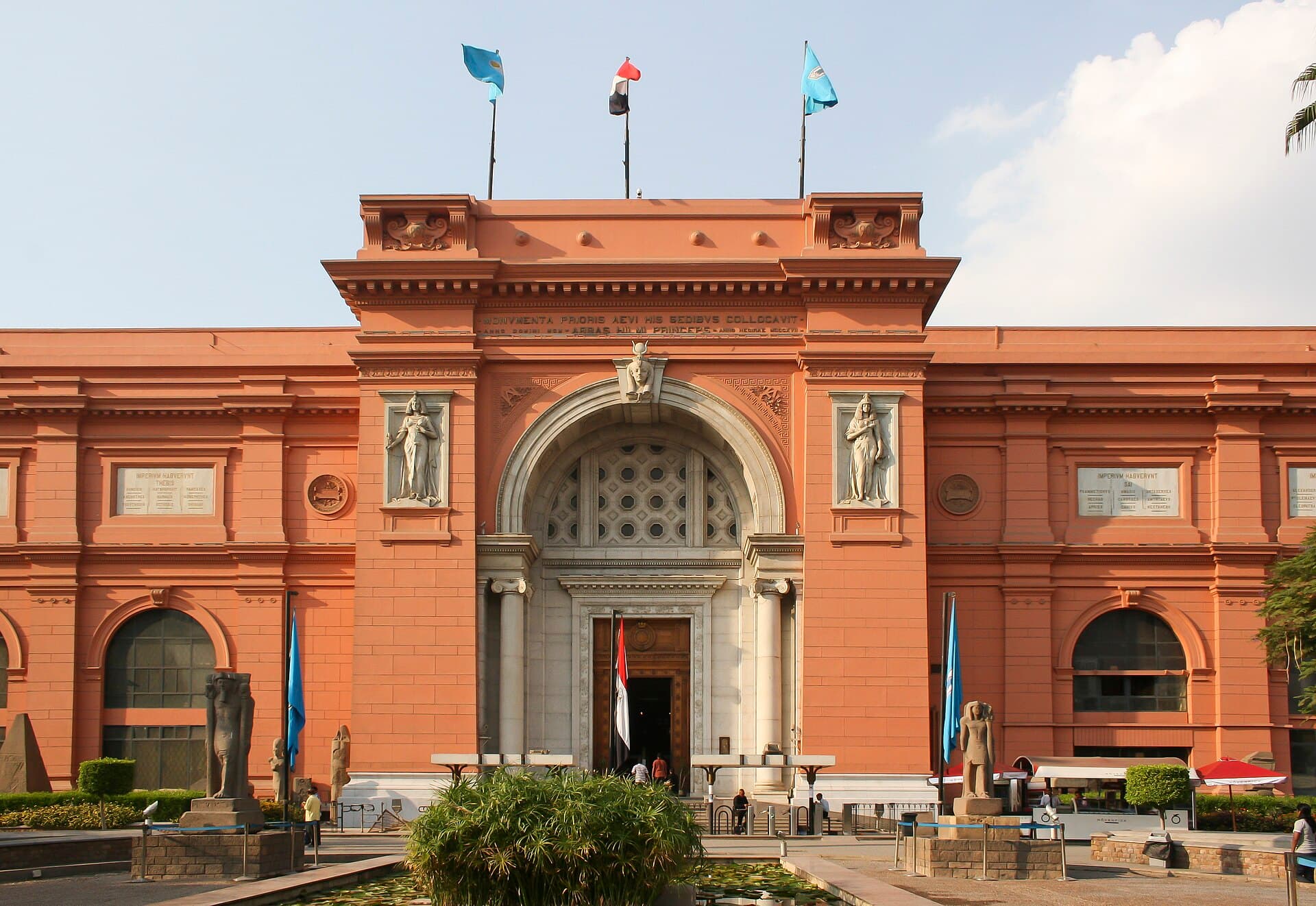
Tahrir is the 1902 building in the middle of Cairo: red, neoclassical, crowded and badly lit. Its cases are dense, its labels are old and in places handwritten, and the effect is closer to a Victorian collection than to a modern museum. Giza is the opposite. Space, climate control, clear sightlines, and objects given enough room to be looked at properly rather than stacked three deep behind glass.
The star pieces have moved. Tutankhamun is at Giza, and the royal mummies went to the National Museum of Egyptian Civilisation at Fustat in 2021, where they are shown in a dark, quiet hall that many visitors rate above both other museums. Tahrir keeps a great deal of Old and Middle Kingdom material, the Amarna sculpture and much else, but it no longer holds what most first-time visitors come for.
There is a question of temperament in this as well as logistics. Tahrir is a place to browse without a plan, where the pleasure is in the density and the accidents of arrangement. Giza is curated, sequenced and explained, and it wants you to follow an argument. Neither is better in the abstract. Which one suits you depends on whether you enjoy rummaging or prefer to be guided, and that is worth being honest with yourself about before you commit half a day.
Should you visit both?
If Egyptology is the reason you came, yes. Tahrir is noticeably quieter than it used to be, and quiet is worth a great deal in Cairo. If you have three days in the city and a general rather than specialist interest, one museum is enough, and it should be Giza. Adding Tahrir for the sake of completeness usually produces a tired afternoon and no clear memory of either place.
If you can add only one more museum, consider Fustat rather than Tahrir. The mummy hall is short, controlled and genuinely affecting, and an hour covers it. Tahrir needs half a day to repay the effort, because its value lies in browsing the density rather than ticking off highlights. Choose on the time you actually have, not on which building is the more famous name.
Do not attempt two museums in one day. It sounds efficient and it is the reliable way to remember neither. Egyptian collections are demanding in a specific way: the objects are unfamiliar, the names are unfamiliar, and the periods run to thousands of years. Concentration runs out long before the galleries do, and a second museum after lunch is usually money spent on walking past things.
What the museum does not hold
Three absences catch people out. The royal mummies are not here: they went to the National Museum of Egyptian Civilisation at Fustat in 2021. Tutankhamun's own mummy is not here either; it stays in KV62 in the Valley of the Kings. And a good deal of the material people associate with the old museum, including the Amarna sculpture and much Old and Middle Kingdom work, remains at Tahrir.
The larger absence is by design. The great temples stay where they were built, and no museum substitutes for them. Karnak, Luxor Temple, Abydos and Dendera are all in place and all reward a visit on their own terms. Abu Simbel is the one deliberate exception, and even that was moved only sixty metres up and two hundred metres back, in a UNESCO-led operation between 1964 and 1968, to keep it above the rising water of Lake Nasser rather than to put it in a display case.
This is the right way to think about how a trip fits together. Objects are in Cairo; architecture is in the south. The museum explains what came out of the tombs and temples, and the sites explain where it stood. Visitors who do only one half of that usually come home with either a lot of gold and no context, or a lot of stone and no sense of what filled it.
Can you combine it with the Giza plateau in one day?
Yes, and it is the sensible pairing, because the two sites are minutes apart by road. The order matters. Go to the plateau first, at opening, when the light is low and the coaches have not arrived; give it two to three hours; then move to the museum for the middle of the day, when the heat outside is at its worst and the air conditioning indoors becomes the point.
The reverse order works if you want the museum at its emptiest, but it puts you on the plateau in the afternoon with the tour groups and the haze. Either way, do not book anything else that day. A pyramids morning followed by a serious museum afternoon is a full day, and adding Saqqara or a bazaar stop is how people end up seeing three places badly.
The two sites are separate in every administrative sense, whatever their proximity suggests. Separate entrances, separate tickets, separate opening patterns. Budget the transfer honestly as well: minutes on a map, longer in practice once you have found a car, cleared the plateau exit and dealt with the parking at the other end.
Where it fits in two or three days in Cairo
With three days, the museum deserves a day of its own, and our Cairo pages argue for exactly that: one day for Giza, one for the museum, one for Saqqara and Dahshur or for the old city. That is the version with the most slack in it and the one most likely to be enjoyed rather than survived, particularly in the warm half of the year.
With two days, the pairing above is the compromise: pyramids at opening, museum through the middle of the day, and the second day given to Saqqara and Dahshur or to Islamic Cairo. It works, but it is a hard morning start on both days and you should plan the evenings accordingly rather than booking anything that needs energy.
With one day in Cairo, see the pyramids and the museum and accept that you are seeing nothing else properly. That is not a failure; it is the honest arithmetic of a city this size. The mistake is adding Saqqara or the bazaar on top and reducing all four to a series of photographs taken from a moving vehicle.
When should you go?
October to April is the comfortable season in Cairo, which makes it the busy one. May to September is hot enough to spoil the plateau but makes no difference to an air-conditioned museum, so summer visitors often get the better museum and the worse pyramids. Ramadan changes opening patterns and local visiting habits across the country. If your trip falls in it, have the times checked rather than assumed.
Within the day, the first entry slot and the last two hours are the quiet windows. Mid-morning is when the coach groups arrive and the Tutankhamun galleries turn into a slow-moving line. Entry is normally timed and booked in advance online, and slots in high season go early, so arrange it before you fly rather than on the morning. The Egyptian weekend of Friday and Saturday is busiest with local families.
One consequence is worth stating plainly for summer travellers. If you are in Egypt between May and September, the museum is the part of a Giza day that improves rather than suffers, and the plateau is the part that punishes you. Build the day around that: the plateau at opening and not a minute later, then indoors for the worst of the afternoon.
Do you need a guide?
A guide earns their fee here more clearly than at most sites, because the collection is vast and almost unlabelled by the standards of a European museum. Somebody who can tell you why a Middle Kingdom model differs from a New Kingdom one, or what the objects around the shrines were for, converts a walk past cases into something you remember. In the Tutankhamun rooms in particular, the difference is stark.
Guiding in Egypt is licensed, and the licence determines whether someone can accompany you inside sites at all. It also explains most of the price difference between cheap operators and good ones. If you are booking independently, ask about the licence, and ask whether the guide's background is in Egyptology rather than general tourism. For a museum of this kind the answer matters more than it does on a bus tour.
Agree the shape of the visit in advance. Say that you want commentary in the halls that matter and quiet in the rest, and that you intend to stop and look. Three unbroken hours of narration is the fastest way to stop taking anything in. If you are going in without a guide, read one period up beforehand and concentrate on that: a partial visit with a thread through it beats a complete circuit with none.
Visiting with children
This is the one museum in Cairo most children tolerate, and in some cases enjoy. It is big, modern and air-conditioned, the staircase of statues gives them something to climb towards, and there is space to move without being constantly shushed. Compared with a crowded, hot gallery of small cases, the odds here are far better.
What holds their attention is scale and recognisable objects: the colossus, the chariots, the boat, the furniture from the tomb. What does not is a case of amulets with a paragraph of text beside it. Plan on that basis. Pick two or three halls, use the lifts to save legs, and leave while everyone is still enjoying it rather than pushing on to the far end.
A short, well-chosen visit is a genuine success with children. A full circuit with a tired six-year-old is not, and the walking distances here make that outcome easy to stumble into. Eat before you go, bring water, and treat the exit as something you plan rather than something that happens to you.
What do most visitors get wrong?
The commonest mistake is treating the museum as an add-on to the pyramids. The second is going straight to Tutankhamun, seeing the gold first, and finding everything afterwards flat. The galleries are built to work in the other direction. The third is expecting the royal mummies, which are not here. The fourth is taking the lift, which skips the one sequence the architects clearly cared about most.
Two smaller things. Food inside is priced for a captive audience, so eat beforehand or accept that it will cost more than it should. And a guide earns their fee in the Tutankhamun rooms in particular, but agree in advance that you want commentary in the halls that matter and quiet in the rest. Three unbroken hours of narration is the fastest way to stop taking anything in.
A fifth, less often named: arriving without having decided what to skip. This is a collection that cannot be seen in a day, and pretending otherwise turns a visit into a route march. The people who come out pleased are almost always the ones who chose three things in advance, looked at them properly, and walked past the rest without guilt.
Common questions
Can you take photographs inside?+
Handheld photography is generally allowed in the main galleries, with flash and tripods restricted. Rules in the Tutankhamun rooms have been tighter and have changed since opening, at times involving a separate permit. Do not rely on what a blog said last year. Ask at the ticket desk on the day, and expect staff to enforce whatever the current rule is.
How long is the journey from central Cairo?+
Allow around an hour each way from downtown or Zamalek in normal traffic, and considerably more at rush hour. There is no direct rail link, so it is a road journey by taxi, ride-hailing app or private car. If you are staying in Giza itself the trip is short. Build the traffic into the plan rather than treating the drive as incidental.
Is it manageable with limited mobility?+
The building is step-free with lifts to every level, so the barrier is distance rather than stairs. It is a long way from the entrance to the far galleries and back again. Wheelchairs have been available to borrow but numbers are limited, so ask ahead if you need one. Plan a shorter route and use the lifts instead of the staircase.
What should you bring with you?+
Comfortable shoes matter more than anything else you carry. The air conditioning is strong, so a light layer is sensible even in high summer. Bring water, a charged phone and some cash for small purchases. Bags go through security screening at the entrance and large ones may not be permitted inside, so travel light rather than arriving with a full day pack.
Is the whole complex open?+
The main galleries and the Tutankhamun rooms are the core of a visit and are open. Other parts of the site have come online at different times, and some, such as the conservation laboratories, are working facilities rather than public galleries. Arrangements around the Khufu boat have changed more than once. Check what is actually running on the day rather than assuming.
Is it worth taking young children?+
The colossal statues, the chariots and the boat hold children's attention well. Cases of small objects do not. The size of the building is the real difficulty, so choose two or three halls, use the lifts and leave before anyone melts down. A short, well-chosen visit works. A full circuit with a tired six-year-old does not.
Is Tutankhamun's mummy on display here?+
No. The grave goods are here, but the king himself remains in KV62 in the Valley of the Kings at Luxor, in the tomb he was found in. The royal mummies of other pharaohs went to the National Museum of Egyptian Civilisation at Fustat in 2021. If seeing a royal mummy matters to you, that is the museum to add rather than this one.
Do you need to book tickets in advance?+
Yes, in practice. Entry is normally timed and booked online, and slots in high season go early, so arrange it before you fly rather than on the morning of your visit. A timed slot is an entry window rather than a limit on how long you can stay, but arriving late in the day leaves you short of the three hours the museum needs.
Is there a combined ticket with the pyramids?+
No. The museum and the Giza plateau are separate sites with separate entrances and separate tickets, whatever their proximity suggests, and they keep their own opening patterns. Budget for both, and budget for the transfer between them, which takes longer in practice than the distance on a map implies.
Can you see the pyramids from inside the museum?+
Yes, from the glazed wall at the top of the Grand Staircase, where the pyramids sit on the horizon beyond the plaza. It is the best single view in the building and the intended reward for taking the stairs rather than the lift. On a hazy day they are faint, so temper expectations and treat a clear morning as a bonus.
How much of the collection is actually on show?+
The holdings run to something in the order of a hundred thousand items, and only a fraction of that is displayed at any one time. The rest sits in storerooms and conservation facilities behind the galleries, which are working spaces rather than public ones. Treat the headline figure as a description of the institution, not of the walk you are about to take.
Is it better than the Egyptian Museum on Tahrir Square?+
For a first visit, yes, and it is the one to choose if you only have time for one. It has Tutankhamun, the space to show objects properly and a sequence you can follow. Tahrir is denser, older and more atmospheric, and it still holds a great deal, including the Amarna sculpture. It rewards browsing rather than highlight-hunting, so it suits a second trip better than a first.
How long should you spend at the Grand Egyptian Museum?+
Plan on three hours as the minimum for a first visit. If ancient Egypt is a real interest, allow five or six hours with a proper break. Three hours covers the atrium, the Grand Staircase, one line through the main halls and the Tutankhamun galleries. With children or anyone who tires easily, choose two or three halls in advance and leave the rest.
Official sources
Entry rules, opening hours, security advice and exchange rates all move. Check them at the source, not here.
Written and checked by the Nile Trip Guide editorial team · Last reviewed . Entry rules, prices and opening hours change — check anything critical against the official sources linked on this page.
The route most people take first, at the length it was built for: Giza and the Grand Egyptian Museum, then a flight to Luxor and four nights sailing down to Aswan.
No boat on this one. Giza and the Grand Egyptian Museum, a night in Luxor for both banks, two nights on the Red Sea, then back to Cairo for the Citadel, Coptic Cairo and the Royal Mummies.
Five nights in Cairo either side of a four-night sail from Luxor to Aswan. The Cairo days are private, just your party and a guide; the sightseeing off the boat is shared with a small group.