What to Buy in Egypt: Souvenirs Worth Bringing Home
The best things to buy in Egypt are made by hand close to where they are sold. That means hammered copper and brass, and appliqué from Cairo's Street of the Tentmakers. Add spices by weight, cotton and linen scarves, inlaid wood, and gold or silver sold by weight. Outside Cairo, the dates and olive oil of Bahariya Oasis are the best edible souvenir. Shop prices are left out on purpose: the Egyptian pound has moved too much for any figure to stay true.
The best souvenirs from Egypt: the short list
Six things are worth buying in Cairo, and they share one trait: you can see, hear or feel the work in them. Hammered copper and brass. Appliqué panels from the Street of the Tentmakers. Spices, dried flowers and loose tea bought by weight. Plain cotton and linen scarves. Boards and boxes with cut wood and shell inlay. Gold and silver sold by weight.
Outside Cairo, add the dates and olive oil of Bahariya Oasis. In Siwa, salt dug from the lakes is sold as lamps and bath crystals. Each comes from the place that sells it.
One test covers almost everything. Machine work is even and identical from piece to piece. Handwork is slightly uneven, and no two pieces match. In an Egyptian market, a long row of identical objects is the thing to be wary of.
Copper and brass: a souvenir you can hear being made
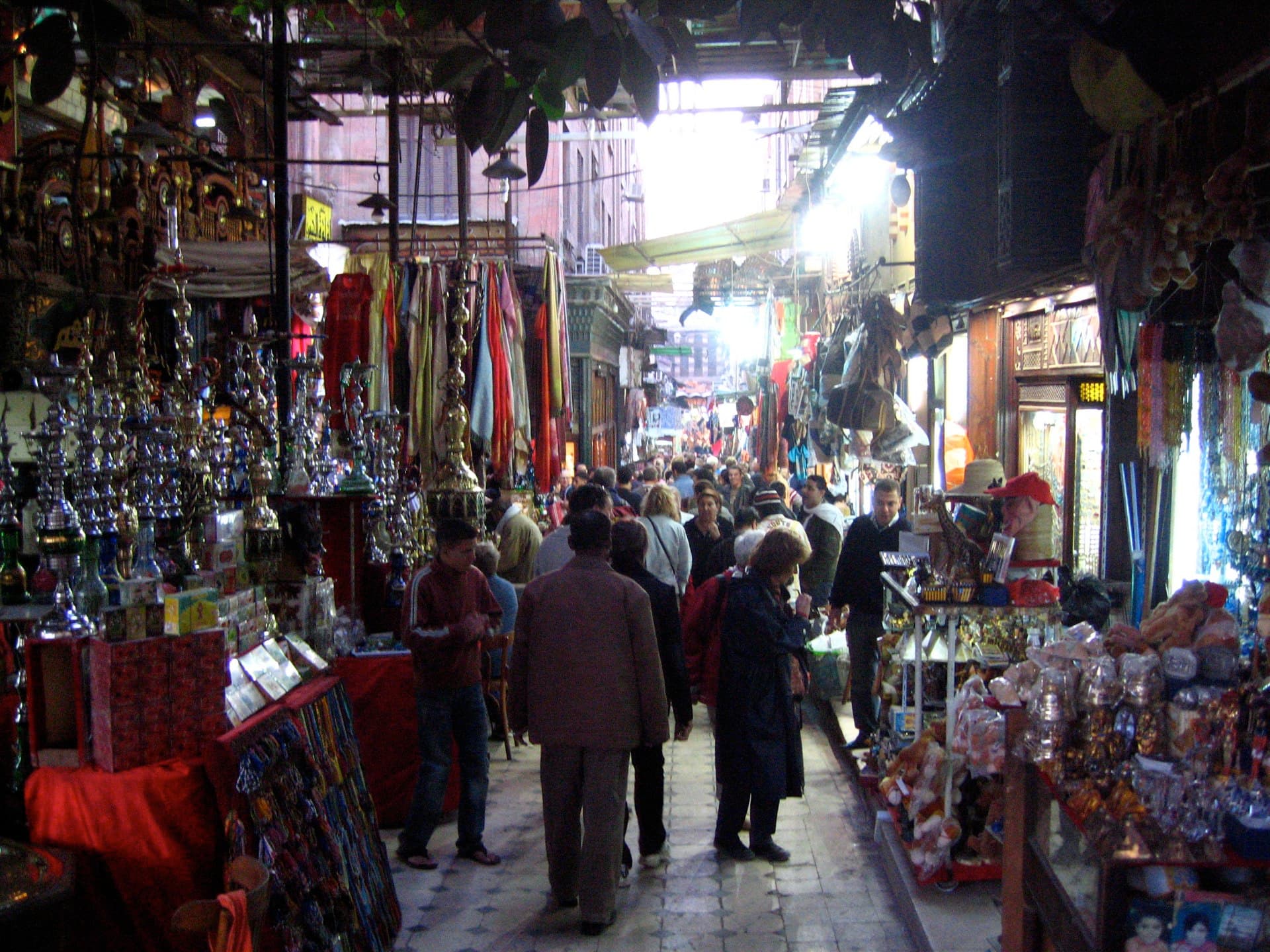
Copper and brass trays, jugs and lamps are beaten by hand in the lanes of Khan el-Khalili. You often hear the hammering a lane before you see the workshop. Hammered copper keeps the marks of the hammer, unevenly, because a hand made each one.
Buy where the work is done. A coppersmith selling his own trays removes a layer of markup and most of the doubt about where a piece came from. Watching a tray being beaten also tells you more about its worth than any sales talk. Old brass lamps and coloured glass are fair buys too, judged on how they look.
Appliqué from the Street of the Tentmakers
The single best thing to buy in Cairo is appliqué from the covered Street of the Tentmakers, south of Bab Zuweila. Panels of coloured cotton are cut and stitched by hand onto a backing, in geometric and Islamic patterns. The panels were historically made for the great ceremonial tents. The makers still sit in the shopfronts and stitch while you watch.
Turn a panel over before you buy. Hand stitching shows on the back, and no two panels are the same. Sizes run from cushion covers to wall hangings. They roll flat and weigh almost nothing, so they fit in a suitcase without a fight.
The street is a short walk from the main bazaar, and few visitors make it. It is calmer, with fewer sellers and talk about the work itself. Our Khan el-Khalili guide shows the route.
Spices, hibiscus and tea, bought by weight
Spices, dried flowers and loose tea have their own run of stalls in Khan el-Khalili. Buy by weight from a merchant whose other customers are local. Smell before you pay, and buy small amounts of several things.
If dried hibiscus is on the stall, it makes karkade, the deep red drink Egyptians serve hot in winter and cold in summer. It is a cheap, light way to take a taste of Egypt home.
Before you pack spices, tea or dates, check your own country's customs rules on food. They differ from country to country. Declare food when the arrival form asks about it.
Cotton and linen scarves
Plain cotton and linen scarves are a sensible buy, and you can use one during the trip. A light scarf covers your shoulders at a mosque and keeps the sun off your neck at a temple. Women are asked to cover their hair at Al-Azhar Mosque, across the road from the bazaar.
Cotton and linen move air in the heat, which polyester does poorly. For fabric, walk the Muski, the street west of the bazaar where Cairenes buy cloth and clothes.
Inlaid wood: the fingernail test
Backgammon boards, boxes and trays inlaid with wood and shell are worth buying when the inlay is cut by hand. Run a fingernail across the surface. Cut inlay has small edges you can catch. A printed transfer feels glassy and continuous, and it is the cheap copy.
Gold, silver and cartouches: buy by weight
Khan el-Khalili has its own gold alley, where goldsmiths make Cairo's wedding jewellery and sell largely by weight. Silver is sold by weight as well. Weight is the part of the price you can check, so agree it on the scale before you discuss the design.
Cartouches are oval pendants cut with your name in hieroglyphs. They are made to order and often well made. They are also a tourist product, priced as one, and only the metal content can be verified. If you want one, buy it by weight from a dealer in the gold alley.
Egypt souvenirs to skip: papyrus, alabaster and perfume oil
Much of the papyrus on sale is pressed banana leaf. Hold a sheet up to the light. Real papyrus is made from strips laid across each other, so a crossed grain shows through. The fake looks flat and even, feels like paper and turns brittle with time.
Alabaster figures arrive by the crate from workshops near Luxor, and the cheapest are pressed stone dust. Perfume oils sold as concentrated essence are usually heavily diluted, and those shops run the hardest sell in the market. Scarabs, small pyramids and camel figurines are stock items, sold at almost every souvenir stall.
Cheap tours often build in stops at papyrus, perfume or alabaster workshops. These are sales rooms with a short demonstration, often listed on the programme as cultural visits. The guide earns commission on what you buy. You can ask for them to be dropped. Our guide to Egypt scams covers this pattern and the polite way out.
Buy two or three things well and spend the rest of the time on the monuments.
Antiques: what Egyptian law says
Leave anything sold as ancient on the stall. Egypt's Antiquities Protection Law, Law 117 of 1983, bans trade in antiquities and makes taking one out of the country a crime. The Ministry of Tourism and Antiquities lists the law and its amendments (checked October 2026).
The law's text as amended in 2010 is published in UNESCO's database of national heritage laws. Under it, an object made in Egypt more than 100 years ago can count as an antiquity. So an object sold to you as ancient is either a copy, or something nobody may lawfully sell you. Buy old brass and glass for how they look, and walk away from any piece whose price rests on its age.
Shopping in Egypt beyond Cairo
In Bahariya, buy what the oasis grows. Dates and olive oil travel well. Ask where you are staying who is pressing oil that season.
In Siwa, salt from the lakes is stacked in blocks and sold in the market as lamps and bath crystals. In Dahab, shops along the strip sell silver, bedspreads and spice, and staff call you in from the door. It is persistent, and a clear no works. Use the Cairo tests there too: weight for silver, stitching for textiles.
In Aswan, the boat trip to a Nubian village usually ends at a shop. If you liked something made in the village, buy it. You are under no obligation to spend. Our Nubian village guide covers the visit.
How to buy: haggling, cash and where to look
Haggling is expected in the markets, and the first price sits well above what the seller will take. Decide what the object is worth to you before you start. Open low, stay friendly, and be ready to walk away. Our Khan el-Khalili guide covers haggling in detail.
Bring Egyptian pounds in small notes. Most stalls take cash only, and a shortage of change is a standing excuse for rounding up. Larger gold and carpet dealers may take cards, often with a surcharge. A price quoted in dollars or euros usually comes at the seller's rate. Our Egypt currency guide covers notes, cash machines and exchange.
Go deeper for better quality. In Khan el-Khalili, the lanes nearest the square are the most worked and the most expensive. Quality and prices improve two or three turns in. If you buy something bulky, settle shipping before you agree a price. The safest purchase is one you can carry home yourself.
Which of our tours give you time to shop
Seven of the Memphis Tours trips we sell include an afternoon at Khan el-Khalili, after the National Museum of Egyptian Civilisation. The shortest is the Cairo Short Break: five days in Cairo, from US$935 per person, land only. The Grand Tour of Egypt runs 16 days, from US$3,910, and its last full day in Cairo ends at the bazaar.
For Bahariya dates and olive oil, the 14-day trip to Cairo, Luxor, a Nile cruise and the White Desert costs from US$3,815. It includes lunch in Bahariya before the drive back to Cairo. None of the day-by-day plans for the 16 trips we sell includes a papyrus, perfume or alabaster workshop.
Common questions
What is the best souvenir to buy in Egypt?+
Appliqué from Cairo's Street of the Tentmakers. It is cut and stitched by hand, it has no factory equivalent, and it packs flat. Hammered copper from the lanes of Khan el-Khalili comes a close second.
What can you buy with 100 Egyptian pounds?+
It changes month to month, because the pound has moved a great deal in recent years. Ask your guide what things cost that week, and compare two or three stalls for the same item. Our Egypt currency guide explains the notes.
Is it legal to buy antiques in Egypt?+
No. Law 117 of 1983 bans trade in antiquities, and taking one out of Egypt is a crime. In the 2010 text of the law, objects over 100 years old can count as antiquities. Treat anything sold as ancient as a copy, or leave it alone.
How do I tell real papyrus from fake?+
Hold the sheet up to the light. Real papyrus shows a crossed grain, because it is made from strips laid across each other. The banana-leaf fake looks flat and even, feels like paper and goes brittle with time.
Do I have to haggle when shopping in Egypt?+
Haggling is expected in the markets, and walking away is your best lever. Fixed-price shops exist too and are often fairer. If bargaining leaves you cold, buy there and browse the market for the experience.
Can I bring Egyptian spices, dates or olive oil home?+
That depends on your own country's customs rules for food, which differ from place to place. Check them before you pack, and declare food when the arrival form asks.
Do your tours stop at papyrus or perfume shops?+
None of the day-by-day plans for the 16 Memphis Tours trips we sell includes a papyrus, perfume or alabaster workshop. Seven include an afternoon at Khan el-Khalili, where shopping is your choice. If a shop stop is suggested on the day, you can decline it.
Is shopping in Egypt as good as in Morocco?+
No. Egypt has fewer crafts worth buying, and much of what is sold near the monuments is mass-produced. The good things are copper, appliqué, spices, scarves, inlaid wood and metal sold by weight. Our Egypt vs Morocco page compares the two trips in full.
Official sources
Entry rules, opening hours, security advice and exchange rates all move. Check them at the source, not here.
Written and checked by the Nile Trip Guide editorial team · Last reviewed . Entry rules, prices and opening hours change — check anything critical against the official sources linked on this page.
Plan this trip
Tell us your dates and we will price it
A real itinerary with real prices, usually within 24 hours. Nothing is booked and nothing is charged until you say yes.
The route most people take first, at the length it was built for: Giza and the Grand Egyptian Museum, then a flight to Luxor and four nights sailing down to Aswan.
No boat on this one. Giza and the Grand Egyptian Museum, a night in Luxor for both banks, two nights on the Red Sea, then back to Cairo for the Citadel, Coptic Cairo and the Royal Mummies.
Five nights in Cairo either side of a four-night sail from Luxor to Aswan. The Cairo days are private, just your party and a guide; the sightseeing off the boat is shared with a small group.