Philae Temple: An Honest Guide to Aswan's Island of Isis
Philae Temple is the temple of Isis, and it does not stand where it was built. The whole complex was taken apart and moved to a neighbouring island in the 1970s to save it from the water behind Aswan's dams. It is one of the more rewarding sites in Egypt, and one of the easiest to rush.
What is Philae Temple, exactly?
Philae is a compact temple complex on a small island in the Nile, just upstream of Aswan. The main building is the temple of Isis: a first pylon, an open forecourt, a second pylon, a hypostyle hall and a dark sanctuary at the back. Around it sit smaller structures, including a birth house for Isis's son Horus and the kiosk named after the emperor Trajan, who appears in its reliefs and whose building was never finished.
The scale is modest by Egyptian standards. Karnak could swallow the whole island several times over. What Philae has instead is coherence and setting. You can take in the entire complex in an hour or two, and every approach to it is across water. That combination is rare in Egypt, where most great sites are reached by coach across dust.
It is also unusually legible. At Karnak you are looking at fifteen hundred years of additions by rival kings, and it takes an effort of will to see a plan at all. At Philae the sequence runs in one direction, from the landing to the sanctuary, in more or less the order the builders intended. Anyone who has struggled to hold an Egyptian temple in their head will find this one falls into place quickly.
Who was Isis, and why was she worshipped here?
Isis is the wife of Osiris and the mother of Horus. In the myth, Osiris is murdered and dismembered by his brother Seth; Isis gathers what is left of him, restores him long enough to conceive a son, and then hides and raises that son in the marshes until he is old enough to claim his father's throne. Every element of that story appears on the walls here, which is why the birth house matters so much at Philae. It is not decoration. It is the argument of the site.
The island's position explains the rest. Immediately beside the original Philae lies Biga, which the Egyptians treated as one of the burial places of Osiris and kept closed to ordinary people. Philae was where the living came; Biga was where the god lay. Offerings were carried across between them. Once you know that, the orientation of the temple and the windows in the western colonnade, looking out towards Biga, stop being incidental.
Isis also travelled further than almost any other Egyptian deity. Her cult spread across the Greek and Roman worlds, and temples to her stood well outside Egypt. That reach is part of why Philae kept receiving imperial money for centuries after Egypt itself had become a Roman province, and part of why the site survived, in use, so long after the rest of the old religion had gone quiet.
Why does a temple built this late matter?
Most of what stands was built under the Ptolemies, the Greek dynasty that ruled Egypt after Alexander, and finished by Roman emperors. The oldest surviving building, the small pillared vestibule near the landing, is earlier, put up under Nectanebo I in the fourth century BC. Philae is still late by Egyptian standards, more than two thousand years younger than the pyramids at Giza. Some visitors treat that as a demerit. It is the opposite.
It stayed in use longer than any other Egyptian temple we know of. The last dated hieroglyphic inscription found anywhere was cut here, in AD 394, long after the script had died out elsewhere. A sixth-century writer credits the emperor Justinian with having the sanctuary closed by force, though how much worship was left to close is disputed and some scholars think the cult had already faded. Part of the hall later became a church, and Coptic crosses are cut into walls that once carried offerings to Isis.
There is a second reason not to dismiss the late date. Because the Ptolemies and the Romans were outsiders claiming an Egyptian throne, they built in a deliberately conservative style, with a heavier and more explicit iconography than earlier dynasties used. The reliefs are easier to read than New Kingdom work, and the rooms are labelled almost to the point of instruction. A late temple is the better teaching building, whatever it loses in antiquity.
How did the temple end up on a different island?
The first Aswan dam, completed at the start of the twentieth century and raised twice afterwards, put the original island of Philae under water for much of each year. For decades visitors rowed between the tops of the columns and looked down at capitals through green water. The surviving paint and much of the surface detail were washed away in the process.
The High Dam, finished in 1970, would have left the temple permanently waterlogged between the two dams. A UNESCO-backed rescue followed. A cofferdam was built, the water pumped out, and the buildings cut into tens of thousands of blocks and re-erected on nearby Agilkia island, which was reshaped to resemble the original. The work finished in 1980.
The joins are visible if you look, and worth looking for. Knowing the temple was rebuilt does not diminish it. It explains why the lower courses are so clean, why the plan sits slightly oddly on the rock, and why almost nothing here is quite where the priests left it.
What decades under water did to the stone
The relocation gets the attention, but the damage had already been done long before the High Dam. From 1902 the temple spent much of each year submerged and the rest of it drying out, and that cycle is far harder on decorated stone than permanent immersion would have been. Colour went first. Almost all of the paint that would once have covered these walls was simply washed off, which is why Philae reads as bare stone while sheltered chambers at other temples still carry blues and ochres.
Look at the walls at knee and waist height and you can often see where the water sat: a paler, cleaner band in the masonry, sometimes with a chalky deposit at its upper edge. Above it the surface is warmer in tone and the carving holds more detail. Nobody points this out on a standard tour, and it is one of the easiest things to see for yourself once you know to look for a horizontal line rather than a scene.
The second set of marks is from the rescue itself. Fine saw lines run through blocks and across joints, usually following the courses rather than cutting scenes in half, because the engineers took the trouble to divide the stone where the damage would show least. Between the two, you are looking at a building that carries the record of what nearly destroyed it and what saved it, on the same wall.
What else the salvage campaign saved, and what it did not
The UNESCO campaign that began in 1960 was not about Philae alone. Abu Simbel was the headline: both temples cut into numbered blocks between 1964 and 1968, lifted around sixty metres higher and roughly two hundred metres back from the water, and rebuilt against an artificial hill. Kalabsha, Beit el-Wali, Wadi es-Sebua, Amada and others were moved as well. Four temples went abroad to countries that contributed to the effort: Dendur to New York, Debod to Madrid, Taffa to Leiden, Ellesiya to Turin.
The consequence is easy to state and hard to absorb. Very little Nubian architecture now stands where it was built. When you cross to Philae you are visiting one item from a scattered collection, most of which was relocated, boxed up or drowned within a single generation.
What the campaign did not rescue was the people. The reservoir flooded the Nubian homeland and tens of thousands were resettled in villages built for them by the state, many well north of Aswan near Kom Ombo. The temples received an international rescue effort and a great deal of attention; the villages received relocation and very little. If that side of the story interests you, the Nubian Museum in Aswan treats it seriously and takes about an hour, in air conditioning.
Getting there: the boat is half the visit
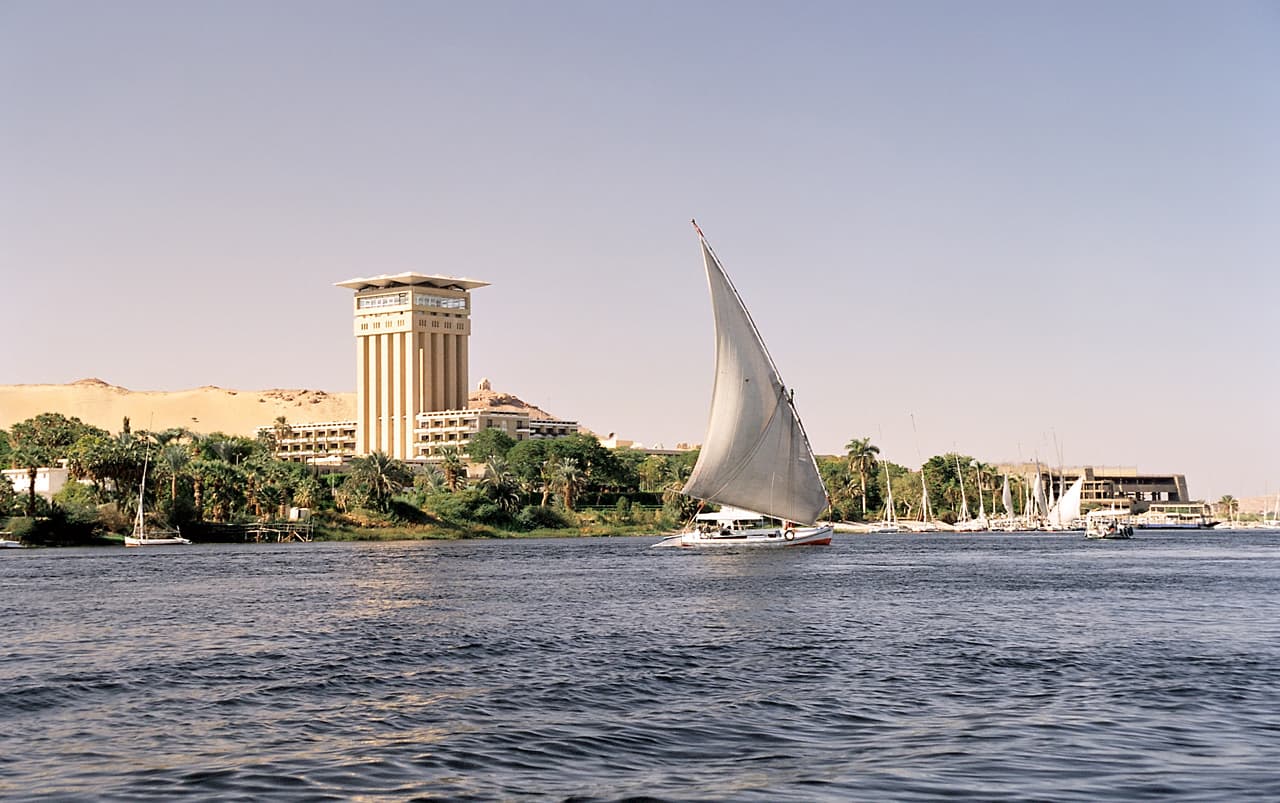
You reach Philae only by boat, from a harbour south of the old Aswan dam. The crossing is short, ten or fifteen minutes in a small motorboat. The temple appears side-on as you come round, with Trajan's kiosk closest to the water. That first view from the boat is the best one you will get, so sit where you can see forward rather than facing your group.
The boat is normally a separate transaction from the site ticket, arranged with the boatmen at the landing and priced per boat rather than per person. Agree the fare and the waiting time before you step in, and be clear that the return is included. Rates change, so confirm the current going rate with your guide or hotel on the day rather than trusting anything written online.
Two practical points that catch people out. A boat priced per boat is cheap split between four and expensive alone, so it is worth asking at the harbour whether another couple wants to share rather than accepting the first quote as a solo traveller. And your boatman waits for you, which means the clock on the island is partly his: say ninety minutes out loud at the start, rather than discovering at the temple gate that he expected forty.
Tickets, opening hours and the order of the morning
Tickets are bought on the mainland at the harbour, before you board, and the boat is paid separately. Do the ticket first and the boat second; people who negotiate a fare and then join a ticket queue lose the time they thought they had saved. Opening hours shift with the season and with the evening show, and posted times are not always current, so have your guide or hotel confirm on the day rather than relying on a figure from a website.
Prices at Egyptian sites are revised regularly and we will not print a number that will be wrong within months. Assume that Philae is charged as a normal monument fee with a student reduction against a valid card, that the boat is extra, and that the sound and light show is a separate ticket again. Carry small notes for the boat, because change at the landing is a familiar negotiating tactic.
If you are booking a driver for the standard Aswan half-day, set the order before you leave: unfinished obelisk, High Dam, Philae. The first two are short and the third is the reason the morning exists. Drivers default to the reverse when they want you back for lunch, and that is how Philae ends up with forty minutes.
Walking the island in order
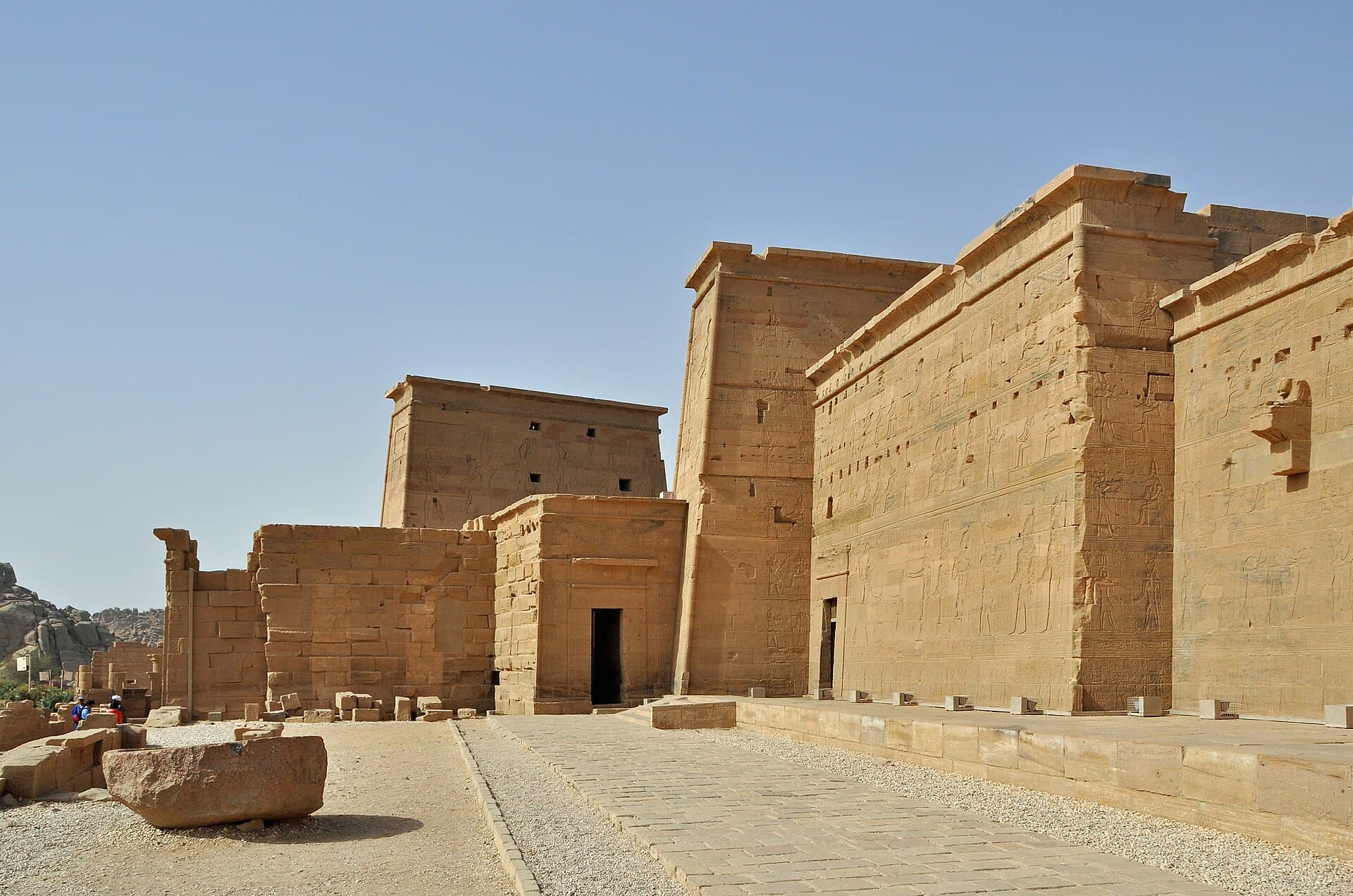
From the landing the route runs past the small vestibule of Nectanebo I, the oldest thing standing here, and into a long forecourt framed by two colonnades. The western one is the good one: a roofed row of columns with windows cut through the wall behind, each capital carved to a different design, looking out over the water towards Biga. The eastern colonnade was never finished, and the contrast between the two tells you plainly how these buildings were made, a stage at a time, as money arrived.
The first pylon closes the far end, two massive sloping towers with a gateway between them and colossal figures of a king striking his enemies carved across the face. Through it you are in the temple's own forecourt, with the birth house on the left and a colonnade of priests' rooms on the right. The second pylon follows, set at an angle to the first because the builders worked around the granite of the original island rather than levelling it.
Beyond that the temple narrows and darkens in the standard Egyptian way: a hypostyle hall, then a sequence of smaller vestibules, then the sanctuary itself, a plain room where a stone pedestal once carried the sacred barque of Isis. The point of that progression is that fewer and fewer people were admitted at each stage. Walking it in order takes ten minutes and makes the whole plan intelligible, which is why it is worth resisting a guide who starts at the kiosk because it photographs well.
What should you look for once you are on the island?
Start with the long colonnade running up from the landing, then the first pylon with its large carved figures. In the forecourt, look at the birth house on your left. The reliefs of Isis nursing the infant Horus in the marshes are often compared with later Christian images of the Madonna and child, though whether one influenced the other is still argued over.
Inside, take a torch or use your phone. The sanctuary rooms are dim and the carving is shallow. Look for the deliberate damage: faces and hands chiselled out by later Christian occupants, crosses cut over older scenes, soot on the ceilings. This layering is the most interesting thing at Philae and most tour commentary skips straight past it.
Outside the main enclosure, the Gate of Hadrian carries a relief of the Nile god in a cave among rocks, understood as the source of the flood. It is often empty while the forecourt is full. Trajan's kiosk, the roofless rectangle of columns on the eastern side, was left unfinished, which is part of why it photographs so well. Locally it is known as Pharaoh's Bed, a name that has nothing to do with its function and everything to do with its shape.
One more detail, easily missed: the Roman emperors on these walls are dressed as pharaohs, making offerings in Egyptian costume with their names written in cartouches. Trajan and Hadrian never came near Aswan. The temple presents them as native kings performing native rites, which is the clearest statement of what Ptolemaic and Roman building in Egypt was actually for.
Reading the later layers: crosses, graffiti and one travelling obelisk
Philae's last eight hundred years of use are written on its walls, and almost nobody explains them on site. Greek and Latin graffiti record visitors and soldiers. Coptic crosses are cut into older reliefs, sometimes centred neatly on the chest of a god, which is not vandalism so much as conversion of the surface. In the hall that became a church, altars and Christian texts sit against Ptolemaic columns. Soot on the ceilings comes from centuries of people living and cooking in a building nobody had needed for its original purpose for a very long time.
The scripts matter too. The hieroglyphic inscription of AD 394 is the latest known anywhere, and demotic, the everyday cursive script, survived here a few decades longer still. Those two graffiti are the accepted end point of a writing tradition more than three thousand years old. They are small, scratched and unremarkable to look at, which is exactly what makes them worth pointing out to anybody in your group who thinks the interesting part of Egypt stopped with the pharaohs.
One piece of Philae left the island altogether. In the early nineteenth century an English traveller had an obelisk removed from the site and shipped home, where it still stands in the grounds of a country house in Dorset. Because its base carried a Greek inscription alongside Egyptian text on the shaft, it fed directly into the decipherment of hieroglyphs, helping to confirm the reading of a royal name. Philae is one of the few Egyptian sites that contributed both a beginning and an end to the story of the script.
When should you go, and at what time of day?
October to April is the sensible window for Aswan. In summer the middle of the day is genuinely punishing, and Philae has very little shade. The island is small, exposed and stone-floored, and the heat comes back up at you. Bring water rather than planning to buy it once you have crossed.
Time of day matters more than season. The first boats of the morning are quiet. From mid-morning the Nile cruise excursions arrive in a block and the forecourt fills for two or three hours. Late afternoon empties again, and the low sun does more for the reliefs than any other light. If you can only choose one, choose early.
There is a seasonal wrinkle worth knowing. Aswan's peak months are November to February, which is also when cruise traffic is heaviest, so the mid-morning crush is at its worst exactly when the weather is at its best. In late September or early April the island is hotter but noticeably emptier, and an early start makes the heat manageable. Shoulder season plus a first boat is the best combination available to anyone with a free hand on their schedule.
What to bring, and how the island treats you
Water, a hat, sunglasses and a torch cover most of it. The torch is the one people forget and the one that changes the visit, because the inner rooms are dark, the carving is shallow, and a phone light held at a low angle across a wall will show you reliefs that are invisible head-on. Shoes with a grip help on the quay and on worn paving. There is almost no shade on the island, and what there is sits inside the temple, so plan your standing-about for indoors.
Treat the island as self-contained once you have crossed. Buy water before you get on the boat. Use whatever facilities exist on the mainland side before you leave rather than assuming their equivalent across the water. Cash in small notes is more useful than a card almost everywhere in this part of the day, from the boat fare to a bottle at the harbour.
The hassle level at Philae is moderate by Egyptian standards and concentrated at the two landings rather than in the temple. Expect vendors and offers of photographs at the quay. A firm no thank you, repeated once without stopping, works. Inside the enclosure you are largely left alone, which is not true of every site on the Nile.
Is the sound and light show worth going back for?
Honestly, it depends what you want. The narration is dated and overwrought, the script leans on drama the site does not need, and the historical content is thin. If you want to learn something about Isis or the Ptolemies, you will not get it here. Judged as history, the show is poor and has been for years.
What is genuinely good is everything around the show. Crossing black water to a lit island is a real experience, the temperature is kind, and the buildings floodlit from below look better than they do at noon. Showings run in different languages on different nights, so check the schedule locally on the day. Go for the walk and the light, not the commentary.
Two caveats before you book. The show is a separate ticket and a separate boat, so the evening costs more than people expect, and on a tight budget it competes directly with a felucca afternoon or an extra Aswan night, both of which we would take first. And it is a poor substitute for a daylight visit rather than an addition to one: you cannot read a wall by floodlight. If you are choosing between the two, go in the morning.
How does Philae fit into an Aswan itinerary?
The standard Aswan half-day pairs Philae with the unfinished obelisk and a stop at the High Dam. The obelisk is quick and worth it, a colossal abandoned block still attached to the bedrock, cracked and left where it lay. The High Dam stop is a viewpoint and a monument, twenty minutes at most, and nobody has ever been sorry to skip it.
Philae deserves better than being the third stop of a rushed morning. Given two nights in Aswan, do Philae early on one day, keep the afternoon for Elephantine island or a felucca, and take the Abu Simbel run on the other. If you are on a Nile cruise with a fixed excursion, ask whether you can go independently at a quieter hour instead.
There is one addition worth considering if you have the time and the inclination to arrange it. Kalabsha, a Nubian temple relocated to a promontory near the High Dam's western end, sits close to the same road and normally needs its own motorboat from a landing, which is why itineraries leave it out. It is usually empty. As a contrast with Philae, an hour there tells you more about the salvage campaign than the dam's viewing platform ever will.
How Philae compares with Egypt's other Ptolemaic temples
Philae, Edfu and Kom Ombo are the three late temples most visitors see, usually in the same week, and they do different things. Edfu is the most complete temple standing in Egypt: a full building with its roof on, dark, enclosed and slightly oppressive, and the clearest picture anywhere of what an Egyptian temple was like to be inside. It sits inland from its mooring, so you arrive by carriage or minibus rather than on foot.
Kom Ombo is the oddity, a double temple with two parallel sets of rooms for two gods, which makes its plan the most memorable of the three. It is also the one site on a Nile cruise you can genuinely walk to, straight up the steps from the boat, usually at the end of the afternoon. It is smaller than it photographs and half an hour covers it properly.
Philae wins on setting and loses on preservation. It has no roof to speak of over most of the complex and its colour is gone, which Edfu can beat on both counts. What it has instead is the island, the boat, the range of later history written on the walls, and a plan you can hold in your head. Seeing all three in a week is not repetition; they are more different from one another than a brochure suggests.
Photographing Philae without fighting the light
The best photograph of Philae is taken from the boat, not on the island, and it happens in the first ninety seconds of the crossing. Sit forward. The complex comes into view side-on with Trajan's kiosk nearest the water and the pylons behind it, and that composition is not available from anywhere on land.
On the island itself, the problem is contrast. At midday the sun is straight down, the reliefs flatten out entirely and every doorway becomes a black rectangle next to a white wall. Early and late are not just cooler, they are the only times the carving has any relief in it at all. Inside, a light held close to the wall and raked across it will show you what a flash pointed straight at the same wall will erase.
Rules about cameras, phones and tripods at Egyptian monuments change and are enforced unevenly from site to site and season to season. Do not plan a serious photographic visit around what somebody wrote online two years ago; ask at the ticket window on the day, and accept that the answer at Philae may not match the answer at Karnak.
Philae with children, and with limited mobility
Philae is one of the better Egyptian sites for children, mostly because of the boat. The crossing is short and exciting, the island is small enough that nobody gets marched for a kilometre in the sun, and the temple has dark rooms to explore with a torch. The Isis and Horus story is also the easiest Egyptian myth to tell to a seven-year-old, which gives the walls a point beyond being old. Go early, bring water, and plan an hour rather than two.
Mobility is the harder question, and the honest answer is that this is one of the more difficult sites in Aswan. The obstacle is the boat rather than the temple: boarding a small motorboat from a stone quay means a step down without a rail onto something that moves. On the island there are steps, uneven paving and raised thresholds in the doorways. With a steady arm, unhurried timing and a boatman who understands the situation it is manageable, but wheelchairs are not practical and nobody should promise otherwise.
What do most visitors get wrong?
The commonest mistake is treating Philae as a photo stop. Groups are frequently on the island for forty minutes, which covers the pylon, the kiosk and little else. Ninety minutes is a fair minimum, and two hours is not too long if you are reading the walls. The island rewards slowness more than most Egyptian sites.
The second is arriving with the wrong expectation. Philae is not overwhelming, and straight after Karnak or Abu Simbel it can feel small. Judge it on what it is: an intact, legible temple in a remarkable position, carrying the fingerprints of Greeks, Romans and Christians as well as Egyptians. Very few sites in Egypt let you read that much history off one set of walls.
The third is going at the wrong hour because somebody else set the schedule. A mid-morning arrival in February puts you on the island with every cruise excursion in Aswan, in flat light, with a boatman glancing at his watch. Almost everything that makes Philae worth the trip is available only to people who either came first or came last: the quiet, the low sun on shallow carving, the time to walk out to the Gate of Hadrian.
Common questions
How long should I allow at Philae Temple?+
Allow ninety minutes on the island as a minimum, plus around half an hour either side for the harbour, the boat and the ticket queue. Two hours is comfortable if you want to look at the reliefs properly and walk out to the Gate of Hadrian. Group tours often allow forty minutes, which is not enough.
Do you need a guide, or can you visit independently?+
You can visit independently. Taxis run to the harbour, boats go all day, and the site is small enough that you will not get lost. A guide earns their fee here, though, because the Ptolemaic and Christian layers are hard to read without one. Nothing on site explains what the crosses and the chiselled faces mean.
Can you still see the original island of Philae?+
Not really. The original island lies under water between the two dams, where the level stays high all year, and there is normally nothing to see. Boatmen will point out roughly where it sat, and Biga island beside it, which ancient Egyptians treated as one of the burial places of Osiris and kept closed to ordinary visitors.
Is Philae worth it after Karnak and Abu Simbel?+
Yes, but for different reasons. Karnak overwhelms by size and Abu Simbel by nerve. Philae is the one you can actually take in as a single building, and the one where the story does not stop at the pharaohs. If your trip is short and you must drop something in Aswan, drop the High Dam, not this.
How hard is Philae for anyone with limited mobility?+
Harder than most Aswan sites. Boarding a small boat from a stone quay involves a step down with no rail, and the boats move. On the island there are steps, uneven paving and raised thresholds inside the temple. It is manageable with a steady arm and enough time, but wheelchairs are not practical. Check conditions locally before committing.
How much does it cost to visit Philae Temple?+
There are two payments: the site ticket, bought at the mainland harbour, and the boat, agreed separately with the boatmen and normally priced per boat rather than per person. Egyptian monument fees are revised often enough that any figure printed here would be wrong within months, so confirm both with your hotel or guide on the day. Carry small notes for the boat.
What is the best time of day to visit Philae?+
First thing. The earliest boats find the island almost empty, and from mid-morning the Nile cruise excursions arrive together and fill the forecourt for two or three hours. Late afternoon is the second-best option, when the crowds have gone and low sun brings out carving that is invisible at noon. Midday is the worst of both, hot and flat.
Why was Philae Temple moved, and where was it originally?+
It stood on a neighbouring island that the first Aswan dam, completed in 1902, left submerged for much of each year. The High Dam would have left it permanently waterlogged between the two dams, so a UNESCO-backed rescue cut the buildings into tens of thousands of blocks and rebuilt them on Agilkia island, reshaped to resemble the original. The work finished in 1980.
Is Philae Temple included on a Nile cruise?+
Usually yes, as part of the Aswan excursion at the end of the itinerary, often alongside the unfinished obelisk and the High Dam. The problem is timing rather than inclusion: cruise groups tend to arrive mid-morning together and stay well under an hour. If your schedule allows it, ask whether you can go independently at a quieter hour instead, and use the boat time that suits you.
Can you visit Philae and Abu Simbel on the same day?+
It is possible and it is a poor idea. Abu Simbel is roughly 280 kilometres south, about three to three and a half hours each way by road, and the classic day trip already leaves before dawn and returns mid-afternoon. Bolting Philae onto the end of that puts you on the island exhausted at the hottest point of the day. Give them separate mornings.
What should I look for that guides usually skip?+
Three things. The pale band low on the walls where decades of standing water stripped the stone, and the fine saw lines from the relocation cutting through the courses. The Coptic crosses cut into older reliefs, and the chiselled-out faces and hands beside them. And the Gate of Hadrian outside the main enclosure, with its relief of the Nile god in a cave, which is often empty while the forecourt is full.
Official sources
Entry rules, opening hours, security advice and exchange rates all move. Check them at the source, not here.
Written and checked by the Nile Trip Guide editorial team · Last reviewed . Entry rules, prices and opening hours change — check anything critical against the official sources linked on this page.
The route most people take first, at the length it was built for: Giza and the Grand Egyptian Museum, then a flight to Luxor and four nights sailing down to Aswan.
No boat on this one. Giza and the Grand Egyptian Museum, a night in Luxor for both banks, two nights on the Red Sea, then back to Cairo for the Citadel, Coptic Cairo and the Royal Mummies.
Five nights in Cairo either side of a four-night sail from Luxor to Aswan. The Cairo days are private, just your party and a guide; the sightseeing off the boat is shared with a small group.