The Valley Temple, Giza: the building you walk through to reach the Sphinx
The Valley Temple, Giza's best-preserved Old Kingdom building, is the granite hall you pass through on the way to the Sphinx. Most people cross it in about thirty seconds, with their eyes already on the viewing terrace. It takes ten minutes to walk properly. This page is about what you are standing in while you hurry through it.
The Valley Temple, Giza: what it actually is
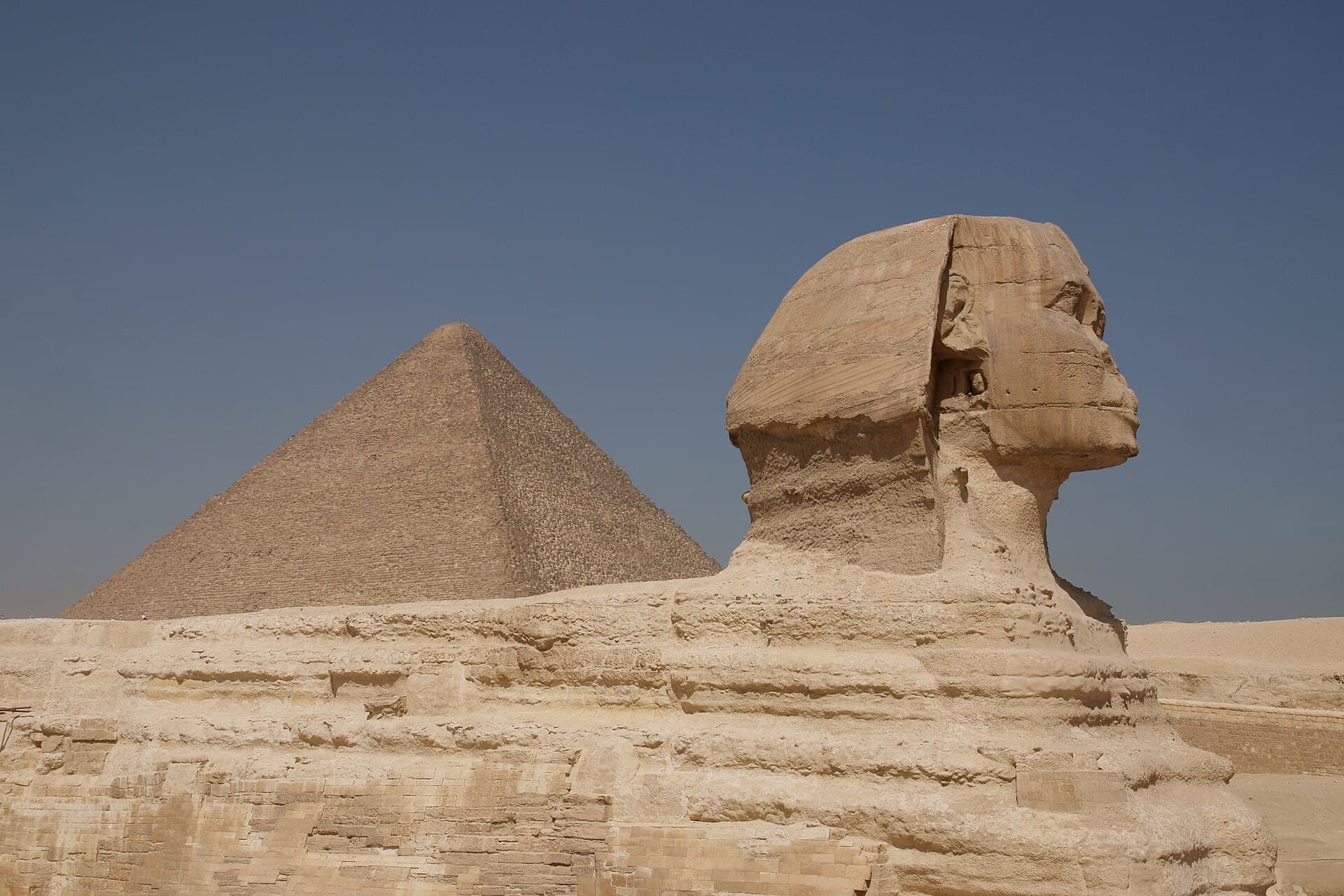
It is Khafre's valley temple, part of his pyramid complex. It stands immediately south of the ruined Sphinx Temple, which sits directly in front of the Sphinx to the east. Granite and alabaster, huge polished piers, no ornament: most accounts rate it the best preserved of the Old Kingdom valley temples.
The important correction is what it was for. It is not a monument to the Sphinx and it was not built to house it. It belongs to Khafre's pyramid, several hundred metres uphill, and the Sphinx sits alongside the route rather than at the end of it. Visitors read the plateau as a set of separate attractions, which is the commonest mistake made here.
It also is not a temple in the sense most visitors bring with them from Luxor. There is no hypostyle forest, no pylon, no processional avenue of rams, no wall of painted gods. It is a compact, heavy, almost windowless building whose entire effect comes from the size of the stones and the accuracy with which they were put together. Once you know that is the intention rather than the remains of something richer, the ten minutes make sense.
What a valley temple was for
Old Kingdom pyramid complexes follow a standard shape, and the valley temple is the bottom of it. The pyramid stands on the desert; a mortuary temple sits against its eastern face; a walled causeway runs down from there to a second, lower temple at the edge of the floodplain, where the desert meets cultivated land and water. That lower building is the valley temple. It is the front door of the whole complex, the point where the royal funerary machinery met the river and the people who supplied it.
Beyond that, be careful how much you accept. The building carries no text explaining what was done inside it, so the ceremonies usually described here are inferred from later evidence and from the architecture rather than recorded on the spot. You will hear it called the place where the king's body was received, purified, embalmed, or given the ritual that restored the use of its mouth. Those are reasonable readings and some of them are widely held. None is written on these walls, and a guide who states one as fact is going beyond the evidence.
What is not in doubt is that the complex kept working after the funeral. Priests, offerings, stores and a staffed estate supported the king's cult for generations, and the valley temple is where the supplies and the personnel came in from the water. Reading it as a gatehouse with a religious function is closer to the truth than reading it as a shrine.
Where it sits: landing, temple, causeway, pyramid
The Old Kingdom sequence runs river landing, valley temple, causeway, pyramid. From this building the causeway climbs west towards Khafre's pyramid. The Sphinx lies just north of that line, carved down into the bedrock beside it.
Taken in that order the plateau stops being three pyramids in a field and becomes a set of connected buildings with a route through them. You get the sequence whether you plan it or not, because the modern approach to the Sphinx normally begins in the valley temple. The difference is whether you notice.
The eastern end is the part that has changed most, and not in a way that shows. The temple was built to face water: the Nile floodplain came far closer to the plateau than it does now, and the ground below the building was the working edge of the complex. Today you look east into Nazlet el-Samman, the town that has grown up to the foot of the plateau. The Sphinx sits on the boundary between Cairo and the desert, not in empty sand, and so does this building. Stand at the front of it and you are standing where the desert stopped.
The plan inside: a pillared hall and the statues that are missing
The interior is simple and deliberate. A narrow entrance opens into a hall of monolithic granite piers carrying granite beams, laid out in a T so that the long arm runs across the building and a shorter one runs back from it. The floor is alabaster in places. There are no columns with capitals, no carved dado, no colour. Everything that is doing work is structural.
The plainness is also partly loss. Sockets and pits cut into the floor show that seated statues of the king once stood along the walls of that hall, and the effect of the room as built was a line of royal figures in dark, polished stone standing in a dim, roofed interior. Take the statues away and open the roof to the sky, which is the state you find it in, and you are looking at the frame rather than the picture.
One of those statues is among the best-known objects to come out of Egypt: a seated figure of Khafre in hard dark stone, recovered from a pit inside this building during nineteenth-century clearance work and now in a museum in Cairo. If you have seen a photograph of a Fourth Dynasty king with a falcon behind his head, you have seen something that stood in the room you are walking through. Which Cairo museum holds which piece has been moving for years as material transfers to the Grand Egyptian Museum, so check before making a special journey for one object.
What survives, and why it looks so plain
Massive granite piers, polished surfaces, alabaster underfoot in places. What holds a room like this together is stone, joint and proportion rather than anything carved on the walls. If you have arrived from Karnak or Abydos expecting registers of relief, the absence is not damage. This building predates those temples by more than a thousand years and belongs to a different kind of architecture.
The material is worth a thought too. The plateau is limestone; the granite is not from here. Egypt's granite comes from Aswan, the better part of a thousand kilometres upriver: the same quarries that supplied the sarcophagi inside the pyramids. Everything cut there travelled down the Nile before anyone could dress it and set it.
The core blocks are a different story again, and the best one on the site. Those of the Sphinx Temple and this temple appear to have come out of the Sphinx enclosure as it was quarried. Masons cut the pit, left the lion standing in the middle of it, and put the stone they removed into the buildings in front. The hole and the buildings are the same act of work.
Look at how the two materials meet and you find the detail that makes people stop. The limestone core blocks are large and irregular, and the granite facing was not laid against them in neat courses; it was dressed to fit them, so the joints step and jog around the shape of what was already there. That is the opposite of how a modern builder would work, and it is expensive in labour. Whoever ran this job was prepared to cut hard stone to match soft stone rather than square the soft stone first.
Why this survived when the Sphinx did not
Two reasons, and both are visible from where you stand. The first is the rock. The Sphinx is carved from the plateau's own limestone, which is layered and unevenly hard, and it has been patched, refaced and patched again since antiquity. The granite here is imported, dense and far more resistant to the salt and wind that do most of the damage on this plateau. The surfaces you touch are close to what the masons left.
The second is sand. The plateau buries things. The Sphinx was swallowed to the neck more than once and dug out again, most recently in a full clearance in the twentieth century, and the valley temple spent long stretches of its history under the same sand. Burial is destructive to some materials and protective of others; here it kept the granite out of the weather and, more to the point, out of sight of anyone looking for building stone.
That last point matters more than it sounds. The Giza pyramids lost most of their smooth outer casing to later builders who needed dressed stone and found a quarry standing ready. A hall of finished granite at the foot of the plateau would have been an obvious target. Much of it is still here, which is a reasonable argument that for most of the period when stone was being carted away, this building was not visible.
The Sphinx Temple next door, and why it looks worse
Directly in front of the Sphinx, to the east, are the ruins of a second building of the same period and much the same construction. It is the one nearly everybody walks past. Where the valley temple still stands to its full height in places, this one is down to stumps, foundations and the outline of a court, and the granite facing that once covered it has largely gone.
The two are worth comparing on the spot because the comparison tells you what you are looking at. Same core blocks, quarried out of the same hole. Same era, same techniques, probably the same workforce. One kept its skin and the other did not. Stand in the valley temple and you see the design; stand at the Sphinx Temple and you see the skeleton, which makes the plan of both far easier to read.
Less is agreed about the Sphinx Temple than about its neighbour, and honest accounts say so rather than filling the gap. It is normally viewed from the walkway rather than entered, so this is a matter of two minutes of looking rather than an extra stop. Two minutes is more than most people give it.
Why almost nobody notices it
The route funnels visitors through the temple and out onto the terrace, where the Sphinx is and where everyone is taking the same photograph. Nobody stops in a corridor when the thing they came for is thirty seconds ahead. Guides know it, and most of them keep walking.
It does not help that Giza has almost no interpretation on the ground. Without a guide you are looking at very large stones with no context. A roofless granite hall does not explain itself the way a wall of painted relief does. That is exactly why it gets skipped, and exactly why it repays being told what it is first.
There is a scheduling reason as well. By the time most visitors reach this point they have already walked a kilometre of sand and rubble, been approached repeatedly about camel rides, and spent an hour photographing three pyramids in strong sun. Attention is finished before the building arrives. Doing the plateau in the reverse order, or arriving at opening and coming here early, fixes more than any amount of good intentions.
What to look at, in order
Start with the piers. They are monoliths, not stacked drums, and the point is not their height but the fact that each is a single piece of stone brought from Aswan and stood upright to within a very fine tolerance. Put a hand flat on one. The polish is not a modern restoration; it is the finish the masons left, protected by sand for most of the intervening period.
Then the joints. Look at where two granite faces meet and how little space there is between them, and then at the places where the granite has gone and the limestone core behind it is exposed. That contrast is the whole construction method in one view: rough mass inside, precise skin outside.
Then the floor. Alabaster survives in patches, and the patches are worth finding because they tell you the room was pale underfoot and dark at shoulder height, which is the reverse of what a ruin suggests. Then the doorways and the shadows they throw: this is the only substantial shade on the plateau, and it is not accidental, because the building was roofed and dim by design.
Finish with the two sightlines. East, down the fall of the ground towards where the water once came close and the modern town now sits. West, along the line of the causeway climbing towards Khafre's pyramid. Those two directions are the reason the building is here at all, and once you have stood on both of them the plateau stops being a set of separate attractions.
How to visit it properly
Go at opening. The Sphinx faces due east, so the light on its face is best in the first two hours. The same early start gets you through the temple before the crowd is pushing behind you. Give it ten minutes on the way in, and another five on the way out. By then the terrace has emptied you back through it and the room is quieter.
Look up rather than at the walls: the piers, the way the blocks meet, the sight lines down the hall. Look for where the alabaster survives against the granite and where it has gone. Then look back east, towards where the ground falls away and the Nile once came closer, and west along the causeway line towards Khafre's pyramid.
Then take the thirty seconds you saved and spend them on the Sphinx Temple ruins in front of the Sphinx. Most people walk past those entirely.
If you are with a guide, ask before you set off that they stop in the temple rather than through it. Most will, and a good Egyptologist earns their fee here more than at the pyramids, which largely explain themselves by scale. If you are on a fixed group itinerary with a coach waiting, the practical move is to let the group go ahead to the terrace, take your ten minutes in the hall, and rejoin them. Nobody will miss you, and the terrace will be no better in ten minutes than it is now.
Photographing it
It is a harder subject than it looks, for one reason: the contrast. You are standing in deep shade inside a roofless building under a very bright sky, and a phone left to its own devices will either blow out the sky to white or turn the granite to a black mass. Tap to expose for the stone, accept that the sky goes pale, and the piers keep their surface. That single adjustment is the difference between a usable photograph and the one most people take here by accident.
The composition worth having is not the wide shot of the hall, which flattens into grey. It is the near detail: a joint between two blocks with a hand or a foot in frame for scale, the edge of an alabaster patch against granite, a pier disappearing upwards out of the top of the frame. The building is about weight and accuracy, and both read better close than wide.
The other one is the framed view. Doorways and gaps in the hall line up on the Sphinx and on open sky in a way that gives you something no one else on the terrace is getting, because they are all standing in the same place pointing at the same animal. Early light helps here as it does everywhere at Giza. Rules on photography, tripods and drones at Egyptian sites change and are enforced unevenly, so ask rather than assume, and expect a flat no on anything that flies.
Heat, footing and getting around inside
The ground is uneven. You are walking on old stone, patched surfaces and sand, with lips, steps and gaps between blocks, and there is no consistent handrail. Closed shoes with some grip matter more here than anywhere else on the plateau, and sandals are a mistake for the same reason they are a mistake on the walk up from the car park.
For anyone with limited mobility the honest answer is that this is difficult but often unavoidable, because the standard route to the Sphinx terrace runs through the building. Arrangements at Giza change from year to year and there have been alternative routes and vehicle access at various times, so the thing to do is ask at the gate on the day rather than planning around any description written in advance, including this one. If someone in your party cannot manage uneven stone, raise it before you buy tickets, not at the entrance to the hall.
On the other hand, this is the coolest place on the plateau. The walls throw real shade, the granite stays cold well into the morning, and there is nothing else between the car park and the terrace that offers any shelter at all. In summer that is worth planning for: five minutes standing still in the hall in the middle of a Giza morning is more use than most of what else you can do with five minutes here.
The claims you will hear about the stone
This building attracts a particular kind of story, and you will meet it on the plateau and online. The blocks are too large, the joints too fine, the granite too hard for people with copper tools, so the temple must be far older than the Fourth Dynasty or the work of somebody else entirely. It is the same argument made about the sarcophagi in the Serapeum at Saqqara and about the weathering on the Sphinx next door, and it is not accepted by the archaeologists and stone specialists who work on these sites.
The mainstream account is less exciting and much better evidenced. Hard-stone working is documented from quarry to finished object: the quarries at Aswan are still there with the tool marks in them, unfinished pieces were left in place when work was abandoned, and the methods, using copper tools, abrasive sand, and hard dolerite pounders for the granite, are attested by wear, by debris and by the objects themselves. Enormous labour and long timescales, not lost technology.
The reason to know this is practical rather than academic. You will be told a version of the older-civilisation story by somebody, possibly by a guide, and it is better to hear it as a story you were going to be told than as a revelation. Ask what the evidence is. That question is a reliable filter at Giza, and it works on people selling books as well as people selling camel rides.
Where it fits in a Giza morning
Allow three to four hours for the plateau proper. The valley temple costs ten to fifteen minutes of that and sits at the Sphinx end, so it works best either at the very start, if you come in from the Sphinx side at opening, or as the last thing before you leave. What does not work is arriving at it at eleven in the morning at the end of a hot circuit, which is when most people meet it.
The Grand Egyptian Museum is roughly two kilometres away, and the sensible pairing is the plateau first thing and the museum for the middle of the day, when the heat outside is at its worst and the air conditioning indoors becomes the point. That is a full day. Adding Saqqara or a bazaar stop to it is how people end up seeing three places badly.
If you have a second day, put Saqqara and Dahshur on it and put that day first if you can. Saqqara's mastabas give you the carved and painted Old Kingdom that this plateau does not, and Dahshur gives you the engineering being argued out at full scale. Coming back to Giza after those two, the valley temple reads differently: not a corridor to the Sphinx, but the bottom of a complex you have now seen built up from its beginnings.
How it compares with the other valley temples
Every Old Kingdom pyramid complex had one, and almost none of them survives in a state a visitor can read. Most are foundations, robbed out or under later ground, and several are known mainly from excavation rather than from anything you can walk into. That is the context for the claim on this page: best preserved of the Old Kingdom valley temples is a real distinction and a low bar at the same time.
Giza itself has the other two. Khufu's has largely gone, under the modern town below the plateau rather than on it, and Menkaure's, at the far end, is a ruin that repaid excavation far more than it repays a visit. Neither gives you what this one does, which is a roofed-in-intent interior standing at something like its original height with its facing stone in place.
Further south the sequence is more instructive than photogenic. Sneferu's complexes at Dahshur include valley temple structures, and Saqqara has the causeway of Unas running down the ridge towards its own lower temple. If you are the sort of visitor who wants to see the pattern repeat rather than a single fine example, those are the places to look, and they are quiet in a way Giza never is.
Is it worth it, and what else gets skipped for the same reason
Yes, and it costs ten minutes on a route you are already walking, which makes it the cheapest upgrade available at Giza. It is also the one building on the plateau where you get Old Kingdom construction at eye level. Out of the sun, and without a separate ticket queue.
The same logic applies to the mastaba tombs in the officials' cemetery, where you get carved and painted wall scenes and a fraction of the people. For most visitors those are better value than the interior of the Great Pyramid, which is a long stooped climb to a bare granite room.
The pattern is consistent enough to plan around. At Giza the things that get skipped are the ones that need explaining, and the things that get crowded are the ones that photograph well from a distance. Khafre's casing cap near the summit of the second pyramid, the granite courses at the base of Menkaure's, the Sphinx Temple ruins and this hall all fall into the first category. Between them they cost about forty minutes and they are most of what makes the plateau comprehensible.
What is open, roped off or ticketed separately on the plateau changes from year to year with no notice. Confirm on the day rather than planning around anything you read in advance, including here. The Egyptian Ministry of Tourism and Antiquities lists what is currently open.
Common questions
Is the Valley Temple the same as the Sphinx Temple?+
No, they are two buildings side by side. The Sphinx Temple is the ruin directly in front of the Sphinx, to its east. Khafre's valley temple stands immediately south of it and is far better preserved, with its granite piers still standing. The route to the Sphinx normally passes through the valley temple, which is why people conflate them.
Do you need a separate ticket for the Valley Temple?+
Access to the Sphinx viewing terrace normally runs through it on the standard plateau ticket, so most visitors are inside it without realising. What is open, roped off or separately ticketed at Giza changes without notice, so confirm at the gate on the day. We do not print prices here, because any figure would be out of date.
How long do you need in the Valley Temple?+
Ten minutes to walk it properly, fifteen if you stop and look at the piers, the joints and the alabaster. Most people give it under a minute. It is the highest return on time available anywhere on the plateau, because you are walking through it regardless.
Who built the Valley Temple and when?+
Khafre, a Fourth Dynasty king, as part of the pyramid complex that gives Giza its second pyramid — roughly 4,500 years ago. That attribution is solid for the temple. For the Sphinx next door it is circumstantial. No inscription from the period names a builder, and while Khafre is the standard answer, specialists have argued for Khufu and for Djedefre.
Can you go inside it?+
You walk through it. It is roofless now, so 'inside' means an open hall of granite piers rather than dark chambers. The walls throw shade you will be glad of by mid-morning. Ask your guide to stop there for a few minutes on the way in rather than treating it as a corridor.
What was a valley temple actually for?+
It was the lower end of a pyramid complex: the point where the causeway from the pyramid reached the edge of the floodplain and the complex met the river. Funerary ceremonies for the king are usually placed here, and the building continued to serve his cult afterwards as the way in for priests, offerings and supplies. Which specific rituals happened inside is inferred from architecture and later evidence rather than recorded on these walls, so treat confident accounts with some caution.
Where did the granite come from?+
Aswan, the better part of a thousand kilometres upriver, from the same quarries that supplied pyramid sarcophagi. The plateau itself is limestone, so every granite pier and facing block in the building was quarried, moved down the Nile and set here. The limestone core blocks came from much closer: they appear to have been cut out of the Sphinx enclosure next door as it was hollowed out.
Are the statues that stood in it still there?+
No. The hall held seated statues of Khafre, and the sockets cut for them survive in the floor, but the sculpture is gone. The famous seated figure of the king in hard dark stone was recovered from a pit in this building during nineteenth-century clearance and is in a museum in Cairo. Holdings have been moving between Cairo museums for years, so check where a particular piece is before making a journey for it.
Why is the Valley Temple so much better preserved than the Sphinx?+
Harder stone and more sand. The Sphinx is carved from the plateau's own layered limestone, which weathers badly and has been patched repeatedly since antiquity. The temple is faced in imported granite, which resists salt and wind far better, and it spent long periods buried, which kept it out of the weather and out of the way of later builders looking for dressed stone.
Can you photograph inside the Valley Temple?+
Handheld photography on the plateau is normal, and the hall is one of the better subjects at Giza if you expose for the stone rather than the sky. Rules on tripods, professional equipment and anything airborne are stricter and change, so ask rather than assume. No flash is needed in any case: the shade is deep but the light bouncing off the granite is plenty for a phone.
Is the Valley Temple older than the pyramids, or built by a lost civilisation?+
No. It belongs to Khafre's complex and to the Fourth Dynasty, and the claim that the stonework is beyond Old Kingdom capability is not accepted by the specialists who study it. The quarries, the tool marks, the abandoned unfinished pieces and the debris all document how hard stone was worked. You may hear otherwise on the plateau; ask what the evidence is.
Is it manageable with limited mobility?+
It is awkward. The floor is uneven old stone and sand with steps, lips and no reliable handrail, and the standard route to the Sphinx terrace goes through it. Access arrangements at Giza change from year to year, so ask at the gate on the day rather than relying on any written description. Raise it when you book rather than at the entrance, because the alternatives, where they exist, need arranging in advance.
Official sources
Entry rules, opening hours, security advice and exchange rates all move. Check them at the source, not here.
Written and checked by the Nile Trip Guide editorial team · Last reviewed . Entry rules, prices and opening hours change — check anything critical against the official sources linked on this page.
The route most people take first, at the length it was built for: Giza and the Grand Egyptian Museum, then a flight to Luxor and four nights sailing down to Aswan.
No boat on this one. Giza and the Grand Egyptian Museum, a night in Luxor for both banks, two nights on the Red Sea, then back to Cairo for the Citadel, Coptic Cairo and the Royal Mummies.
Five nights in Cairo either side of a four-night sail from Luxor to Aswan. The Cairo days are private, just your party and a guide; the sightseeing off the boat is shared with a small group.