The Great Sphinx of Giza is a limestone lion with a human head, carved down into the bedrock at the edge of the Giza plateau, just north of Khafre's causeway. It is smaller than most people expect and it sits in a pit, which changes how you photograph it. Most visitors give it ten minutes and leave without understanding what they looked at.
What is the Great Sphinx of Giza, exactly?
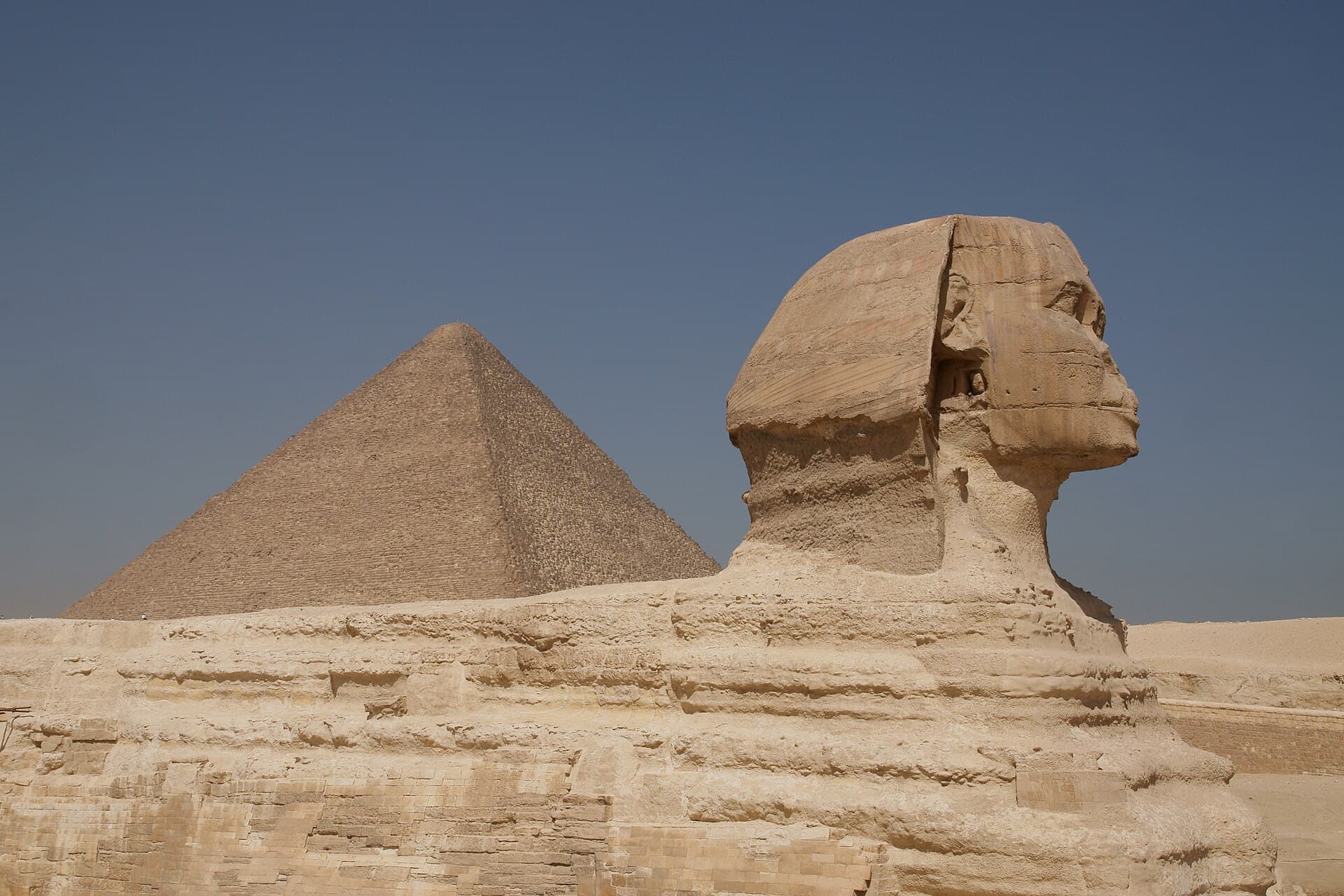
The core of it is a single piece of rock. The Sphinx was not built up from blocks but carved down into the Giza plateau, cutting a horseshoe-shaped pit around a knoll of limestone. It is roughly 73 metres long and about 20 metres high, in the form of a recumbent lion with a human head wearing a royal headcloth. Because it sits in that pit rather than on a plinth, you look slightly down at it from the modern viewing terrace.
The rock is the problem and the reason for everything you see. The layers vary in hardness: the head is cut from a tougher upper band, the body from softer, crumbling stone below. That is why the face survives in reasonable condition while the flanks have been patched, refaced and patched again since antiquity. Much of the lower body you photograph today is restoration masonry, some of it ancient, some of it from the twentieth century.
Two consequences follow from being a carving rather than a building, and both are worth holding in your head on the terrace. The first is that the Sphinx cannot be moved, dismantled or rebuilt; whatever is done to it is done in place, on top of the last repair. The second is that the pit around it is not a decorative setting but the quarry face left behind when the statue was freed from the plateau. You are looking at a sculpture and at the hole it came out of at the same time.
Who built the Sphinx, and when?
The standard attribution is Khafre, a Fourth Dynasty king, which puts the Sphinx at roughly 4,500 years old. The case is circumstantial but strong. The enclosure was quarried alongside Khafre's causeway as part of his complex, the temple in front of the Sphinx is built in the same manner as his valley temple next door, and the core blocks of both appear to have come out of the enclosure as it was cut.
The honest caveat is that no inscription from the period names a builder. Not one. Some Egyptologists have argued for Khufu, Khafre's father, on the grounds of the face's proportions and the layout of the plateau. Others have proposed Djedefre, Khafre's predecessor. This is a real scholarly argument rather than a fringe one, and it is unresolved. What almost no specialist disputes is the broad period: the Old Kingdom, most likely the Fourth Dynasty.
It helps to understand what the argument is made of, because the same evidence gets cited on the plateau in support of wilder claims. There is no dated foundation deposit, no builder's inscription, no papyrus naming the job. What there is instead is context: the geometry of the enclosure against the causeway, the shared quarry and shared construction of the two temples in front, and the absence of anything on the plateau from another period that could plausibly have produced it. That is an argument from the site as a whole, which is weaker than a text and stronger than a guess.
What was the Sphinx for?
Nobody wrote it down, and any guide who tells you otherwise with confidence is filling a gap. The honest answer is that a lion with a king's head is a straightforward piece of Egyptian royal symbolism: the strength and solar associations of the lion joined to the face and headdress of a ruler. Read that way, the Sphinx is a statement about kingship on the largest scale the plateau allowed, placed where the desert meets the cultivation and where the route into Khafre's complex began.
The other common reading is that it functioned as a guardian of the necropolis, facing east at the point where the living approached the dead. That fits the position, it fits the way later Egyptians treated the monument, and it is a reasonable inference rather than a documented fact. The sensible position is that the Sphinx works as guardian and as royal image at once, and that the two are not competing explanations in Egyptian terms.
What is documented is what happened afterwards. By the New Kingdom the Sphinx was worshipped in its own right, a thousand years or more after it was carved, and the small temple structures, offering chapels and stelae that accumulated around it belong to that later cult rather than to the original scheme. The monument acquired its religious meaning partly by lasting long enough for a much later Egypt to invent one for it. That is a more interesting fact than most of what gets said on the terrace.
What did the Egyptians call it?
Not the Sphinx. That word is Greek, borrowed from a creature in Greek mythology which was female, winged and fond of riddles, and applied to a very different Egyptian figure by visitors who came late and named what they found. Egyptian sphinxes are normally male and royal, and have nothing to do with riddles. The name has stuck for two thousand years and will not be dislodged, but it describes the observer rather than the thing observed.
The New Kingdom name was Horemakhet, Horus in the Horizon, later rendered by Greek writers as Harmachis. It appears in the text on the stele between the paws, where it is compounded with other solar names. The compound matters more than the individual words: the monument was understood as a form of the sun god at the point on the horizon where the sun rises, which is precisely the direction the face is pointing.
In Arabic it is Abu al-Hol, usually translated as father of dread or father of terror. It is the name you will hear from drivers and ticket staff, and it is worth recognising when it is said to you. Three names, three cultures, one object, and none of the three is what the people who carved it called it, since nothing from their own period survives to tell us.
What happened to the nose?
Napoleon's troops did not shoot it off. The nose was already missing when European travellers drew the Sphinx in the eighteenth century, decades before the French expedition arrived. The British and stray target practice get blamed in the same way, and the evidence for those stories is no better. It is a good line for a guide and it is not history.
The one account with any weight comes from an Egyptian historian writing in the fifteenth century, who recorded that a Sufi mutilated the face in the 1370s because local people were leaving offerings to it. Treat that as the best available story rather than settled fact. The beard is a separate matter: fragments survive in Cairo and in the British Museum, and specialists still argue over whether it was original or added later.
There is a wider point buried in the nose story. The damage to this monument is overwhelmingly the work of weather, salt and time, not of soldiers or iconoclasts, and the parts people find most romantic to explain are the parts least well explained by drama. A face carved in layered limestone, exposed for millennia, with a projecting feature at its most vulnerable point, does not need an army to lose its nose.
How to read the head: headdress, beard and paint
Start with the headcloth, because it is the clearest surviving detail and almost nobody looks at it properly. It is a nemes, the pleated royal headcloth, with the folds running back over the crown and the two lappets falling forward onto the shoulders. Those lappets are what give the head its width in photographs and why the face looks broader than it is. The nemes is royal dress, which is a large part of why the figure is read as a king rather than a god.
Above the brow you would expect a royal cobra, the standard companion to the nemes on a king's head. What is there now is damaged surface. The beard is the other absence: a long, straight, plaited false beard of the kind kings are shown wearing, whose fragments ended up in two museum collections and whose date is still argued about. Look at the underside of the chin and you can see the area it was attached to.
The last thing to look for is colour. Traces of pigment have been recorded on the face, and they matter because the default mental image of Egyptian monuments is bare stone. It was not bare. A painted Sphinx, with the nemes striped and the face in a strong flat colour, is a very different object from the weathered beige one on the terrace in front of you, and it is closer to what the Old Kingdom actually saw.
Why do people argue about the erosion?
Stand at the enclosure and you will see deep vertical fissures and rounded, undulating weathering on the walls and on the Sphinx's flanks. In the early 1990s a geologist argued that this pattern was cut by heavy rainfall, which would push the carving back thousands of years before the Old Kingdom. That claim is a minority position, rejected by most geologists and Egyptologists who have examined the site, but it is why the argument keeps circulating online.
The mainstream answer is less dramatic and better supported. The limestone is layered and unevenly hard, so it weathers in bands whatever the agent. Salt crystallising inside the rock does much of the damage, helped by wind, sand and water standing in the pit. Egypt was also wetter in the centuries around the Old Kingdom. And nothing else on the plateau suggests a society capable of this work millennia earlier.
That last sentence is the one that does the work, and it is the one the argument usually skips. A carving of this size implies quarrymen, supervisors, food, tools, waste and a state to pay for it, and all of that leaves debris. At Giza the debris is Fourth Dynasty: workers' settlements, bakeries, cemeteries, tool marks, the two temples built from the stone taken out of the enclosure. A monument thousands of years older would have to have left no trace of any of that, which is a great deal to ask of a hole in the ground next to a building site.
The other stories you will hear on the terrace
The Hall of Records is the most persistent. The claim that a chamber of lost knowledge lies beneath the Sphinx comes from the readings of an American psychic in the twentieth century rather than from any excavation, and it has been looked for repeatedly without result. Surveys do pick up cavities and anomalies in the bedrock, which is exactly what you would expect in quarried, fissured limestone, and none of them has produced anything that alters the monument's likely date or purpose.
The astronomical claims are the second family. These hold that the lion form points to an age of the sky thousands of years before the Old Kingdom, and therefore dates the carving to that period. The problem is not the astronomy, which is arithmetic, but the assumption that the Egyptians shared the modern constellation scheme and meant to encode a date in it. There is no Egyptian text that says so. A calculation is not evidence that anyone intended the thing calculated.
The third is more interesting because it is partly a real observation. The head does look small for the body, and a minority of specialists have argued that it was recarved, either from an earlier and larger head or from a different original. That is a debate about proportion and tool marks, conducted in the literature, and it is not the same kind of claim as the other two. Worth knowing which arguments have a rough consensus against them and which are simply unsettled: the question to ask anyone telling you any of this is what the evidence is.
What is the Dream Stele between the paws?
Between the forepaws stands a tall granite slab, placed and inscribed by Thutmose IV around 1400 BC. Its text tells how, as a prince, he slept in the Sphinx's shadow and was promised the throne if he cleared the sand choking it. Whether the dream happened matters less than what the stele proves: by the New Kingdom the Sphinx was already ancient, already buried to the neck, and already a place of pilgrimage.
Sand is the whole story of this monument. It swallowed the body repeatedly and was dug out repeatedly, most recently in a full clearance during the twentieth century. Burial is also why the body survived as well as it did. From the terrace, look at the enclosure walls as well as the statue: the quarry cuts show you how the thing was made.
The stele is also a piece of politics, and reading it as anything else is naive. A king who had reason to explain why the throne was his commissioned a monument saying the sun god promised it to him in a dream, and placed it in the most conspicuous holy spot available. That does not make the text worthless. It makes it evidence of what the Sphinx meant to people a thousand years after it was carved, which is more than we have for what it meant to the people who carved it.
Sand, burial and the business of digging it out
The plateau buries things, continuously and without help. Wind carries sand into the enclosure, the pit has no natural drain, and left alone the hollow fills. The Sphinx has spent more of its existence buried to some degree than standing clear, and the recurring pattern of Egyptian and later history is a ruler or an institution clearing it, a period of neglect, and the sand coming back. Thutmose IV's stele commemorates one such clearance. It was neither the first nor the last.
This is why the body is in better shape than the exposure would suggest. Sand is abrasive when it is moving and protective when it is still: buried limestone is out of the wind, out of the rain and, critically, out of sight of anyone looking for building stone. The same logic explains why the granite valley temple next door survived when the pyramids lost their casing, and it is one of the few pieces of preservation history at Giza that a visitor can see the evidence for on the spot.
The last full clearance, in the twentieth century, is the reason you can see the whole animal at all, and it changed the monument's problems rather than solving them. Exposed stone weathers, and an enclosure open to the sky collects rainwater with nowhere to go. Groundwater and salt are the current conservation concerns, and work on drainage and on the surface goes on more or less continuously. Some of what looks like scaffolding clutter in your photographs is that work.
The repairs: what you are actually photographing
Look along the flanks and the paws and you will see courses of rectangular blocks laid against the body like brickwork. That is restoration masonry, and there is a great deal of it. The earliest was added in antiquity, from the New Kingdom onwards, when the monument was already an object of pilgrimage and worth maintaining; more was added in the Graeco-Roman period; and the twentieth century added a good deal more again. On much of the lower body you are looking at repairs to repairs.
The modern campaigns are not a uniform success story, and it is worth knowing why the surface looks patchy. Some mid-century work used cement, which is harder and less permeable than the limestone around it, and that turned out to trap salts and stress the original stone rather than protect it. Later work has been more cautious, replacing unsuitable material with softer, more compatible limestone and lime mortars. The result is a body carrying several centuries of differing opinions about how to fix it.
None of this makes the Sphinx a fake, which is the conclusion some visitors jump to. The head, the neck, the upper body and the whole form are carved bedrock. What is added is skin over the softest rock, and the practical effect on your visit is simply that the closer you look at the lower body the more of a building and less of a carving it becomes. Knowing which is which is most of the difference between looking at it and photographing it.
How does it fit with Khafre's pyramid complex?
The Sphinx is not a standalone monument, and reading it as one is the commonest mistake visitors make. Directly in front of it, to the east, are the ruins of the Sphinx Temple. Immediately south of that stands Khafre's valley temple, a severe granite and alabaster building, the best preserved of the Old Kingdom valley temples, and about ten minutes to walk through. From there the causeway climbs west towards Khafre's pyramid.
Take it in that order and the plateau starts to make sense: river landing, valley temple, causeway, pyramid, with the Sphinx sitting alongside the route. The valley temple is usually where the modern approach to the Sphinx begins, so you get the sequence whether you plan it or not. Do not skip the temple interior to reach the terrace faster.
The connection between the Sphinx and those two temples is physical as well as conceptual, and it is the best fact on the site. The core blocks of both buildings appear to have come out of the Sphinx enclosure as it was quarried. Masons cut the pit, left the lion standing in the middle of it, and put the stone they removed into the buildings in front. The hole and the buildings are the same act of work, and standing at the junction you can see both halves of it at once.
Where should you stand, and when is the light best?
The Sphinx faces due east, so morning sun lands flat on the face and the light is best in the first two hours after the site opens. By mid-afternoon the face is in its own shadow and you are shooting towards the sun. The terrace in front is the only place most visitors are allowed. The enclosure floor and the area between the paws are normally closed, though access rules change, so ask on the day.
On the terrace, position matters more than equipment. Moving a few metres north or south changes which pyramid sits behind the head. The wide panorama from the desert road behind the plateau is good for the pyramids and poor for the Sphinx, which more or less vanishes at that distance. For season, November to February is comfortable; from May to September the plateau is punishing by mid-morning.
The walkway along the northern side of the enclosure is the other position worth using and the one most groups walk past. From there you get the profile, the full length of the body, and the layering in the flanks that explains the monument's condition better than any frontal view can. It is also usually emptier than the terrace, because it does not produce the photograph everybody came for.
Photographing it without taking everybody else's photograph
The technical problem is contrast. A pale monument in a pit under a very bright Egyptian sky will defeat a phone left to its own devices, which will either burn the sky to white or turn the face into a flat mask. Tap to expose for the stone, accept a pale sky, and the surface keeps its texture. That one adjustment separates a usable photograph from the one most people take here by accident.
The composition problem is that everyone is standing in the same place pointing at the same animal. The fixes are small and they work: shift north or south until a pyramid sits where you want it behind the head rather than accepting whatever the crowd position gives you; shoot the profile from the northern walkway; and take at least one frame close enough that the patched masonry on the body reads as masonry. That last one is the photograph that will still be interesting in a year.
Rules on tripods, professional equipment and anything airborne change at Egyptian sites and are enforced unevenly, so ask rather than assume, and expect a flat no on drones. Handheld shooting is normal and nobody will trouble you for it. The forced-perspective kissing shot is discussed below, and the short version is that it costs more time than it returns.
How long does it take, and what do people get wrong?
Twenty to thirty minutes at the Sphinx is enough, and an hour with the valley temple included. The frequent mistake is seeing it first, at the start of a plateau visit, when the crowds and the touts are heaviest and the light is not yet interesting. Working the other way round, or arriving at opening before anything else, makes a noticeable difference.
The other mistake is the photograph. The forced-perspective kissing shot has been taken several million times and costs fifteen minutes of shuffling on a busy terrace. It is not worth the wait. Expect steady offers of camel rides and unsolicited photography near the entrance; a flat, repeated refusal works better than negotiating.
The third mistake is expectation rather than scheduling, and it is the one that ruins visits. People arrive with a picture of a colossus alone in open desert and find a weathered, patched carving in a hollow, with a town behind them and a crowd beside them. If you know that before you go, the actual monument has a fair chance. If you do not, ten minutes of disappointment is all it gets, which is roughly what most visitors give it.
Getting there, tickets and the two ways in
Giza sits on the western edge of the Cairo urban area, so the distance from the centre is short and the journey is not. Depending on traffic and where you start, allow anywhere from forty minutes to well over an hour and a half. An early departure is dramatically faster than a mid-morning one, which is a second argument for the dawn start on top of the light and the crowds.
The plateau has more than one entrance, and the lower one sits at the Sphinx end, in the town of Nazlet el-Samman, while the older main gate is up the hill. The standard route from the lower side brings you through Khafre's valley temple and out onto the Sphinx terrace, which is why so many people walk through the best-preserved Old Kingdom building in Egypt without registering it. Arrangements for entrances and for moving around inside the site have been changed more than once in recent years.
On tickets and prices we print nothing, deliberately, because any figure would be wrong within a year. The Sphinx is normally covered by the general plateau ticket rather than sold separately, while pyramid interiors and some tombs carry their own charges. What is open, roped off or separately ticketed changes without notice, so buy at the ticket office on the day and ask there rather than relying on any description written in advance, including this one.
Heat, footing and visiting with limited mobility
The plateau is hard walking and the Sphinx sits at the far end of it. The ground is sand, broken rock and patched old stone, with lips, steps and no reliable handrail, and closed shoes with some grip matter more here than anywhere else at Giza. Sandals are a mistake. So is arriving without more water than you think you need, a hat and sunglasses, particularly between May and September when the glare off the stone is as tiring as the heat.
There is almost no shade on the route. The one exception is the valley temple, whose walls throw real shadow and whose granite stays cold well into the morning, and in summer five minutes standing still in there is worth more than most other uses of five minutes on the plateau. The terrace itself is fully exposed, which is another reason the first hour after opening beats any other part of the day.
For anyone with limited mobility the honest position is that the standard approach to the Sphinx involves uneven stone and cannot simply be routed around. Access arrangements at Giza change from year to year and alternatives have existed at various times, so raise it when you book rather than at the gate, and ask on the day rather than planning around any written account. Being told no at the entrance is a poor moment to discover the constraint.
Other sphinxes in Egypt, and how this one differs
The form is common and this example is the exception, which is the opposite of the impression most visitors leave with. Sphinxes appear across Egyptian art for thousands of years, usually at a size you could put in a courtyard, and usually in numbers. At Luxor a paved processional way runs roughly 2.7 kilometres to Karnak lined with several hundred of them, human-headed at the Luxor end and ram-headed at the Karnak end, most of them from the reign of Nectanebo I, around a thousand years after building began at Luxor.
At Memphis, on the road below Saqqara, there is an alabaster sphinx standing on open ground beside the fallen colossus of Ramesses II. It repays a slow walk around, partly because alabaster behaves differently from the Giza limestone: warmer, softer, translucent at the edges in strong light. Alexandria has a handful more, brought in from elsewhere and some of them raised from the harbour, which tell you more about later Egyptian history than about pharaonic sculpture.
Set against all of that, what makes the Giza figure singular is not the idea but the method and the scale. Every other sphinx you will see in Egypt was carved from a block that was quarried, moved and then worked. This one was made by removing the landscape around it and leaving the statue standing in the hole. Nothing else in Egypt was made that way at that size, and that, rather than the missing nose, is the thing worth telling someone about afterwards.
Where the Sphinx fits into a Cairo trip
Allow three to four hours for the plateau proper, with the Sphinx and the valley temple taking an hour of that at the end or the beginning depending on which gate you use. The common pairing is the plateau in the morning and the Grand Egyptian Museum, roughly two kilometres away, for the middle of the day, when the heat outside is at its worst and the air conditioning indoors becomes the point. That is a full day on its own, and adding a bazaar stop to it is how people end up seeing three places badly.
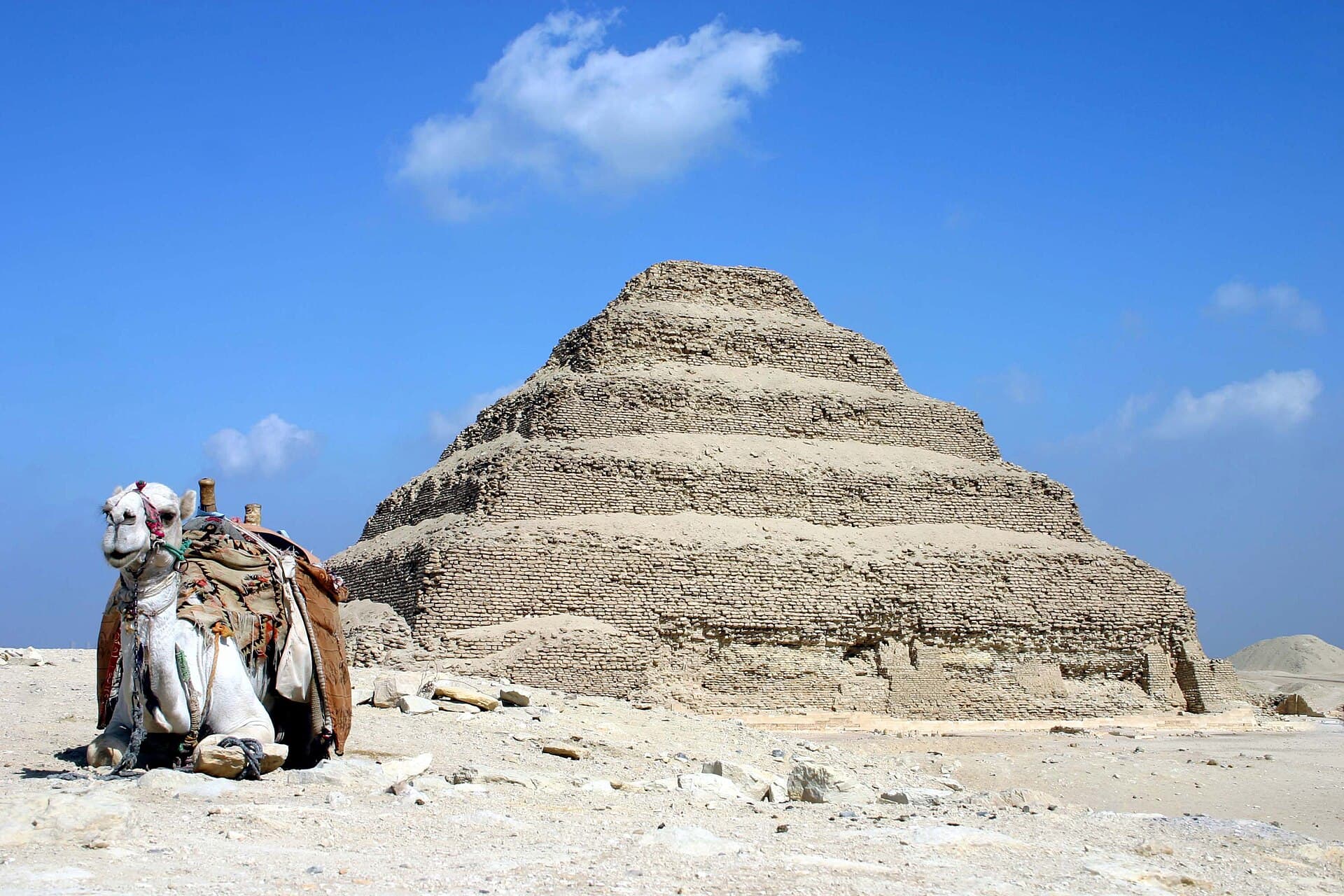
If you have a second day, spend it south at Saqqara and Dahshur, and put that day first if you can. Saqqara has the Step Pyramid of Djoser, generally regarded as the earliest large stone building in the world, and mastaba tombs with carved and painted wall scenes that Giza does not offer. Dahshur has Sneferu's Bent Pyramid and Red Pyramid, where the geometry was worked out by trial and error. Coming back to Giza after those, the Sphinx reads as the end of a sequence rather than a photo stop.
One scheduling note that costs nothing. Most itineraries put the Sphinx first because it is closest to the lower gate, which delivers you to the busiest place on the plateau at the busiest moment, in light that has not yet done anything for the face. Either arrive at opening and go straight to it, or leave it until the pyramids are behind you and come back down. Both work. The default does not.
Common questions
Can you walk right up to the Sphinx or touch it?+
No. Visitors view it from the terrace in front and from the walkway along its northern side. The enclosure floor and the area between the paws are normally closed, and there is no interior to enter. Access on the plateau changes from year to year, so confirm the current situation locally on the day rather than relying on older accounts.
How big is the Great Sphinx of Giza?+
Roughly 73 metres long and about 20 metres high, which is large by any measure and smaller than almost everyone expects. Two things cause the disappointment: it sits in a quarried pit rather than on a plinth, so you look slightly down at it, and it stands within sight of the pyramids, which are on a different scale entirely. Seen on its own it would be overwhelming. Seen next to Khufu's pyramid it is not.
Are there hidden chambers under the Sphinx?+
Surveys have picked up cavities and anomalies in the bedrock around it, which is unsurprising in quarried limestone. None of that supports the Hall of Records claims that circulate online. There are known small cuttings and shafts in and around the body, investigated long ago. Nothing found so far changes the monument's likely date or purpose.
Is the Sphinx older than the pyramids?+
Almost certainly not, and it is probably a little younger than the Great Pyramid. The standard view places it in Khafre's reign, which puts it after his father Khufu's pyramid and alongside his own. Claims pushing it thousands of years earlier rest on weathering patterns in the enclosure and are rejected by most geologists and Egyptologists who have examined the site. The question that is genuinely open is which Fourth Dynasty king, not which millennium.
What is the Sphinx made of, and why is it in such poor condition?+
It is carved from the plateau's own limestone, which is layered and unevenly hard. The head comes from a tougher upper band, which is why the face survives, and the body from softer stone below, which is why the flanks have been patched since antiquity. Salt crystallising inside the rock does most of the damage, helped by wind, sand and water standing in the pit. Much of the lower body you photograph is restoration masonry rather than original carving.
Is the evening sound and light show worth booking?+
For most people, no. The script and staging are long-running and dated, the commentary is heavy going, and winter evenings on the plateau are cold. The one argument for it is seeing the Sphinx and pyramids lit after dark. If your time in Cairo is short, an extra hour in a museum or an early start the next morning does more for you.
What is the Sphinx actually looking at?+
Due east, towards the sunrise and, today, the edge of Nazlet el-Samman, the town that has grown up to the foot of the plateau. The desert lies behind it, to the west. Worth knowing before you arrive: the Sphinx sits on the boundary between Cairo and the desert, not in empty sand, and you approach it through the modern town.
What is the best time of day to visit the Sphinx?+
The first two hours after the site opens. The face points due east, so early sun falls flat on it and the modelling is at its best; by mid-afternoon the face is in its own shadow and you are shooting into the sun. The early slot also beats the coach groups and, on the drive out from central Cairo, most of the traffic. November to February is the comfortable season; May to September is punishing by mid-morning.
Do you need a separate ticket for the Sphinx?+
It is normally covered by the general Giza plateau ticket rather than sold on its own, while pyramid interiors and certain tombs carry separate charges. We print no prices here, because any figure would be out of date within a year. What is open, roped off or separately ticketed at Giza changes without notice, so buy at the ticket office on the day and ask there.
Why does the Sphinx have a lion's body and a human head?+
Because it is a statement about kingship. The lion carries associations of strength and of the sun in Egyptian thought, and the head wears the nemes, the pleated royal headcloth, which is the dress of a ruler rather than a god. Joining the two produces a royal figure with a lion's power, placed at the edge of the necropolis facing the sunrise. No Old Kingdom text explains the intention, so this is a reading of the iconography rather than a recorded fact.
Is it worth seeing if you have already spent a morning at the pyramids?+
Yes, and it costs little extra time, since the route out of the plateau passes it. It also does something the pyramids do not. It has a face, and a documented history of people burying it, digging it out, defacing it and repairing it. That record of what later Egyptians made of their own past is the reason to stand there.
Official sources
Entry rules, opening hours, security advice and exchange rates all move. Check them at the source, not here.
Written and checked by the Nile Trip Guide editorial team · Last reviewed . Entry rules, prices and opening hours change — check anything critical against the official sources linked on this page.
The route most people take first, at the length it was built for: Giza and the Grand Egyptian Museum, then a flight to Luxor and four nights sailing down to Aswan.
No boat on this one. Giza and the Grand Egyptian Museum, a night in Luxor for both banks, two nights on the Red Sea, then back to Cairo for the Citadel, Coptic Cairo and the Royal Mummies.
Five nights in Cairo either side of a four-night sail from Luxor to Aswan. The Cairo days are private, just your party and a guide; the sightseeing off the boat is shared with a small group.