Saqqara: The Step Pyramid, the Mastabas and How to Visit
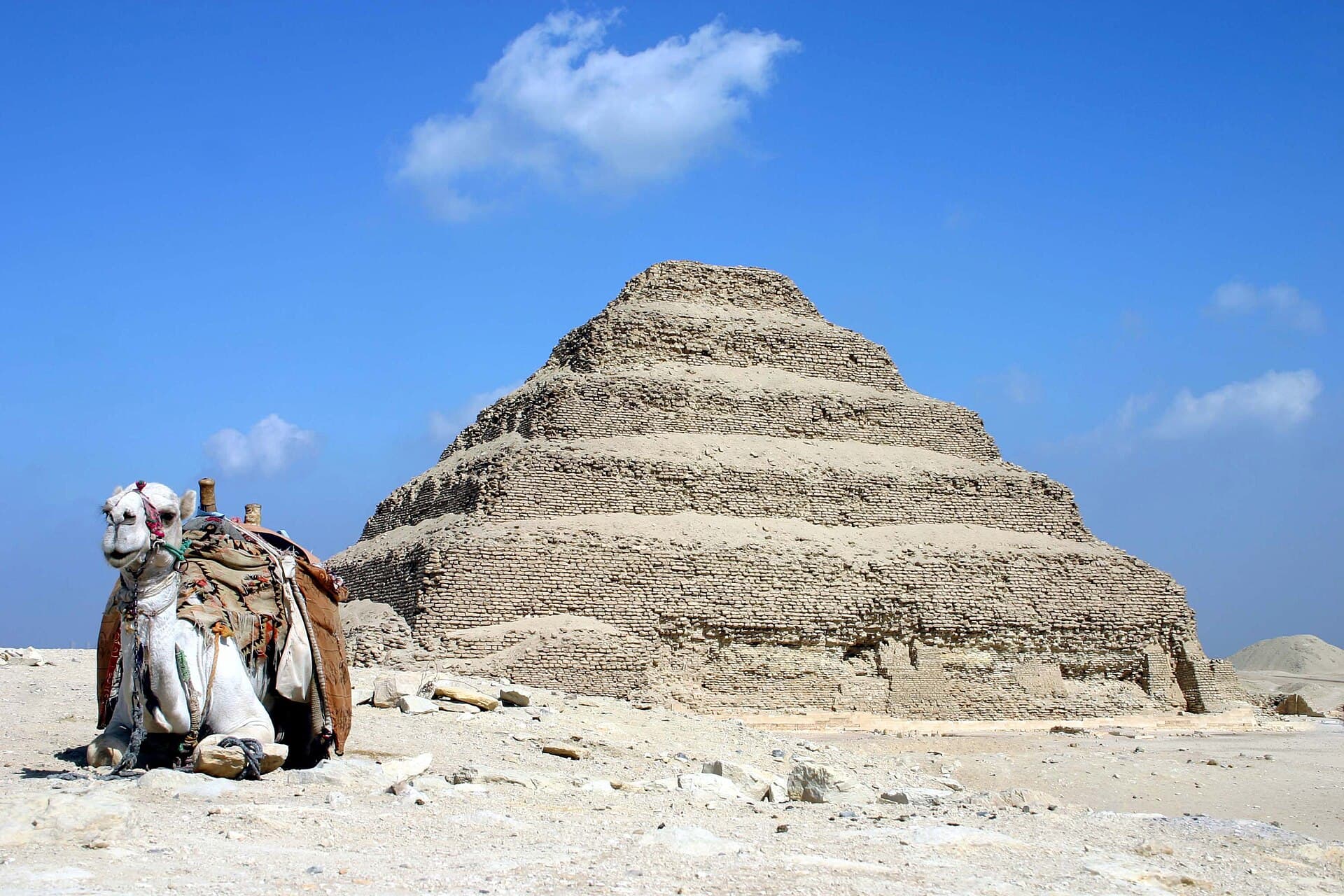
Saqqara is the burial ground of ancient Memphis and the site of Djoser's Step Pyramid, generally regarded as the earliest large stone building in the world. It sits about 30 kilometres south of central Cairo, on a desert ridge above the palm belt, and most visitors give it two rushed hours on the way to or from Giza. That is a mistake: Saqqara rewards slow looking more than any other pyramid site in Egypt.
What is Saqqara, exactly?
Saqqara is not a single monument. It is a necropolis several kilometres long, running north to south along the desert edge, and it was used for burials for more than three thousand years, from the First Dynasty through to the Roman period. Kings, high officials, priests, scribes and vast numbers of sacred animals were buried here. The Step Pyramid dominates the centre, but the site also holds a dozen or so royal pyramids in varying states of collapse, hundreds of private tombs, and animal catacombs cut deep into the rock.
The practical consequence is that Saqqara is spread out. You cannot walk it end to end in an afternoon. Vehicles move between the main clusters, and a visit means choosing which tombs to enter rather than trying to see everything. Anyone who tells you they did Saqqara in ninety minutes saw the Step Pyramid from a distance and left.
Why does the Step Pyramid matter so much?
Djoser's Step Pyramid, built around 2650 BC — absolute dates this early are estimates, and specialists differ by a century either way — is where monumental stone architecture begins. Before it, Egyptian tombs were largely mudbrick rectangles. Someone decided to build in cut limestone instead, then to stack six diminishing platforms on top of each other, reaching roughly sixty metres. Nothing on that scale in stone had been attempted anywhere. Every later pyramid, including the ones at Giza, descends from this experiment.
You can read the experiment in the building itself. The enclosure walls imitate mudbrick panelling in stone. The columns are engaged with the walls rather than free-standing, which is usually explained as caution: nobody yet knew how far stone columns could be trusted on their own. Ceilings are carved to look like bundled reeds and palm logs. This is architecture translating older materials into a new one and not quite letting go of them.
The pyramid was restored over many years and reopened after a long closure, and the interior has been enterable on a ticket separate from general entry. Access at Saqqara changes often and without much notice: monuments close for conservation, and newly cleared tombs open in their place. Do not take any list of what is open, including this one, as current. Ask at the ticket office on the day and buy everything you want there.
What is inside the Djoser enclosure?
The pyramid stands inside a walled precinct, and the precinct is the part visitors skip. You enter through a colonnade: a narrow roofed passage lined with tall engaged columns carved to resemble bundled plant stems, opening into the great court in front of the pyramid. It is the oldest surviving building of its kind and it does something no photograph conveys, which is to compress you in shadow for thirty metres and then hand you the whole monument at once.
South of the court is a second court lined with what are usually called dummy chapels: solid stone facades with no interiors, or with a token recess you cannot use. The standard reading is that they were built for the Heb Sed, the royal jubilee at which a king renewed his fitness to rule, and that the stone versions were meant to let Djoser repeat the festival for ever rather than to serve any living ritual. Architecture as a permanent stage set, in other words.
At the southern end of the enclosure is the South Tomb, a second substructure with its own shaft and chambers, whose purpose is still argued about. The walls of the enclosure, where they survive or have been rebuilt, carry the panelled niching that copies mudbrick in stone. Walking the circuit takes perhaps forty minutes at a slow pace and it is the single best-value use of time at Saqqara. Most people spend it photographing the pyramid from one spot.
What else is there besides the Step Pyramid?
The Pyramid of Unas, immediately south of the Djoser enclosure, looks from outside like a low mound of rubble and is one of the most important buildings in Egypt. Unas was the last king of the Fifth Dynasty, and the walls of his burial chamber carry the Pyramid Texts: the oldest known body of Egyptian religious writing, carved in vertical columns of hieroglyphs, concerned with getting a dead king into the sky. Nothing at Giza is inscribed at all. This is where funerary texts start.
A long causeway ran from the valley below up to the pyramid, and stretches of its course are visible on the ground. Further north, the Pyramid of Teti, first king of the Sixth Dynasty, is another shapeless mound over an inscribed interior, and the great viziers' mastabas cluster around it because officials wanted to be buried near their king.
There is also a New Kingdom layer that almost nobody comes for. Horemheb, army commander under Tutankhamun, built himself a fine tomb here long before he became king; when he did, he was buried in the Valley of the Kings instead, and much of the Saqqara tomb's relief was dispersed into European collections in the nineteenth century before excavators relocated the structure in the twentieth. Saqqara stopped being a royal cemetery after the Old Kingdom, but it never stopped being used.
Who was Imhotep?
Imhotep was Djoser's chief official, and one of the very few ancient Egyptian commoners whose name outlived his king's. He is credited with the design of the Step Pyramid complex, largely because his name and titles appear on the base of a Djoser statue found at the site. That is unusually good evidence for his standing at court, though it stops short of proving he drew the plans himself, and some Egyptologists are careful to say so.
Much later, Egyptians deified him, associating him with wisdom, writing and healing; the Greeks equated him with Asclepius. His tomb has never been securely identified, which is part of why archaeologists keep digging here. Treat the medical-genius reputation with caution. It accumulated in the two thousand years after his death and tells you more about later Egyptian religion than about whoever the man actually was.
Are the mastaba tombs better than Giza?
For painted and carved decoration, yes, often considerably. The mastabas of Old Kingdom officials at Saqqara contain reliefs of a quality you will not find inside the Giza pyramids, which are essentially bare stone corridors and chambers. The tombs of Mereruka, Kagemni and Ti are the usual highlights, along with Ptahhotep's. Mereruka's is the largest private tomb at the site, with more than thirty chambers, and it was built for a vizier who married a daughter of King Teti.
What makes them worth the time is the subject matter. These are scenes of daily life: cattle being forced across a canal, craftsmen at work, boatmen fighting with poles, geese being force-fed, a hippopotamus hunt in the marshes. The carving is shallow, precise and full of observed detail. Colour survives in patches and is sometimes startlingly fresh. Nothing at Giza gives you this much of what Old Kingdom Egypt looked like at ground level.
Bring a torch. Lighting inside the tombs is inconsistent and some chambers are genuinely dark, though flash photography is banned because it damages the pigment. A guide who knows the reliefs is worth more here than almost anywhere else in Egypt, because the scenes become legible once someone points out the conventions: how figures are sized by rank, how a canal is shown in section, why the same man appears four times in one register.
Whose tombs are you actually walking into?
Knowing who owned a mastaba changes what you see in it, so it is worth five minutes before you go. Mereruka and Kagemni were both viziers under Teti, effectively the most powerful officials in the country after the king, and both chose to be buried a short walk from his pyramid. Their tombs are large because their offices were large; the scale is a statement about rank, not about wealth in the modern sense.
Ti was a Fifth Dynasty official who held responsibility for royal pyramids and sun temples, and his mastaba is the one most often singled out for the quality of its reliefs — the marsh scenes and the workshops in particular. It also contains a serdab: a sealed chamber holding a statue of the owner, with narrow slots cut through the wall so that the figure could look out into the offering chapel and receive what was brought there.
Ptahhotep was a vizier of the later Fifth Dynasty. His name is attached to the Maxims of Ptahhotep, a wisdom text of fatherly advice on conduct and speech, though the surviving copies are far later than his lifetime and the attribution is traditional rather than demonstrated. The chapel he shares with Akhethotep is worth entering for a different reason: parts of it were left unfinished, so you can see the draughtsman's grid and outline drawing beneath the carving.
Is the Serapeum worth the extra ticket?
The Serapeum is the underground catacomb where the Apis bulls, sacred to Ptah and treated in life as manifestations of the god, were buried. It is a long rock-cut gallery lined with side chambers, each holding a huge stone sarcophagus, mostly granite and basalt. The largest weigh dozens of tonnes. Moving them into position underground was a serious feat of quarrying, transport and leverage, and it is the kind of problem Egyptian engineers solved repeatedly at this scale.
You may hear, on site or online, that the sarcophagi are too precisely made to be ancient work and point to some lost technology. People do make that claim; Egyptologists and stone specialists do not accept it, and the tool marks, the quarries and the unfinished examples left elsewhere in Egypt tell a fairly ordinary story of skilled hard-stone working. Ask what the evidence is rather than taking either version on trust.
Opinion divides sharply on whether it is worth the extra ticket. Some visitors find it the most impressive thing at Saqqara: cool, dim, silent, and strange in a way no above-ground monument is. Others find it an empty corridor of empty boxes and wonder what the fuss was about. The sarcophagi are undecorated and most of the lids are displaced. If you like engineering and atmosphere, go. If you want painted walls, spend the time in the mastabas.
Why are there so many mummified animals here?
Because Saqqara was a pilgrimage site as well as a cemetery. In the later periods, worshippers came to dedicate a mummified animal to a god as an offering — ibises and baboons for Thoth, falcons for Horus, cats for Bastet in the cliff area known as the Bubasteion — and the galleries cut to hold those offerings run for considerable distances underground. The numbers involved are not in the hundreds. They are in the hundreds of thousands.
That implies an industry, and the evidence supports one: breeding, killing, wrapping, selling and depositing animals on a scale that supported priests, embalmers and traders around the necropolis. The Serapeum, with its single enormously expensive bull burial at a time, sits at one end of that system; a cheap wrapped ibis bought by a pilgrim sits at the other.
It was not always honest. Modern imaging of votive bundles has repeatedly found packages containing only part of an animal, or feathers, sticks and mud rather than a body. That is worth knowing before a guide tells you the practice was purely devotional. It was devotional and commercial at once, which is a more interesting fact about ancient Egypt than the tidy version, and it is one of the things current excavation at Saqqara keeps adding to.
What is being excavated at Saqqara now?
Saqqara is one of the most active excavation sites in Egypt. Recent seasons have produced large caches of sealed wooden coffins, bronze statuettes, mummified animals in great numbers, and the workshops where mummification was carried out. Announcements come regularly, and where a headline says something is unprecedented it is worth waiting for the published excavation report before believing the strongest version of the claim. The site's story is genuinely still being written.
This has two effects on a visit. New tombs open, sometimes at short notice, and are often in excellent condition because they have been protected from a century of tourism. Equally, areas close without warning while work is underway, and photographs circulating online may show a tomb that is currently sealed. Do not plan a whole day around one specific newly discovered tomb without checking first, ideally with a local guide rather than a news article.
Is Saqqara quieter than Giza?
Much quieter, and that changes the experience more than most people expect. Giza has coaches, camel touts, ticket queues and a constant low-grade hustle. Saqqara has a fraction of the volume. You can stand in front of the Step Pyramid with a handful of other people around you, and inside the mastabas you may be alone with a guard who will unlock a gate and then leave you to it.
Giza is still worth seeing; the scale of the Great Pyramid does not translate into photographs. But if you have one day and you want to look at ancient Egypt rather than queue at it, Saqqara is the stronger choice. The Imhotep Museum near the entrance is small and worth twenty minutes, mainly for the statue material and the fragments from the Step Pyramid complex that are easier to read at eye level than in situ.
How do you get to Saqqara from Cairo?
By road, and effectively only by road. Saqqara is about 30 kilometres south of central Cairo and roughly 40 minutes from Giza when traffic behaves, though the drive from the eastern side of the city can run well over an hour. There is no useful public transport to the gate. The realistic options are a private driver for the day, a taxi or ride-hailing car arranged as a return trip, or an organised day tour that bundles Saqqara with Dahshur and Memphis.
If you arrange your own car, arrange the return leg at the same time. Coverage for ride-hailing apps thins out at the desert edge, and the standard arrangement everywhere on this route is a driver who waits while you are on site. Being stranded at a rural ticket gate in the afternoon heat is a solvable problem, but not a pleasant one, and it is entirely avoidable.
Two roads run south. The desert road is faster and duller; the agricultural road runs through the palm belt and villages along the canal, and is slower, narrower and considerably more interesting. Either is fine, but agree which one you are taking, and the order of the day's stops, before you set off. Once you are moving, renegotiating with a driver in traffic is a poor use of the morning.
What is it like on the ground: tickets, guards and facilities?
Tickets are sold at the main entrance, and the general entry ticket does not cover everything. The Serapeum, the Step Pyramid interior and certain individual tombs have been sold separately, and which ones carry a supplement changes. Buy what you want at the gate, because the monuments themselves are spread across kilometres of desert and walking back to the ticket office to correct an omission will cost you the better part of an hour.
Facilities are concentrated at the entrance area, near the Imhotep Museum and car park. Out among the tombs there is essentially nothing: no shops, no shade, no water. Carry more water than you think you need, and a hat, because the ridge is open desert and the middle of the day is unforgiving even in winter.
Expect the tombs to be locked. A guard holds the key, opens the gate for you, and will often point out a scene or two before stepping back. A small tip in local currency is customary for that and it smooths the whole visit, so carry small notes rather than arriving with nothing under a large denomination. It is not a fee and nobody can compel it, but refusing on principle mainly guarantees a colder reception at the next gate.
How do you combine Saqqara with Dahshur and Memphis?
The three sit close together and are usually done as one loop. Dahshur, further south, holds the Bent Pyramid and the Red Pyramid, both built by Sneferu, who founded the Fourth Dynasty a few decades after Djoser and fathered Khufu. The Red Pyramid is usually described as the first successful true pyramid, though Sneferu's pyramid at Meidum complicates that claim, and its interior is normally open to climb down into. Dahshur is even quieter than Saqqara.
Memphis, the ancient capital, is the weakest of the three. What survives is an open-air museum with a large fallen colossus of Ramesses II under a purpose-built shelter and an alabaster sphinx. The colossus is genuinely fine, and the sphinx is worth a slow walk around. The rest is a modest scatter of blocks. Half an hour is enough, and skipping it entirely to spend longer at Saqqara is a defensible choice rather than a heresy.
Done properly, the loop is a full day from Cairo: Saqqara in the morning when it is cooler and the tomb interiors are least crowded, Dahshur after, Memphis briefly if at all. Traffic out of Cairo is unpredictable and the drive can take well over an hour in either direction, so an early start buys you more than it costs in sleep. Agree the order with your driver before you set off.
Is Saqqara manageable with limited mobility?
Partly, and it is better to know which parts than to find out at the gate. The ground across most of the necropolis is uneven sand, loose rubble and slope, with no made paths between the clusters, and distances that look short on a map are longer on foot. A wheelchair is not practical away from the car park and the museum. Anyone who tires easily should plan on being driven between clusters rather than walking the site.
The Djoser enclosure is the most forgiving part. It is broadly level, the colonnade and the great court have solid footing, and you can take in the most significant architecture at Saqqara without going underground at all. If you do only one thing, do that one.
The tomb interiors are the difficulty. Entrances are often low, the approach is by ramp or steep steps, and some chambers require you to stoop for several metres at a time. The Serapeum involves a descent and a long gallery underground. None of it is extreme, but it is unsuited to bad knees, bad backs or any unease in confined spaces, and there is no alternative route once you have committed to a passage with people behind you.
Where does Saqqara belong in an Egypt itinerary?
Early, if you have the choice. Saqqara and Giza are Old Kingdom, more than a thousand years older than the temples and painted tombs most people see at Luxor, and taking them in that order stops the trip blurring into one long corridor of stone. Seeing where pyramid building starts, then where it is perfected at Giza, then what Egypt built a millennium later, gives the sequence a shape that no amount of guiding can supply after the fact.
On a three-day Cairo stay the usual honest split is Giza and the Grand Egyptian Museum on separate days, with Saqqara and Dahshur filling the third. Two days in Cairo means choosing, and most first-time visitors will choose Giza. If you are back for a second trip, or you already know you care more about carving than about scale, invert that without hesitation.
One more argument for going early in the trip: Saqqara is where you learn to read a relief. The scenes in the mastabas use the same conventions you will meet at Karnak, Dendera and in the Valley of the Kings — registers, ranked figure sizes, repeated figures across a sequence of actions — and an hour spent having them explained here pays for itself for the rest of the holiday.
When should you go, and what do most people get wrong?
October to April is the comfortable window. Summer at Saqqara is punishing: open desert, very little shade, and tomb interiors that hold the heat rather than escaping it. Arrive early in the day whatever the season, both for temperature and because tour groups tend to reach Saqqara mid-morning after Giza. The Khamsin winds of spring can bring dust that flattens the light and makes photography frustrating, though they pass quickly.
The most common mistake is under-allowing time. Three to four hours is a realistic minimum for Saqqara alone if you want to enter several tombs. The second is buying only the general entry ticket and then discovering that the Serapeum, the Step Pyramid interior and certain tombs need separate tickets, sold at the main entrance rather than at each monument. Decide what you want before you go through the gate, because walking back is a long way.
Third: people photograph the Step Pyramid and leave. The enclosure around it, the colonnade entrance, the courtyard with its dummy chapels and the south tomb are the actual architectural achievement, and they are quiet. Fourth: no shade means a hat, water and closed shoes. The ground is uneven sand and rubble across most of the site, and the walk between clusters is longer on foot than it looks on a map.
Common questions
Can you go inside the Step Pyramid?+
The interior has been accessible following restoration, on a ticket separate from general site entry. Access to Egyptian monuments changes without much notice, so check on the day rather than assuming. If it is open, the descent is steep and the passages are narrow and low in places. Anyone uneasy in confined spaces, or with knee or back trouble, should think twice before committing to it, because turning back partway is awkward.
Is Saqqara suitable for children?+
Reasonably, with caveats. The open areas are hot and exposed, and the tomb entrances involve stooping, steep ramps and dark chambers. Younger children often find the animal catacombs and the Serapeum more gripping than the reliefs. Bring water and plan on a shorter visit than an adult itinerary would allow. There is little in the way of shade or facilities once you are away from the entrance.
How much time do you need at Saqqara?+
Three to four hours for the site alone if you intend to enter several tombs and walk the Djoser enclosure properly. Two hours covers the Step Pyramid and one or two mastabas at a brisk pace. A full day covers Saqqara plus Dahshur, with Memphis squeezed in. If you only have two hours, spend them on the Djoser enclosure and one good mastaba rather than trying to see everything badly.
How far is Saqqara from Cairo, and how long does the drive take?+
Saqqara is roughly 30 kilometres south of central Cairo, and about 40 minutes from Giza when the road is clear. From the eastern side of the city the drive can take well over an hour, and traffic, not distance, is the variable that decides your day. There is no useful public transport to the site, so budget for a driver who waits rather than assuming you can arrange a return car at the gate.
Can you visit Saqqara without a guide?+
You can, and the site is straightforward to move around. But the reliefs are the point, and without someone to explain the scenes and their conventions most visitors look at beautiful carving and take nothing from it. A knowledgeable guide adds more value at Saqqara than at Giza, where the monuments largely explain themselves by scale. Ask what a guide actually knows about the Old Kingdom before you book; a weak one will recite dynasties at you.
Which tombs should you prioritise if you can only enter two or three?+
Ti and Mereruka are the usual answer, for the quality and the quantity of relief respectively, with Kagemni close behind. Add the Serapeum only if underground engineering appeals more to you than painted walls. The complication is that closures are frequent and unannounced, so decide your order of preference rather than fixing on one tomb, and ask at the ticket office which of your list is actually open that day.
Is photography allowed inside the tombs?+
Rules vary by monument and have changed several times in recent years, with some interiors requiring a photography ticket and others prohibiting cameras entirely. Flash is generally banned because it damages pigment. Assume you will need to ask at each tomb, and respect the answer; guards enforce it. Do not rely on what an older guidebook or forum post says.
Do you need to tip the guards who unlock the tombs?+
It is customary rather than compulsory. A guard will usually open a locked tomb for you, sometimes point out a scene, and expect a small tip in local currency for it. Carry small notes so you are not choosing between overpaying and having nothing to give. Nobody can require it, and a firm, polite refusal is not a scandal, but the practice is universal at Egyptian sites and the visit runs more smoothly if you plan for it.
Is the Imhotep Museum worth the time?+
For about twenty minutes, yes. It sits near the entrance and holds material excavated at Saqqara, including statue fragments and pieces from the Step Pyramid complex that are far easier to read at eye level in a case than in place on a wall. It is small, and it is not a substitute for the Egyptian Museum collections in Cairo. Treat it as a short orientation before or after the site rather than a destination.
Is Saqqara safe to visit?+
Yes, in normal conditions. It is a managed archaeological site with a police presence and it sees steady, if modest, visitor numbers. The practical risks are heat, dehydration and uneven ground rather than anything else. Persistent sellers operate near the entrance and around the car park, though far less aggressively than at Giza. A firm no works. Check your own government's current travel advice before booking, since that is the only source that stays current.
Official sources
Entry rules, opening hours, security advice and exchange rates all move. Check them at the source, not here.
Written and checked by the Nile Trip Guide editorial team · Last reviewed . Entry rules, prices and opening hours change — check anything critical against the official sources linked on this page.
The route most people take first, at the length it was built for: Giza and the Grand Egyptian Museum, then a flight to Luxor and four nights sailing down to Aswan.
No boat on this one. Giza and the Grand Egyptian Museum, a night in Luxor for both banks, two nights on the Red Sea, then back to Cairo for the Citadel, Coptic Cairo and the Royal Mummies.
Five nights in Cairo either side of a four-night sail from Luxor to Aswan. The Cairo days are private, just your party and a guide; the sightseeing off the boat is shared with a small group.