The Pyramids of Giza: What to Expect and How to Visit Well
The Pyramids of Giza sit on a limestone plateau on the western edge of Cairo, roughly 4,500 years old, and the Great Pyramid remained the tallest building on earth for close to four thousand years. They are not alone in the desert, whatever the photographs suggest: the city runs right up to the boundary wall. Knowing that in advance is the difference between a disappointing morning and a very good one.
What is actually at the Pyramids of Giza?
Three large pyramids, a scatter of much smaller subsidiary pyramids built for queens and satellite burials, the Sphinx, several temples, and a large field of mastaba tombs belonging to officials and family members. The Khufu boat that used to sit in its own museum beside the Great Pyramid has been moved to the Grand Egyptian Museum, so do not plan your day around it. The site is well over a kilometre end to end and mostly uphill on sand and broken rock. People routinely underestimate the walking.
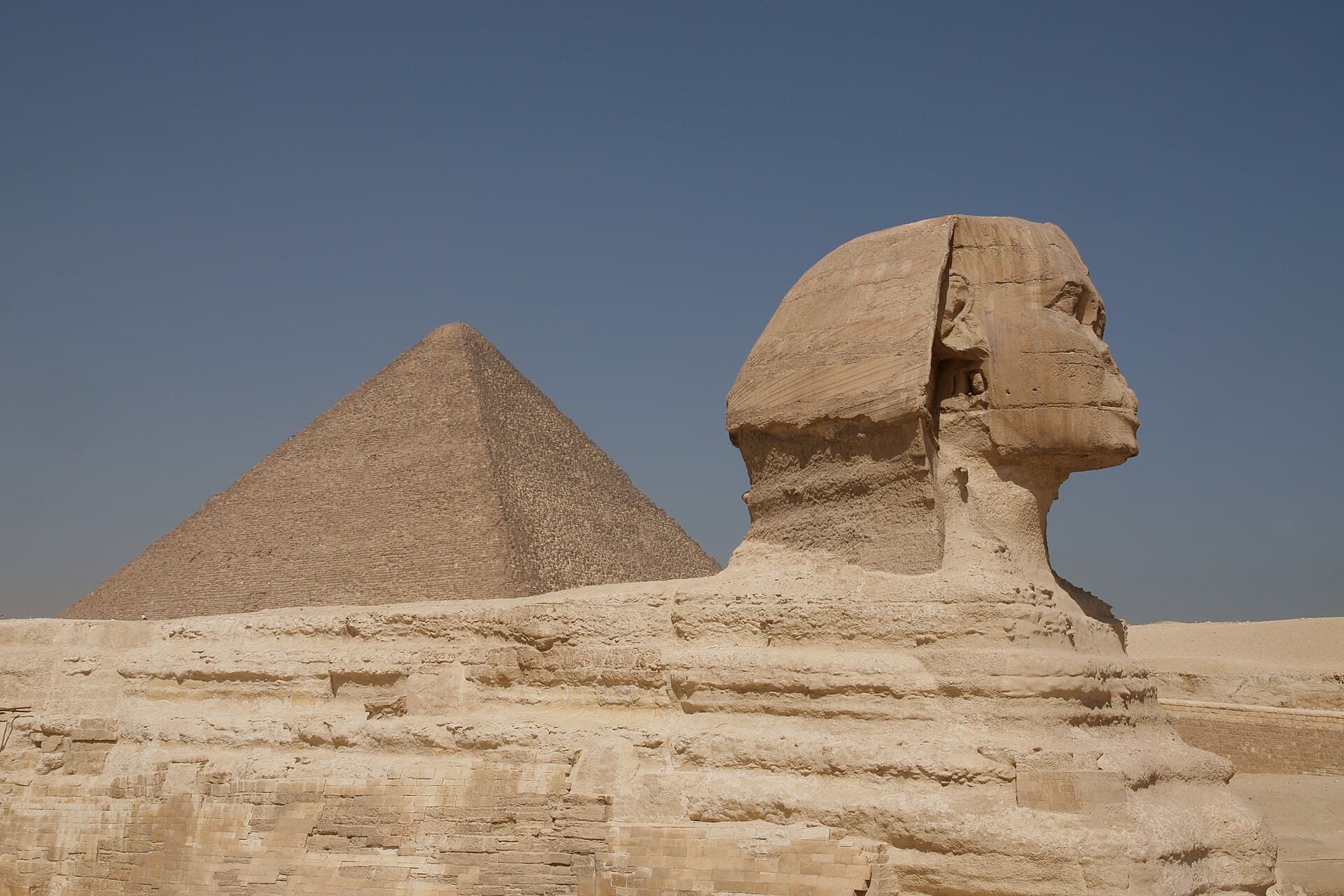
The Great Pyramid was built for Khufu, usually dated to around 2560 BC, though Old Kingdom dates carry a margin of decades either way. It stood about 146 metres when finished and is roughly eight metres shorter today, having lost its capstone and the polished casing that once covered it. The second pyramid, built for his son Khafre, looks taller than it is because it stands on higher ground.
Khafre's pyramid keeps a cap of original casing stone near the summit, and that cap is the single best thing on the plateau for understanding what these buildings once looked like: smooth, pale, reflective, nothing like the rough stepped mass you see today. The third pyramid, built for Menkaure, is much smaller and gets a fraction of the attention. Its granite lower courses, left unfinished, are worth two minutes of your time.
Why does Giza matter beyond its size?
Giza is where Egyptian state-building peaked. Quarrying, moving, dressing and placing millions of blocks to that tolerance needed a working bureaucracy, a food supply and a rotating labour force over decades. The workers were not slaves. Excavated settlements and cemeteries beside the plateau show organised crews who were fed, housed and buried on site, some with their job titles recorded on their tombs. You will hear the slave story from more than one person selling you something, so it is worth knowing.
The Great Pyramid is also the only one of the seven wonders of the ancient world still standing, and almost every later culture measured itself against it. Herodotus wrote about the pyramids when they were already more than two thousand years old, and the nineteenth-century antiquarians who followed dug here with more enthusiasm than method. For a visitor that matters in one practical way: much of what you walk past was cleared, moved or partly rebuilt by someone, and a good guide can tell you which.
How were they built, and how much of that is actually known?
Less is settled than the documentaries suggest, and the honest version is more interesting than the confident one. The bulk of each pyramid is local limestone, quarried on the plateau itself within a few hundred metres of where it was laid. That is why the ground around the pyramids is cut and pitted rather than flat: you are walking across the quarry that supplied the building beside you. The finer white casing limestone came from across the river, and the granite used in the internal chambers came from Aswan, most of the length of Egypt away.
The tools were copper, stone and wood. There was no iron in general use, no pulley system as we would recognise one, and no wheel doing any serious work on sand. Blocks were dragged on sledges, and the lubrication of the track with water is shown in Egyptian art of later periods, which is the nearest thing to a contemporary picture of the process that exists. Levering, packing and sheer organised manpower did the rest.
How the blocks got up is the part nobody can prove. Straight ramps, spiralling ramps wrapped around the outside, internal ramps, and combinations of all three have been proposed by serious people, and none of the proposals has won. Each has an arithmetic problem: a straight ramp at a workable gradient becomes a larger construction project than the pyramid, and a wrapping ramp obstructs the surveying you need to keep the corners true. Treat anyone who states the answer flatly, in either direction, as telling you a story.
What is not in doubt is the accuracy. The four sides are aligned close to true north, south, east and west, and the base is close to level across a footprint of more than five hectares. That precision, achieved with sighting instruments, plumb lines and water, is the genuinely astonishing thing about Giza, and it is invisible in photographs. It is also the best argument against the lost-civilisation theories: the errors that do exist are exactly the errors that careful surveyors make, not the absence of error a machine would leave.
Who built them, and how do we know they were not slaves?
The evidence sits a short distance south-east of the Sphinx, in ground most visitors never look at. Excavation there uncovered a settlement associated with the building of the pyramids: bakeries, storage, the debris of feeding large numbers of people, and the administrative apparatus of running a workforce. Beside it lies a cemetery of the workers themselves, with modest tombs built from leftover material from the royal projects.
Two things about those tombs settle the argument. First, their position: they are on the plateau, in the shadow of the king's monument, which is not where a slave society buries its disposable labour. Second, their inscriptions: some of the people buried there recorded their titles, and gang names preserved as painted graffiti inside the structure of the Great Pyramid show crews working under identities of their own. This was organised, named, accounted-for labour.
The best current reading is a mixture: a permanent skilled core of quarrymen, masons, surveyors and administrators, supplemented by much larger numbers of seasonal workers brought in under a system of obligation to the state, fed and housed while they served. Whether you call that conscription, taxation in labour, or national service is a matter of vocabulary. It is not chattel slavery, and no serious Egyptologist has argued that it was for a very long time.
This is worth carrying with you onto the plateau for a practical reason. The slave story is the single most common thing said out loud at Giza, usually by someone whose income depends on being entertaining rather than accurate. Knowing why it is wrong is a small pleasure and a useful filter for everything else you are told that morning.
Is going inside the Great Pyramid worth it?
Honestly, for most people, no. The interior costs extra on top of the main ticket, and here is what you get: a long, low, sloping passage where you shuffle bent double, then the Grand Gallery, then a bare granite room holding a lidless stone sarcophagus. No decoration, no inscriptions, no treasure. The air is hot, humid and heavy with other people's breath, and a fair number of visitors find it hard to manage.
The Grand Gallery is genuinely impressive as engineering, and if you are the sort of person who will regret not going, go. But if you are claustrophobic, unsteady on stairs, have a bad back or knees, or are travelling with young children in high summer, skip it without guilt. Better value is a mastaba tomb in the officials' cemetery, where you get carved and painted wall scenes and far fewer people. Which chambers and tombs are open changes without notice, so confirm on the day.
What is inside the Great Pyramid, in order
It helps to know the plan before you are crouched in it, because there is no interpretation underground and the passages are too narrow to stop and think in. From the entrance a descending passage runs down into the bedrock beneath the pyramid, ending in an unfinished chamber that was apparently abandoned. Partway down, an ascending passage branches upward: this is the route visitors take, and it is the low, steep, awkward section people remember.
That climb opens into the Grand Gallery, a tall corbelled corridor whose walls step inward course by course as they rise. It is the one piece of the interior that justifies the ticket, and it is worth stopping at the bottom of it to look up before you join the shuffle. At the top, a low passage with granite blocking arrangements leads into the King's Chamber: a plain granite box of a room, flat-ceilinged, with the lidless sarcophagus at one end.
Two features of that room are worth knowing about even though you cannot see them. Above the ceiling are a series of stacked relieving chambers, built to distribute the weight of the mass above, and it is inside those spaces that the workmen's gang graffiti survives. Narrow shafts also run from the King's Chamber, and from the so-called Queen's Chamber below it, outward through the body of the pyramid. What they were for is disputed: ventilation, a symbolic route for the king's spirit, or something structural. Nobody knows.
The pyramid is also still being surveyed. Non-invasive imaging work published in recent years has reported a large previously unknown void above the Grand Gallery, and a short corridor behind the chevron blocks on the north face has been confirmed and examined with a borescope. Neither is open to visitors and neither contained treasure. They are mentioned here because you will be told about them on the plateau, usually with embellishment: the finds are real, the interpretations are open, and no chamber of gold has been found.
Khafre's and Menkaure's pyramids: quieter, and sometimes better
Most visitors photograph all three and go inside only the Great Pyramid, which is the wrong way round for a lot of people. The interiors of the second and third pyramids are simpler, shorter, and considerably less crowded, and the queue is often a fraction of the one at Khufu's entrance. If your reason for going inside is to have been inside a pyramid rather than to see a specific chamber, the smaller ones deliver the same experience with less discomfort.
Khafre's pyramid is the one to walk around properly, because of the casing cap at the top. Stand on its north side and look up: the transition from rough stepped core to smooth intact skin is abrupt and it does the explaining for you. Menkaure's is the smallest of the three and the least visited, and its unfinished granite casing at the base is the clearest evidence anywhere on the plateau of how these buildings were dressed from the bottom upward, and what happens when a reign ends before the work does.
Which interiors are open varies. It is common for one pyramid to be closed for conservation while the others are accessible, and the rotation is not published in a form you can rely on from abroad. Ask at the ticket office, buy what you want there, and do not build the morning around getting into a specific one.
The mastaba fields: where the decoration actually is
East and west of the Great Pyramid lie ordered blocks of rectangular tombs, laid out in streets. These are mastabas, the burial places of the officials, priests and relatives who ran the machinery of the Fourth Dynasty and expected to keep serving the king after death. They are the most overlooked part of Giza and, for many visitors, the most rewarding.
The reason is simple: the pyramids are bare inside and the mastabas are not. Where a tomb is open you get carved and painted wall scenes of offering, farming, butchery and daily work, at eye level and close enough to read. It is the difference between admiring a mass of stone and seeing what the people who built it thought life looked like. The quality here is a step below the famous tombs at Saqqara, but it is on the same plateau as the pyramids and costs you nothing but the walk.
Which tombs are unlocked changes, sometimes week to week, and a guard with a key is often the deciding factor. Carry a torch, since the lighting is poor or absent, and expect flash photography to be prohibited because it damages the pigment. Fifteen minutes in a decorated mastaba is a better souvenir of Giza than an hour in the queue at the Great Pyramid.
What about the Sphinx?
The Sphinx is smaller than most people expect, roughly 20 metres high and about 70 long, and it is carved from the limestone bedrock of the plateau rather than built from blocks, with the paws and parts of the body repaired in masonry over the centuries. It sits in a quarried hollow below the level of the causeway, which is why it never dominates a view the way the pyramids do.
Most Egyptologists attribute it to Khafre, around 2500 BC, though a minority argue for his father Khufu or his brother Djedefre. The evidence is circumstantial and the question is genuinely open. Claims that the Sphinx is many thousands of years older than that, usually based on weathering patterns, are made loudly online and by the occasional guide, but they are not accepted by the archaeologists working on the site. Treat them as stories you will hear, not as history.
You cannot walk up to it or touch it. Access is through the Valley Temple of Khafre, which brings you out onto a viewing terrace to one side. The terrace is crowded and everyone is taking the same photograph. The Valley Temple itself, with its huge polished granite piers, gets walked through in thirty seconds by people who should be looking at it. It is one of the best-preserved Old Kingdom buildings anywhere.
Reading the plateau as a set of complexes, not three pyramids
Giza is usually photographed as three isolated shapes in sand, and that framing is the reason most visitors leave without understanding it. Each pyramid was the centrepiece of a complex with a standard layout: the pyramid itself, a mortuary temple against its eastern face, a walled causeway running down the slope, and a valley temple at the bottom where the desert met the floodplain and the water that supplied everything. Add the subsidiary pyramids for queens, the boat pits cut beside the main pyramid, and the cemeteries of officials, and you have a working funerary estate rather than a monument.
Khafre's complex is the one that survives well enough to read on the ground, which is why the walk from the Valley Temple up the line of the causeway is the single most useful thing you can do at Giza. The Sphinx sits beside that route rather than at the end of it. It was never a standalone attraction, and treating it as one is the commonest mistake made here.
The other thing this explains is the geography of your own visit. The floodplain the valley temples were built to face is now Nazlet el-Samman, the town at the foot of the plateau. The pyramids did not sit in empty desert even in antiquity; they sat on the boundary between the desert and the cultivated land, deliberately, on the side of the river associated with the dead. Standing at the front of the Valley Temple, you are standing on that boundary line.
Where do you get the view worth having?
There is a panorama point on the high desert side of the plateau, reached by the ring road that loops behind the pyramids. From there all three line up with open sand in the foreground and the city behind you rather than in front. Almost every tour stops here, so it is busy, and the camel and quad-bike touts concentrate around the car park.
Two things make it better. Go there first rather than last, before the coaches arrive, and walk a couple of hundred metres away from the parked vehicles. The crowd thins out fast. A second good vantage is the causeway area near Khafre's pyramid, where you get scale rather than the postcard composition, close enough for the individual blocks to read at human size.
Photography: light, angles and the shots that do not work
The pyramids are aligned to the cardinal points, which decides your day for you. In the morning the eastern faces are lit and the western faces are in shadow, and the reverse is true in the late afternoon. The Sphinx faces east, so it is lit in the morning and backlit for the rest of the day, which is why so many photographs of it are silhouettes taken by people who arrived after lunch.
Midday is the worst light available: flat, hard, and it flattens the stepped texture that gives the stone its character. If photographs matter to you, be on the plateau at opening or in the last two hours, and accept that the two hours in the middle are for shade, water and the museum rather than for pictures. Haze is the other constraint. Cairo air is often thick, and the long view from the panorama point can be milky even on a cloudless day, which no filter fixes.
The perspective trap is worth knowing about too. Because the pyramids are enormous and there is nothing beside them for scale, a photograph taken close in makes them look like a slope of rubble, and a photograph taken far out makes them look small. The shots that work put something human in the frame at a known size, or use the individual blocks at the base as the scale reference. The forced-perspective picture of somebody appearing to hold a pyramid between two fingers has been taken several million times, which is a reason to attempt it or to avoid it, depending on your temperament.
How do you handle the camel and horse touts?
This is the part visitors find most wearing, and it is worth preparing for rather than being surprised by. You will be approached repeatedly by men offering camel rides, horse rides, quad bikes, headscarves, souvenirs and unofficial guiding. Some are licensed. Many are not. The approaches start in the car park and continue most of the way across the plateau.
The reliable method is short and unembarrassed. Say no clearly, keep walking, do not stop, do not take anything offered into your hand, and do not accept a headscarf or a small souvenir described as a gift. A gift becomes a price once you are holding it. Never mount a camel before the price and the duration are agreed out loud, and be aware that the fee to get off again is a well-worn trick. If you want a camel photograph, arrange it through your guide or driver in advance at a fixed rate.
On animal welfare: conditions vary and some of the horses and camels are visibly in poor shape. If that matters to you, look at the animal before you decide, and be willing to walk away. Walking the site on foot is entirely practical if you have decent shoes and enough water, and it costs you nothing.
Practical mechanics: entrances, tickets and moving around the site
There is more than one way in. The long-standing arrangement has a main entrance on the Cairo side, at the top of the approach road near the old hotel strip, and a second entrance lower down beside the Sphinx at Nazlet el-Samman. Which you use changes the shape of your visit: enter at the top and you work downhill towards the Sphinx, enter at the bottom and you climb. Downhill is the better order in heat, and it puts the Sphinx and the Valley Temple at the end, which is where they belong.
Entrances, ticketing and internal transport on the plateau have all been reorganised more than once in recent years, and the arrangements continue to change. Interior tickets for the pyramids are sold separately from general admission, and the panorama point and the various tombs are handled differently at different times. Nothing written in advance, on this page or anywhere else, should be treated as current: check with the ticket office on the day, buy everything you want at the same time, and be sceptical of anyone selling tickets away from an official window.
Carry small notes. Tipping is expected for small services throughout the site, including from the guards who unlock tombs, and being unable to break a large note leaves you either overpaying or in an awkward negotiation. There is very little shade anywhere on the plateau and the refreshment options are limited and expensive, so bring more water than you expect to drink rather than relying on buying it there.
A walking order that works
If you have three or four hours and want a route rather than a wander, this one uses the terrain sensibly. Start at the panorama point early, before the coaches, and walk out from the car park to get the line-up of all three with clean foreground. Then come down to Menkaure's pyramid and look at the unfinished granite at the base. Then Khafre's, walking round to the north side for the casing cap, and along the line of the causeway.
Then the Great Pyramid, which is where the crowds are thickest and where the decision about going inside gets made. Whichever way that goes, give yourself fifteen minutes at the base with your hand on the stone and your eyes on the individual blocks, because the scale only registers close up. From there, the mastaba field to the east if anything is open.
Finish at the bottom: the Valley Temple, then the Sphinx terrace. This puts the two most crowded viewpoints at the end rather than the beginning, gets the walking done while you are fresh, and means you are heading downhill as the heat builds. It also leaves you at the lower entrance, which is the easier side to be collected from.
Is the sound and light show any good?
It is dated. The script is heavy, the narration is theatrical, the technology has not moved on much in decades, and the seating is basic. If you are expecting a modern projection-mapped production, you will be disappointed. Performances run in several languages on a rotating schedule, so check which language is playing before you commit an evening to it.
That said, it has one thing going for it: the pyramids and the Sphinx lit at night, at scale, with the crowds gone. If your itinerary has a free evening in Cairo and you can treat it as an hour of atmosphere rather than a show, it holds up. If your time is tight, spend that evening somewhere else. Nights get cold on the plateau from November to February, so take a layer.
When should you go, and how long do you need?
Go at opening, or go late in the afternoon. The middle of the day brings the coach groups and the heat at the same time. From May to September the plateau is punishing by late morning, with no shade anywhere and glare coming off the stone. October to April is the comfortable window, with December and January cool enough to want a jacket at dawn.
Allow three to four hours for the plateau proper, more if you are going into chambers. Half a day at Giza plus the Grand Egyptian Museum, which sits close to the plateau, is a common plan and a tiring one. Take more water than you think you need, a hat, sunglasses and closed shoes; the ground is sharp and sandy, and sandals are a mistake.
Fridays tend to be quieter for foreign visitors in the morning and busier with local families later in the day. School holidays and Egyptian public holidays fill the site. Whatever you read about ticket prices, opening times and which pyramids and tombs are open, confirm locally on the day, because all of them change with little warning.
Giza and the Grand Egyptian Museum in the same day
The Grand Egyptian Museum stands roughly two kilometres from the plateau, on the desert edge, which makes pairing them look obvious on a map. It is not as easy as it looks. The museum needs three hours as an absolute floor and rewards five or six, the walking inside it is long and on hard floors, and the Tutankhamun galleries sit at the far end of that walk rather than the start. Adding them to a morning that already involved four hours of sand and sun produces two half-done visits and a wasted afternoon.
If you have one day, our view is to do Giza properly at dawn and the museum properly on a different trip, or to cut the plateau to the panorama point, the Great Pyramid base and the Sphinx, and give the museum the rest of the day. If you have two days, split them, and put the museum on the second so that legs and attention are fresh for it.
One practical connection between the two: the Khufu solar boat, a cedar vessel of more than forty metres buried beside the Great Pyramid and reassembled over years of work, was moved from its old museum beside the pyramid to the new site. If that is on your list, it is a museum item now, not a plateau one, and access arrangements have changed more than once since the move.
How does Giza fit with Saqqara and Dahshur?
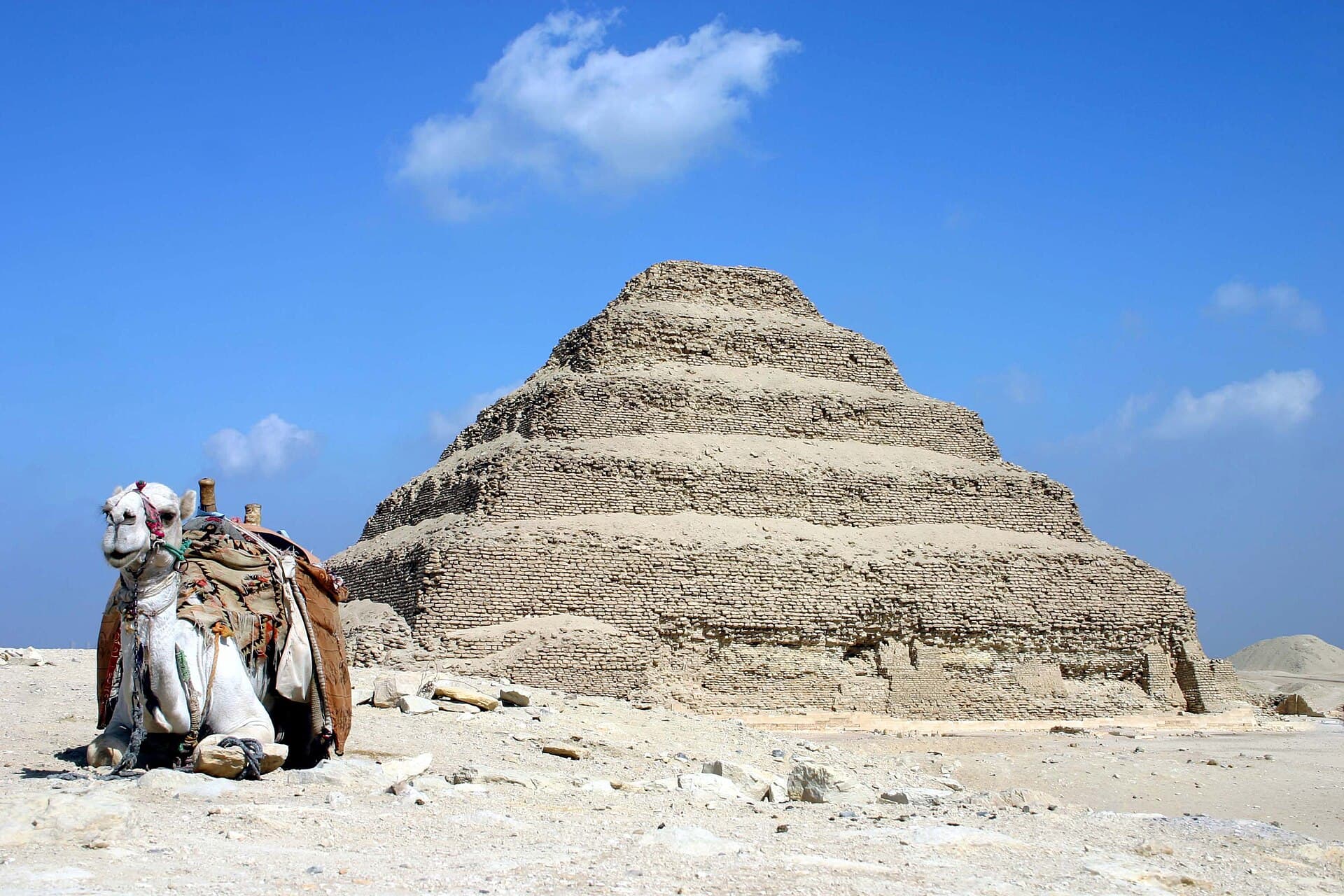
Giza is not the whole story, and seeing it alone gives you the ending without the argument. Saqqara, a short drive south, has the Step Pyramid of Djoser, the earliest large stone building in Egypt and the point where the idea begins. Dahshur, further south again, has Sneferu's Bent Pyramid and Red Pyramid, where the geometry was worked out by trial and error. The Bent Pyramid literally changes angle partway up, most likely because the structure was in trouble, though the reason is still argued over.
Visited in that order, Saqqara then Dahshur then Giza, the plateau stops being a spectacle and becomes the result of several generations of hard engineering. Dahshur in particular is quiet, has almost no touts, and when its chambers are open it lets you walk into a full-size pyramid with a fraction of the queue you would face at Giza.
The practical constraint is time. Doing all three properly is a long day and needs a driver, since they are spread across a wide area with no useful public transport between them. If you only have one day and want the famous view, do Giza. If you have two, split Giza and a Saqqara-Dahshur combination, and put the quieter day first.
Memphis, the vanished capital these necropolises served, sits on the road below Saqqara and takes half an hour: a fallen colossus of Ramesses II under a shelter and an alabaster sphinx on open ground. It is worth the stop only if you are already driving past, and it is genuinely useful for anyone in your party who cannot manage sand, ramps and long walks.
Visiting with children, or with limited mobility
Giza is harder work than its reputation suggests, and both groups are better served by planning for the ground rather than the monuments. The surface is sand, loose rock and broken quarry floor, on a gradient, with no shade and considerable distance between the things you have come to see. Wheelchairs do not handle it well outside the paved approach areas, and small children run out of enthusiasm quickly once they realise that a very large triangle stays a very large triangle for an hour.
The pyramid interiors are not suitable for either group and this is not a matter of caution. The passages are low, steep, unlit in places, and there is no way out except back the way you came, past everyone coming down. Anyone with a heart condition, breathing difficulty, a bad back or knees, or a real problem with enclosed spaces should treat that as a straightforward no.
What does work: arrive at opening while it is cool, use a vehicle to move between the panorama point, the pyramids and the Sphinx rather than walking the whole plateau, keep the visit to two hours, and let the camels be looked at rather than ridden. Children generally get more out of the Sphinx and the mastaba scenes, which have faces and animals in them, than out of the pyramids themselves, which are abstract at close range.
The stories you will be told, and what to do with them
Giza attracts more confident nonsense than any other site in Egypt, and it is worth having the common items filed in advance so they do not eat your morning. The slaves are the first, and dealt with above. Aliens, lost civilisations and pre-Ice-Age construction dates are the second, and they share a single weakness: they require the surrounding evidence, the quarries, the workers' settlement, the unfinished pyramids at Meidum and Dahshur, the whole developmental sequence, to be explained away. It is easier to accept that Old Kingdom Egypt could do this, because everything around the pyramid shows it learning how.
The blade-of-grass claim comes up constantly: that the joints are so fine you cannot slide a knife between them. Some of the casing joints genuinely are extraordinary, and you can look at the surviving casing blocks on the north side of the Great Pyramid and judge for yourself. The core masonry behind them is much rougher, with generous mortar, and the two things get conflated by people who want the whole building to be uniform precision. It is not, and the difference between finish and structure is more interesting than the myth.
Curses, secret chambers full of gold, and imminent discoveries about to be announced are the standard closing move, usually delivered near a shop. The genuine recent findings, the void above the Grand Gallery and the corridor behind the north-face chevrons, are undramatic in exactly the way real archaeology is: empty spaces, carefully imaged, still being argued over. The correct response to all of this is polite, cheerful scepticism, which is also the correct response to most of what is said to you in the car park.
Common questions
Can you see the Pyramids of Giza for free from outside the site?+
Yes, partly. The pyramids are visible from streets in Giza town, from rooftop restaurants and hotels along the approach road, and from parts of the ring road. Several rooftops face the plateau directly and are popular at sunset. The view is real but distant, and framed by buildings and cables. It is a supplement to visiting, not a replacement for standing at the base.
Are the pyramids safe to visit as an independent traveller?+
The site itself is heavily policed and serious crime against visitors is rare. The persistent problem is commercial pressure: touts, unofficial guides, inflated prices and small scams. That is an irritation rather than a danger. Solo women report more approaches than average. Agreeing prices in advance, carrying small notes, and arranging your own transport removes most of the friction.
Can you climb the pyramids?+
No. Climbing any pyramid is prohibited and enforced, and people are detained for trying it. The blocks are large and loose in places, and falls have killed climbers. Anyone offering to arrange a climb for a fee is offering to get you arrested. You can, however, walk right up to the base and put your hand on the stone, which is enough.
How far is Giza from central Cairo, and how long does the transfer take?+
Giza sits on the western edge of the Cairo urban area, so the distance is short but the journey is not. Depending on traffic and where you start, allow anywhere from forty minutes to well over an hour and a half. Early departures are markedly faster. This is the main reason a dawn start works: you beat the traffic as well as the coaches.
Is a guide necessary at the Pyramids of Giza?+
Not strictly, but a good Egyptologist guide changes the visit considerably. The site has almost no interpretation on the ground, so without one you are looking at very large stones with no context. A guide also absorbs the touts, which is worth something on its own. Book through a known operator rather than accepting an offer at the gate.
What is the single most common mistake visitors make?+
Treating it as a two-hour photo stop bolted onto a museum day, and arriving at eleven in the morning. That combination gives you the worst heat, the largest crowds, no time for the tombs or the Valley Temple, and an exhausted afternoon. Going early, staying longer, and cutting something else from the day fixes almost everything people complain about.
How old are the Pyramids of Giza?+
Roughly 4,500 years. The Great Pyramid is usually dated to around 2560 BC, with Khafre's and Menkaure's following over the next few decades. Absolute dates this early carry a margin of several decades either way, and specialists differ, so treat any single year you are given as a best estimate rather than a fact.
How many pyramids are there at Giza?+
Three large ones, for Khufu, Khafre and Menkaure, plus a scatter of much smaller subsidiary pyramids built for queens and satellite burials. The small ones are easy to miss because they read as heaps of rubble from a distance. If you count everything on the plateau you get into double figures, which is why you will hear different numbers quoted.
Do you need to book pyramid tickets in advance?+
Arrangements for tickets, entrances and the interiors have been reorganised several times in recent years and continue to change, so nothing written in advance is reliable. Interior tickets are sold separately from general admission and are limited in number, which is the main argument for arriving at opening. Confirm on the day at an official window and buy everything you want at once.
Can you go inside all three pyramids?+
Sometimes, but not dependably. It is common for one to be closed for conservation while the others are open, and the rotation is not published in a form you can plan around from abroad. Each interior needs its own ticket. The second and third pyramids are usually far quieter than the Great Pyramid and deliver much the same experience with less queueing.
What is the best time of day for photographs at Giza?+
Early morning or the last two hours before closing. The pyramids are aligned to the cardinal points, so eastern faces are lit in the morning and western faces in the late afternoon, and the Sphinx faces east, which means it is properly lit only in the morning. Midday light is flat and unflattering, and Cairo haze can wash out the long views whatever the hour.
Is the Grand Egyptian Museum included in the pyramid ticket?+
No. It is a separate site with its own admission, about two kilometres from the plateau, and it needs at least three hours of its own. Pairing it with a full morning at Giza is a common plan and a tiring one. If both matter to you, put them on different days, or shorten the plateau visit deliberately rather than by accident.
Official sources
Entry rules, opening hours, security advice and exchange rates all move. Check them at the source, not here.
Written and checked by the Nile Trip Guide editorial team · Last reviewed . Entry rules, prices and opening hours change — check anything critical against the official sources linked on this page.
The route most people take first, at the length it was built for: Giza and the Grand Egyptian Museum, then a flight to Luxor and four nights sailing down to Aswan.
No boat on this one. Giza and the Grand Egyptian Museum, a night in Luxor for both banks, two nights on the Red Sea, then back to Cairo for the Citadel, Coptic Cairo and the Royal Mummies.
Five nights in Cairo either side of a four-night sail from Luxor to Aswan. The Cairo days are private, just your party and a guide; the sightseeing off the boat is shared with a small group.