The Bent Pyramid: Dahshur's correction in stone, and the descent inside it
The Bent Pyramid at Dahshur is the one that visibly went wrong, and that is exactly why it is worth the drive south from Cairo. The lower half rises at a steep angle; about halfway up the angle drops to something shallower, and the whole profile kinks. You can see it from the road. Giza is more impressive and less interesting: Giza shows you a solved problem, and Dahshur shows you the problem being solved, at full scale, by people who could not take it down and start again.
What the bend actually is
One pyramid, two angles. The lower courses rise steeply, the upper courses are noticeably shallower, and the join between them is a visible kink running right round the building. From a distance the silhouette looks pinched, as though someone leaned on it. It is not subtle and it is not a trick of the light: this is the shape the builders left behind.
The standard reading, and the one this site takes, is that the design was failing. A steep pyramid loads its own structure very heavily, and the usual explanation is that cracking or settlement showed up while work was still going on, so the angle was reduced to take weight out of the upper part and the job was finished on the safer slope.
Be a little sceptical about how confidently that story gets told. It follows sensibly from what the building does, and specialists broadly accept some version of it, but nobody has the site foreman's notes. Other explanations circulate, including a rush to finish. What is beyond argument is the change itself, and the change is the interesting part regardless of which reason turns out to be right.
The figures usually quoted put the lower slope at around 54 degrees and the upper at around 43, with the finished building standing a little over a hundred metres. Treat those as published approximations rather than measurements you should repeat as gospel; what matters on the ground is that the difference between the two angles is large enough to see from a car window, and that no other full-size Egyptian pyramid does this.
The explanations on offer, and how much weight each takes
The structural argument is the strongest of them, and it has physical support inside the building. There is cracking in the masonry of the interior, and heavy ancient timbers are wedged across parts of the upper chamber. Whether those timbers went in as an emergency response to a building that was moving, or were part of the plan from the beginning, is argued rather than settled — but a pyramid that needed bracing at all is a pyramid whose designers had something to worry about.
A second line blames the ground. The Bent Pyramid does not sit on the same clean bedrock shelf that the Giza builders later chose, and the suggestion is that the foundation settled unevenly under a very steep and very heavy mass, opening the cracks rather than the slope alone causing them. This is not in competition with the first explanation so much as an account of what set it off.
A third says haste: Sneferu was ageing, the pyramid had to be finished, and a shallower top is a great deal less stone to quarry, drag and lift. That reasoning is sound arithmetic, and it is also the sort of explanation that can be attached to almost any unfinished-looking building, which is why it should not be leaned on too hard on its own.
A fourth group of readings treats the two angles as deliberate — a designed shape with religious meaning rather than a correction. These are difficult to argue with and difficult to test, because a theory that explains any shape equally well explains none of them in particular. The honest position is that the reason is not recoverable from the evidence that survives. The bend is a fact; the motive is an inference, and you should be told which is which.
Why a change of angle matters at all
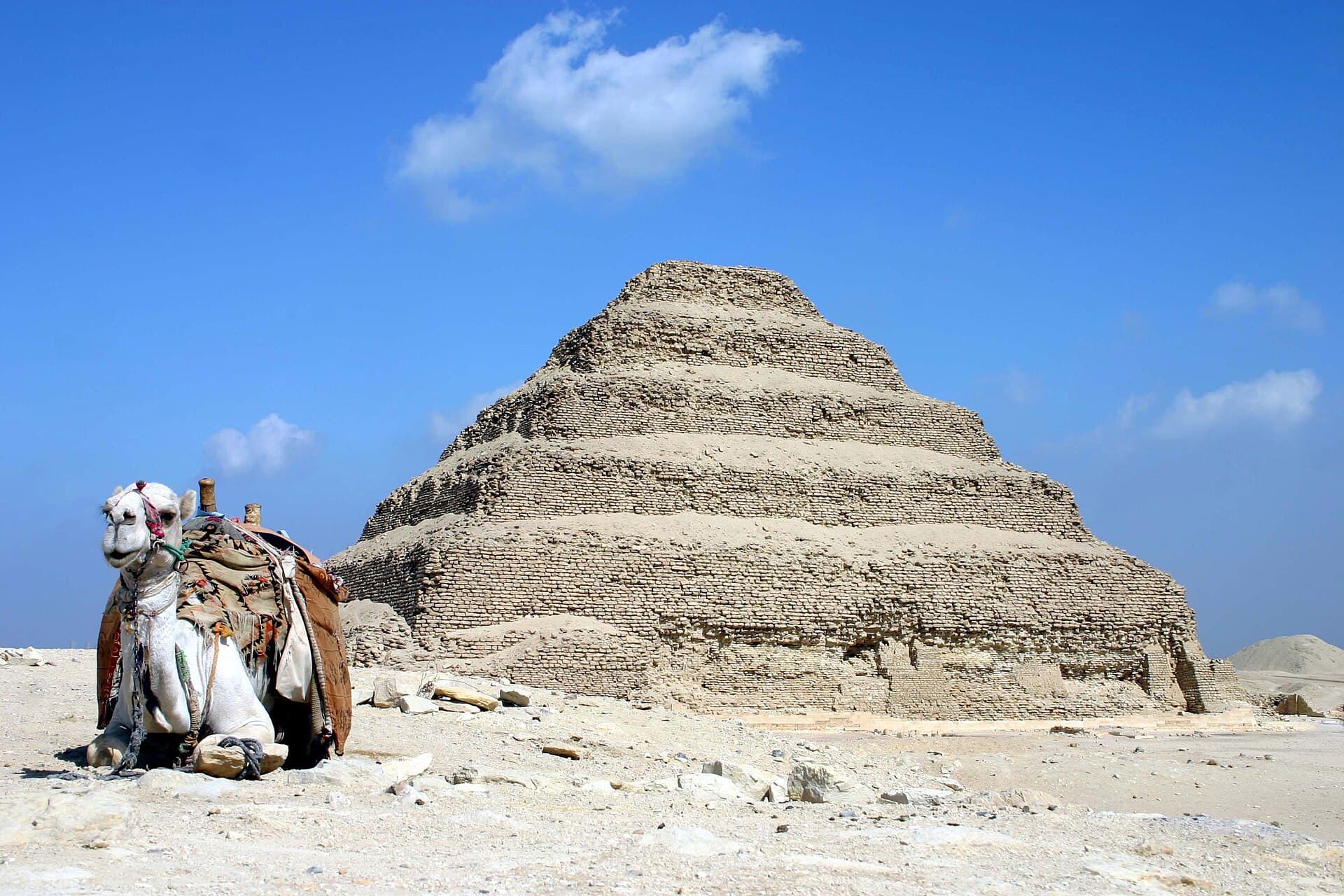
Because of where it sits in the sequence. At Saqqara, Djoser's Step Pyramid is where monumental stone building starts: six diminishing platforms stacked on each other. At Giza, a few generations later, Khufu's Great Pyramid is a smooth-sided true pyramid built with total assurance. Getting from one to the other was not a small step, and Dahshur is where the working out happened. Sneferu, who founded the Fourth Dynasty a few decades after Djoser and fathered Khufu, is the king whose building programme covers the gap.
The Red Pyramid, standing on the same stretch of desert, is usually described as the first successful smooth-sided pyramid — and it is built on the shallower slope, the one the Bent Pyramid was corrected to. Even that neat line has a complication: Sneferu's pyramid at Meidum muddies the order, and honest accounts say so rather than tidying it away.
For a visitor the payoff is simple. Giza is certainty in limestone. Dahshur is a mid-job correction, permanent, at a scale that could not be undone. Standing where you can see both Dahshur pyramids at once is the single clearest lesson in Old Kingdom engineering available anywhere in Egypt, and hardly anybody goes.
Sneferu, and why the working out happened here
Sneferu is the reason Dahshur exists as a royal site. He is generally reckoned to have had more stone piled up in his name than any other Egyptian king, spread across several pyramids rather than concentrated in one, and the Bent Pyramid is the middle of that record rather than an isolated failure. A king who builds three or four times is a king whose builders get to learn something between attempts, which is precisely what the Dahshur skyline shows.
The site itself is fresh ground. Saqqara, a little to the north, was already a working necropolis crowded with earlier monuments; Dahshur is open desert on the same escarpment, with room to lay out a full-size smooth-sided pyramid, its causeway and its valley buildings without negotiating around anyone else's tomb. Exactly why this stretch was chosen is not documented, and accounts that give you a confident motive are guessing.
What this means for the visit is that you are not looking at one building but at a programme. The Bent Pyramid is the attempt where the problem surfaced; the Red Pyramid, a short distance north, is the attempt where it was solved and the answer stuck. Every later pyramid in Egypt, Giza included, is built on the conclusion reached in this square kilometre of desert.
It looks more finished than Giza, and that is not an illusion
The Bent Pyramid keeps a great deal of its outer casing. The Giza pyramids lost most of theirs to later builders, which is why they read as stepped stacks of blocks with a rubble texture. Here large areas of the smooth sloping surface are still in place, so the building has the finish it was meant to have.
That is worth understanding before you photograph it. What you are looking at is closer to what a completed Old Kingdom pyramid actually looked like than anything at Giza — minus the pinch in the middle. People who have only seen Giza sometimes assume the Bent Pyramid has been restored. It has not; it simply kept its skin.
What the surviving casing lets you read
Two explanations usually get offered for why the skin survived here and not at Giza, and both are probably doing some of the work. The first is the way the casing was laid: the blocks are set leaning slightly inwards rather than stacked square, which is generally credited with holding the surface together and making individual stones awkward to prise out. The second is geography. Stone robbing follows convenience, and the Giza plateau sat far closer to the mediaeval city that wanted building material than this stretch of desert did.
Up close the effect is unlike any other pyramid you will see in Egypt. Instead of a staircase of weathered core blocks you get an actual sloping plane, with the joints between casing stones still legible and the surface running unbroken for long stretches. Put a hand flat on it and the angle is obvious in a way it never is at Giza, where you are essentially touching the inside of a building whose outside has gone.
It also makes the bend read properly. Because both halves kept their finished surface, the kink is a change in a continuous plane rather than a change in a pile of rubble — which is why photographs taken here look like a designed object that went wrong, and photographs of Giza look like geology. Give the casing five minutes of close attention before you walk away; it is the second reason to come, after the angle itself.
Two entrances, and two systems of chambers
The Bent Pyramid is unusual inside as well as out. It has two entrances: one in the north face, which is the one visitors use, and a second set high in the west face. No other full-size Egyptian pyramid was built this way, and the two entrances do not lead to the same place. Each opens into its own descending passage and its own chamber with a corbelled ceiling, and the two systems were only later found to be joined by a rough cut passage rather than by anything that looks like planned architecture.
What that arrangement was for is genuinely unresolved. It has been read as evidence of two design phases, with the second system added when the first was compromised; it has been read as two functions within one building; and it has been read as a feature of the original plan that later kings simply did not repeat. All three are inferences from the stonework. Nobody has a text that explains it.
One related point worth having straight before someone tells you otherwise at the site: there is no evidence that anyone was ever buried in the Bent Pyramid. Sneferu is generally assumed to have been buried in the Red Pyramid instead, which would be consistent with a building abandoned as a tomb once its design went wrong — but assumption is the right word, and a guide who states it as established fact is overselling.
Going inside: the honest version
Access to pyramid interiors in Egypt changes without much notice, and this page carries no opening information because any list would be out of date before you read it. Ask at the ticket office on the day, buy what you want there, and treat the Ministry of Tourism and Antiquities as the official word. What follows is what the descent is like when it is open, so you can decide before you are standing at the entrance with a queue behind you.
The entrance is set well above ground level, so the visit starts with a climb up the outside. Then the passage: long, narrow, and running down at a steep angle into the mass of the pyramid. It is not a staircase. It is a slope with wooden slats over it, low enough that most adults go down bent double or in a crouch, one hand on each wall, feet feeling for the next cleat. Depending on your height you may do a good share of it with your head near your knees.
Then the air. It is still, warm, warmer in places than the desert outside, and it smells strongly of ammonia — the same smell people describe inside the Red Pyramid next door, and the thing more visitors mention afterwards than anything they saw. It does not fade while you are down there. Some people find it the hardest part of the whole business.
At the bottom are bare stone chambers with corbelled ceilings, courses stepping inward over your head until they meet. There is no decoration, no paint, no colour and nothing on display. Pyramid interiors are not painted tombs, and anyone expecting the Valley of the Kings will be baffled. What you are there for is the corbelling, the silence, and the fact of being inside a solid mountain of quarried stone.
Be honest with yourself about whether you want this. If you dislike confined spaces, have a bad back or bad knees, or hate being somewhere you cannot leave quickly, do not do it to prove a point. The passage takes one line of people at a time, so turning back partway is awkward for everyone. And the descent is the experience here — the chambers are largely the excuse for it.
Two practical things nobody mentions in advance. Take as little as possible with you: hands on both walls is how you control the descent, and a bag on your shoulder will catch the ceiling. And go down slowly enough that your eyes adjust, because the lighting is minimal, the slats are worn smooth in places, and the way back up the same slope is harder work than the way down.
Bent or Red: which one should you go into?
Both Dahshur pyramids have been enterable, and neither is guaranteed on the day you turn up. Monuments close for conservation and reopen without fanfare, and photographs circulating online may show an interior that is currently sealed. Do not build a morning around one specific descent without checking first, ideally with a guide on the ground rather than an article.
If both are open and you only have one descent in you, they are more alike than different: steep, low, hot, unpainted, memorable. Choose on the queue and on which entrance your legs prefer after the climb up the outside. The Red Pyramid is the more commonly offered of the two on standard day trips, so if the Bent is open, that is the rarer thing to have done.
Doing both in one morning is possible when both are open, and most people should not. The second descent adds very little you did not get from the first — the same crouch, the same ammonia, the same bare corbelled room — and it takes a great deal out of a day that still has walking in it. One interior, then time spent outside looking at the two buildings against each other, is the better use of the same hour.
What else stands at Dahshur
A small subsidiary pyramid stands just south of the Bent Pyramid, close enough to photograph in the same frame and easy to walk to. It is the kind of thing most visitors register as rubble and ignore; it is worth a few minutes, because it gives you the only convenient sense of scale you will get standing next to something this large.
Running down towards the cultivation there is a causeway and, at the far end, the remains of a valley temple — the buildings that connected a pyramid to the river and to the world of the living. Early examples of this arrangement matter for understanding how the whole complex was meant to function rather than as sights in themselves, and whether any of it is within the area you are allowed to walk varies. Ask rather than wander.
North of the Bent Pyramid stands the Red Pyramid, the more visited of the two and the one usually offered on day trips. Between and around them are further ruined pyramids of much later date, built in mudbrick with stone casing long gone, now dark eroded mounds rather than recognisable buildings. They are not open and are chiefly useful as an explanation for why the Dahshur skyline has odd lumps in it.
The distances here are larger than they look across flat desert. Walking from the Bent Pyramid to the Red is a real walk over sand in full sun, and almost everyone drives between the two. Have your driver take you rather than setting off on foot at midday because the next pyramid looks close.
The quiet alternative to Giza
Dahshur is even quieter than Saqqara, which is already a fraction of Giza. Open desert, sand running right up to the base of the pyramid, a car park with a handful of vehicles in it, and long stretches where nobody is in your photograph. You can walk up and put a hand on the casing stones. Nobody will sell you a camel ride while you do it.
It is not a minor site, either, and people who arrive expecting a footnote are usually taken aback by the size. The trade-off is that there is nothing else here: no Sphinx, no skyline, no cafe, no shade of any kind. Giza is still worth seeing, because the scale of the Great Pyramid does not survive into photographs. But if you have one morning and you would rather look at ancient Egypt than queue at it, Dahshur wins on every count except fame.
Why it is still this empty
Partly history. Dahshur sat inside a restricted military zone for decades and was closed to visitors until the 1990s, by which time the standard Cairo itinerary had long since been built around Giza and Saqqara. Tour operators route people where the routes already go, and a site that was off limits when those routes were laid down does not get added back quickly.
Partly economics. There is nothing here to sell: no cafe, no shop, no cluster of stalls, and nothing for a coach to do while it waits. Giza supports a whole trade because a whole trade can survive there. Dahshur cannot, so the sellers and the camel men are not at your elbow, and the quiet is a side effect of commercial thinness rather than of anyone protecting the atmosphere.
None of which makes it obscure in the official sense. The pyramid fields running from Giza south to Dahshur are inscribed together as a World Heritage Site; this is a first-rank monument that happens to be under-visited. Expect the quiet to be real on the day, and expect it to be thinner on Egyptian public holidays and at the tail end of a Saqqara morning, when whatever coaches do come through arrive at once.
How to visit, and when
Dahshur is normally done as part of the loop south from Cairo with Saqqara and Memphis, and done properly that is a full day. Traffic out of the city is unpredictable and the drive can take well over an hour in either direction, so start early. If you intend to go inside a pyramid, do it before Saqqara has taken three hours out of your legs rather than after.
October to April is the comfortable window. High summer here is punishing: open desert, no shade whatsoever, and an interior that holds heat rather than escaping it. Whatever the season, bring water, a hat and closed shoes, because the walk from the parking area is over loose sand and uneven ground.
This is working archaeological desert with restrictions across parts of it. Stay on the ground you are directed to and do what the guards tell you about where you may walk and what you may point a camera at. That is not a security warning so much as basic manners at a site where people are still digging.
Building the day: what order actually works
The conventional order is Saqqara first, Dahshur second, Memphis briefly if at all, and it is conventional for a good reason: Saqqara's tomb interiors are least crowded early, and Saqqara is the part of the day that most rewards unhurried time. If you are going to be honest about which site you would sacrifice when the morning overruns, it is Memphis, and it should be agreed with your driver before you set off rather than negotiated in the car at two in the afternoon.
There is a decent argument for inverting it. Dahshur is emptiest at opening, the descent is far easier on legs that have not already climbed around a necropolis, and arriving here first means the bend is the thing you are freshest for rather than the thing you photograph on the way home. The cost is that you hit Saqqara's mastabas later in the morning, when the groups have arrived. Which trade you take depends on whether you came for the interiors or for the reliefs.
Giza belongs on a different day if you can possibly arrange it. Three pyramid sites in one run is a great deal of walking with very little shade, and by the third one most people have stopped looking. Where two days around Cairo are available, the usual split is Giza and the Grand Egyptian Museum on one, Saqqara and Dahshur on the other — and putting the quieter day first makes Giza easier to read when you get there.
Tickets, guides and what is actually at the site
Buy everything at the entrance. Interior tickets in Egypt are generally sold separately from site entry and are bought where you come in rather than at the door of the monument, so decide before you pass the gate whether you intend to go down. Carry cash in small notes: there is no infrastructure here, and this is not a site where you should assume a card will work. Prices change often enough that no page should quote them, including this one.
There is no cafe, no shop and no shade. Whatever water you want for the next two hours comes with you from the car. Facilities near the entrance are minimal. Guards are present and helpful, will point you to what you may and may not approach, and a small tip for a guard who has actually done something for you is customary rather than compulsory.
A guide adds less here than at Saqqara, and that is not a criticism of guides. Saqqara is carved walls, and carved walls need reading; Dahshur is a geometry problem you can largely see for yourself. What a good guide buys you is the sequence — Meidum, Bent, Red, then Giza — told with the arguments left in. What a weak one does is recite dynasties at you in the sun. Ask what they know about the Old Kingdom before you commit a day to them.
What to look at, and where to stand
The bend reads best from a distance and from an oblique angle, where you catch an edge of the pyramid against open sky. Stand square in front of a face and the kink flattens out; move round towards a corner and it snaps back into a profile. The approach road gives you the wide view, so look before you arrive rather than only after you have parked.
Light matters more than usual because the casing is still there to catch it. Low sun early or late rakes across the surviving surface and picks out the joints and the change of plane; midday flattens the whole thing into a pale triangle and wastes the one feature that makes this pyramid photograph differently from every other. If you have any say over when in the day you arrive, take the early slot.
Then walk. Go along the base far enough to lose the sense of it as a shape and gain the sense of it as a mass, look at the casing joints close up, walk south to the subsidiary pyramid, and look north to the Red Pyramid so you can put the Bent Pyramid's upper slope and the Red Pyramid's single slope side by side in the same view. That comparison is the entire argument of the site, and it takes about ten minutes to see once somebody has told you it is there.
One prohibition: do not climb. Climbing pyramids is not allowed in Egypt, the casing here is the thing that makes the building exceptional, and people have been arrested for it. Getting up on the lowest course for a photograph is the sort of thing that ends a day badly.
Mobility, children and the limits of the site
Outside, the ground is loose sand and uneven rubble from the parking area onwards, with no made paths, no seating and no shade. A wheelchair is not practical away from the vehicle. What is practical is being driven close, seeing the pyramid and its casing from a short distance, and treating Dahshur as a twenty-minute stop rather than a walk — which still delivers most of the point, because the bend is a thing you look at rather than a thing you go into.
The interiors are the hard limit. A steep slatted slope taken in a crouch, with a single line of people behind you and no easy way to turn back, is unsuited to bad knees, bad backs, heart or breathing trouble, or any unease in confined spaces. There is no alternative route and no lift. Deciding this in the car park is far better than deciding it thirty metres down.
Children generally do better here than at Giza, for the simple reason that nobody is hassling them and there is open space to move in. Set against that: there is nothing interpretive at the site, no shade to retreat into, and the descent frightens some children badly while delighting others. Heat is the real constraint, not interest. A short early visit with plenty of water works; a long midday one does not.
What most visitors get wrong
Treating Dahshur as a lesser Giza. It is not a smaller version of the same thing; it is an earlier and stranger thing, and judged as a warm-up for Giza it will disappoint. Judge it on what it shows that Giza cannot, which is the design still being argued with.
Assuming the interiors are open, or assuming a closure is permanent. Both assumptions have ruined mornings. Ask on the day.
Expecting decorated chambers, then feeling short-changed by bare stone. The decoration in Old Kingdom Egypt is in the private tombs at Saqqara, not inside the pyramids, and doing Saqqara's mastabas and a Dahshur descent in the same day gives you both halves.
Photographing from the car park and leaving. The bend reads best from a distance, but the casing, the scale and the relationship between the two pyramids only work if you walk. Give the site an hour and a half if you are not going inside, two to three if you are.
Taking the failure story home as a settled fact. The correction is visible and undeniable; the reason for it is an argument, and the page, guide or documentary that gives you a single confident cause is telling you less than it appears to. The building is more interesting with the uncertainty left in.
Common questions
Why is the Bent Pyramid bent?+
Because the angle was changed partway through construction: steep at the bottom, shallower above the kink. The usual explanation is that the steeper design was failing under its own weight, so the builders reduced the slope to finish it safely. That reading is widely held and fits what the building does, but the reasons are argued rather than documented. The change itself is not in doubt — you can see it from the road.
Who built the Bent Pyramid?+
Sneferu, who founded the Fourth Dynasty a few decades after Djoser and fathered Khufu, the builder of the Great Pyramid at Giza. The Bent Pyramid is one of several pyramids raised in his reign, alongside the Red Pyramid a short distance north at Dahshur and the earlier pyramid at Meidum. He is generally reckoned to have had more stone piled up in his name than any other Egyptian king.
Can you go inside the Bent Pyramid?+
It has been open to visitors, but access to Egyptian monuments changes without much notice and this page will not pretend to know the position on your date. Ask at the ticket office when you arrive and buy any interior ticket there. If it is open, expect a climb up the outside, then a long, low, steep passage you descend in a crouch. It is not for anyone uneasy in confined spaces.
What is the descent actually like?+
Steep, narrow and low: a slatted slope rather than stairs, taken bent double for much of the way, with a hand on each wall. The air is still and warm and smells strongly of ammonia, which is the detail most people remember. At the bottom are bare stone chambers with corbelled ceilings and nothing on display. Ten to fifteen minutes underground, and a genuinely hard ten minutes if your back or knees are unreliable.
Was anyone actually buried in the Bent Pyramid?+
There is no evidence that a burial ever took place in it. Sneferu is generally assumed to have been buried in the Red Pyramid instead, which would fit a building abandoned as a tomb once its design went wrong. Assumption is the right word, though: this is an inference from what survives rather than something a text confirms, and a guide who states it flatly is overselling the case.
Is Dahshur worth it if you have already seen Giza?+
Yes, on completely different grounds. Giza sells you scale and fame; Dahshur sells you quiet, intact casing and a building that records its own mistake. If you found Giza impressive but exhausting to be at, Dahshur is the correction — you can stand in open desert with almost nobody around and look at two pyramids that explain how the Giza ones became possible.
How long do you need at Dahshur?+
An hour and a half if you are staying outside, two to three hours if you are going into a pyramid and walking between the Bent and the Red. As part of a full day from Cairo with Saqqara and Memphis, it usually gets the second half of the morning or the early afternoon. Do not schedule it as a twenty-minute photo stop; the walking is the visit.
Is Dahshur crowded?+
No. It is quieter than Saqqara, which is already far quieter than Giza. Coach traffic here is light, the touting is minimal, and it is normal to have long stretches of the site to yourself. That is the main reason to come, and it holds up outside Egyptian public holidays.
Why is it so much quieter than Giza?+
Two reasons, neither of them about the quality of the monument. Dahshur sat inside a restricted military zone and was closed to visitors until the 1990s, by which point the standard Cairo itineraries had been built without it. And there is no trade here to support a crowd: no cafe, no shop, no stalls, nothing for a coach to wait for. The quiet is a by-product of that rather than a policy.
Can you walk between the Bent Pyramid and the Red Pyramid?+
In principle yes, in practice almost nobody does. The distance across open sand is longer than it looks over flat desert, there is no shade at any point, and the surface is loose underfoot. Have your driver take you between the two and spend the energy on walking around each pyramid instead. In high summer, treat the walk as a bad idea rather than an ambitious one.
Can you climb the Bent Pyramid?+
No. Climbing pyramids is prohibited in Egypt and enforced, and people have been arrested for it. At Dahshur there is a second reason to take the rule seriously: the surviving outer casing is exactly what makes this pyramid worth the drive, and it is not a staircase. The climb up to the entrance, when the interior is open, is the only ascent on offer.
Is there anywhere to eat or buy water at Dahshur?+
No. There is no cafe, no shop and no reliable place to buy anything, and facilities near the entrance are minimal. Bring whatever water you need for the visit with you from the car, along with a hat and closed shoes for the loose sand. Carry small notes in cash as well, both for tickets and for the customary tip to a guard who has opened or pointed out something for you.
Do you need a guide at Dahshur?+
Less than at Saqqara, where the carved tomb walls genuinely need someone to read them. At Dahshur the main point is visible: two angles, one building. What a good guide adds is the sequence from Meidum through the Bent and Red pyramids to Giza, with the arguments left in rather than flattened into one confident story. A weak guide will recite dynasties at you in the sun, so ask what they know about the Old Kingdom first.
Is Dahshur suitable for children?+
Better than Giza in one respect: nobody is hassling them, and there is open space to move about in. Against that, there is nothing interpretive at the site, no shade whatsoever, and the interior descent delights some children and frightens others badly. Heat is the real limit rather than boredom. A short early visit with plenty of water works well; a long one in the middle of the day does not.
Can you visit Dahshur independently?+
Most people go with a car and driver from Cairo, usually on the loop with Saqqara and Memphis, and that is the sensible arrangement. There is no useful public transport to the pyramids themselves and nothing at the site if you get stranded. Agree the order of the three stops with your driver before you set off, and confirm which tickets are and are not already paid for.
Official sources
Entry rules, opening hours, security advice and exchange rates all move. Check them at the source, not here.
Written and checked by the Nile Trip Guide editorial team · Last reviewed . Entry rules, prices and opening hours change — check anything critical against the official sources linked on this page.
The route most people take first, at the length it was built for: Giza and the Grand Egyptian Museum, then a flight to Luxor and four nights sailing down to Aswan.
No boat on this one. Giza and the Grand Egyptian Museum, a night in Luxor for both banks, two nights on the Red Sea, then back to Cairo for the Citadel, Coptic Cairo and the Royal Mummies.
Five nights in Cairo either side of a four-night sail from Luxor to Aswan. The Cairo days are private, just your party and a guide; the sightseeing off the boat is shared with a small group.