Memphis: Egypt's first capital, and what is left of it
Memphis was the capital of ancient Egypt, and there is almost nothing left of it to look at. What survives is a fenced open-air museum on the road below Saqqara, holding a fallen colossus of Ramesses II under a purpose-built shelter and an alabaster sphinx on open ground. Most visitors give it twenty minutes and come away feeling slightly cheated. The useful question is not whether Memphis was important — it plainly was — but whether those twenty minutes are better spent back up the hill at Saqqara.
Where did the city go?
The answer is in the building materials, and it explains the whole visit. Tombs and temples went up in stone, on the desert edge, above the reach of the flood — which is why Saqqara, the burial ground of ancient Memphis, is still there to walk around. The city itself was mudbrick, built low on the floodplain, and it was lived in without a break for a very long time. Mudbrick gets rebuilt on top of itself. Stone gets carried off and reused in later buildings. Silt arrives every year. Villages, fields and roads settle over the top.
So the capital did not fall into picturesque ruin. It dissolved, and then people farmed it. There is no street plan to see, no ruin field, nothing with scale to it. When a guide tells you that you are standing in Egypt's first capital, that is true and it gives you nothing to look at, which is a strange combination to be handed on a hot morning.
Archaeological work continues in this area, and what has been uncovered changes. This page carries no figures on that, because we have no source of our own for them; the Egyptian Ministry of Tourism and Antiquities, linked at the foot of this page, is where the announcements land.
Why the capital stood here at all
Look at the geography from the car window and the choice of site explains itself. This is the point where the narrow Nile valley opens out into the flat spread of the Delta. Anything moving downriver passes it; anything moving up from the coast meets it first. A government trying to hold Upper and Lower Egypt together as one country needed to sit on the join between them, and this is the join. The cultivation here is wide and green, the desert ridge rises abruptly to the west, and the road runs along the seam between the two.
Tradition credits the founding of the city to the unification of the two lands under a single king. Treat that tidily packaged version with some care: the tradition is much later than the events it describes, and the sources do not agree with each other about names. What is not in doubt is the city's function. For the whole of the Old Kingdom this was where the administration sat, and it stayed a major city for thousands of years after kings had stopped ruling from it.
That long life is exactly why there is nothing to see. Places that are abandoned early can survive as ruins. Places that are lived in continuously eat themselves: walls come down for new walls, stone goes into later buildings, ground level rises, and the river keeps depositing silt across the lot. Memphis was too useful for too long to leave anything standing, and the centre of gravity only moved away slowly — north to Alexandria under the Ptolemies, and later to the Arab city that grew into Cairo.
Ptah, the Apis bull, and what the city was for
The god of Memphis was Ptah, associated with craftsmen and makers, worshipped here with the lioness goddess Sekhmet and with Nefertem as a family of three. His temple was the great building of the city, and it is one of the things you cannot go and look at: what remains of the enclosure lies under fields and modern housing rather than standing above ground. You are asked to take the most important structure in the place entirely on trust.
The usual explanation for the English word Egypt runs through that temple. The temple's Egyptian name is generally given as Hut-ka-Ptah, and the standard account has it passing into Greek and from Greek into the European languages. It is an etymology rather than a demonstrated fact, and it is worth saying so, but it is a fair indication of how large this one building loomed to outsiders.
The clearest link between the city and the cemetery above it is the Apis bull. A living bull was kept at Memphis and treated as a manifestation of Ptah; when it died it was buried at Saqqara, in the underground galleries known as the Serapeum, and a successor was found and installed. That single practice ties your morning together better than any guide's summary: the sacred animal lived down here on the floodplain and was buried up there on the ridge. If you have already been down into the Serapeum, the yard at Memphis is the other end of the same institution.
What you actually see
A walled garden with gravel paths and trees. Statuary, sarcophagi and carved blocks set out on plinths, in the way things are arranged when they have been brought in from the surrounding fields to somewhere they can be roofed and guarded. A shelter built specifically to house the fallen colossus. The alabaster sphinx outside on open ground. Labelling is thin, and some of the material has no obvious explanation attached to it at all.
It presents as a museum yard rather than an archaeological site, because that is what it is. Understanding that in advance removes most of the disappointment. You are not visiting Memphis. You are visiting the collection of things that outlived Memphis, in the place where they were found.
The rest of the yard, and how to look at it
Beyond the two headline pieces there is a scatter of material in varying condition: statue fragments, sarcophagi, architectural blocks, the odd large slab of alabaster. Those slabs are generally explained on site as embalming tables connected with the Apis burials. That is the usual reading rather than a settled fact, and it is a good example of the kind of claim you will hear delivered here with more confidence than it deserves.
A yard of unlabelled blocks becomes a great deal more interesting once you decide what you are looking for. Tool marks are the easiest: the strokes of the chisel across a rough face, and the polish where a surface was meant to be seen. Then names — cartouches cut over other cutting, or hacked out. Then weathering, which tells you which face of a block lay uppermost in a field for a few centuries. Three or four minutes an object is plenty, and it turns a shrug into a short, genuinely absorbing walk.
Because material continues to come in from the surrounding area, what is on display is not fixed. Do not treat any list, this page included, as the current contents of the yard. Ask at the gate on the day and be prepared for something to have moved.
The colossus is the reason to stop
The fallen colossus of Ramesses II is genuinely fine, and it is worth the detour on its own terms. It lies on its back and it is not complete, and lying down changes everything about how you see it. Colossal Egyptian sculpture is normally something you crane up at from below, foreshortened, at a distance, with the sun behind it. Here the face is level with you and a few paces away. You can see how the mouth is modelled, how the eye is cut, how sharp the edges still are on the belt and the cartouches after everything that has happened to the stone.
That is the one thing Memphis has that nowhere else on the Cairo loop gives you: proximity to work at this scale. If the upper level of the shelter is open when you go, the view down the whole length from above is the one worth queuing a few minutes for. Then go back down and look along it from the feet, which is where the size registers.
It is also, unhelpfully for a photograph, indoors and in mixed light. Most people take one picture from the walkway and leave. Ten minutes of walking round it is a better use of the same time.
The other colossus, and where it went
There is a second colossus of Ramesses II from Memphis, and it is not at Memphis. It was moved into Cairo in the twentieth century and spent about fifty years standing in the traffic of Ramses Square, which is where a generation of visitors met it without ever quite seeing it. It was moved out to Giza in 2006 and now stands in the atrium of the Grand Egyptian Museum: roughly eleven metres of red granite, upright, indoors, at the distance it was meant to be seen from.
That is the honest shape of Memphis as a site. The best things found here are largely somewhere else — in Cairo, in museum collections abroad after a century of nineteenth-century collecting, or still under the fields. What remains on site is a fenced sample, well kept, with one outstanding object in it. Knowing that before you arrive is the difference between a good half hour and a grievance.
It also makes a useful pairing across a Cairo trip. See the fallen colossus horizontal and close enough to read the tool work, then see the standing one vertical in the museum atrium a day or two later. Same king, same scale, two completely different encounters, and between them you learn more about how this sculpture was meant to work than either gives you alone.
The alabaster sphinx
The second thing worth your time, and the one most groups walk straight past on the way back to the coach. It stands outside, and alabaster behaves differently from the limestone of the Giza sphinx: warmer, softer, more translucent at the edges in strong light, and worn smoother by weather. The surface reads as stone that has been handled by the sun rather than cut yesterday.
Walk around it rather than photographing it head-on. The profile is better than the front view, and the way the light comes through the thinner sections at the base is the sort of thing that does not survive into a phone picture. Five minutes, and it is the only alabaster of that size most visitors will ever stand next to.
You will hear it attributed to a specific ruler, sometimes very confidently. Its owner is not securely identified, the attributions on offer are inferences from style rather than from an inscription naming the thing, and different people will tell you different names on different days. Ask what the evidence is. It is a small test, and a guide who answers it honestly is worth keeping for the rest of the trip.
Does it earn its half hour?
Half an hour: yes, comfortably, if you are already driving past. An hour: no. A separate half-day trip from Cairo: absolutely not. The site is small and it is honest about being small, and the failure mode is arriving with the expectations a word like "capital" sets up.
The case for stopping is that the colossus is a first-rate piece of sculpture you can get close to, the sphinx is unusual, and seeing where the city was makes sense of why the necropolis at Saqqara is where it is. The case against is arithmetic: on a day already full of Saqqara and Dahshur, the same forty minutes buys you a second mastaba tomb, or the descent into a pyramid, and both of those are stronger experiences.
There is one group for whom Memphis is unambiguously worth it. If anyone in your party cannot manage steep ramps, low passages and long walks over sand — which is most of what Saqqara and Dahshur ask of you — this is the stop on the loop that is flat, shaded, short and genuinely rewarding. Plan around that rather than apologising for it.
How Memphis explains the pyramid fields
Stand on the floodplain and then look west at the ridge, and the arrangement of the whole Cairo area stops being a list of separate pyramid sites. The cemeteries run in a line along the desert edge — Giza to the north, then Abusir, Saqqara and Dahshur to the south — and they are strung out along the western horizon of this city, above the flood, close enough to the river for stone to be barged in and for a funeral to cross from the town in a morning. The pyramids are not scattered at random across Egypt. They are the burial grounds of the place you are standing in.
UNESCO makes the same point in its listing, which treats the city and the cemeteries as a single property: “Memphis and its Necropolis – the Pyramid Fields from Giza to Dahshur”. That title is the whole argument compressed into a phrase. The half hour you are wondering whether to spend is the only stop on a Cairo itinerary that shows you the living half of it.
This is also why the loop is worth doing in the right frame of mind. Saqqara gives you the architecture, Dahshur gives you the engineering, and Memphis gives you the reason both are there. None of the three is improved by being seen as an isolated attraction with a ticket barrier in front of it.
How it fits the Saqqara and Dahshur morning
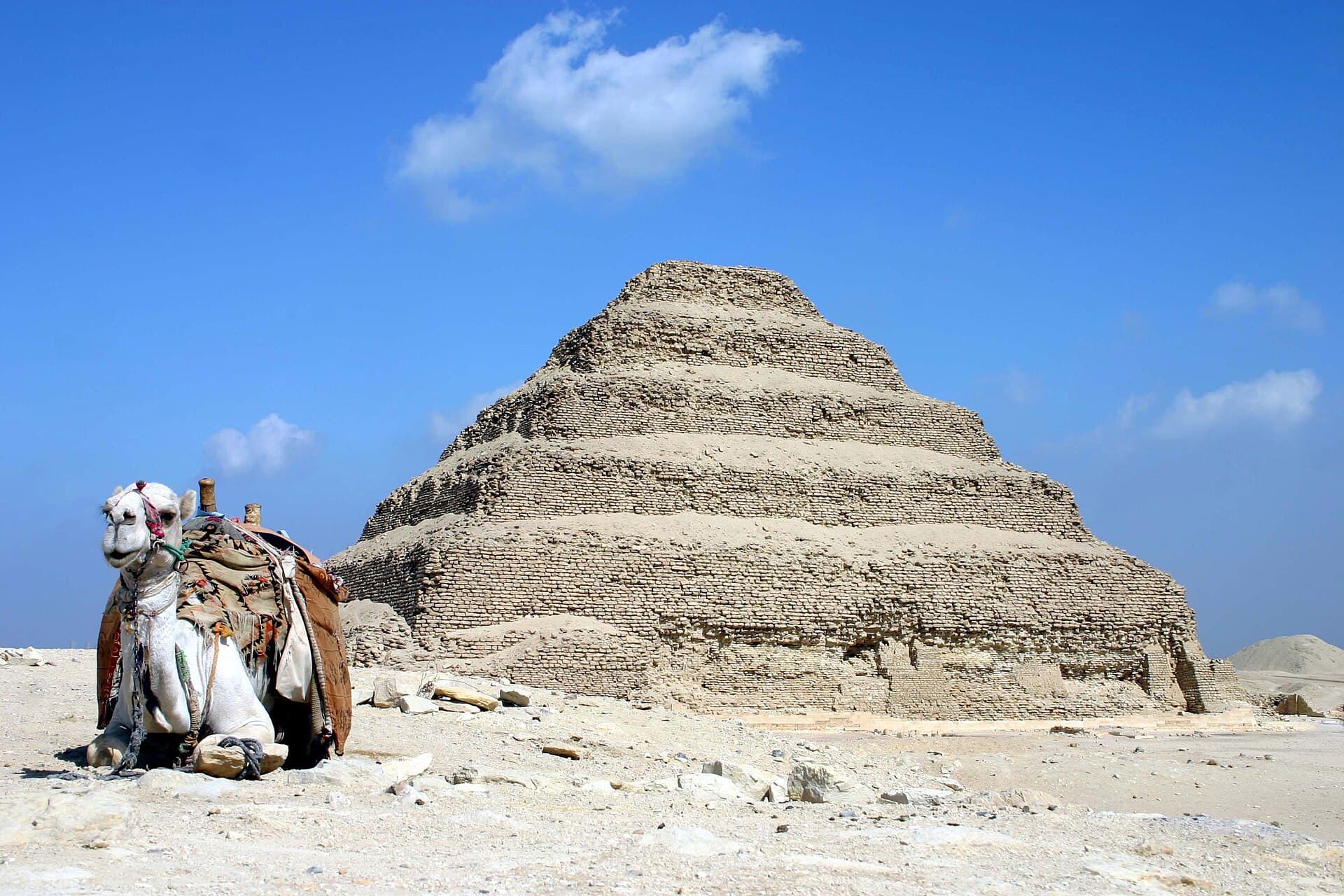
The three sit close together on the same road south of Cairo and are almost always done as one loop: Saqqara for the Step Pyramid and the mastaba tombs, Dahshur for the Bent and Red pyramids, Memphis briefly on the way past. Done properly that is a full day out of Cairo, and traffic in and out of the city is unpredictable enough that an early start buys you more than it costs in sleep.
Where Memphis goes in the order is worth deciding rather than leaving to chance. It asks the least of you physically, so it works well after Saqqara has already taken three hours out of your legs, or as the last stop before the drive back when everybody is finished. It is also the only shade on the loop. Agree the sequence with your driver before you set off, because rearranging it at the second stop rarely works.
Tickets are bought at each site. Do not assume that whatever your driver has already paid covers all three, and check what is included before you go through any gate.
When to go, and what the stop actually feels like
October to April is the comfortable window for the whole loop, and the floodplain is no kinder than the desert in high summer: it is humid as well as hot, and the middle of the day is unpleasant in a way that shortens everybody's patience. Morning is better than afternoon for every stop on this road, and Memphis is the one that copes best with a late slot precisely because it has trees.
The stop itself is undemanding. Flat gravel paths, short distances, no climbing, no crouching, nothing underground. Ordinary shoes are fine, which is not true at Saqqara. Take water anyway, and a hat for the sphinx, which stands out in the open with no cover at all.
Coaches arrive in clusters, and the walkway around the colossus only holds so many people at once. If you pull up behind two tour buses, go straight out to the sphinx first and come back to the shelter when the group has done its five minutes and moved on. That one manoeuvre is the difference between filing past the best object here and standing alone with it.
Tickets, guards and the sellers at the gate
Each of the three sites on the loop is ticketed separately, and Memphis is no exception. If you are on an organised day, ask in advance which entries are included in the price and which are not, and keep the stubs until you are back in the car. If you are with a driver rather than a guide, assume nothing has been paid for you unless you watched it happen.
Carry small notes in local currency. Tipping is customary at Egyptian sites for guards who unlock something, point out a detail or keep an eye on a bag, and the visit runs more smoothly if you are not choosing between overpaying and having nothing at all. Nobody can compel it and a polite refusal is not a scandal, but arriving with only large denominations is a self-inflicted problem.
There are sellers at the gate, working the same trade as everywhere on this loop and responding to the same firm, friendly no. The stock is the stock you have already seen at Giza: scarves, small carvings, scarabs, the lot. Decline anything described as a gift, since it rarely is. Photography rules vary from site to site in Egypt and have changed more than once in recent years, so ask rather than assuming, and do not rely on what an older forum post or guidebook told you.
Is a guide worth it here?
Less than at Saqqara, where the reliefs are unreadable without someone to explain the conventions, but more than you might expect for a yard of statues. The labelling at Memphis is thin, and the objects that are not the colossus or the sphinx come with almost no explanation attached. Five minutes of informed commentary changes that. Thirty minutes of recited dynasties does not.
Most people on this loop already have a guide or a driver-guide for the day, so the practical question is what to ask while you are here. Three good ones: where was the temple of Ptah and what has been excavated of it; why is there nothing of the city left; and who is the sphinx attributed to and on what basis. The answers tell you a great deal about the rest of your day, because Memphis is where the gap between what is known and what is repeated is widest.
Going without a guide is perfectly workable. The site is small, the two things worth seeing are obvious, and ten minutes of reading beforehand covers what a guide would tell you. That is roughly what this page is for.
Where Memphis belongs in a Cairo itinerary
On a three-day Cairo stay the usual honest split is Giza on one day, the Grand Egyptian Museum on another, and Saqqara with Dahshur filling the third. Memphis lives inside that third day and nowhere else. On a two-day stay most first-time visitors will spend the time on Giza and the museum, the loop south gets dropped, and Memphis goes with it. That is the right call, and it is not a loss worth agonising over.
If you are on a second trip, or you already know that carving interests you more than scale, the calculation shifts in favour of the loop but not in favour of Memphis. Saqqara and Dahshur reward a full unhurried day between them. Memphis rewards half an hour whether you have three days in Cairo or ten.
For families, it works better than its reputation suggests: short, shaded, level, with one very large face lying on the ground at child height. It is the stop where nobody has to be carried, coaxed through a dark passage or told to keep up, which after a morning at Saqqara has a value that does not show up in any itinerary.
What most visitors get wrong
First, expecting a city, then blaming the site for not being one. Second, expecting a museum in the modern sense: this is a yard with a roof over the best object in it, not the Grand Egyptian Museum. Third, giving it either five minutes or ninety. The right answer is in between and it is closer to the five.
Fourth, and the commonest: photographing the colossus from one angle and calling it done. It is the reason to be there. Fifth, budgeting no patience for the sellers at the gate, who work the same trade as everywhere on this loop and respond to the same firm, friendly no.
Sixth, and this one costs people the whole point: treating Memphis as a substitute for Saqqara because the names get muddled. They are different places with different tickets, a short drive apart. Memphis was the city. Saqqara was its cemetery, and the cemetery is the half that survived.
Common questions
How long do you need at Memphis?+
Half an hour covers it without rushing, and that includes proper time with the colossus and the sphinx. Twenty minutes is enough if you are only after the colossus. Anyone recommending longer is padding an itinerary. The site is a walled garden with one outstanding object in it, not a place that opens up the more you walk.
Is Memphis worth visiting?+
As a half-hour stop on the Saqqara and Dahshur loop, yes — mainly for the fallen colossus of Ramesses II, which is very fine and unusually easy to get close to. As a destination in its own right, no. If your day is tight, skipping it to spend longer in the tombs at Saqqara is a defensible choice rather than a heresy.
Is Memphis the same place as Saqqara?+
No, and the confusion is common enough to spoil itineraries. Memphis was the ancient capital, down on the floodplain. Saqqara is the necropolis that served it, up on the desert ridge a short drive away. Different sites, different tickets, completely different visits. Saqqara is where the pyramids and the painted tombs are; Memphis is where the city was.
Can you visit Memphis on its own from Cairo?+
You can, but it is hard to justify. The drive out of Cairo is unpredictable and can take well over an hour each way, and the site is a half-hour visit. It exists on itineraries because it is on the road to somewhere else. If you only want the colossus, accept that you are spending most of a morning in traffic for it.
Where exactly is Memphis, and how do you get there?+
It is south of Cairo on the west bank floodplain, a short drive below Saqqara on the same road, and drivers and maps sometimes use the name of the modern village on the site rather than the ancient one. Getting there means a car: there is no useful public transport, and the standard arrangement is a driver who waits while you are on site. Almost everyone arrives as part of the Saqqara and Dahshur day rather than separately.
Is Memphis suitable for people with limited mobility?+
More so than anything else on this loop. The paths are level, the distances are short, there is shade, and there are no passages, ramps or stairs of the kind that make Saqqara and Dahshur hard work. If mobility or heat is a real constraint for someone in your group, this is the stop to build time into rather than the one to cut.
Do you need a guide at Memphis?+
Not strictly. The site is small and the two things worth seeing are obvious the moment you walk in. A good guide earns their keep here because the labelling is thin and the lesser objects come with no explanation at all, but ten minutes of reading beforehand does most of the same work. If you do have a guide, ask them what is actually known about the sphinx rather than accepting the first confident name offered.
Who does the alabaster sphinx represent?+
Nobody can tell you with certainty, whatever you are told on the day. It carries no inscription that settles the question, and the attributions in circulation are arguments from style. What is not in doubt is that it is a large piece of alabaster, standing in the open, weathered smooth, and unlike anything else you will see on a standard Egypt itinerary. Enjoy it on those terms.
Why is there nothing left of the city itself?+
Because it was built of mudbrick on a floodplain and lived in continuously for thousands of years. Mudbrick buildings are rebuilt on top of their own remains, usable stone is carried off into later construction, the annual flood adds silt, and villages and fields settle over the top. The stone tombs on the desert ridge survived for the opposite reasons: durable material, dry ground, and no one living on them.
Can you combine Memphis with the Pyramids of Giza in one day?+
You can physically fit them into a day, but it makes a poor one. Giza deserves a morning of its own, and the loop south to Saqqara, Dahshur and Memphis fills a separate day comfortably. Cramming both means seeing four major sites badly and spending a large part of the day in a car. If you only have one day around Cairo, do Giza and leave this road for the next trip.
Is there anything else to see at the site?+
There is a scatter of statuary, sarcophagi and carved blocks around the garden beyond the two headline pieces, and excavation continues in the surrounding area, so what is displayed changes. This page does not carry a current list, and no page should. Ask at the gate on the day, and check the Ministry of Tourism and Antiquities for anything newly opened.
Is photography allowed at Memphis?+
Rules for cameras vary from site to site in Egypt and have changed several times in recent years, so ask at the gate rather than assuming, and respect the answer. The practical problem here is not permission but light: the colossus lies indoors under a shelter in mixed light, which defeats most phone cameras. Walking round it is more rewarding than photographing it, and the sphinx outside is the better picture anyway.
What should you wear and take for the stop?+
Nothing special, which is part of the point. The paths are flat gravel, so ordinary shoes are fine where Saqqara and Dahshur want something sturdier. Take water and a hat for the sphinx, which stands in full sun, and carry small notes in local currency for tips. Between October and April the stop is comfortable at any hour; in high summer the floodplain is humid as well as hot, so go early.
Official sources
Entry rules, opening hours, security advice and exchange rates all move. Check them at the source, not here.
Written and checked by the Nile Trip Guide editorial team · Last reviewed . Entry rules, prices and opening hours change — check anything critical against the official sources linked on this page.
The route most people take first, at the length it was built for: Giza and the Grand Egyptian Museum, then a flight to Luxor and four nights sailing down to Aswan.
No boat on this one. Giza and the Grand Egyptian Museum, a night in Luxor for both banks, two nights on the Red Sea, then back to Cairo for the Citadel, Coptic Cairo and the Royal Mummies.
Five nights in Cairo either side of a four-night sail from Luxor to Aswan. The Cairo days are private, just your party and a guide; the sightseeing off the boat is shared with a small group.