Ramesses II is the name you will hear most often on an Egypt trip. Partly because he built and inscribed at a scale nobody else matched, and partly because guides know it lands. This is not a biography. It is a guide to the places where you actually stand in front of his work: what each one costs you in a day, and which of them you can skip without regret.
Why his name is on everything
Ramesses II ruled in the thirteenth century BC and left more standing stone with his name on it than any other Egyptian king. That is the plain reason you keep meeting him. Abu Simbel, Luxor Temple, Abydos, Memphis, the atrium of the museum outside Cairo. If a colossal seated figure has no label, the odds are on him.
He also put his name on work that was not his. At Abydos, an inscription of Seti I was filled with plaster and recarved with a text of Ramesses II. Three thousand years later the plaster has fallen out, and both sets of signs sit on top of each other. That overlap is where the strange 'helicopter' hieroglyph story comes from. The same walls show the other half of his method. Work completed under him is sunk relief: quicker, coarser, a step down from his father's craftsmen. Volume over finish.
One thing this page will not give you is a life. Reign dates, campaign counts, how many children he had, where his mummy is now: we have no fact-checked source of our own for any of it. We are not printing numbers we cannot stand behind. What follows is where you go and what you will see when you get there.
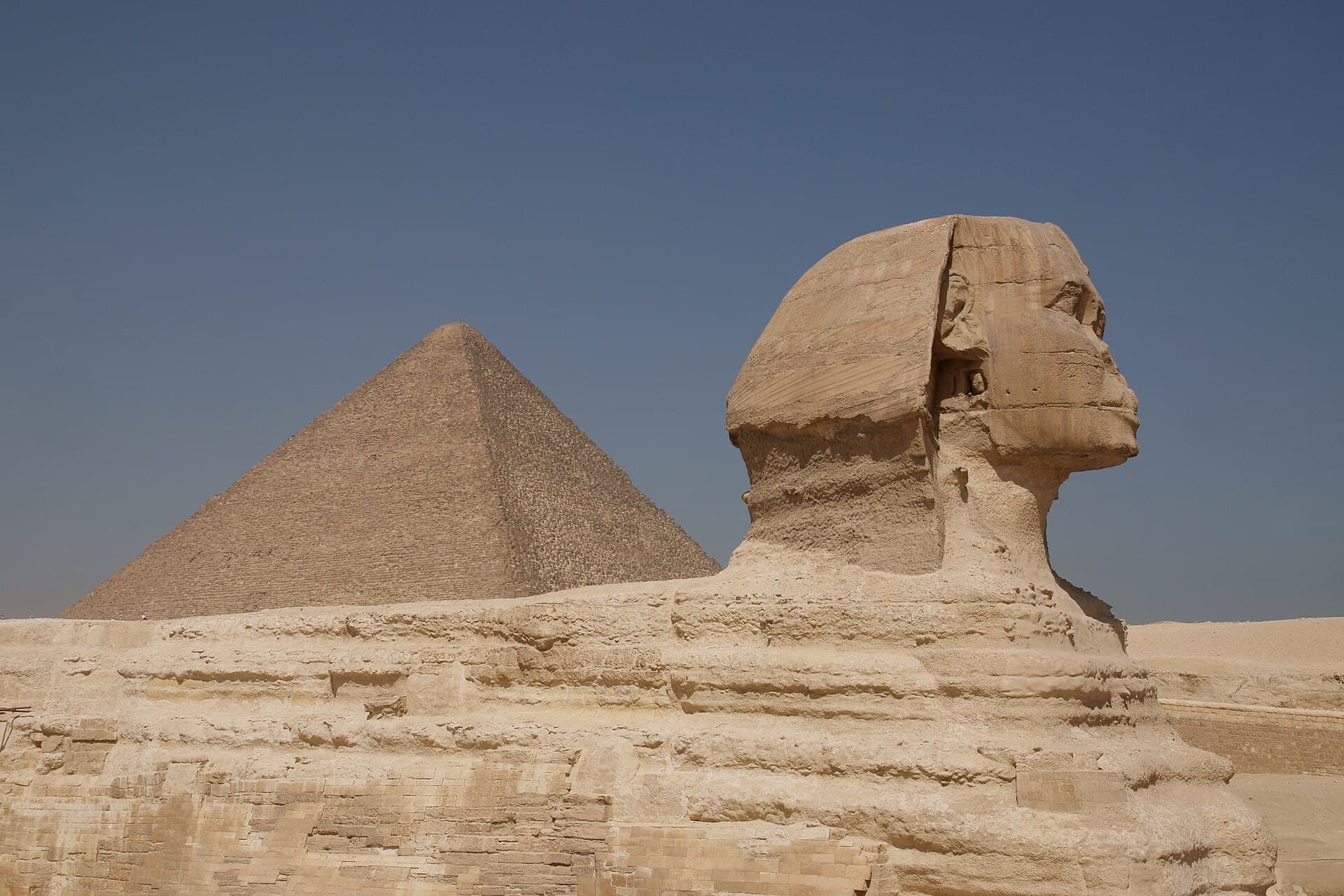
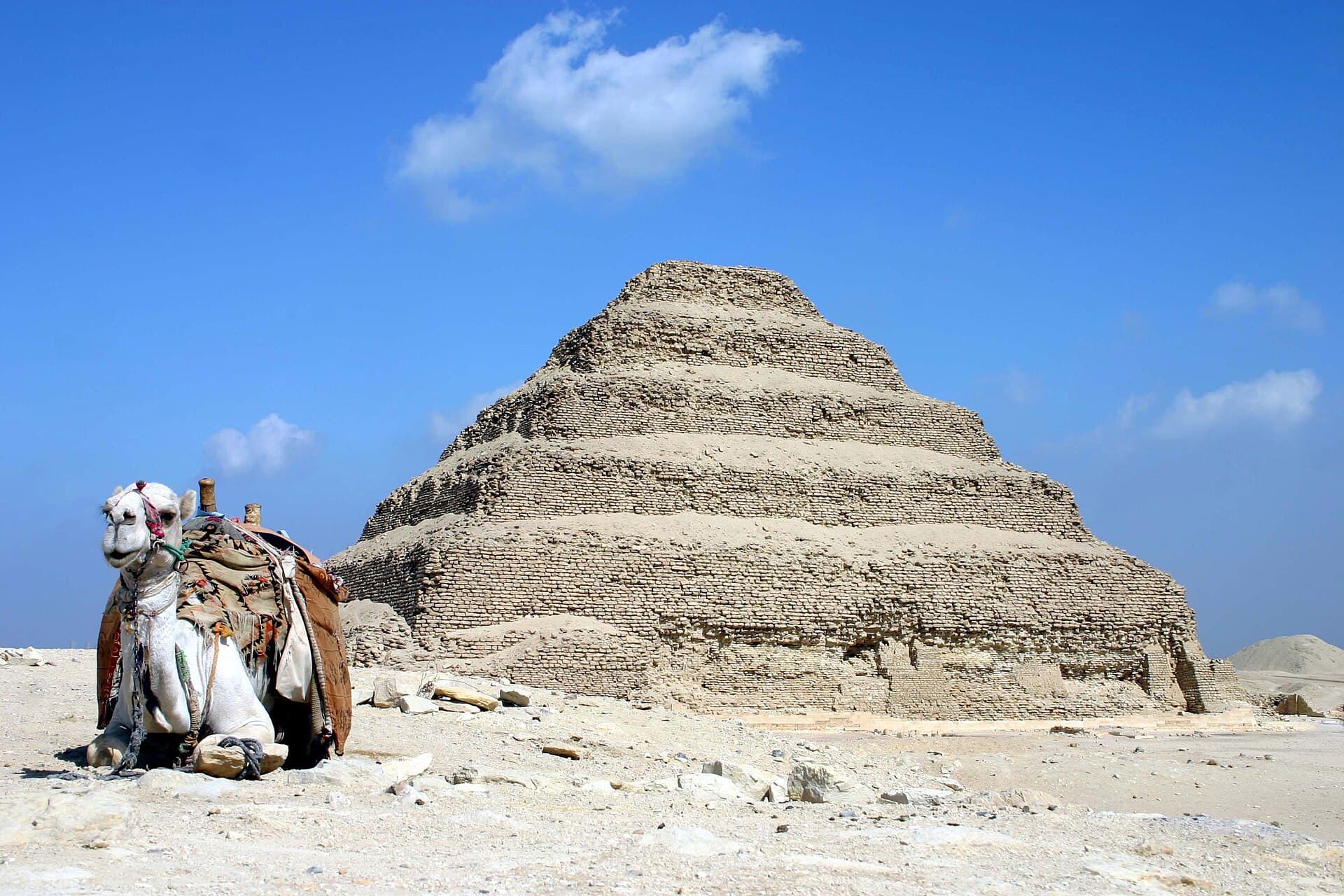
The one piece of arithmetic worth carrying around is how late he arrives. The pyramids at Giza are roughly 4,500 years old and the Great Pyramid is usually dated to around 2560 BC, which puts them well over a thousand years before him. The step pyramid at Saqqara is older still. Ramesses II sits roughly halfway between the men who built the Great Pyramid and Cleopatra, closer in time to the Ptolemaic temples at Dendera and Edfu than to the monuments he himself would have visited as antiquities.
That matters on the ground more than it sounds. Visitors arrive with ancient Egypt compressed into a single period and come away thinking the pyramids and the Ramesside temples belong to the same world. They do not, and the difference is visible: Old Kingdom work at Giza and Saqqara is bare stone and precise shallow relief, while what you meet at Luxor and Abu Simbel is a later, louder tradition of colossal statuary and deeply cut royal names.
How to recognise his work without reading the label
Two tests cover most cases. The first is the cutting. Relief in Egyptian temples comes in two kinds: raised relief, where the background is chiselled away so the figures stand proud of the wall, and sunk relief, where the figures are cut down into it. Raised relief takes far longer and is the finer of the two. Most work completed under Ramesses II is sunk relief, and the difference is obvious from a few paces away once somebody has shown it to you once.
The second is the cartouche. His name is cut deep, often deeper than the scene around it, and it is repeated with a persistence that becomes comic by the third temple. Deep cutting is harder to erase and harder to recarve, which is the point. A cartouche you can put a finger into is usually his.
There is one room in Egypt where you can run both tests in thirty seconds, and it is in the section on Karnak below. Until then, the working rule for a guided trip is simple. When you are told a building is his, ask whether he built it or finished it. The answer is interesting surprisingly often, and it is the difference between a temple and a signature.
Abu Simbel: the one worth planning a day around
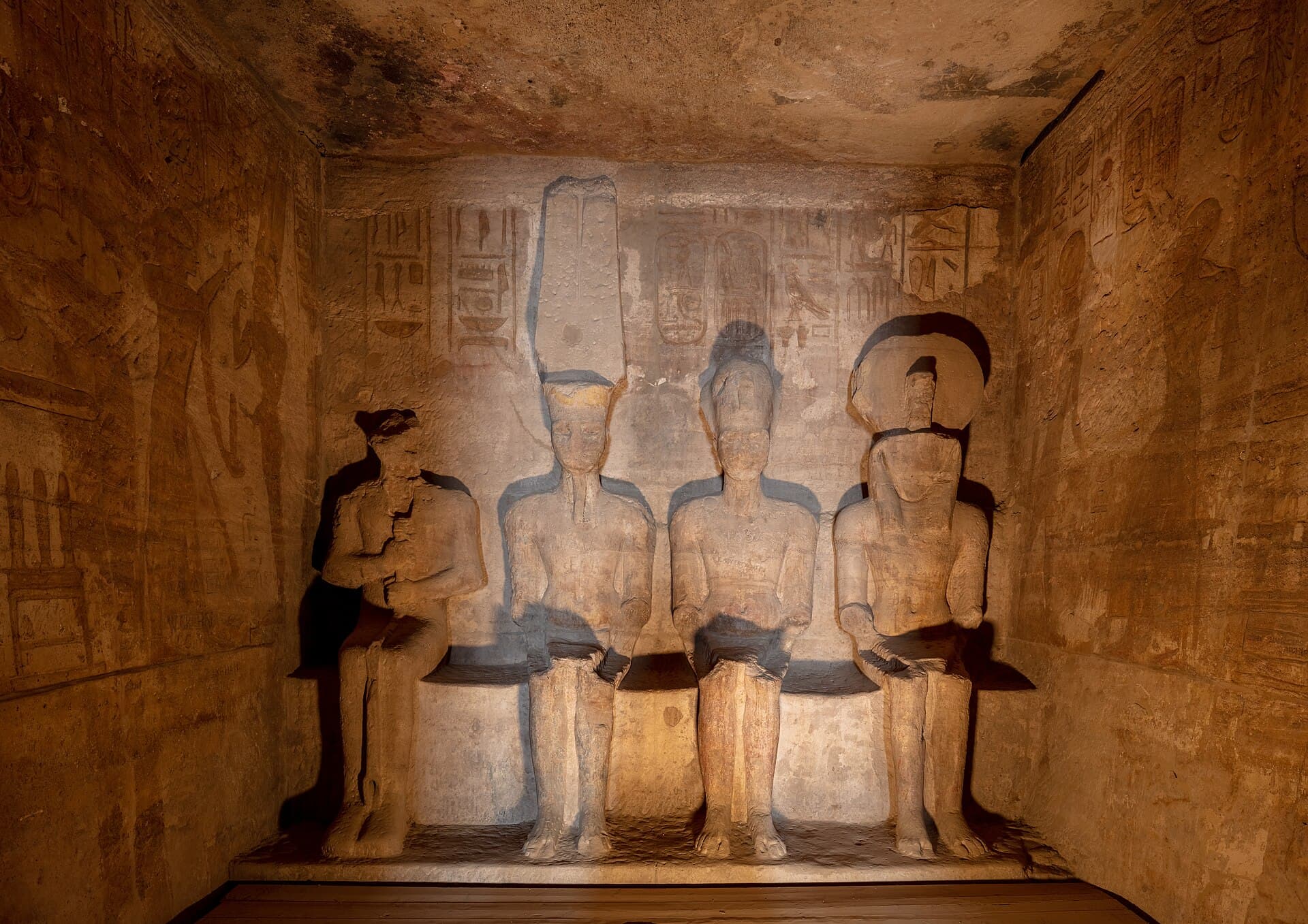
Four seated figures of Ramesses II, each around twenty metres high, front the Great Temple, cut into a cliff face rather than assembled from blocks. One lost its head and shoulders to an earthquake in antiquity and the pieces still lie at its feet, where nobody put them back. Inside, a hall of Osiride pillars leads to reliefs of the Battle of Kadesh. The sanctuary at the back holds four seated figures: Amun-Re, Ra-Horakhty, Ptah, and Ramesses himself, promoted into their company. That last detail is the man at his most explicit.
The second temple, a short walk north, belongs to Nefertari and the goddess Hathor. Six standing figures front it, four of the king and two of the queen, all cut to the same height. Royal wives are usually shown knee-high to their husbands, so the equality is the unusual part. Most visitors give it ten minutes and it deserves more.
Neither temple is where he left it. Between 1964 and 1968 a UNESCO-led operation cut both into numbered blocks. Crews rebuilt them sixty metres higher and two hundred metres back from the rising water of Lake Nasser, against an artificial hill. The cost in your time is real. About 280 kilometres from Aswan, three to three and a half hours each way, a departure around 4am, and roughly two hours on site. A 45-minute flight buys back about five hours of the day. Our Abu Simbel page has the detail.
The approach is worth knowing in advance, because it is the best-staged arrival at any site in Egypt. The path from the car park curves round the back of the artificial hill and gives you nothing, and then the facade arrives all at once. Do not spend that moment looking at a screen. Ninety minutes covers the site and two hours is comfortable: roughly forty minutes at the Great Temple including time simply sitting in front of it, twenty at Nefertari's, and the rest on the lake shore.
Behind the Great Temple there is a door into the dome that holds up the artificial hill. Whether it is open varies. Look in if it is, because it is a bare concrete vault and it settles the question of what you have just walked through. Some visitors find that deflating. Most find it more impressive rather than less, given what the move took. The joins between blocks are visible across the statues too, once you have noticed the first one.
There is no shade anywhere on the site. The car park, the path, the terrace in front of the colossi and the queue at the door are all in full sun, and pale sandstone throws the heat and the glare back at you. From June to September the temperature passes forty degrees well before midday. The interiors are the only cool ground and they are dark and crowded. Take more water than you think you need, and sunglasses matter more here than a hat.
The sun alignment, and whether to plan around it
Twice a year the rising sun runs the full length of the axis of the Great Temple and reaches the sanctuary, lighting three of the four seated figures at the back. Ptah, the one of the four tied to darkness and the underworld, stays in shadow. The dates are usually given as around 22 February and 22 October, a day later than before the move, because the rebuilt temple could not be set in exactly its old position.
Being honest about what that morning is like: large crowds, a queue in the dark, and a few minutes inside before you are moved on. It is a genuine thing to have seen and it is not a good way to see the temple. If the alignment is not the reason you came, avoid those dates rather than accidentally booking into them.
The alternative most people never consider is staying the night. The site takes its entire daily load in one block, from the arrival of the first vehicles from Aswan until they leave again late morning, and it is close to empty either side of that. An overnight buys you the temples in late afternoon once the coaches have gone, and again at opening. The honest downside is that the town is small and there is nothing else in it: a few hotels, a Nubian settlement resettled when the lake rose, and the water.
Luxor Temple: the front of the building is him announcing himself
Luxor Temple was begun under Amenhotep III and extended by Ramesses II roughly a century later, and you meet the extension first. The pylon carries his account of the Battle of Kadesh. In front of it stand seated and standing colossi of the king, and originally a matched pair of obelisks. One still stands, around 25 metres of pink granite. The other has been in the Place de la Concorde in Paris since the 1830s.
Walk through and the building changes hands. His open court gives onto the great colonnade and then the sunlit court of Amenhotep III, which is older and quieter work. Read the temple front to back and you are reading Ramesses II bolted onto somebody else's building. That is a fair description of a great deal of his career.
Practical note: Luxor Temple is markedly better after dark, when low angled floodlighting makes carving legible that reads as grey noise at midday. Ninety minutes covers it.
Two details in his court repay a minute each. The first is that the court is not square to the rest of the temple. It bends. The usual explanation, and the one most Egyptologists accept, is that an older triple shrine standing in the north-west corner was already there and was not to be moved, so the new court was set at an angle around it. The man who recarved his father's walls at Abydos built a crooked courtyard rather than shift a small way-station chapel, which is a more interesting fact about him than anything on the pylon.
The second is the obelisk pair. They were not quite the same height, and the way they were set up compensated for the difference so that they read as equals from the approach. It is a piece of stagecraft almost everybody walks past. The missing one left in the 1830s as a gift to France from Egypt's Ottoman viceroy Muhammad Ali; France formally gave up its claim to the one still standing in 1981.
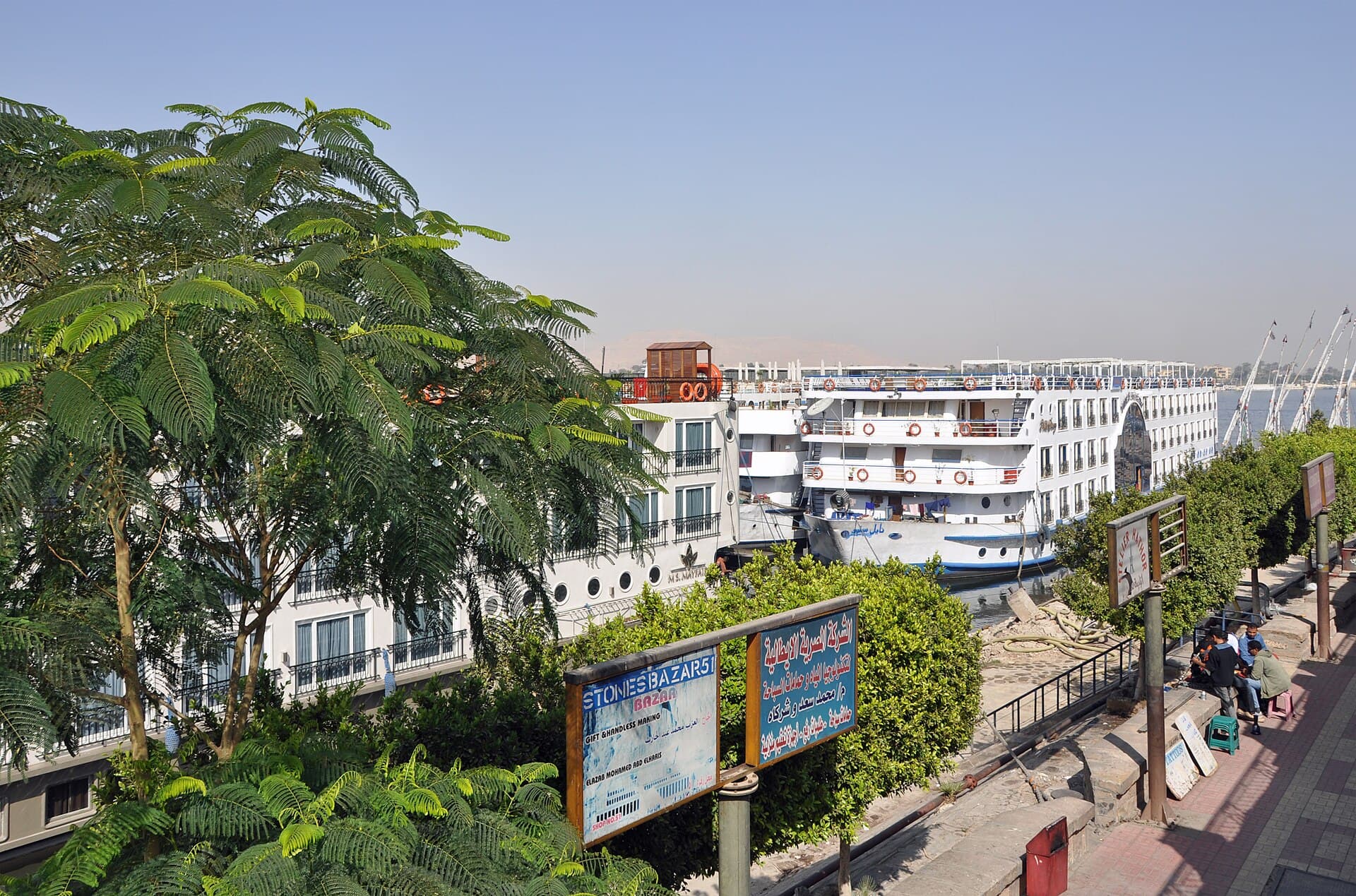
Stand back on the corniche side before you go in. The facade was designed to be seen from further away than the modern path allows, and from the road you get something closer to the view an ancient visitor had arriving from the river. At night that view is floodlit and costs nothing, which makes it the best free ten minutes in Luxor.
Karnak: the room where his hand changes halfway across
Karnak is not his building in any meaningful sense. Work there spans from the Middle Kingdom into the Roman period, and half the dynasties of Egypt added something. But the Great Hypostyle Hall, which is the single most impressive interior in the country, was built and decorated by Seti I and Ramesses II, and it contains the clearest lesson available anywhere about how to read the difference.
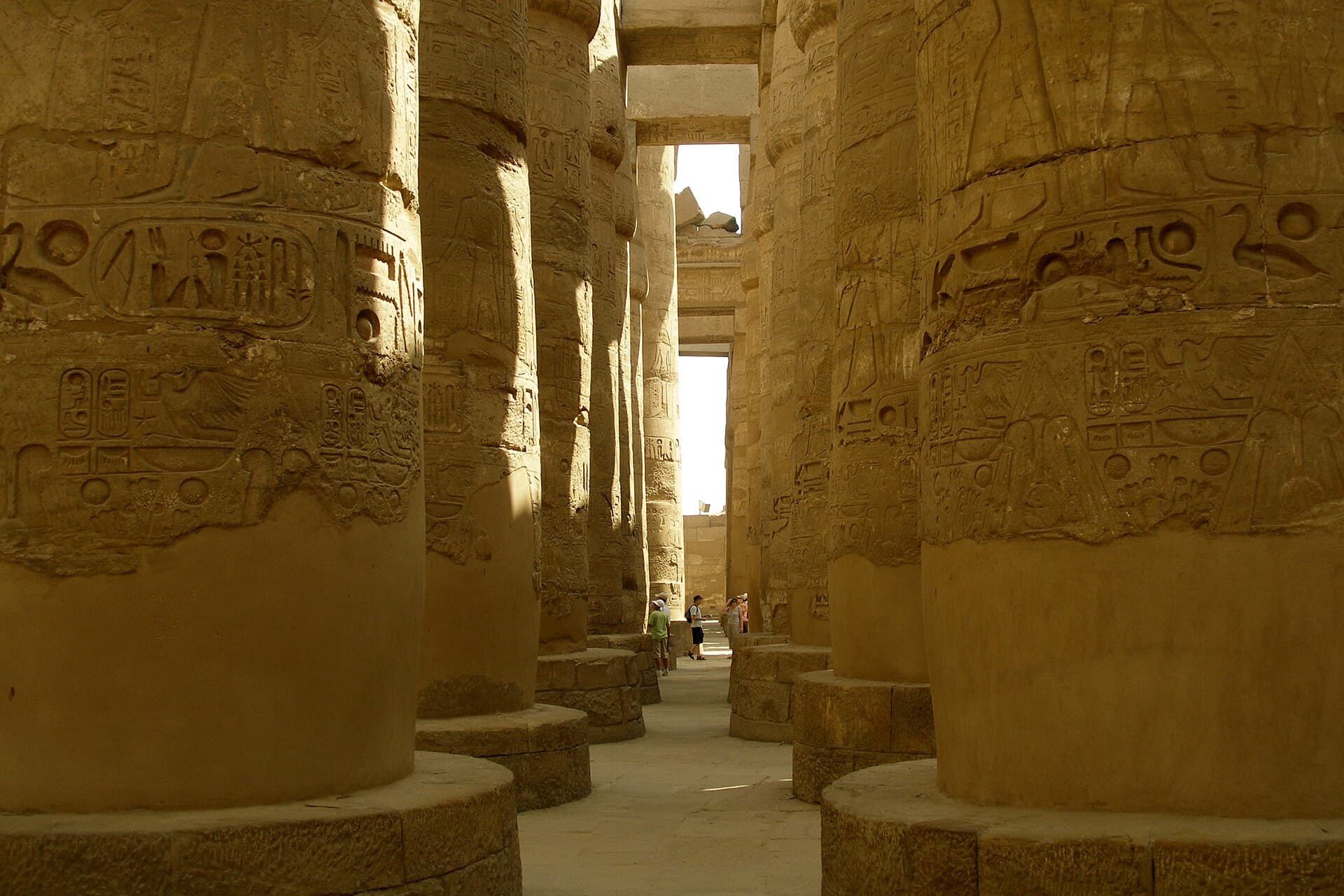
The northern half of the hall was decorated under Seti I in raised relief, standing proud of the wall. Much of the southern half was cut under Ramesses II in sunk relief, down into it. Stand in the middle, look one way and then the other, and you are watching a change in technique happen across a single room. It takes thirty seconds and almost no guidebook points it out.
What you do with that afterwards is the useful part. Once you can tell the two apart you stop needing to be told who did what, and the whole Nile valley becomes legible in a way it was not the day before. Karnak needs two to three hours to be done properly, and if your visit lands in the middle of the day the hypostyle hall is also the best shade on the site.
The standard Luxor mistake is doing Karnak and Luxor Temple back to back in a single hot morning. Karnak early, a long break through the heat, Luxor Temple after dark is the pattern that works, and it costs nothing extra. Karnak first also puts the two in the right order: the enormous confusing version of an Egyptian temple, then the small legible one.
Abydos: where you can judge him against his father
Abydos sits roughly three hours' drive north of Luxor and almost nobody on a standard itinerary goes. The Temple of Seti I there is widely reckoned to hold the finest relief carving to survive in Egypt: raised relief cut into fine white limestone, with fingernails, the line of a calf muscle and the fall of pleated linen all modelled properly. Seven chapels at the back keep their vaulted stone roofs, so pigment survives on ceilings that would have bleached out anywhere open to the sky.
Ramesses II inherited the unfinished temple and completed parts of it, and his work is sunk relief. On some walls the drop in quality happens mid-scene. That is the whole argument about him in one building, and it is why Abydos matters on a page like this one: nowhere else puts the two hands in the same rooms rather than at opposite ends of a hall.
Two more things there are directly his. In a side corridor, Seti I and his young son Ramesses stand before 76 cartouches naming earlier kings in order, the document known as the Abydos King List. It is not a history; it is a list of royal ancestors receiving offerings. Because so few complete king lists survive, Egyptologists have leaned on it heavily, and it remains one of the most quoted documents in the field. Nearby, father and son are shown roping a bull together.
A few hundred metres away stands a smaller temple built by Ramesses II himself. It has lost its roof, the walls stand at varying heights, and what it has kept is colour. Out in the open with nothing over it, the surviving reds, yellows and blues read more vividly in sunlight than anything in the covered chapels next door, where the pigment is better preserved but the light is poor. Seeing the two temples within half an hour of each other is the clearest lesson in Egyptian relief carving available in the country.
The seven chapels also settle an argument people have about Abu Simbel. One of the seven is dedicated to Seti I himself, alongside Osiris, Isis, Horus, Amun-Re, Ra-Horakhty and Ptah. A king taking a place in the company of gods was not an invention of his son. Ramesses II simply did it at twenty metres high, on a cliff, facing the sunrise.
The cost is a long day: six hours in a car for about three hours on site, usually paired with Dendera on the same run. It is the one item on this page that requires a deliberate decision rather than turning up as part of the itinerary you already booked. Our Abydos page goes through whether that trade is worth it.
The Ramesseum, and the honest position on it
His memorial temple stands on the Luxor west bank. It sits among the sites strung along the desert edge with the Valley of the Kings, Deir el-Bahari, the Colossi of Memnon and Medinet Habu. It is a ruin rather than a standing temple, and we do not have a page on it yet. Rather than pad this one with detail we cannot source, here is the part that affects your day.
A west bank morning holds about three sites. The Valley of the Kings, Hatshepsut's temple at Deir el-Bahari and one more runs to four or five hours with the transfers. It ends when the heat does. Adding a fourth temple makes it a long day, and by the fourth most people have stopped looking properly and are simply walking through stone.
So if the Ramesseum is the reason you came to the west bank, put it in the three rather than the four and drop something else. If it is not, you are choosing between it and Medinet Habu, where colour survives on the walls and there are almost no groups.
Two things that are true and worth knowing. Being a ruin is why it is quiet: the coach itineraries take the Valley of the Kings and Hatshepsut, so the Ramesseum sees a fraction of the traffic and you can hear yourself think in it. And the drives between west bank sites run five to fifteen minutes, so slotting it in is a question of attention rather than logistics. The limit on a west bank morning has never been opening hours.
If you are flying the sunrise balloon over the west bank, you will see it from above before you see it from the ground: the Ramesseum sits in its own patch of green, with the desert edge behind it and irrigated fields in front. That view makes the geography of the whole west bank obvious in a way no amount of driving between car parks does.
Memphis: the fallen colossus, and half an hour
Memphis was the ancient capital and what survives is an open-air museum on the Saqqara and Dahshur road. The centrepiece is a large fallen colossus of Ramesses II lying under a purpose-built shelter, with an alabaster sphinx nearby. It is genuinely fine. Seeing a statue of that size horizontal, close enough to read the face, is something the standing ones do not give you.
The rest is a modest scatter of blocks. Half an hour is enough, and skipping Memphis entirely to spend longer at Saqqara is a defensible choice rather than a heresy. Since it sits on the same road, most Saqqara and Dahshur days pass it anyway, so the decision is whether to stop, not whether to detour. Our Memphis page goes through that call in more detail.
How to actually look at it, since most people manage about ninety seconds. The colossus lies on its back and it is not complete. Colossal Egyptian sculpture is normally something you crane up at from below, foreshortened, with the sun behind it; here the face is level with you and a few paces away. You can see how the mouth is modelled, how the eye is cut, and how sharp the edges still are on the belt and the cartouches. If the upper level of the shelter is open, take the view down the whole length from above, then come back down and look along it from the feet, which is where the size registers.
The alabaster sphinx outside is the thing groups walk straight past on the way back to the coach. Alabaster behaves differently from the limestone of the Giza sphinx: warmer, softer, more translucent at the edges in strong light. Walk around it rather than photographing it head-on, because the profile is better than the front view. Five minutes, and it is the only alabaster of that size most visitors will ever stand next to.
One group for whom Memphis is unambiguously worth the stop: anyone in your party who cannot manage steep ramps, low passages and long walks over sand, which is most of what Saqqara and Dahshur ask of you. This is the flat, shaded, short and genuinely rewarding stop on the loop. Plan around that rather than apologising for it.
The standing colossus outside Cairo
The atrium of the Grand Egyptian Museum is dominated by a colossal statue of Ramesses II, about eleven metres of red granite. It stood for half a century in the traffic of Ramses Square in central Cairo, and moved out to Giza in 2006. Indoors, at the right distance, it finally reads as sculpture rather than as a roundabout ornament.
Most people photograph it from the entrance and walk on. Walk round it instead, and look at it from the stairs. It is the easiest encounter with him on the whole trip, and the one most often wasted.
The stairs are not incidental. The Grand Staircase climbs from the atrium through the height of the building, lined with statuary, sarcophagi and stelae arranged so the scale grows as you rise, and it ends at a glazed wall with the pyramids on the horizon. Take it rather than the lift, stop at each level, and give the atrium and the staircase together about forty minutes. It is the part of the visit people in a hurry skip, which is the wrong instinct: it is the sequence the building was designed around.
Practically, the museum needs three hours minimum and entry is normally timed and booked online in advance, with high-season slots going early. Arrange it before you fly rather than on the morning. It is a separate site from the Giza plateau with a separate ticket, whatever the proximity suggests, and a pyramids morning followed by a serious museum afternoon is a full day with nothing else in it.
Kadesh, and how to read what he says about himself
You will meet the Battle of Kadesh twice: on the pylon at Luxor Temple and inside the Great Temple at Abu Simbel. Both tell the story of a decisive victory. The battle was fought to a draw.
Knowing that in advance changes what you are looking at, and for the better. These are not war records. They are a monument to how a king wanted to be seen. He repeated it at the two ends of his kingdom, in the two places most people would pass. The same instinct explains the recarved inscription at Abydos and the sheer number of times his cartouche appears. Read him as a builder of reputation and the sites stop being a list and start making sense as a campaign.
The detail worth having is what the walls leave out. The battle was fought against the Hittites in what is now Syria, it ended without a clear winner, and it produced one of the earliest surviving peace treaties between two states. None of that appears on the stone. What appears is the king alone in his chariot, enormous, scattering enemies. It is the oldest surviving form of the press release, and it is more impressive once you read it as one.
There is a method for reading any Ramesside wall that takes about four attempts to learn and makes the rest of the trip better. Find the king: usually the figure in motion, holding something out. Find the god: usually seated or standing still. Identify what is being handed over, which is generally a small crouching figure of Maat, jars of wine, loaves, cones of incense or cloth. Then look at the short vertical columns of text above the hands, which name the two parties and the gift.
After four or five of those, temple walls stop being wallpaper. You will also find that the difference between a Seti wall and a Ramesses wall becomes something you notice rather than something a guide has to point out, which is the single biggest upgrade available to a visitor on this particular trail.
Nefertari, and the family you also meet
Nefertari was his chief wife, and you will meet her twice. Her temple at Abu Simbel is the smaller and quieter of the pair. Her tomb is QV66 in the Valley of the Queens, found in 1904 and nearly destroyed by salt pushing out through the plaster. A long conservation programme in the 1980s and 1990s stabilised the paint, and the tomb reopened under tight control. It has its own expensive ticket, a daily limit on numbers, and a short visit timed by a guard at the door.
One name worth keeping straight: Khaemwaset. The famous one is a son of Ramesses II, a high priest remembered for repairing older monuments. That makes him a rare thing in this story: a member of the family who put other people's names back. The Khaemwaset whose tomb you can visit in the Valley of the Queens is a son of Ramesses III. Guidebooks confuse them regularly.
What is actually inside QV66, since the ticket price invites the question. A steep flight of steps drops to an upper chamber with a side room, then a second stair reaches the pillared burial chamber. The decoration is raised relief modelled in plaster rather than cut into rock, which gives the figures a soft, rounded surface that carved tombs do not have. Nefertari appears in white linen and gold, led by Isis and by Horus son of Isis, and in one panel she plays a board game against an opponent you cannot see. The ceilings are deep blue with yellow stars.
Judged as painting it is unmatched in Egypt. Judged as a monument it is modest: a small tomb down a steep stair, seen in about ten minutes under supervision, with no sarcophagus, no treasure and no grand architecture. Visitors who have not been told that come out feeling cheated by something that was never the problem.
The rules at the door are not theatre. Moisture moving through the rock carries dissolved salts, which crystallise as it dries and push the plaster off the wall from behind, taking the painting with it. That is the damage the conservation programme had to arrest, and every visitor brings in heat and breath. The cap, the timing and the guard are the price of the tomb still existing.
Practically: the ticket is sold at the valley on the day, in cash, with a daily allocation that can be gone by mid-morning, and it cannot be booked in advance by anybody, including us. If QV66 is the reason you are going, come to the Valley of the Queens first rather than last. Access has been suspended before and will be again, so keep it as an option to ask about on your first morning in Luxor rather than a plan made months out.
Her temple at Abu Simbel deserves the same second look. Six standing figures, four of the king and two of the queen, all cut to the same height, on a facade built for her in a period when royal wives were normally shown knee-high to their husbands. That equality of scale is the best single indication of what her position was worth, and it is the reason her tomb was painted by the best draughtsmen available rather than the ones who were free that month.
Nubia beyond Abu Simbel
The rescue operation that saved Abu Simbel was not about one site. UNESCO ran a salvage campaign from 1960 as Lake Nasser filled, and Kalabsha, Beit el-Wali, Wadi es-Sebua, Amada and others were relocated alongside it. Philae was moved to a neighbouring island through the 1970s. Four temples left Egypt entirely, to countries that had helped pay: Dendur to New York, Debod to Madrid, Taffa to Leiden, Ellesiya to Turin.
The consequence is easy to state and hard to absorb. Very little Nubian architecture now stands where it was built. When somebody tells you that Abu Simbel was moved, the accurate version is that most of Nubia was moved, and that Abu Simbel was the part the world agreed to pay for.
We are not going to tell you which of those temples carry his name, because we do not have a sourced list of our own and this is exactly the kind of page where a confident guess would be worse than a gap. What we can say is how you would see them. Lake Nasser cruises run between Aswan and Abu Simbel, usually three or four nights, calling at the relocated temples, and traffic is light enough that you may pass two other boats in a day. They arrive from the water, which is how these buildings were meant to be approached.
Kalabsha is the one relocated temple within reach of a normal Aswan day. It sits on a promontory near the western end of the High Dam, it is a genuine temple rather than a fragment, and it is usually empty, which is a condition Philae never achieves. Reaching it normally means hiring a motorboat at the landing, which is why most itineraries leave it out.
Half an hour at the High Dam itself is the cheapest context available on this whole trail. It is a dull stop as a sight, but Abu Simbel sits inside an artificial hill because of that embankment, Philae stands on the wrong island because of it, and the temples in New York, Madrid, Leiden and Turin left Egypt because of it. Seeing the cause before the effects turns the saw lines and joins at both temples from oddities into the point.
Where he is not, and why it is worth knowing
Guides attach his name to anything colossal, and travellers finish a trip believing he built rather more of Egypt than he did. The short list of things that have nothing to do with him is useful to carry.
Giza and Saqqara are Old Kingdom, roughly 4,500 years old, and were already ancient monuments long before he was born. The pyramids, the Sphinx, the Step Pyramid, the mastaba tombs with their scenes of cattle and craftsmen: none of it is his, and none of it is remotely of his period. Dendera, Edfu, Kom Ombo, Philae and Esna are the other end of the scale, built or completed in the Ptolemaic and Roman centuries, more than a thousand years after him, and they are the best-preserved large temples in the country precisely because they are so late.
Hatshepsut's temple at Deir el-Bahari, the Colossi of Memnon and the great sun court at Luxor Temple all belong to earlier New Kingdom rulers. Medinet Habu is Ramesses III, a different king entirely, several generations later, and the confusion between the two names is the commonest one on the west bank after Memphis and Saqqara.
Knowing the negative list is what makes the positive one mean something. If everything colossal is his, his scale tells you nothing. Once you can say which buildings are not, the sheer quantity that is starts to register properly, which is the effect the man was going for in the first place.
What each site actually costs you in a day
Abu Simbel is the expensive one and the only genuine full day. From Aswan by road it is six to seven hours in a vehicle for ninety minutes to two hours on site, with a departure around 4am. Flying turns it into most of a morning: about forty-five minutes each way, normally sold as a return pair, which leaves roughly two hours on the ground. That is enough rather than generous, and it costs a good deal more than the road.
Luxor Temple is ninety minutes and belongs in the evening. Karnak is two to three hours and belongs at opening. The two together make the best-value day in Luxor provided you put the heat of the day between them rather than a taxi ride.
The Ramesseum sits inside a west bank morning of four to five hours that already holds three sites, and it competes for the third slot rather than adding a fourth. Memphis is half an hour on a Saqqara and Dahshur day that runs to a full day out of Cairo. The Cairo colossus is five minutes of looking inside a museum visit that needs three hours. Nefertari's tomb is about ten minutes inside and twenty with the wait at the door.
Abydos is the outlier: roughly six hours of driving for three hours on site, usually paired with Dendera. Everything else on this page is already on the route of a standard Cairo, Luxor, Nile cruise and Aswan itinerary. Abydos is the only one you have to go out of your way for, and it is also the only one that changes how you see all the others.
Tickets, cash and the things that change
We do not print prices on this page. Egyptian site prices move with the pound and with periodic official increases, and a figure that is right when written is wrong within the year. Treat any number you find online, including on operator sites, as approximate rather than current, and check at the window on the day.
The pattern is more useful than the numbers. Across Egypt, headline entry tickets are modest and the things people most want are ticketed separately: certain tombs at Luxor, the inner chamber of the Great Pyramid, photography permits. Nefertari's tomb is the clearest case on this trail, at many times an ordinary tomb ticket.
Carry cash and a card. Egypt has been pushing its major sites towards card payment, but terminals fail and machines go offline. Small notes matter more than you expect, for tips, for guards who lift a rope or aim a torch at something you would otherwise miss, and for the toilets. Nefertari is bought in cash at the valley. The Grand Egyptian Museum is the opposite case: timed entry booked online before you fly.
A multi-site Luxor Pass exists, and its higher tier covers Nefertari's tomb and Seti I in the Valley of the Kings. It only pays off if you are staying several days and visiting heavily, you need your passport and photographs to buy one, and it is sold at a small number of offices, which makes it a first-morning errand. Terms change, so check it is still being issued before you build a plan on it.
If you are travelling on a package, ask which entries are included and which are collected on the day, and ask in writing. A quote that looks cheaper has often just moved those line items out of the headline total. Abu Simbel in particular is frequently an add-on to the Aswan day rather than part of it.
Guides, and the two questions worth asking
Guiding in Egypt is licensed, and the licence determines whether someone can accompany you inside sites at all. It also explains most of the price difference between cheap operators and good ones. Ask about the licence, and ask separately whether the guide's background is in Egyptology rather than general tourism. On this particular trail the second question matters more than usual, because the interesting material is technical rather than scenic.
The other thing to know is that guides go where the questions go. At Abydos, the questions are overwhelmingly about the helicopter hieroglyphs, so that is what you get. At Abu Simbel it is the alignment dates. If you let a visit run on demand you will get the famous anecdote and a walk-through of everything else.
Say at the start what you actually want. On this page's sites that means three things: the difference between raised and sunk relief, who built the wall behind the colossus you are being photographed in front of, and which parts of the building are original rather than added. A good guide will be pleased to be asked. A weak one will recite dynasty numbers at you, which is the tell.
When to go
November to February is the comfortable season and the busy one. March and October are workable. June to August is genuinely brutal in daylight in the Nile valley, and worse at Abu Simbel, where there is no shade at all and the temperature passes forty degrees well before midday.
Heat also changes what is worth doing rather than just how pleasant it is. In summer the evening visit to Luxor Temple stops being a nice idea and becomes the only sensible one. On the west bank, order the morning by heat rather than distance: the Valley of the Kings at opening because the tombs hold the heat of every group that has walked through them, Hatshepsut second because the terraces are a sun trap, and anything walled and roofed last.
Two scheduling notes that catch people out. Ramadan shifts opening patterns across the country, and closing times at Luxor Temple in particular move with the season, so confirm evening hours locally on the day rather than trusting a printed schedule. And crowds at Luxor track the Nile cruise moorings rather than the calendar, so a temple that is quiet at eight can fill by ten regardless of what month it is.
The two alignment dates at Abu Simbel, around 22 February and 22 October, are worth putting in your diary for the opposite reason to the usual one: so that you do not book into them by accident unless you want them.
What most visitors get wrong
Taking every colossus as his without asking. It is usually the right guess, which is precisely why it is a bad habit: the interesting sites are the ones where the answer is that he finished it, took it over, or simply signed it.
Photographing the Cairo colossus from the entrance and walking on. It is the easiest encounter with him on the whole trip and the most commonly wasted. Five minutes circling it teaches more about how these statues were made than any label upstairs.
Giving Nefertari's temple at Abu Simbel ten minutes because the big one is next door. Stretching a west bank morning to four temples and remembering none of them. Arriving at Abydos hunting for the helicopter and leaving without having looked properly at the seven chapels, which are the reason the temple matters.
And believing the Kadesh reliefs, which is the most forgivable one, because they are extremely well made and they were designed to be believed. The battle was a draw. Read the wall knowing that and it becomes a far better thing to look at.
Building a trip around Ramesses II
You do not need a special itinerary. A standard Egypt trip already passes almost everything. Cairo for the museum colossus and Memphis on a Saqqara day. Luxor for the temple after dark and a west bank morning. Aswan for the Abu Simbel excursion. What changes is knowing which building is his, which he took over, and which he simply signed.
If you only do one of them for his sake, do Abu Simbel. It is the most impressive thing in Egypt after Giza, and no city presses up against it. It is also the one place where the man and the monument are the same size.
In practice the usual eight-day shape of Cairo, a flight to Luxor, a cruise south and two nights in Aswan covers the museum colossus, Memphis if you take the Saqqara day, Karnak, Luxor Temple, the west bank and Abu Simbel. Two things need asking for rather than assuming: whether Abu Simbel is included or an add-on, and whether the west bank morning has room for the Ramesseum in place of something else.
Adding Abydos is the only real decision. It is a long day out of Luxor, it does not fit a cruise schedule, and it is the site that makes sense of everything else on this page. If you have three full days in Luxor rather than two, it is the best use of the third that almost nobody plans.
Common questions
Where is the best place to see Ramesses II?+
Abu Simbel, without much argument. Four seated figures around twenty metres high cut into a cliff, the Kadesh reliefs inside, and a sanctuary where he sits among the gods. It costs a full day from Aswan by road, or a 45-minute flight each way. If you have one day to give him, that is the one.
Is the Ramesseum worth adding to a west bank morning?+
Only if it is the reason you came. A west bank morning realistically holds three sites: the Valley of the Kings, Hatshepsut and one more. That is four to five hours with transfers. Add a fourth temple and most people stop looking properly. Put the Ramesseum in the three and drop something else rather than stretching the morning.
Where is the giant statue of Ramesses II in Cairo?+
In the atrium of the Grand Egyptian Museum near Giza: about eleven metres of red granite. It spent half a century in the traffic of Ramses Square in central Cairo and was moved out in 2006. Seen indoors at the right distance it reads as sculpture rather than as a landmark you drive round.
Did Ramesses II win the Battle of Kadesh?+
No. It was fought to a draw. He recorded it everywhere as a victory: on the pylon at Luxor Temple, and inside the Great Temple at Abu Simbel. That gap between the reliefs and the outcome is the most useful thing to know before you look at either.
Is Memphis worth stopping for?+
For half an hour, if you are already on the Saqqara and Dahshur road. The fallen colossus of Ramesses II under its shelter is genuinely fine and the alabaster sphinx repays a slow walk around. The rest is a scatter of blocks, and giving the time to Saqqara instead is a perfectly reasonable choice.
Why does his name appear on monuments built by earlier kings?+
Because he put it there. The clearest example is at Abydos. An inscription of Seti I was plastered over and recarved with a text of Ramesses II; the plaster has since fallen out, and both texts now overlap. Treat any unlabelled colossus as his until told otherwise, and ask a guide who actually built the wall behind it.
How do you tell Ramesses II's work from his father's?+
By the cutting. Raised relief, where the figures stand proud of the wall, is the older and finer technique and is what Seti I's craftsmen used. Most work completed under Ramesses II is sunk relief, cut down into the stone, which is quicker and coarser. The Great Hypostyle Hall at Karnak lets you compare the two in one room: the northern half is Seti's, the southern half largely his son's.
When does the sun reach the sanctuary at Abu Simbel?+
Around 22 February and 22 October, when the rising sun runs the length of the axis and lights three of the four seated figures at the back. Ptah, tied to darkness and the underworld, stays in shadow. The dates fall a day later than before the temple was moved, because it could not be set in exactly its old position. Expect crowds, a queue in the dark and a few minutes inside.
How long do you need at Abu Simbel?+
Ninety minutes covers both temples and two hours is comfortable: roughly forty minutes at the Great Temple, twenty at Nefertari's, and the rest on the lake shore and at the dome behind the hill. The constraint is not the site but the day around it, which runs to six or seven hours in a vehicle unless you fly.
Is Nefertari's tomb worth the extra ticket?+
As painting, yes; it is unmatched in Egypt. As a monument, manage your expectations: a small tomb down a steep stair, about ten minutes inside under supervision, no sarcophagus and no treasure. The ticket is sold at the Valley of the Queens on the day, in cash, with a daily cap that can be gone by mid-morning, so go there first if it matters to you.
Is Abydos worth the long day if you are interested in Ramesses II?+
More than any other optional site. It is the one place where his work and his father's sit on the same walls, so the difference between raised and sunk relief stops being an abstraction. His own roofless temple a few hundred metres away keeps more colour than the covered chapels do. The cost is about six hours in a car for three hours on site.
Where is Ramesses II buried?+
This page does not carry it, for the same reason it carries no reign dates: we have no fact-checked source of our own for his burial or his mummy, and we will not print what we cannot stand behind. What we can tell you is that his own tomb is not among the ones you will be offered. The Valley of the Kings usually opens Ramesses IV, Ramesses IX, Merenptah and Ramesses III on the general ticket, with Tutankhamun, Seti I and Ramesses V/VI sold separately.
Which famous Egyptian sites have nothing to do with him?+
Giza and Saqqara, which are Old Kingdom and roughly 4,500 years old, so well over a thousand years before his time. Dendera, Edfu, Kom Ombo, Philae and Esna, which are Ptolemaic and Roman and more than a thousand years after it. Hatshepsut's temple and the Colossi of Memnon belong to earlier New Kingdom rulers, and Medinet Habu is Ramesses III, a different king several generations later.
Official sources
Entry rules, opening hours, security advice and exchange rates all move. Check them at the source, not here.
Written and checked by the Nile Trip Guide editorial team · Last reviewed . Entry rules, prices and opening hours change — check anything critical against the official sources linked on this page.
The route most people take first, at the length it was built for: Giza and the Grand Egyptian Museum, then a flight to Luxor and four nights sailing down to Aswan.
No boat on this one. Giza and the Grand Egyptian Museum, a night in Luxor for both banks, two nights on the Red Sea, then back to Cairo for the Citadel, Coptic Cairo and the Royal Mummies.
Five nights in Cairo either side of a four-night sail from Luxor to Aswan. The Cairo days are private, just your party and a guide; the sightseeing off the boat is shared with a small group.