Egyptian Arabic phrases for travellers, with Arabic script
Egyptian Arabic phrases to learn first: as-salamu aleikum (hello), shukran (thank you), min fadlak (please) and la shukran (no thank you). Learn them in the Egyptian dialect. Textbooks teach kayfa halak for how are you. In Cairo you will hear izzayak. Every phrase below has the Arabic script beside it, so you can also show it on your phone. The phrases are Egyptian colloquial Arabic, checked against published Egyptian Arabic references.
How is Egyptian Arabic different from textbook Arabic?
Egyptians speak their own dialect of Arabic, called Egyptian Arabic or masri. Textbook Arabic is Modern Standard Arabic, the formal language of books and the news. The two share a script and much of their vocabulary. Many everyday phrases differ.
Four differences cover a lot of what you will hear. The letter jim (ج) is a hard g, as in go, so the Egyptian pound is gineih. The q sound (ق) usually becomes a short catch in the throat, so qahwa, coffee, becomes ahwa. Mish makes a phrase negative, as in mish fahim, I do not understand. Fein means where. The textbook word is ayna.
Arabic has no agreed spelling in Latin letters. Published guides write the same word as izzayak, ezzayak or izzayyak. On this page, an apostrophe marks an Arabic sound that English has no letter for, as in ma'lesh.
How to say hello in Egyptian Arabic
As-salamu aleikum (السلام عليكم) means peace be upon you, and it works as hello. The reply is wa aleikum as-salam (وعليكم السلام).
Ahlan (أهلا) is a lighter hi. Ahlan wa sahlan (أهلا وسهلا) means welcome. The reply is ahlan beek (أهلا بيك) to a man, or ahlan beeki (أهلا بيكي) to a woman.
Sabah el-kheir (صباح الخير) is good morning. The reply is sabah en-nur (صباح النور), morning of light.
Masa el-kheir (مساء الخير) is good evening. The reply is masa en-nur (مساء النور).
Izzayak (إزيك) means how are you, said to a man. To a woman it is izzayik, with the same Arabic spelling. A man answers kwayyis (كويس), fine. A woman answers kwayyesa (كويسة). Anyone can answer il-hamdu lillah (الحمد لله), thanks be to God.
Ma'a as-salama (مع السلامة) is goodbye.
Please, thank you and no thank you
Shukran (شكرا) is thank you. The reply is afwan (عفوا), you are welcome.
Min fadlak (من فضلك) is please, said to a man. To a woman it is min fadlik, with the same Arabic spelling.
La shukran (لا شكرا) means no thank you. Use it for anything you are offered and do not want, from a taxi ride to a souvenir. Say it pleasantly.
Aiwa (أيوه) is yes. La (لا) is no. In Egyptian speech you will often hear la' (لأ), with a short stop at the end.
Ana asif (أنا آسف) is I am sorry, said by a man. A woman says ana asfa (أنا آسفة).
Mish fahim (مش فاهم) means I do not understand, said by a man. A woman says mish fahma (مش فاهمة).
Everyday Egyptian Arabic words and what they mean
Inshallah (إن شاء الله) means if God wills. It goes with plans for the future, from tomorrow's pickup time to next week's meeting.
Ma'lesh (معلش) means never mind, it is OK, or a light sorry.
Yalla (يلا) means come on, or let's go.
Khalas (خلاص) means enough, or done.
Mafeesh mushkila (مفيش مشكلة) means no problem. The Egyptian Arabic dictionary Lisaan Masry notes that it can also carry the sense of it's not my problem. To answer a thank you, use afwan. Mish mushkila (مش مشكلة) is another way to say no problem.
Egyptian Arabic phrases for shopping and bargaining
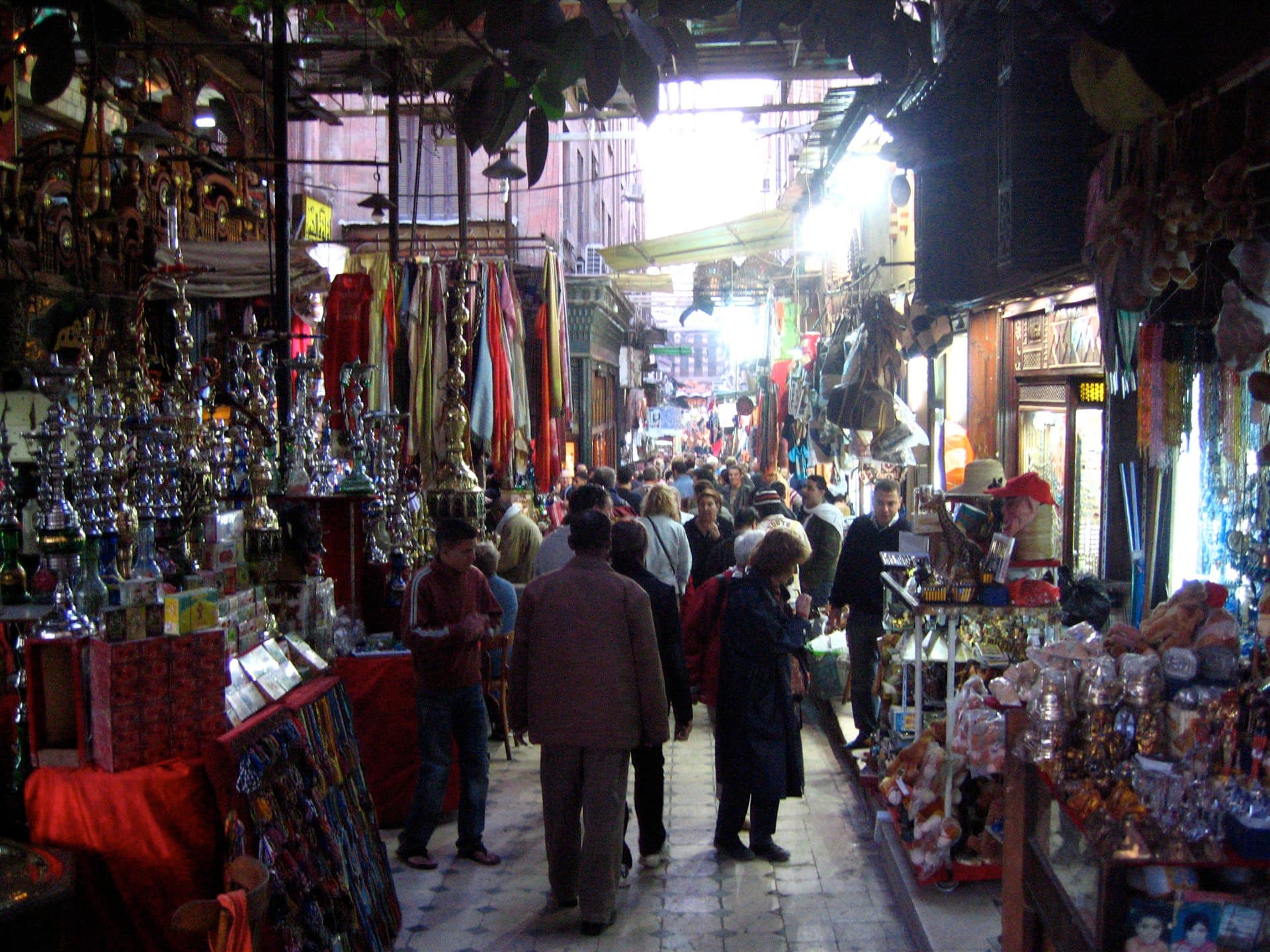
Bikam? (بكام؟) means how much. Point and say bikam da? (بكام ده؟), how much is this. It works in any shop or market, including Khan el-Khalili in Cairo.
Ghali awi (غالي أوي) means very expensive.
Ana mish ayez (أنا مش عايز) means I do not want it, said by a man. A woman says ana mish ayza (أنا مش عايزة). Add la shukran and move on.
Fakka (فكة) is small change. Ma'ak fakka? (معاك فكة؟) asks a man whether he has change. Small notes matter for tips, and our tipping guide explains why.
Gineih (جنيه) is the Egyptian pound. Our currency guide shows the notes and coins you will handle.
Numbers in Egyptian Arabic
Arabic has its own numerals, called Eastern Arabic numerals. Each number below has its Egyptian word, its Arabic spelling and its numeral. Ten shapes are all you need to learn.
One to five: wahid (واحد, ١), itnein (اتنين, ٢), talata (تلاتة, ٣), arba'a (أربعة, ٤), khamsa (خمسة, ٥).
Six to ten: sitta (ستة, ٦), sab'a (سبعة, ٧), tamanya (تمانية, ٨), tis'a (تسعة, ٩), ashara (عشرة, ١٠).
Larger numbers you will need: ishrin (عشرين, ٢٠), khamsin (خمسين, ٥٠), miyya (مية, ١٠٠) and miteen (متين, ٢٠٠).
One numeral catches people out. Zero is written as a dot (٠), and five (٥) looks like a Western zero. So ٥٠ is fifty.
What to say at a café or restaurant
El-hisab, min fadlak (الحساب من فضلك) means the bill, please. Read the bill for a service charge before you tip. Our tipping guide covers this.
Shai (شاي) is tea and ahwa (قهوة) is coffee. Sukkar (سكر) is sugar. Min gheir sukkar (من غير سكر) means without sugar, so say it when you order if you take your drink plain.
Mayya (ميه) is water. It sounds close to miyya, a hundred. This page writes water as ميه to keep the two apart, though you will also see مية for water.
Aish (عيش) is bread. Our Egyptian food page lists the dishes by name, which covers most of what you need to order.
Directions and taxis in Egyptian Arabic
Fein? (فين؟) means where. Fein el-hammam? (فين الحمام؟) asks where the toilet is.
Yemeen (يمين) is right and shimal (شمال) is left. Ala tool (على طول) means straight on. Hena (هنا) means here.
Ala gamb, min fadlak (على جنب من فضلك) asks a driver to pull over, please. Use it at the end of a taxi ride.
In a street taxi, agree the fare out loud before the car moves. Ride-hailing apps show a price estimate before you book. Our guide to getting around Egypt covers both.
Talking to a man or a woman: the one grammar point to know
Arabic changes many phrases depending on who you speak to. That is why this page gives izzayak and izzayik, or min fadlak and min fadlik. The Arabic script is often the same. Only the final vowel changes when you say it.
Some phrases also change with who is speaking. A man says ana asif for I am sorry. A woman says ana asfa. Wherever the forms differ, this page gives both.
Where to use your phrases on our trips
The phrases matter most when you are on your own: in a market, a café, a taxi or a walk between sites. The Khan el-Khalili bazaar in Cairo is a good place to try bikam da? and ghali awi.
Seven of the trips we sell with our partner, Memphis Tours, include an afternoon at Khan el-Khalili. Each has an airport meeting, an English-speaking guide on touring days and private sightseeing in Cairo. Prices are from-prices in US dollars, per person. International flights are extra.
The five-day Cairo Short Break spends day four at the National Museum of Egyptian Civilisation, then the afternoon in Khan el-Khalili. It costs from US$935. Cairo and a Nile Cruise, ten days, visits the bazaar on day nine, from US$2,635. Cairo, Luxor and a Nile Cruise, twelve days, goes on day eleven, from US$3,160.
Common questions
Will Egyptian Arabic phrases work in other Arab countries?+
They are widely understood. Egyptian Arabic is the most widely understood Arabic dialect, thanks to decades of Egyptian film, television and music.
How do you say good night in Egyptian Arabic?+
Say tisbah ala kheir (تصبح على خير) to a man, or tisbahi ala kheir (تصبحي على خير) to a woman. Use it when you part for the night.
How do you ask if someone speaks English in Egyptian Arabic?+
Ask a man bititkallim ingilizi? (بتتكلم إنجليزي؟). Ask a woman bititkallimi ingilizi? (بتتكلمي إنجليزي؟).
What do you say during Ramadan or Eid in Egypt?+
During Ramadan, say Ramadan kareem (رمضان كريم). The reply is Allahu akram (الله أكرم). For Eid and birthdays, say kol sana wenta tayyeb (كل سنة وانت طيب) to a man, or kol sana wenti tayyeba (كل سنة وانتي طيبة) to a woman. Our Ramadan page covers what else changes that month.
What does habibi mean?+
Habibi (حبيبي) means my dear, said to a man. Habibti (حبيبتي) is the form for a woman.
Why do Egyptians write Arabic with numbers in messages?+
Many Egyptians write Arabic in Latin letters when they text, a style called Franco-Arabic or Arabizi. Numbers stand in for sounds English has no letter for. 3 is the ain sound, 7 a breathy h, and 2 the catch in the voice. So ma'lesh becomes ma3lesh, and el-hisab becomes el 7isab. Hotel wifi stops at the door, so a local SIM card or eSIM keeps your phone's data working outside.
Do I need to speak Arabic on a guided trip in Egypt?+
No. Our Cairo trips include an English-speaking guide on touring days and a meeting at the airport. The phrases on this page help most where you are on your own: in markets, cafés and taxis.
Official sources
Entry rules, opening hours, security advice and exchange rates all move. Check them at the source, not here.
Written and checked by the Nile Trip Guide editorial team · Last reviewed . Entry rules, prices and opening hours change — check anything critical against the official sources linked on this page.
Plan this trip
Tell us your dates and we will price it
A real itinerary with real prices, usually within 24 hours. Nothing is booked and nothing is charged until you say yes.
Five days in Cairo and nowhere else: Giza, the Grand Egyptian Museum, the Egyptian Museum, the Citadel, Coptic Cairo and Khan el-Khalili. Four nights in one hotel, and every sightseeing day run privately.
Five nights in Cairo either side of a four-night sail from Luxor to Aswan. The Cairo days are private, just your party and a guide; the sightseeing off the boat is shared with a small group.
The standard Cairo-and-cruise route with two extra nights in a Luxor hotel before boarding, which is what buys you the Valley of the Queens, Medinet Habu, the Ramesseum, and a day out to Dendera and Abydos.