Is the Aswan High Dam worth visiting? Half an hour, honestly
Is the Aswan High Dam worth it? As a sight, no. It is an embankment with a road on top, a viewing area, a few souvenir stalls and a lot of wind, and nobody has ever come away moved by the view. As a thirty-minute stop on a road you are already driving, yes — because it explains the rest of southern Egypt, and because Philae's jetty is a few minutes further on.
The short answer
Keep it if it is already on your morning, which on a standard Aswan half-day it is. The dam sits on the road between the town and the jetty for Philae, and on the road south towards Abu Simbel, so stopping costs you the thirty minutes you spend standing on it and nothing else. In exchange the geography of everything else you have seen along the river finally makes sense.
Drop it, without a second thought, if someone is selling it as an excursion of its own, adding a premium to a tour price for it, or proposing to take an hour off Philae to fit it in. It is not a monument. There is nothing to walk through, no exhibition to speak of and no access to the machinery, and no amount of time on the crest improves it.
The one variable that genuinely changes the answer is whether anybody is there to explain what you are looking at. With a guide who can tell you what the embankment did to the river, it is a useful half hour. Without one it is a windy car park with a view of a lake.
It helps to name the category properly before you decide. This is not a sight in the sense that Philae or Abu Simbel are sights, and judging it as one guarantees disappointment. It is a piece of working infrastructure that happens to be the single most consequential structure built in Egypt since antiquity, and the visit is an act of orientation rather than sightseeing. Travellers who arrive expecting the second thing enjoy it. Travellers who arrive expecting the first do not.
What half an hour on the dam is actually like
You arrive by road and drive onto the crest, because the top of the dam carries a road. The structure is not a concrete wall; it is close to four kilometres of rock and clay piled across the Nile, about 110 metres high. Standing on it, the sensation is width rather than height. You are on a broad embankment with the reservoir on one side and the river and the power station on the other, and it takes a moment to register that the thing you are standing on is the thing you came to see.
The stop itself is a viewing area, a few souvenir stalls, and twenty to thirty minutes of standing in the wind. That wind is the detail nobody warns you about: it comes off Lake Nasser constantly and is stronger than people expect, which matters when you are holding a hat, a hood or a lens cap. There is no shade at all, anywhere on the crest.
Then you look at the lake. It is enormous and it is featureless, stretching roughly 500 kilometres south and across the border into Sudan, where it is called Lake Nubia. Photographs of it are disappointing in a specific way: there is nothing in the frame to give it scale. What you are really doing here is standing at the switch, not looking at a view.
One small mercy is worth recording, because on a hot Aswan morning it counts for more than it sounds. This is the least demanding thing you will do all day. The crest is flat, the viewing area is a few paces from where the vehicle stops, there is nothing to climb and no ticket queue of any length. Set against the ramps and thresholds at Philae and the exposed trench at the unfinished obelisk, half an hour that asks nothing of your knees has a value of its own.
Two dams, and why the mix-up spoils the stop
A good share of the disappointment around this stop is a case of mistaken identity, and it is the operators' fault rather than yours. There are two dams at Aswan. The old Aswan Dam, finished by the British in 1902 and raised twice afterwards, is a masonry wall a few kilometres downstream, and you cross it by road. The High Dam is the much larger earth-and-rock embankment upstream, built between 1960 and 1970. A morning excursion often crosses both without anyone saying which is which.
Telling them apart on the day is easy once you know what to look for. If you are driving over something that reads as a wall, with the drop visible below you, that is the 1902 dam. If you are on a broad bank of rock and clay and can barely tell you are on a structure at all, that is the High Dam. The jetty for the Philae boat sits between the two, which is precisely why the dam is on your route whether you get out or not.
The mix-up matters to the verdict because people who were expecting a wall look at a bank of rubble and conclude they have been sold nothing. They have been sold something, just not a view. Knowing which structure you are on, and that the unremarkable one is the significant one, is the difference between thirty wasted minutes and thirty useful ones.
The old dam also explains why the rescue of Philae happened when it did. From 1902 the temple stood partly under water for much of each year, and visitors rowed between half-submerged columns. Each raising of the old dam pushed the water higher. The High Dam would have finished the job and left the island permanently drowned, which is why the salvage campaign came in the 1960s and 1970s rather than sixty years earlier.
Why it is on your itinerary in the first place
Geography, mostly. The standard Aswan half-day is the unfinished obelisk, the High Dam and Philae, and that order works because all three sit along the same short run of road. The boat out to Philae leaves from a jetty between the two dams, so you pass the High Dam whether you stop on it or not. The same road carries on south towards Abu Simbel.
The second reason is that it is the explanation for most of what you have already looked at. The reason Philae stands on the wrong island, the reason Abu Simbel sits inside an artificial hill, the reason there are drainage works around the temples at Luxor and Karnak, and the reason the Nubian villages you were shown are where they are: all of it runs back to this embankment. Seeing the thing that did it lands differently from being told about it in a minibus.
The third reason is honest enough to state plainly: it fills a gap in a morning, and it is free of the queues and ticket-desk friction that everything else in Egypt has. Operators like it for that. That is not a reason for you to pay extra for it.
Why the dam is here and nowhere else
The reason is geological, and it is the same reason Aswan exists at all. North of here the Nile runs through sandstone and, further north, limestone, across a broad floodplain with nothing hard to build against. At Aswan it hits granite, and the rock breaks the river into channels around islands. That is the First Cataract. It gives a dam what a dam needs: solid rock on both banks, a defined point at which to close the river, and a long valley upstream deep enough to hold what you stop.
The ancients read the same line the same way. The First Cataract was Egypt's southern frontier for most of antiquity, the town on Elephantine Island was the border post, and a Nilometer cut into the rock there gauged the annual flood, because everything downstream depended on how high the water came. Two dams and four thousand years later the modern state chose the identical spot for the identical reason. That continuity is more interesting than the embankment, and it is the kind of thing a good guide will point at rather than recite.
The granite explains the stop you probably made an hour earlier, too. The unfinished obelisk lies in the old quarries inside modern Aswan because this is where the hard stone was. The obelisks at Karnak, the granite colossi and the sarcophagi inside the pyramids all came from here and travelled downriver, in some cases the better part of a thousand kilometres. The rock that made a dam site possible is the rock the ancient quarrymen were after, and on this one morning you see both uses of it within a few kilometres.
What to look at while you are up there
Orient yourself first, because nothing on the site will do it for you. The reservoir is on the upstream side, to the south; the river, the power station and the road back into Aswan are downstream, to the north. Water leaves the lake through the works below you and reaches the turbines, and everything between here and the Mediterranean depends on how much of it is released today. That single sentence is most of the visit, and it is the sentence nobody says out loud unless you have brought somebody who knows it.
Then notice how little of the structure you can actually perceive. Look north towards the town and the old dam and the crest reads as landscape rather than engineering, which is the honest character of the place. The scale is real and it refuses to present itself. That is worth ten seconds of attention rather than a photograph, because the photograph will not carry it.
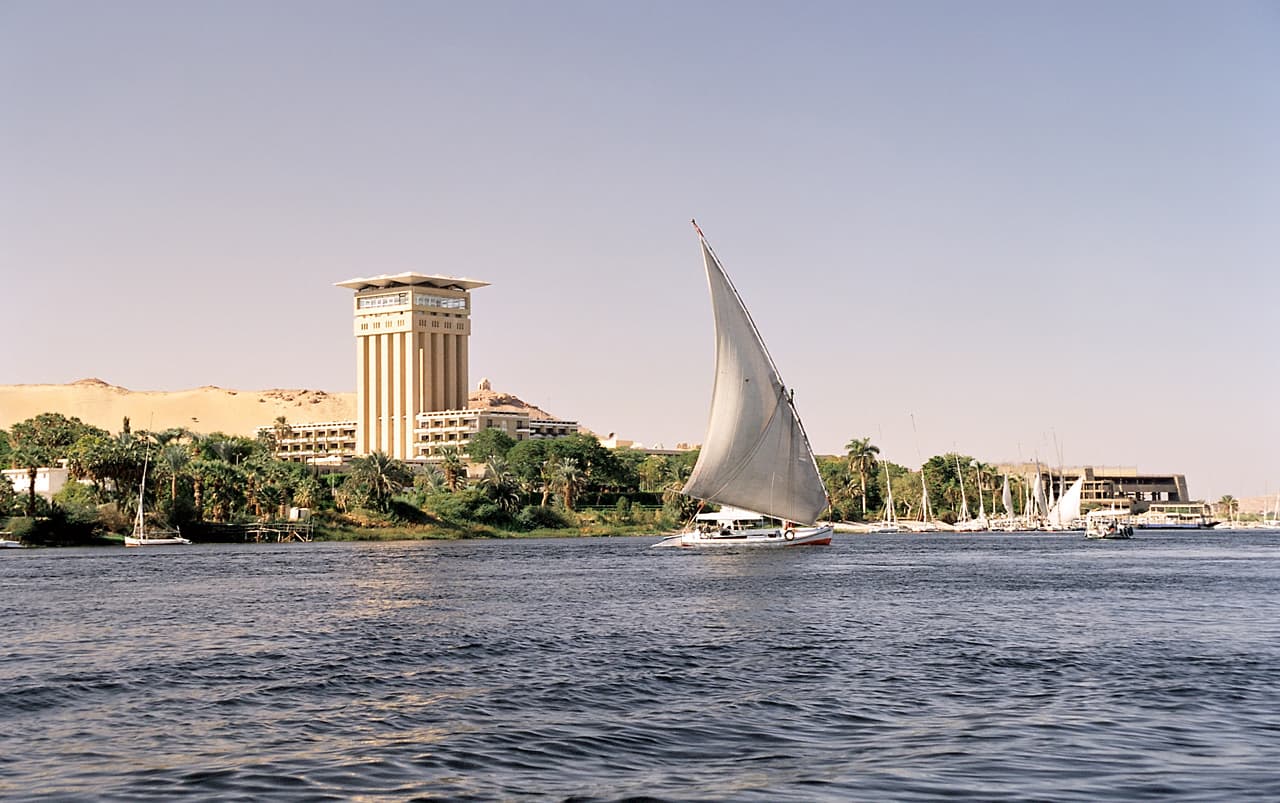
Finally, give the lake the two minutes it deserves and then stop trying to photograph it. There is no foreground, no far shore and nothing in the frame to give it size, so the image comes back looking like any bright day on any large body of water. The better shots from the crest are the sluices and the works on the downstream side, where there is structure to fix the eye, and the lotus tower at the western end.
When it is not worth your time
If it is being sold as its own excursion, decline. If your quote itemises it as a supplement, ask what the supplement buys, because the answer is a car park and a viewing area. If the schedule has you at the dam for an hour, move forty minutes of that to Philae, which needs at least ninety and rarely gets it.
If you are travelling in the middle of the day between May and September, skip it. Aswan is the hottest stop on a normal Egypt route and regularly passes 40C, the crest is fully exposed, and standing on an embankment in that heat to look at a reservoir is a bad use of the small number of comfortable hours you have. The same stop early in the morning is a different proposition.
And if you only want one of the two dams, take the view from the Philae motorboat instead. From the water the reservoir tells you what the dam did, and the temple standing on a rebuilt island tells you what it cost to save one small piece of what it drowned. That is the whole lesson in a better setting.
The failure mode to watch for is not too little time but too much. Groups drift towards the stalls, twenty minutes becomes fifty, and the lost half hour comes out of the island at the end of the morning rather than out of the embankment. Say before you set off that this is a thirty-minute stop and that anything saved goes to Philae, and the morning holds together.
What separates a dull stop from a useful one
Somebody explaining it. The dam gives up nothing on its own — there is no interpretation on site, no exhibition, and nothing labelled. Its value depends almost entirely on having a guide who can tell you what the lake replaced, and what the country got and lost in the trade.
Failing that, know the story before you get out of the car. The dam ended the annual Nile flood, which had organised Egyptian life for thousands of years. Water is now held in Lake Nasser and released on demand, which means two or three crops a year instead of one, land reclaimed from desert, and enough storage to absorb dangerous floods and carry the country through drought years. The twelve turbines produce around 2,000 megawatts, which was something like half of Egypt's electricity in the mid-1970s and is a small share of it now.
The other half of the ledger is what makes the stop worth anything. The old flood carried silt that fertilised the fields and rebuilt the Delta each year, and that silt now settles in the reservoir instead: Egyptian agriculture runs on manufactured fertiliser, the coast erodes without new sediment, salt pushes inland, and perennial irrigation raised the water table under the fields and under the monuments. Egypt bought reliable water and lost a functioning natural system. Both halves of that sentence are true at once, and standing between the lake and the river is the one place it is obvious.
The cleanest way to hold it in your head is this. Before 1970 the amount of water Egypt had in any given year was decided in Ethiopia and East Africa months earlier, and the country found out when the river arrived. After 1970 it is decided in a control room at Aswan. That is an enormous transfer of control, it is the reason the dam is treated as a national achievement rather than an item of infrastructure, and it is why the politics of it still matter here in a way that no amount of standing on the crest will tell you.
Lake Nasser is not scenery, and that is the point
It helps to stop looking at the reservoir as a lake. It is a working store of water: it absorbs floods, it releases through the year, it buffers low-Nile years, and it loses a great deal of water to evaporation, because a body of water that size lying open in one of the hottest and driest places on earth cannot do otherwise. That evaporation is permanent, and it is part of the price of holding the flood in the desert rather than letting it run to the sea.
It is also a fishery. The fish on an Aswan menu often comes out of this water, which is one of the few parts of the story you can eat rather than be told. And it is a border: the far end of it is in Sudan, where it is called Lake Nubia, which is why the stretch of desert road south towards Abu Simbel is as empty as it is.
There are boats on it, though very few. Lake Nasser cruises run between Aswan and Abu Simbel, usually three or four nights, calling at the Nubian temples that were moved when the lake filled: Kalabsha, Wadi es-Sebua, Amada. Traffic is light enough that you may pass two other boats in a day. That is a separate trip from a Nile cruise, which works the river north of the dam, and its appeal is that you arrive at the temples from the water rather than from a car park. If the crest interests you more than you expected it to, that boat is where the interest leads.
The part the viewing platform does not show you
The reservoir drowned the Nubian homeland, a long stretch of river villages between Aswan and the Sudanese border. Something like a hundred thousand people were moved in the 1960s, roughly half in Egypt and half in Sudan, though the counts vary between sources. Egyptian Nubians were resettled on irrigated land near Kom Ombo, north of Aswan; Sudanese Nubians went east to Khashm el-Girba; the town of Wadi Halfa went under entirely.
None of that is visible from the crest, and none of it is mentioned there. The temples got an international rescue campaign and a great deal of attention. The villages got resettlement and very little. If that is the part of the story you want, the Nubian Museum in Aswan is the serious answer: it covers Nubian history, the salvage campaign and the resettlement, in air conditioning, and takes about an hour. It is the better hour of the two.
The lotus-shaped tower at the western end is the Egyptian-Soviet Friendship Monument, five tall concrete petals marking the Soviet role in funding and engineering the project after American and British money was withdrawn in 1956. Whether visitors can go up varies, and it is closed more often than it is open, so look at it rather than plan around it.
It is worth knowing that the 1960s displacement was not the first. The old dam downstream was raised twice after 1902, and each raising pushed the water further south and emptied villages that had already been rebuilt once. By the time the High Dam filled, families along that stretch of river had been moved repeatedly within a single lifetime. If you are taken to a Nubian village on Elephantine or the west bank later in your stay, that history is the thing standing behind the hibiscus tea and the painted walls, and it is the reason some visitors find those trips uncomfortable.
The rescues this embankment made necessary
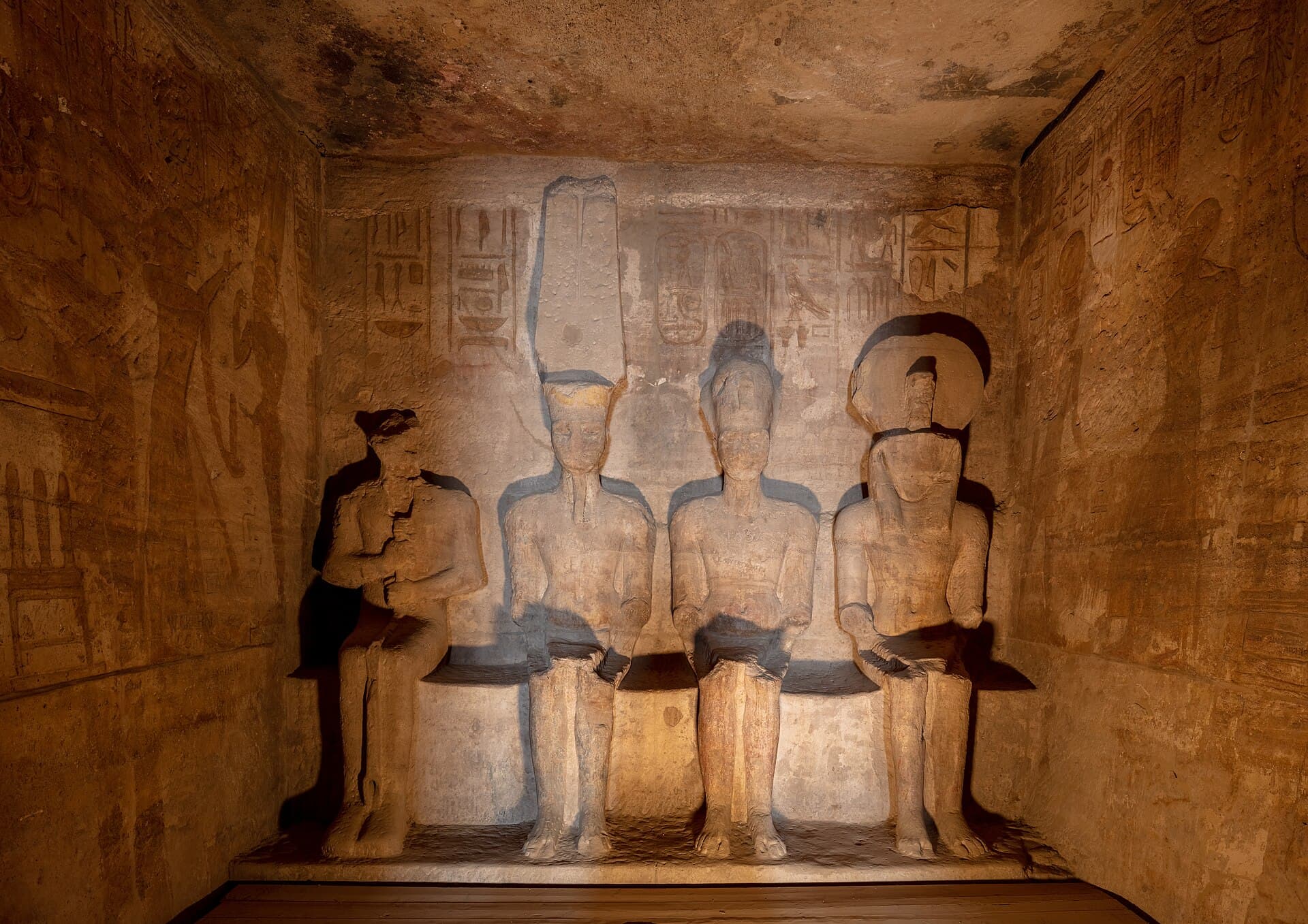
The strongest argument for the stop is that half your itinerary is downstream of it, in the literal sense and the causal one. Rising water threatened dozens of monuments, and UNESCO ran a salvage campaign from 1960. Abu Simbel was cut into blocks between 1964 and 1968, lifted about 65 metres higher and set back some 200 metres onto an artificial hill built to imitate the original cliff. The construction of the dam and the dismemberment of the temples were happening at the same time, which is the part of the timeline most visitors have never put together.
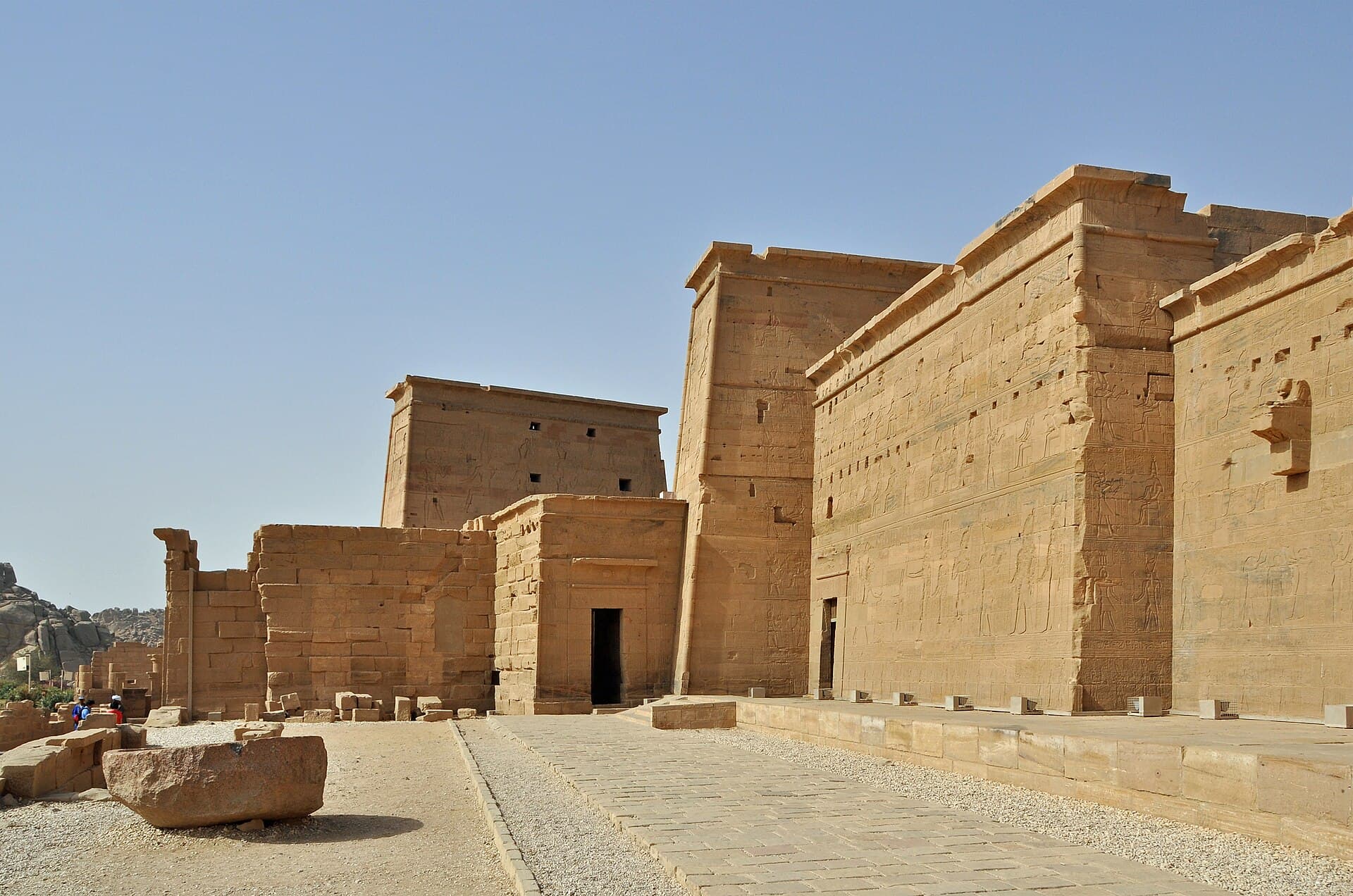
Philae had a different problem, being already half-drowned between the two dams. A cofferdam was built around it, the water was pumped out, and the buildings were cut into tens of thousands of numbered blocks and re-erected through the 1970s on Agilkia, a neighbouring island reshaped to resemble the original. The work finished in 1980. Kalabsha, Beit el-Wali, Wadi es-Sebua and Amada were moved as well, and four temples left Egypt altogether as thanks to the countries that helped: Dendur to New York, Debod to Madrid, Taffa to Leiden, Ellesiya to Turin. Very little Nubian architecture now stands where it was built.
The evidence is visible at both of the sites you are most likely to see, once you know to look. At Philae, faint saw lines run through the masonry and the lower courses of some walls carry a pale band where decades of standing water stripped the colour out of the stone. At Abu Simbel, the joins run across the statues once you have noticed the first one, and the cliff behind the facade is concrete and rubble under a skin of sandstone. Half an hour on the dam turns those marks from oddities into the point of the whole trip, which is an unusually good return on thirty minutes of standing in the wind.
How to split the morning it belongs to
Half an hour at the unfinished obelisk, half an hour at the dam, at least ninety minutes at Philae, in that order. Philae is the reason the morning exists and the only one of the three that suffers from being rushed. Booked that way, the dam is the only stop that gets hurried, and it can take it.
The obelisk is worth its half hour and usually gets treated as filler. It lies in the old granite quarries in town: a single abandoned block close to 42 metres long, cracked before it could be freed, and the clearest surviving evidence of how the Egyptians cut stone. It carries no inscription, so the usual link to Hatshepsut is inference rather than proof. Go early, because there is no shade and the granite holds heat.
Kalabsha, the relocated temple near the dam's western end, normally needs a separate motorboat from the landing and is left out of most itineraries. That is exactly why it stays quiet, and it makes a useful contrast with Philae if you have the time and can agree a price with a boatman.
At Philae itself, remember that the boat is a separate transaction from the site ticket, arranged with the boatmen at the landing and normally priced per boat rather than per person. Buy the ticket on the mainland first and settle the boat second, agree the fare and the waiting time before you step in, and carry small notes. People who negotiate a fare and then join a ticket queue lose the time they thought they had saved, and the time they lose is the time they were hoping to spend on the island.
Is it worth it on the last morning of a cruise?
Usually not, and this is the single clearest case for cutting it. Most Nile cruises finish in Aswan, and most passengers fly out on the morning the boat docks for the last time. Their Aswan is a rushed Philae stop wedged between disembarkation and the airport, and in that version the dam is the first thing that should go. There is no spare half hour for a viewing platform when the temple itself is being done in forty minutes.
The stop earns its place on a morning that was already built around Philae with time in hand, which in practice means a morning that starts from a hotel in Aswan rather than from a departure schedule. That is the strongest argument for adding a night after the cruise, and it changes the trip more than almost any other decision on it: an unhurried afternoon on the water, an evening on the corniche, and a morning that is not spent watching a clock. It also converts the dam from something you sacrifice into something you can take calmly.
If you are sailing the other way, north from Aswan to Luxor, the dam usually lands on the first morning before you board, and the same rule applies. It is worth half an hour on the way to Philae and nothing at all as a separate item, and the time to protect is the island's, not the embankment's.
Is it worth it with children, or with limited mobility?
With children, no, and it is not a close call. There is nothing to climb, nothing to walk through, no machinery to look at and no exhibition, and the wind and the total absence of shade make standing about unpleasant rather than merely dull. Twenty minutes is generous. If the morning is being planned around young travellers, the motorboat crossing and the island at Philae will do far more work, and the granite quarry at the obelisk is more interesting to a child than a reservoir is.
With limited mobility the answer flips, and this is one of the few stops in Upper Egypt where it does. The crest is flat and level, the viewing area is a short walk from the vehicle, there is nothing to negotiate and no queue to stand in. Philae, by contrast, is one of the harder sites in Aswan for exactly the opposite reasons: boarding a small motorboat from a stone quay means a step down without a rail onto something that moves, and the island has steps, uneven paving and raised thresholds. If your group is splitting up for the boat, the dam is a reasonable place to wait rather than a punishment.
For anyone with a genuine interest in twentieth-century engineering or in modern Egyptian history, the calculation changes again and the half hour becomes the best-value stop of the morning. That is a small group of travellers, but they exist, and they are the only people we would tell to linger.
If you skip it, what to do with the time
More of it at Philae is the obvious answer. The island needs at least ninety minutes and routinely gets forty, which is the real scandal of the standard Aswan morning. Two hours is comfortable if you want to read the reliefs properly and walk out to the Gate of Hadrian, and the extra time costs nothing beyond the boatman's waiting arrangement.
The Nubian Museum is the better hour if the human side of the story is what interests you, and it is indoors, which matters between May and September more than any other consideration. A felucca out to Elephantine Island in the late afternoon is the thing most people actually remember about Aswan, and it uses the hours when the sites are unbearable anyway. The unfinished obelisk, taken early and properly rather than as filler, is a more interesting half hour than the crest for most visitors.
And if the dam is what you want but the standing is not, take the lesson from the water. From the Philae motorboat the reservoir tells you what the dam did, and the temple sitting on a rebuilt island tells you what it cost to save one small piece of what it drowned. You will have crossed the water either way.
Practicalities for the stop itself
Treat it as a working strategic site, because it is one. There are police posts at both ends and identity checks happen, so your passport should be with you rather than back at the hotel. Photograph the lake, the sluices and the friendship monument; do not photograph checkpoints, guard posts or soldiers. The rules tighten and loosen without notice, so ask your driver what is allowed on the day rather than finding out afterwards.
There is an admission charge for the viewing area, and whether it is already covered varies by operator. Check before you leave Aswan rather than arguing at the barrier. Bring water and a hat, and accept that the hat will need holding.
Go early in the morning in any month. The light is better, the coaches have not arrived, and you are not standing on an exposed embankment in the middle of the day. November to February is comfortable in Aswan, March and October are warm but workable, and May to September is genuinely punishing.
Egyptian monument fees and site rules are revised often enough that any figure printed here would be wrong within months, which is why there is none on this page. Assume the viewing area is charged, assume the Philae boat is a separate payment again, and confirm both with your hotel or guide on the morning. The same goes for camera rules, which are enforced unevenly from site to site and season to season.
So: is the Aswan High Dam worth it?
Yes, for thirty minutes, on a morning that was going past it anyway, with somebody who can explain it. It is the single structure that changed modern Egypt more than anything since antiquity, and understanding it makes Philae, Abu Simbel, the drainage works at Karnak and the position of the Nubian villages all read differently on the way home.
No, as anything else. It is not a monument, the view is not the point, and it is the one stop in Upper Egypt where the mistake people make is giving it more time rather than less. The common errors are predictable: confusing it with the 1902 dam downstream and wondering why it looks like a bank of rubble, expecting a visitor centre, giving it an hour it does not deserve, and pointing a camera at security.
Held against the rest of a southern Egypt itinerary it occupies an odd position: the most consequential structure on the river and the least rewarding half hour on the route. Both statements are true at once, and keeping them in mind together is the whole skill of the stop. Arrive knowing what it did, stay thirty minutes, and give the rest of the morning to the island it very nearly drowned.
Common questions
How long do you actually need at the Aswan High Dam?+
Twenty to thirty minutes, and that is the whole visit. It is a stop on the crest: lake on one side, river and power station on the other, a viewing area and a few souvenir stalls. There is no exhibition, nothing to walk through and no access to the machinery. Anything longer is time taken from Philae, which needs at least ninety minutes and is the reason the morning exists.
Can I skip the High Dam without missing anything?+
Yes, if you are short of comfortable hours or travelling in high summer. You will still cross the water on the way to Philae's jetty, and the view from the motorboat tells you most of what the crest does. What you lose is the explanation for a lot of what you have already seen, which is worth more if you have a guide with you and less if you do not.
Is the High Dam worth paying extra for as a separate excursion?+
No. It is worth the thirty minutes it takes when you are already driving past it, and nothing beyond that. If a quote itemises the dam as a supplement, ask what the supplement buys, because the answer is a car park and a viewing area with no exhibition and no access to the machinery. The same money spent on an extra night in Aswan changes your trip considerably more.
Is there an entrance fee for the dam?+
There is an admission charge for the viewing area. Whether it is already covered varies by operator, so check before you leave Aswan rather than sorting it out at the barrier.
Is this the same as the old Aswan Dam?+
No, and the confusion is common. The old Aswan Dam, finished by the British in 1902 and raised twice afterwards, sits a few kilometres downstream and is a masonry wall you cross by road. The High Dam is the much larger earth-and-rock embankment upstream, built between 1960 and 1970. Tours often cross both without saying so.
Can you take photographs there?+
Generally yes from the designated viewing area, pointing at the lake, the sluices and the lotus-shaped friendship monument. Not at checkpoints, guard posts or any military position at either end, and not at soldiers. Enforcement varies by day and by officer, so ask your driver before you raise a camera.
Do you need your passport at the dam?+
Carry it. This is a working strategic site with police posts at both ends, and identity checks do happen. Leaving your passport in the hotel safe is the usual advice elsewhere in Egypt and the wrong advice on this particular road, which also carries on south towards Abu Simbel.
Is the High Dam worth it with children?+
Not really. There is nothing to climb, nothing to walk through and no exhibition, and the constant wind off the lake and the complete lack of shade make standing about unpleasant rather than merely dull. Twenty minutes is generous with children in tow. The boat crossing to Philae and the island itself will do far more for them.
What is the lotus-shaped tower beside the dam?+
The Egyptian-Soviet Friendship Monument, at the western end: five tall concrete petals marking the Soviet role in funding and engineering the project after American and British money was withdrawn in 1956. Whether visitors can go up varies and it is closed more often than it is open, so treat it as something to look at rather than something to plan around.
Does the dam still supply most of Egypt's electricity?+
No. The twelve turbines produce around 2,000 megawatts, which was something like half of Egypt's electricity in the mid-1970s. National demand has grown enormously since, so the dam's share today is small. It has always mattered more as a water-control structure than as a power station, which is the part that gets lost when it is described as a hydroelectric project.
What should I do instead if the dam does not interest me?+
The Nubian Museum in Aswan is the better hour: it covers Nubian history, the salvage campaign and the resettlement of the people the reservoir displaced, in air conditioning. Beyond that, more time at Philae, an afternoon felucca out to Elephantine Island, or the walk through the granite quarries at the unfinished obelisk all beat a longer stop on the crest.
Official sources
Entry rules, opening hours, security advice and exchange rates all move. Check them at the source, not here.
Written and checked by the Nile Trip Guide editorial team · Last reviewed . Entry rules, prices and opening hours change — check anything critical against the official sources linked on this page.
The route most people take first, at the length it was built for: Giza and the Grand Egyptian Museum, then a flight to Luxor and four nights sailing down to Aswan.
No boat on this one. Giza and the Grand Egyptian Museum, a night in Luxor for both banks, two nights on the Red Sea, then back to Cairo for the Citadel, Coptic Cairo and the Royal Mummies.
Five nights in Cairo either side of a four-night sail from Luxor to Aswan. The Cairo days are private, just your party and a guide; the sightseeing off the boat is shared with a small group.