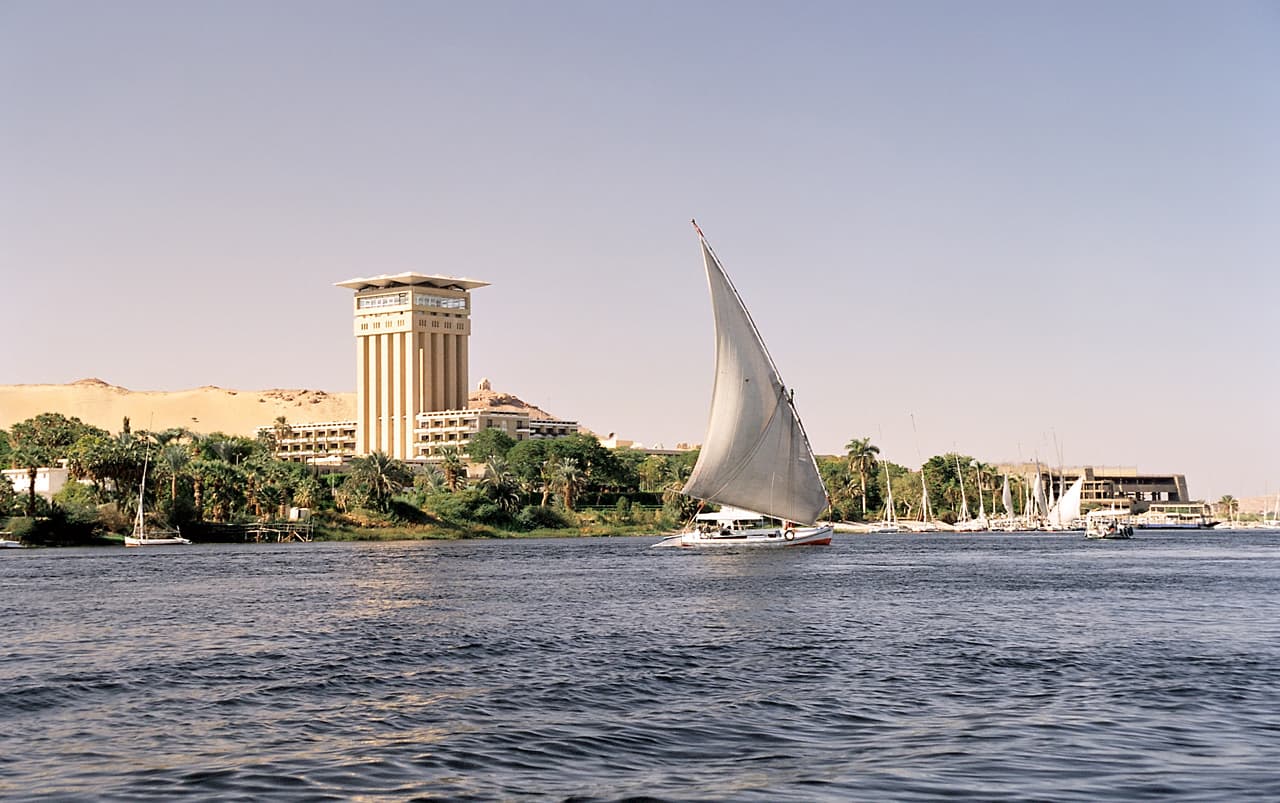
A dahabiya is a small sailing boat built for the Nile. The hull is shallow and flat-bottomed. Sails are usually lateen, the tall triangular kind you see in old paintings of the river. Guest numbers are small: one modest group on board rather than the passenger list of a river cruise ship.
What a dahabiya is, and where the word comes from
A dahabiya is a small sailing boat built for the Nile. The hull is shallow and flat-bottomed. Sails are usually lateen, the tall triangular kind you see in old paintings of the river. Guest numbers are small: one modest group on board rather than the passenger list of a river cruise ship.
The shallow hull matters more than it sounds. It lets the boat lie close to the bank, tie up beside a sandbank, and stop where a deep-hulled ship cannot go. Crews are small, and the same few people cook, sail and handle the ropes. By the second day you will know their names.
The name comes from Arabic, usually traced to a word meaning golden, after the gilded barges of Egypt's rulers. By the nineteenth century it meant something plainer: the boats foreign travellers hired, crew included, for the journey upriver. Waiting for wind was part of the bargain. Today's fleet is a revival rather than an unbroken tradition, so judge a boat on what it is like now.
You will see the word spelled several ways in English, because it is a transliteration rather than a translation: dahabiya, dahabeya, dahabiyah and a few others besides. They all describe the same kind of vessel, and a boat is not older, better or more authentic for carrying one spelling rather than another. Two masts and a handful of cabins is the shape of the thing, whatever it is called on the brochure.
Why the wind, not the engine, runs the whole trip
There is a geographical accident behind all of this, and it is worth understanding before you book, because it explains the itinerary, the direction and the delays. The Nile flows south to north. The prevailing wind on this stretch blows from the north. So a sailing boat can work its way upstream under canvas against the current, then simply drift back down on the flow with the sails stowed.
That is exactly how the river was travelled for most of its history, and the ancient Egyptians built the fact into their writing: the hieroglyph for travelling south was a boat with its sail up, and for travelling north a boat with the sail down. A dahabiya is not a themed reconstruction of that. It is the same physics, still working.
The practical consequence is that the wind decides your day. Blow steadily and the boat covers ground and the crew look pleased. Drop away and the boat stops, sometimes somewhere pleasant and sometimes somewhere ordinary. Nobody on board can fix this, and the operators who are worth dealing with say so in advance rather than on the afternoon it happens.
How it differs from a motorised cruise ship
Start with scale, because everything else follows from it. A large river ship is a floating hotel, and capacities differ a lot from ship to ship. A sailing boat of this kind takes one small group and no more. That changes how long it takes everyone to get ashore and whether the crew know how you take your coffee.
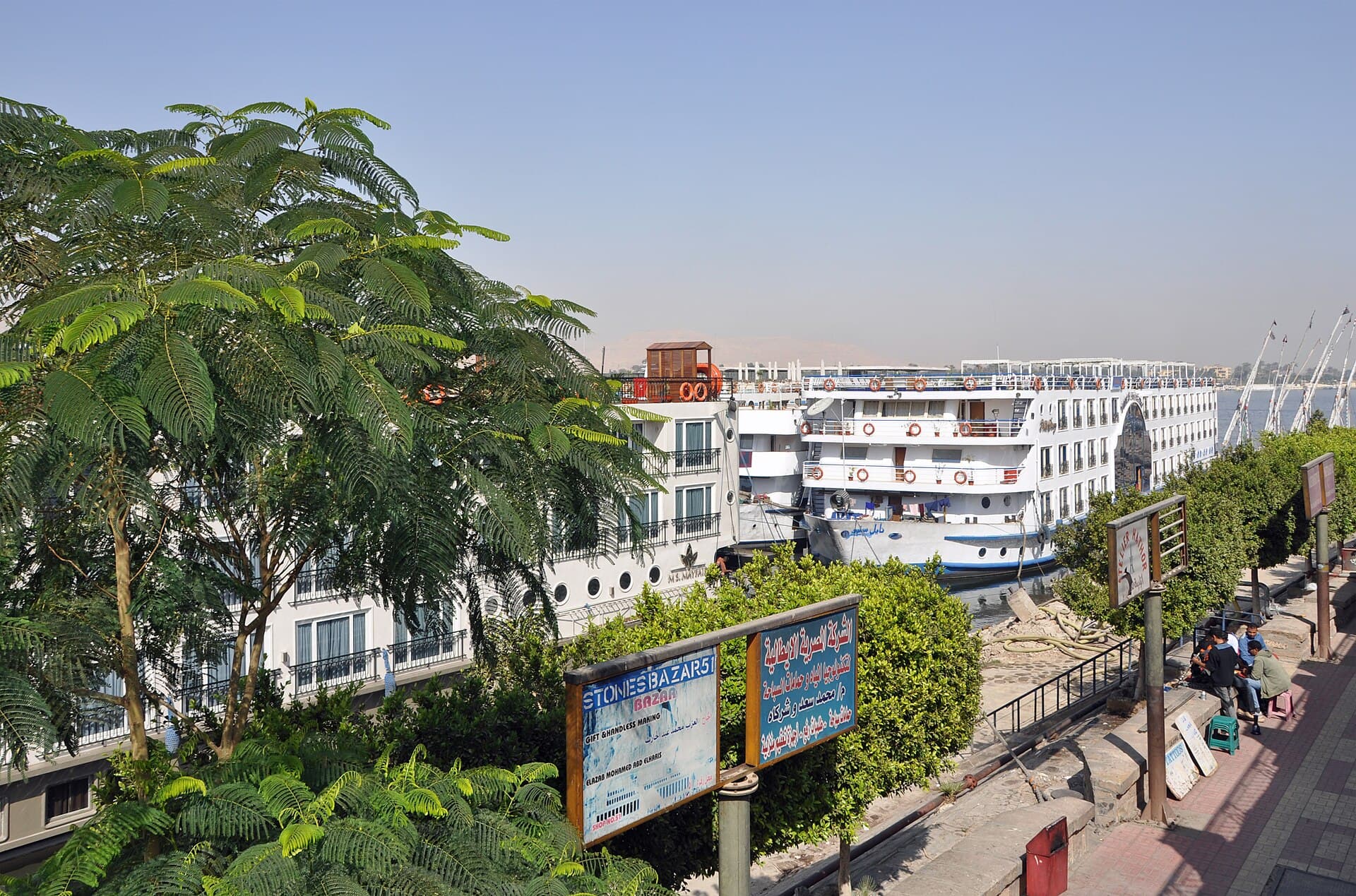
Noise is the next difference. Under sail there is no engine, so you hear water, birds and the crew talking. Large ships run generators through the night. Mooring is the third: a small boat can stop at a bank, an island or a village, while the ships gather at fixed quays in the same few towns, sometimes tied up several deep.
Then there is the itinerary. A ship keeps a timetable because it can. A sailing boat bends to the wind. Blow well and you go further; drop away and you stop early somewhere nobody planned. Sensible operators build slack into the route and reorder the sites. Understand that before you book, not on the afternoon the sails go slack.
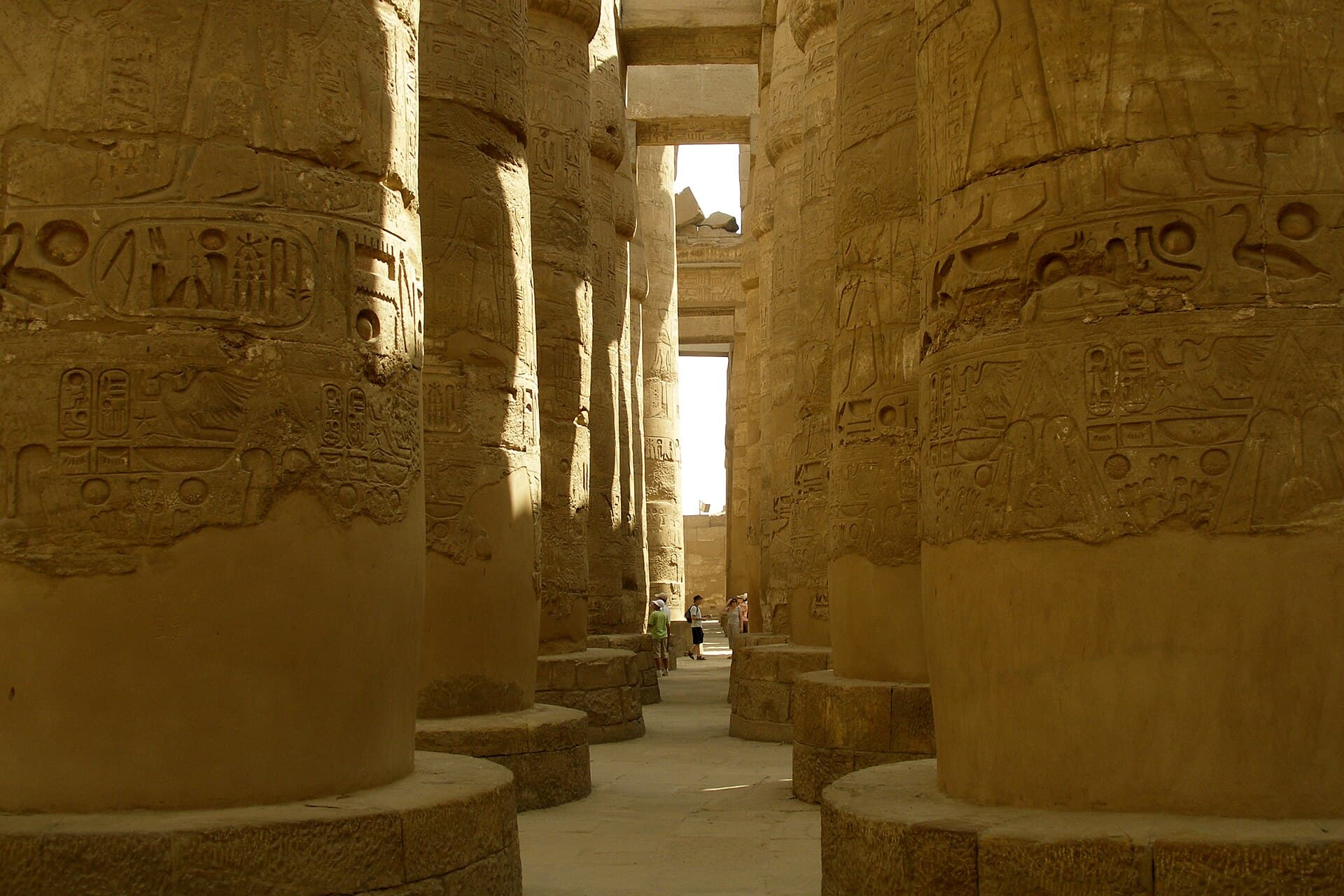
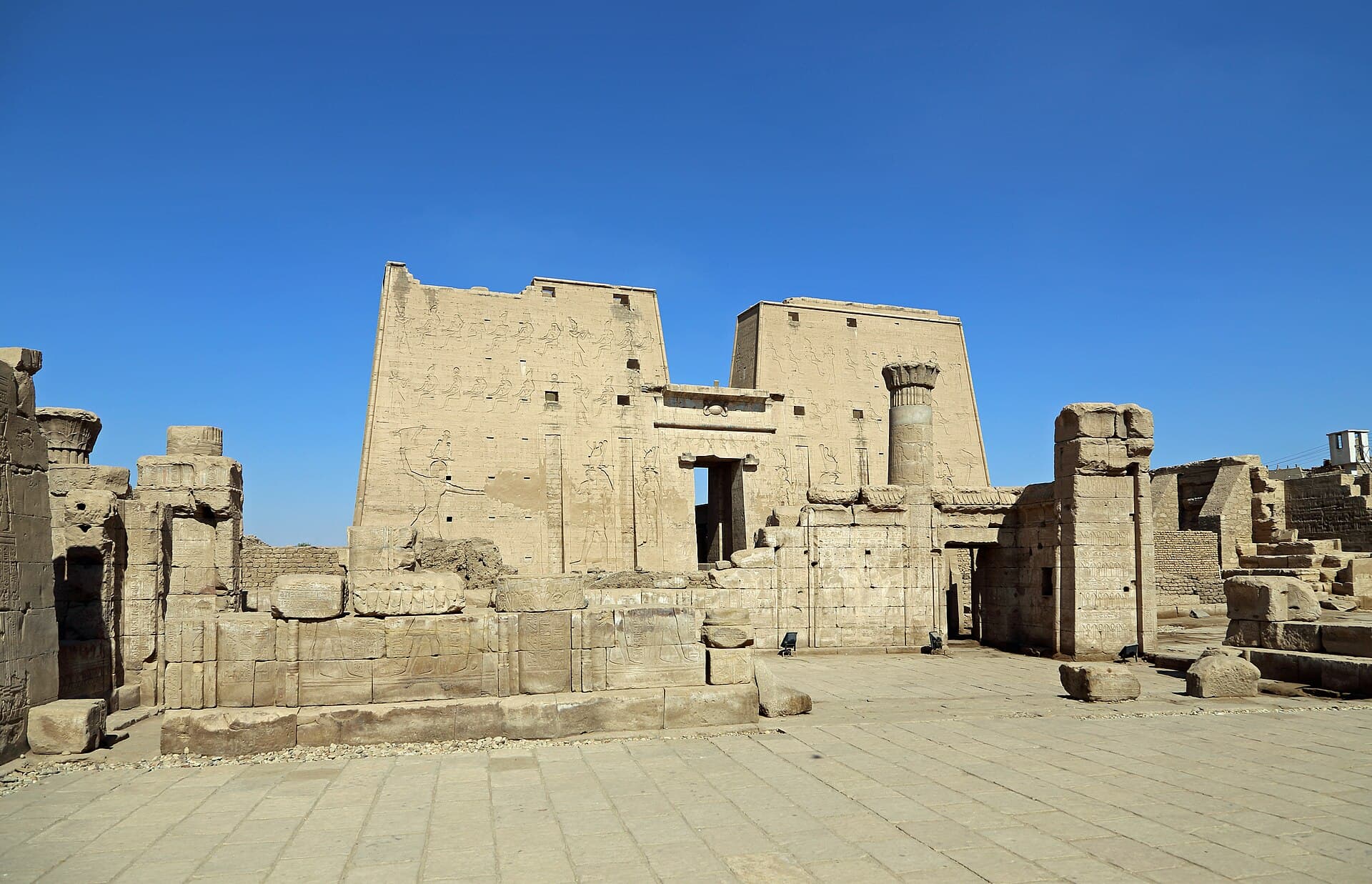
The last difference is the one people notice only once they are aboard: how you move around a site. A ship arrives with enough passengers to fill several coach-sized groups, and the groups move through Edfu or Karnak in a block behind one guide with a raised arm. A boat carrying a dozen people walks in at a different hour and at a different pace. The temple is identical. The hour around it is not.
Dahabiya, felucca or small motor boat: three different things
These get muddled constantly, and the confusion costs people money. A felucca is the small version of the same idea: a lateen-rigged open sailing boat with no engine and no cabins, usually taken for two or three hours at a time around the islands at Aswan in the late afternoon when the heat drops. It is an excursion, not accommodation. Overnight felucca trips do exist and are a different proposition again, closer to camping on a deck than to a cruise.
A dahabiya is the larger, overnight version of the same principle: the same shallow hull and the same reliance on the wind, but with cabins, a galley, bathrooms and a crew who feed you. That is the boat this page is about, and it is the one people mean when they talk about sailing the Nile for several nights rather than several hours.
The third category is the small motor boat, which sits between a dahabiya and the large fleet. Fewer passengers than a big ship, a quieter deck, and more comfort than a sailing boat, but it is still engine-driven and still keeps to a fixed schedule at the main quays. If what you want is small numbers without the uncertainty of wind, that is the category to look at, and nobody should let you call it a dahabiya.
What a day on board actually feels like
Mornings start early, partly for the light and partly because the heat builds fast. You visit a site, come back, eat, and then a long middle stretch follows where the boat simply sails. That stretch is the point of the whole thing. Reading, watching the bank go past, talking to the few other people on board.
Afternoons often bring a stop with no temple attached. A walk into a village, a swim off a sandbank if the crew judge it sensible, tea on deck while the sails are trimmed. Evenings stay quiet. No show, no bar band, no shop. Dinner is cooked fresh in a small galley and eaten with everyone else on board.
Some people find the empty hours hard going. If you want something scheduled at four o'clock each afternoon, you will feel the gap where it should be. Bring books. Connectivity, where it exists at all, is a phone signal borrowed from the bank, and it comes and goes.
What fills those hours, if anything does, is the bank itself. Sugar cane, water buffalo, brick kilns, children shouting from the shore, a heron lifting off ahead of the hull. On a large ship that scenery slides past a window on the way to the next fixed mooring. On a sailing boat it is the programme, and people who came for it describe those afternoons afterwards more often than they describe the temples.
The Luxor to Aswan route and the temples it reaches
Sailing itineraries usually run between Luxor and Aswan, in one direction or the other. Heading south to Aswan is upstream against the current but generally with the prevailing northerly wind, which is why the old boats sailed up and drifted back down. The Nile flows south to north, so downstream and downwind pull against each other.
Along that stretch sit the temples the river was made for. Esna, sunk below the level of the modern town. Edfu, among the better preserved temples in Egypt. Kom Ombo, standing on the bank so you arrive at the steps rather than by coach. Between them lie places the big ships pass without stopping: the rock-cut tombs at El Kab, the quarries at Gebel el-Silsila.
Two things sit outside the sailing part. Luxor's own sites, Karnak and the west bank among them, are normally land days at either end. So is Abu Simbel, roughly three hours by road from Aswan and a day in itself. Boats also pass through the lock at Esna, where waits happen. Allow for it.
It is worth being precise about what the lock is, because it is the one delay nobody can plan around. A lock is a single gated chamber that raises or lowers vessels between two levels of water, and only so many hulls fit in it at a time. When a whole fleet works the same two hundred kilometres and reaches the lock in the same window, they pass through in turns. The wait can run to an hour or swallow an evening, and there is no overtaking a queue of cruise boats.
The stops only a shallow hull can reach
This is the substance of what the extra money buys, and it is worth naming rather than leaving as atmosphere. El Kab, on the east bank between Esna and Edfu, has rock-cut tombs that the large fleet passes at speed because there is nowhere for a deep hull to tie up. Gebel el-Silsila is the other one: an ancient sandstone quarry where a great deal of the stone that built Egypt's temples was cut, so you are standing at the source of walls you have spent a week walking through.
Then there are the stops with nothing ancient attached at all. A sandbank the crew judge safe enough to swim from. A village reached on foot rather than by coach, where the encounter is ordinary rather than staged. An island mooring for the night with no quay, no other boats and no lights except your own.
None of this appears on a standard cruise itinerary, and none of it is a substitute for the main temples, which are the same list either way. What changes is the proportion. On a ship the river is the gap between sites. On a sailing boat the sites are the punctuation and the river is the sentence.
Two great temples sit outside every version of this trip, sailing or otherwise. Dendera and Abydos lie north of Luxor, off the cruise stretch entirely, and are reached by road from Luxor as a long day out. If they matter to you, add a land day rather than hunting for a boat that goes there, because none does on a normal schedule.
How many nights a sailing itinerary needs
More than a motor cruise, and that is arithmetic rather than salesmanship. The standard sailings on this stretch are four nights southbound and three nights northbound, and both of those numbers assume an engine. A boat relying on wind covers the same ground more slowly, so five nights is about the minimum that works and a week is the comfortable length.
Be careful how the nights are counted, because the convention on the river is generous. You typically board around the middle of the day and leave after breakfast, so the number on the ticket is roughly one more than the number of full days you actually get. Ask which days are travel days at each end before you judge whether a five-night itinerary is really five days of sailing.
What the extra nights buy is not a longer temple list. The temples between Luxor and Aswan are what they are, and no amount of money or time adds to them. The extra nights buy the sandbanks, the village walks, El Kab, Gebel el-Silsila and the afternoons with nothing scheduled. If that reads as the point, book the longer version. If it reads as filler, you have just talked yourself into a motor cruise, and that is a useful thing to learn before paying.
Which direction to sail, and why it matters more here
On a motor ship, direction mainly changes the price and the running order. Southbound from Luxor to Aswan is the classic four-night run, starting with the heavyweight sites and ending in the calmest of the three cities. Northbound from Aswan to Luxor is usually three nights and cheaper on the same boat, because the current does the work, but it finishes with the busiest, hottest sightseeing when you are already tired of temples.
On a sailing boat the calculation is different, because wind and current pull against each other. Going south you are working against the flow but generally with the prevailing northerly wind, which is the combination the boats were built for. Going north you have the current behind you and the wind against you, which tends to mean more drifting and, in practice, more time on the tug.
Neither direction is wrong, and the temples are identical either way. But ask the operator which way their boat runs on your dates and how much sailing they expect in that direction, rather than assuming that southbound automatically means more canvas. The honest answer varies by season and by week.
Finishing in Aswan has one practical advantage worth weighing. Abu Simbel is a day trip from Aswan and not from Luxor, roughly three hours each way by road or a short flight, so ending at the southern end makes it far easier to add without a punishing pre-dawn start pressed against a sailing schedule.
Mooring: alongside the bank, not rafted three deep
This is a small technical distinction that changes a week, and almost nobody asks about it. Mooring alongside means the boat ties directly to the bank, so you step off onto land and your window faces open water or shore. Rafting means boats tie to one another in a row, and reaching the ground can involve walking through another vessel's lounge.
At the busy Nile quays, rafting is routine. Boats tie up two, three or four abreast at Luxor, Edfu, Kom Ombo and Aswan, berths are allocated by the port rather than the operator, and a river view becomes a view into somebody else's cabin for an evening. No amount of money moves you up that queue, and it is not a failure of service; it is the consequence of a great many boats working a short stretch of water.
A shallow-hulled sailing boat escapes most of this, which is one of the genuine, verifiable advantages of the format rather than a matter of taste. It can lie against a bank, an island or a sandbank away from the towns. Where it has to use a town quay it is still subject to the same traffic as everyone else, so ask how many nights of your itinerary are expected at a quay and how many on open bank.
Who it suits, and who should book something else
This suits couples, small groups of friends, and anyone who would rather have the river than a programme. It suits people happy to eat with the same few faces each night. Families can work well when they take the whole boat, because then the small group is your own group and the quiet stops being a problem shared with strangers.
It suits people who are honest about pace. If your best holiday memory is a slow morning spent doing very little, this was built for you. If you judge a trip by how many sites you got through, a motorised ship or a land-based Luxor itinerary will serve you better and cost less. Better to say that now than take the enquiry.
It does not suit everyone. Families wanting a pool and other children on board, anyone flying home on a fixed date with no slack, and anyone who wants a gym, a spa or nightly entertainment should book a larger ship. Guests with limited mobility should ask hard questions first. These boats have steps, narrow side decks and small tenders for getting ashore.
On children specifically, age does most of the work. Older ones who read, draw, swim off a sandbank and are content eating with adults tend to do well. A bored eight-year-old looking for other children and a pool will have a long week, and there is unlikely to be either on board. That is not a criticism of the boat; it is what a boat with six cabins and no deck space to spare can offer.
Getting aboard, and getting ashore
Access is the practical question people leave until they are standing on the quay, and on a sailing boat the answer is harder than on a ship, not easier. Decks are connected by steep companionways rather than stairs with a handrail on each side. Side decks are narrow. Where there is no quay, going ashore means a small tender and a step up onto a bank that nobody has levelled.
None of that is a reason not to go, and it is not a reason for an operator to be vague with you. It is a reason to describe your own mobility plainly at the enquiry stage, so the answer you get back is a real one rather than a reassuring one. The temple approaches are sand and uneven stone in any case, whatever boat delivers you to them.
If mobility is a genuine constraint, the honest alternatives are a larger river ship, where some newer vessels manage rather better, or a land-based Luxor and Aswan trip using hotels and a private car. Both give up the sailing. Both are a great deal more comfortable than discovering the problem on day two, halfway between Esna and Edfu with nowhere to transfer to.
Chartering the whole boat, and when the arithmetic works
On a boat this small, taking the whole thing is a real option rather than a fantasy. A dahabiya may have only five or six cabins, so a family group, a set of friends travelling together, or two or three couples can buy out the passenger list and sail with nobody else aboard. What you gain is not extra comfort, because the cabins are the same cabins. It is control: mealtimes, the order of the sites, how long you linger at a mooring, and the absence of anyone else's holiday happening at the next table.
The arithmetic is the reason to take it seriously. A small boat already costs more per person per night than a large one, because you are paying for a crew that is large relative to the guest list and for the empty space around you. Chartering simply removes the discount you get from sharing that fixed cost with strangers. For two people it is usually indefensible. For six or eight travelling together it can land surprisingly close to what those same people would pay individually for good cabins on a ship, and it buys a different trip entirely.
If you are considering it, ask the same question in two forms: the per-cabin rate, and the whole-boat rate for your dates. The gap between them tells you how full the operator expects to be, which is itself useful information about the week you are buying.
The honest trade-offs: slower, dearer, fewer facilities
It costs more per person per night than a large ship, and there is no way around that. You are paying for a crew that is large relative to the passenger list, and for the empty space around you. Nobody should book one as the economical way to see the Nile.
It is slower. The same stretch of river takes longer under sail than under engine, so a comparable route needs more nights than a ship would. And when the wind fails, which it does, most boats are towed by a small tug for part of the way. Any operator claiming their boat never needs a tow is overselling.
Facilities are thin by design. Expect small cabins, small bathrooms and stairs rather than lifts. Most boats have no pool, and dinner is what the galley cooked rather than a choice of restaurants. Air conditioning is common now but not universal, and on some boats it runs only at certain hours. That is simply what a small sailing boat is.
The last trade-off is the least discussed and the most likely to matter: there is no exit. On a ship carrying a hundred people you can avoid anyone you dislike for four nights without effort. On a boat carrying ten you cannot, and if the group is poorly matched, that is your week. It is the strongest single argument for chartering the whole boat if there are enough of you to make it work.
When to sail, and why the season is short
Roughly October to April is the usable window, and the reasoning is not quite the same as it is for Egypt as a whole. On a large ship the hard part of the day is bounded: you are out early in full sun, then back aboard behind glass and air conditioning. On a sailing boat with open decks and limited cooling, the heat follows you back on board. Summer is a materially worse proposition here than it is on a ship.
The numbers behind that are blunt. Luxor runs around 41C from June to August and about 39C in May, which makes an open deck unusable from mid-morning until late afternoon. Some small boats go into dry dock for maintenance in the hottest months, which is one reason the sailing season is shorter than the cruise season. March at around 29C and October at around 34C are the two months where nothing is really a compromise.
Midwinter is the reverse problem. December, January and February sit around 23 to 25C in Luxor, which is close to ideal for walking a temple, and it is why those weeks are the busiest and dearest of the year. But evenings on deck are cool enough for a jacket, and the desert nights nearby can approach freezing. Packing only for a hot country is the standard mistake, and on a boat whose best hours are spent outdoors after dark it costs you the thing you came for.
Two variables move independently of temperature. The khamsin, a hot southerly wind, can arrive from late March and carry sand for a day or two at a stretch; it rarely stops a boat but it flattens the light and the photographs. And Ramadan shifts through the calendar each year, affecting opening hours and the mood ashore rather than the sailing itself, so check where it falls against your dates before fixing them.
The guide, and why one person matters more here
Egypt licenses its guides, and the good ones hold degrees in Egyptology. The gap between a competent guide and an excellent one is enormous anywhere in the country, but on a boat carrying a dozen people it is decisive, because that person is not a voice on a microphone at the front of a group. They are at your table for a week.
There are two arrangements and they are not equivalent. On some boats a guide travels with the vessel for the whole itinerary, which means continuity, conversation over dinner and somebody who notices what you are actually interested in by day three. On others, a guide meets the boat at each temple and leaves again afterwards, which is cheaper and perfectly workable but gives you a series of introductions rather than a relationship.
Ask which of the two you are getting, and ask before you compare prices between operators, because it is one of the larger differences hiding inside two quotes that look alike. If the arrangement is a guide travelling with the boat, it is also worth saying at the enquiry stage what you care about, whether that is architecture, hieroglyphs, daily life or the Ptolemaic layers. On a boat this size there is a genuine chance of being matched to a person rather than allocated one.
Star ratings on the river mean something different
Nile boats are rated locally, and a five-star rating on the river is not the same thing as a five-star hotel rating in Europe or the Gulf. The categories are applied loosely and they are measured against other Nile boats rather than against anything you have stayed in at home.
Sailing boats sit outside that system more often than not, because the criteria assume facilities these vessels were never built to have. A boat with no lift, no pool, no shop and no restaurant choice will always score badly against a scale that awards points for exactly those things, and none of that tells you whether the cabin is pleasant or the cooking is good.
Treat the star count as background noise and ask better questions instead. When was the boat last refurbished, with a date rather than an adjective? Can you see photographs taken this season, and when exactly were they taken? Nile boats work hard in heat, dust and humidity and they age quickly. If nobody will put a date on either the refit or the pictures, treat that refusal as the answer.
What to pack, and what is not on board
Start from the absences, because they are the part people get wrong. There is no shop. There is no pharmacy, no newsagent, no evening programme and, on most boats, no pool. Whatever you would normally buy on the second day of a holiday needs to be in your bag when you board, because the next opportunity is a village or a town stop at whatever hour the wind delivers you there.
Warm layers are the item most often left behind. From roughly November to February the daytime temperature is pleasant and the evening on deck is cold, and the evening on deck is the reason many people booked. A fleece and something windproof are worth more on this trip than a second set of smart clothes, for which there is no occasion at all.
Then the ordinary sun discipline, which matters more here than on a ship because there is less indoors to retreat into: a hat with a brim, long sleeves, cream reapplied through the day, and water carried on every excursion. There is almost no shade at the sites, and stone and sand throw the light back at you. Finally, bring more reading than you think you need, and download it before you go. The phone signal is borrowed from the bank and it comes and goes.
How a sailing week fits the rest of an Egypt trip
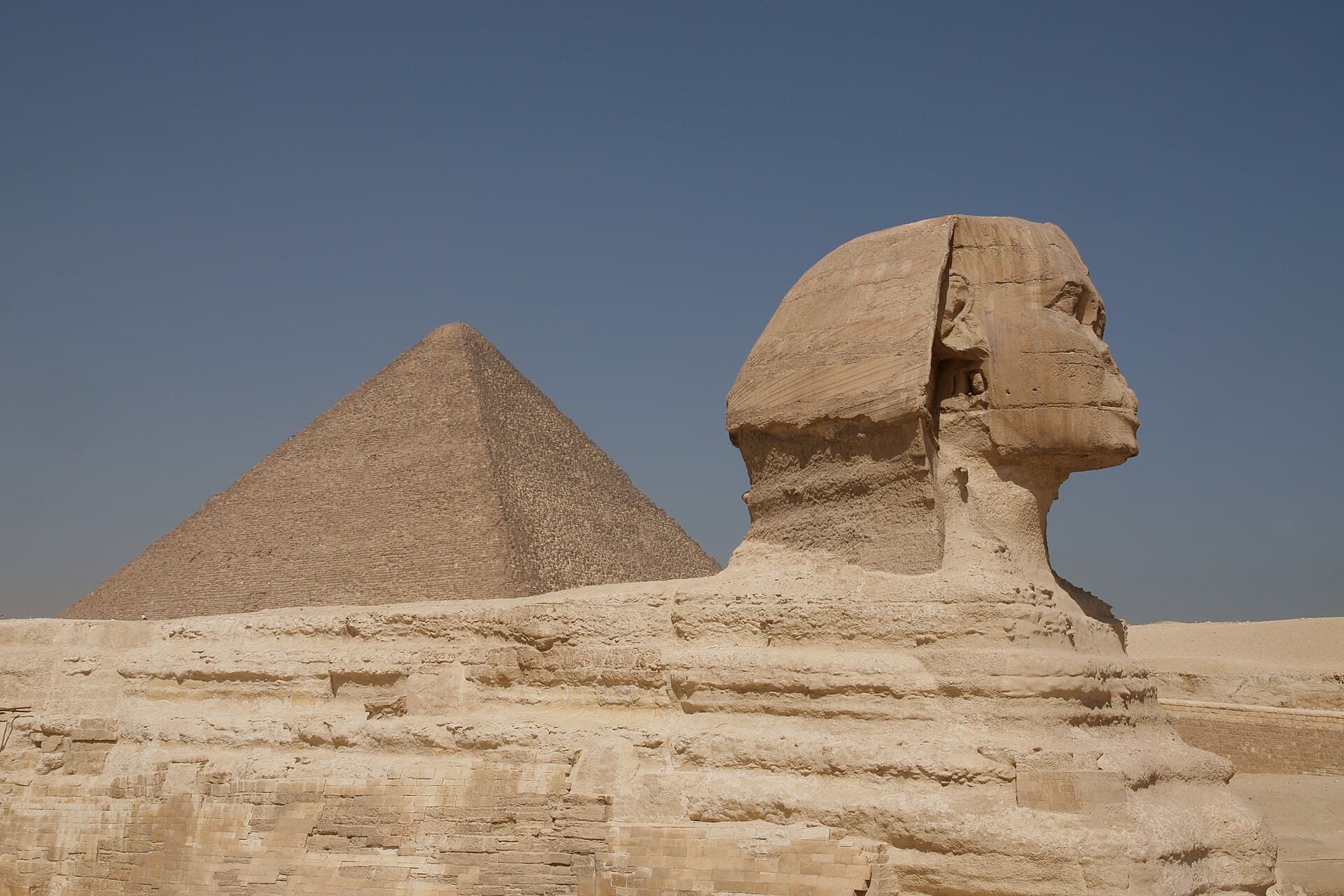
A dahabiya is rarely the whole holiday, because the sailing stretch is only two hundred kilometres of a much larger country. The common shape is Cairo first, for Giza and the Grand Egyptian Museum, then a flight south to Luxor, then the boat. That sequence works because the boat is the slow part and it is better placed after the sightseeing rather than before it.
Allow land days at both ends deliberately rather than by accident. Luxor's own sites, Karnak, Luxor Temple, the Valley of the Kings and the west bank, are not sailing days and deserve at least one full day of their own, ideally two. At the southern end, a hotel night in Aswan after the boat is the single best-value addition to a Nile trip: it buys an unhurried afternoon on the water, an evening on the corniche, and Abu Simbel without a four o'clock start pressed against a sailing schedule.
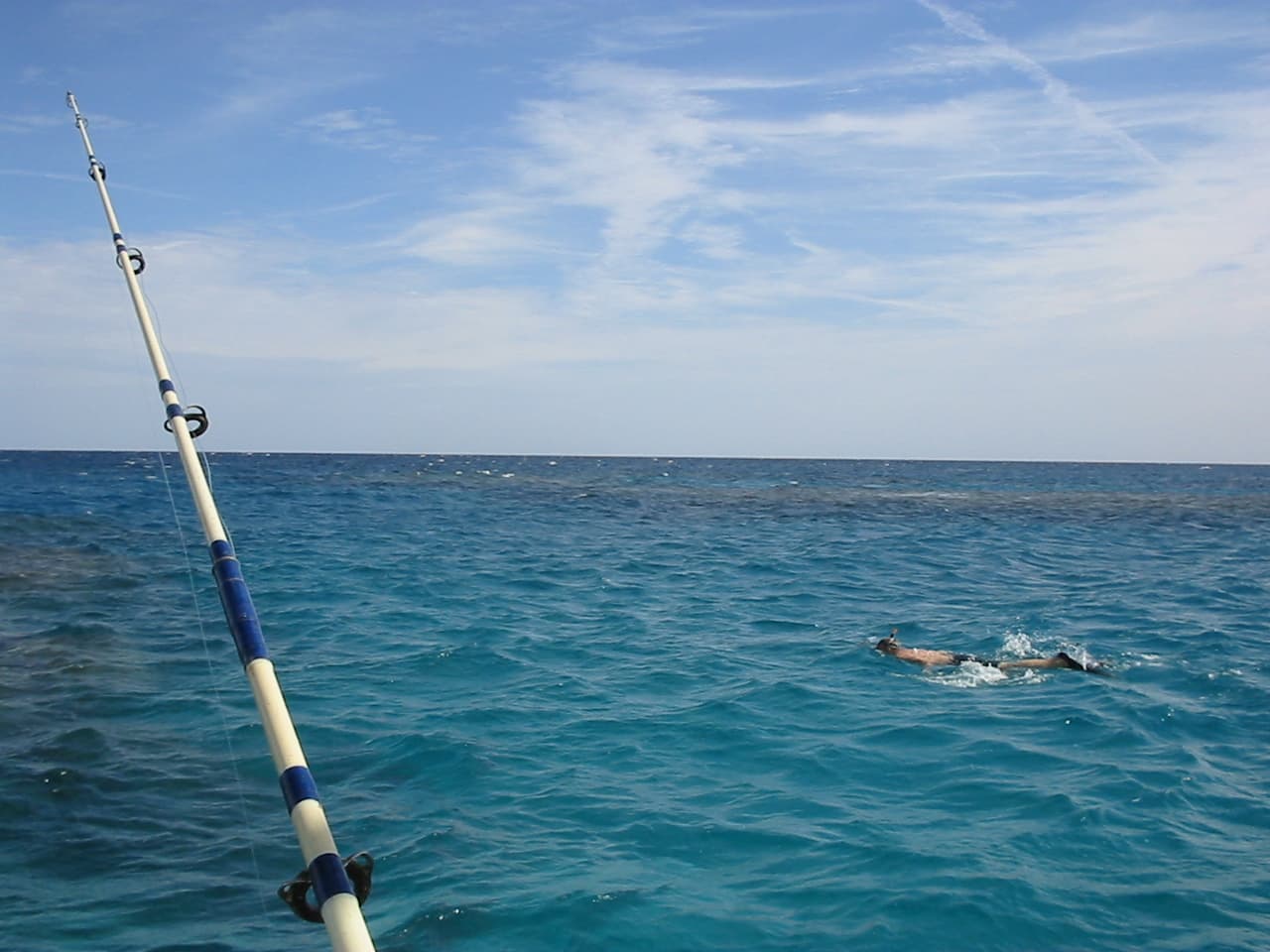
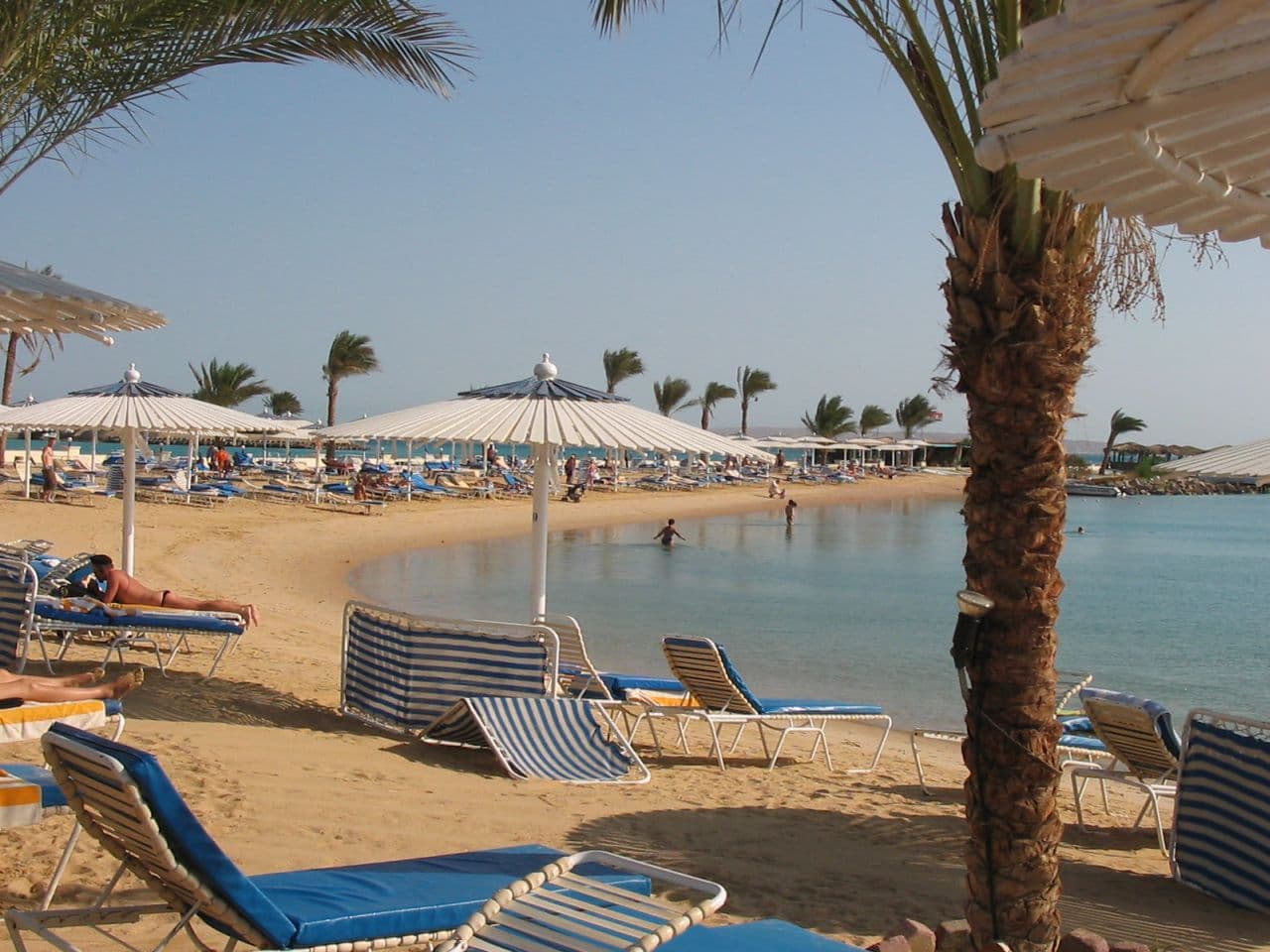
If the Nile is only half your plan, the usual partner is the Red Sea, which is about four hours by road from Luxor to Hurghada. That combination argues for finishing northbound in Luxor rather than southbound in Aswan, which is one of the few genuine reasons to prefer the northbound direction on a sailing boat. And Lake Nasser, south of the High Dam, is a separate trip on a different boat entirely rather than an extension of this one.
What to confirm with an operator before you book
Boats vary enormously, so check the details of the boat you are actually offered. These questions belong with the operator, not with us. Ask whether you are chartering the whole boat or booking a cabin alongside strangers, and how many guests are already booked on your dates. Find out how much of the route is expected under sail and how much under tow. Cabins differ too: window or porthole, which deck, and whether air conditioning runs overnight.
Then pin down the money and the plan. Confirm what the price covers, particularly site tickets, drinks, internal flights, transfers, and whether a guide travels with the boat or meets you at each temple. Confirm the direction of travel, which nights are on board, and what happens if wind or the lock queue costs you a day. Flag dietary needs and mobility limits early. One galley and one set of steps serve everybody.
Get the boat named in writing, and ask what happens if it changes. Substitutions do occur on the river, and the same category does not mean a similar week when the fleet is this small and the boats are this different from one another. Ask the same question about the guide, and about the number of guests, since a boat sold to you as intimate can fill up between deposit and departure.
We do not publish cabin counts, sailing dates, prices or facility lists for individual boats on this page, because we cannot verify them independently and a wrong number here would cost you money. Fleets change hands, get refitted and change what they include from one season to the next. Anything specific to a given boat and a given departure is checked against the operator at the point of enquiry, so the details you get are the ones in force for your dates rather than the ones printed last year.
Common questions
What does the word dahabiya mean?+
It comes from Arabic and is usually traced to a word meaning golden, after the gilded barges once used by Egypt's rulers. By the nineteenth century it described the sailing boats travellers hired for the Nile. You will see it spelled several ways in English, including dahabeya and dahabiyah. They all mean the same kind of boat.
Is a dahabiya better than a Nile cruise ship?+
Not better, different, and it is the wrong answer for plenty of people. You get quiet, few passengers and small moorings. You give up pace, facilities and a fixed timetable, and you pay more per night. If your priority is seeing as many temples as possible for as little as possible, a motorised ship does that job well.
Do these boats really sail, or are they towed?+
Both, and any honest answer includes the tug. The sails are real and used whenever the wind allows. When it drops, and it does drop, a small tug tows the boat so the route still works. How much towing you get depends on the season, the wind that week and the direction you are travelling. Ask what is typical on their route.
When is the best time of year to sail?+
Roughly October to April is the comfortable window. Summer in Luxor and Aswan is extreme, and a boat with open decks and limited air conditioning is a poor place to sit through it. The cooler months are busier and dearer. Winter days are pleasant on deck, but evenings on the water get genuinely cold, so pack something warm.
Can you take children on board?+
You can, but think it through first. Most boats have no pool, no club for children, and probably no other children unless you bring them. Older ones who are happy reading, swimming off a sandbank and eating with adults tend to do fine. Younger ones often do not. Taking the whole boat solves most of it, at a price.
How many nights does a dahabiya itinerary need?+
More than a motor cruise, because sailing is slower than an engine. Five nights is about the minimum that works on the Luxor to Aswan stretch and a week is the comfortable length, against three or four nights for a standard ship. Note that cruise nights are counted generously, with boarding around midday and departure after breakfast, so ask how many of those nights are full days.
What is the difference between a dahabiya and a felucca?+
Size and whether you sleep on it. A felucca is a small open lateen-rigged boat with no engine and no cabins, usually hired for two or three hours around the islands at Aswan. A dahabiya uses the same sailing principle at a larger scale, with cabins, bathrooms, a galley and a crew, for several nights on the river.
Which temples does a dahabiya visit that a cruise ship does not?+
The core temple list is the same either way: Esna, Edfu, Kom Ombo, with the Luxor and Aswan sites at each end. What a shallow hull adds is the places the large fleet cannot moor at, such as the rock-cut tombs at El Kab and the quarries at Gebel el-Silsila, plus sandbanks and village stops with nothing ancient attached. Dendera and Abydos are off the sailing stretch entirely and need a road day from Luxor.
Can you charter the whole boat?+
Yes, and on a vessel with five or six cabins it is a realistic option rather than a luxury fantasy. For two people it rarely makes sense. For a group of six or eight travelling together it can come close to what the same people would pay for cabins on a good ship, and it buys control over mealtimes, pace and the order of the sites, plus the absence of strangers.
Do dahabiyas have air conditioning and Wi-Fi?+
Air conditioning is common now but not universal, and on some boats it runs only at certain hours rather than continuously. Confirm it for the specific boat and specific cabin. Connectivity is a phone signal borrowed from the bank, so it comes and goes between towns, and there is no reliable Wi-Fi to plan around. Download what you want to read before you board.
Is a dahabiya suitable for someone with limited mobility?+
Usually not, and it is harder rather than easier than a large ship. Expect steep companionways instead of stairs, narrow side decks, no lift, and small tenders for getting ashore where there is no quay. The temple approaches are sand and uneven stone in any case. Raise it plainly before booking, and consider a larger ship or a land-based Luxor and Aswan trip instead.
Which direction should a sailing itinerary run?+
Southbound from Luxor to Aswan is the combination these boats were built for, working against the current but with the prevailing northerly wind, and it puts Abu Simbel conveniently at the end. Northbound has the current behind you and the wind against you, which tends to mean more time under tow, though it suits anyone carrying on to the Red Sea from Luxor afterwards. Ask what the operator expects on your dates.
Official sources
Entry rules, opening hours, security advice and exchange rates all move. Check them at the source, not here.
Written and checked by the Nile Trip Guide editorial team · Last reviewed . Entry rules, prices and opening hours change — check anything critical against the official sources linked on this page.
Plan this trip
Tell us your dates and we will price it
A real itinerary with real prices, usually within 24 hours. Nothing is booked and nothing is charged until you say yes.
The route most people take first, at the length it was built for: Giza and the Grand Egyptian Museum, then a flight to Luxor and four nights sailing down to Aswan.
No boat on this one. Giza and the Grand Egyptian Museum, a night in Luxor for both banks, two nights on the Red Sea, then back to Cairo for the Citadel, Coptic Cairo and the Royal Mummies.
Five nights in Cairo either side of a four-night sail from Luxor to Aswan. The Cairo days are private, just your party and a guide; the sightseeing off the boat is shared with a small group.