Best Time to Visit Egypt and Jordan: Every Month, Both Countries
The best time to visit Egypt and Jordan is not one season but twelve separate arguments, because the two countries only appear to share a calendar. Egypt sits low, along a river and a warm sea. Jordan sits high, and that single fact pulls the two apart by more in January than any brochure admits. This page takes the year one month at a time and says what each does on both sides of the trip.
How to read a two-country calendar
If you want the verdict without the working, we have a shorter page that gives it: October to April for both countries, with March, April, October and November as the four months that suit them equally. Everything below is the detail underneath that answer, written for anyone whose dates are already half fixed and who needs to know what a particular month will actually be like rather than which months are best in the abstract.
There is one structural idea to carry through the whole year. Egypt has an escape valve and Jordan does not. When the Nile valley becomes unusable in summer, the Red Sea is at its best, and an Egyptian holiday simply shifts its centre of gravity from temples to water. Jordan has no equivalent move. Petra and Wadi Rum are the trip, they are outdoors, and there is nowhere to go when they are cold, wet or baking. That asymmetry is why Jordan sets the calendar for a combined trip even though Egypt takes the larger share of the days.
The second thing to hold in mind is that the two countries fail in opposite directions. Egypt fails hot and Jordan fails cold, and they do it at the same time of year as each other in reverse. A January that is close to ideal in Aswan is the worst month of the year in Wadi Musa. A May that is perfectly comfortable in Petra has already put Luxor at 39C. There are only about four months where neither country is compromised, and the whole planning problem is that everyone else has worked that out too.
Egyptian numbers in this guide are typical daytime highs, with sea temperatures taken at Hurghada. They are long-run approximations rather than forecasts, and any given week can sit several degrees either side of them. We give no numbers for Jordan because we hold none of our own, and inventing a figure for Petra in February would be worse than describing it honestly without one.
January in Egypt and Jordan
January is the widest gap of the year between the two countries, and it is not close. In Egypt it is the coolest month and arguably the best one for the sites: Cairo around 19C, Luxor around 23C, which is walking weather for six hours rather than two. The Valley of the Kings at midday in January is bearable in a way it simply is not from April onwards, and Karnak can be done properly rather than in raids. The sea is the weak point at around 22C, swimmable but not warm, so a Red Sea tail on a January trip is a mild beach rather than a holiday in itself.
Jordan in January is a different country altogether. Petra sits at roughly 1,000 metres and Amman spreads across hills at roughly 800 to 1,000 metres, so nights fall to freezing or below, rain arrives in multi-day spells rather than showers, and snow reaches Petra in some years, occasionally in enough quantity to shut the site for a day. Heavy rain can also send flash floods through the Siq, and the site closes while that risk lasts. None of this stops the trip. It changes what the days are for.
Egypt is also at its most crowded and most expensive in January, so you are paying peak rates for the half of the trip that works and taking the weather risk on the half that does not. That is the January trade stated plainly. If your dates are fixed here, the sensible response is structural rather than optimistic: weight the fortnight towards Egypt, cut Jordan to three or four days covering Petra and one desert night, and build a spare half-day into the Jordanian leg so a closure has somewhere to go.
One date worth knowing. Coptic Christmas falls on 7 January rather than 25 December and is a public holiday in Egypt, so some sites keep shorter hours around it. It is a minor complication rather than a reason to move your dates, but it catches people who assume the Egyptian holiday sits where the Western one does.
February in Egypt and Jordan
February keeps almost all of January's Egyptian weather and loses the Christmas and New Year surcharge, which makes it one of the better-value months on the whole calendar. Cairo sits around 21C and Luxor around 25C, crowds are busy rather than very busy, and prices are high rather than peak. For a trip weighted towards temples and tombs, February in Egypt is close to the best combination of conditions and cost the year offers.
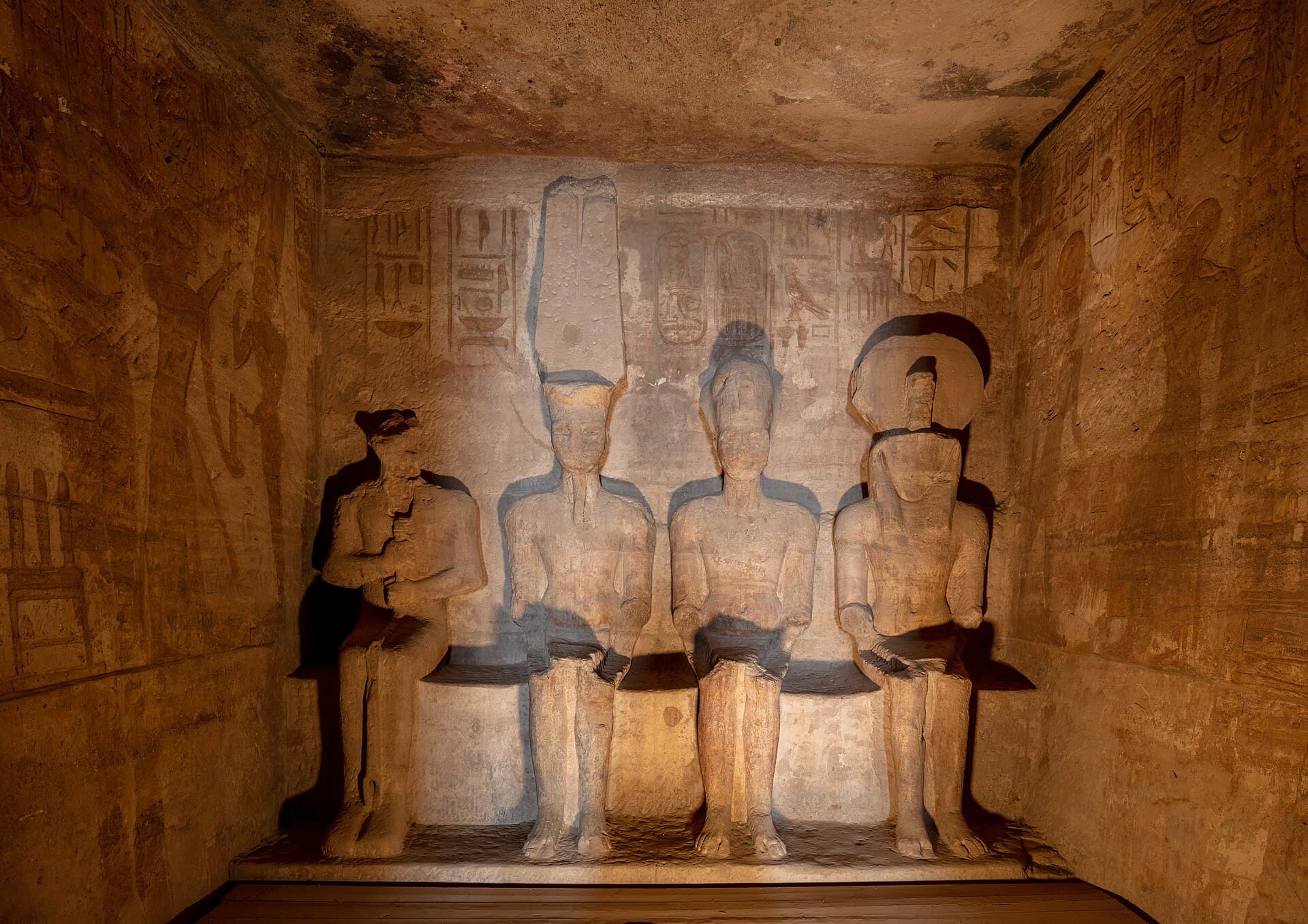
The one fixed date is the sun alignment at Abu Simbel, which falls around 22 February, when the rising sun reaches the inner sanctuary. It is genuinely worth seeing, it draws large crowds, and it requires a very early start from Aswan. If it appeals, it is a fair reason to fix the whole trip around a single morning, and Aswan accommodation needs booking well ahead for it.
Jordan in February is still winter and should be planned as such. The rain pattern is the same as January's, the nights at Petra are still cold, and snow is still possible. What changes is the direction of travel: by the last week the balance has started to tip, and a late-February trip is meaningfully more likely to get usable Jordanian days than an early-February one. If your dates are movable by ten days, move them later rather than earlier.
There is a pricing wrinkle in the middle of the month. European half-term traffic lifts Egyptian rates for a week or two around mid-February, so booking either side of it saves noticeably for identical weather. That is the sort of thing that only shows up when you compare two quotes a fortnight apart and wonder why they differ.
March in Egypt and Jordan
March is the best single month for doing both countries, and if you only read one section of this page, read this one. Luxor sits around 29C, which is warm enough to feel like a holiday and cool enough for a full morning on the west bank without tactics. Cairo is around 24C. Jordan has usually shaken off the worst of the winter rain, the hills turn briefly green, and Petra is comfortable in the middle of the day without being hot on the climbs.
The days are also lengthening rather than shortening, which matters more than people expect. Every winter month costs you usable hours on the Luxor west bank, where the sites are spread out and the light goes early. March gives them back. It is also the best month of the year for balloon flights over the west bank, which need calm mornings and get them more often now than at the shoulder edges, and for felucca sailing at Aswan, where the afternoons are warm and the wind is reliable.
The one genuine variable is the khamsin, a hot southerly wind off the desert that can blow for a day or two at a stretch from late March and carries enough sand to flatten visibility. Nobody can forecast it more than a day or two out, it very seldom costs you a whole trip, and it will quite happily cost you the pictures you came for. The response is to swap the day: an indoor one at the Grand Egyptian Museum, and the plateau tomorrow.
March's weakness is the sea, at around 23C. It is cool for swimming and cold for a lazy week on a lounger, so a March trip should be built around the sites in both countries rather than around a beach ending. If the holiday needs to finish horizontally, October does the same job with warmer water.
April in Egypt and Jordan
April is Jordan's best month and Egypt's crossover. Petra and Wadi Rum are as comfortable as they get, warm by day and cool but entirely sleepable at night, and the desert is at its best for both walking and camping. Egypt, meanwhile, is starting to turn: Cairo around 28C is pleasant, Luxor around 35C is still workable if you start early and stop by the middle of the day, and the Red Sea reaches around 25C, which is the first properly warm reading of the year.
That combination makes April the only month where all three elements of a big trip work at once: Jordan at its peak, Upper Egypt still manageable, and a sea you would actually swim in. If your idea of the fortnight is Petra, the Nile and a few days on the coast, April carries all of it where March and November each carry two parts out of three.
The catch is Easter, which moves year to year and takes prices and crowds with it. April looks like a shoulder month on paper and is not if Easter falls inside your dates, so check where it lands before assuming the logic of the quieter season applies. The khamsin remains possible into April as well, and Sham el-Nessim, the Egyptian spring festival, falls on the Monday after Coptic Easter and fills parks and riverbanks. It is a good day to be in a city rather than at a site.
By the last week of April the Egyptian half has begun to argue with you. Thirty-five degrees with no shade at Giza, Karnak or Abu Simbel is a different proposition at nine in the morning than at one in the afternoon, and any itinerary proposing a mid-morning departure for the Valley of the Kings at this point in the year is not doing you a favour.
May in Egypt and Jordan
May is the first month where the pairing stops being balanced. Jordan is fine, hot but perfectly workable, with Petra hard going only in the exposed sections beyond the Treasury and in the middle of the day. Upper Egypt is not fine. Luxor at around 39C with no shade in the Valley of the Kings is endurance rather than sightseeing, and the afternoon becomes indoor time whether you planned it or not. Cairo at around 32C is hot but far more bearable, with air-conditioned museums doing real work.
The Red Sea, by contrast, is excellent in May at around 27C, with reliable visibility and resorts at low-season prices. So the month splits cleanly: the water and the Jordanian sites are good, the Nile valley is hard. Crowds in Egypt are genuinely quiet and prices are low, which is the compensation on offer.
There is a way to use May rather than avoid it, and it involves inverting the usual split. Instead of eight or nine nights in Egypt against four or five in Jordan, give Jordan the full week it can absorb in good weather, keep the Egyptian leg short and dawn-based, and finish on the Red Sea rather than on the river. That is a different holiday from the standard fortnight, and in May it is a better one.
What does not work in May is the standard shape done stubbornly. A leisurely Nile itinerary with mid-morning starts, planned as though it were March, will lose you the middle of every day and leave you remembering the heat rather than the temples.
June in Egypt and Jordan
June is the bottom of the Egyptian market and it shows in the price of everything, from boats to hotels to guides. Luxor sits around 41C, Cairo around 34C, and crowds inland are as thin as they get all year. If budget is genuinely the deciding factor and you can organise every day around the heat, that is a real opportunity rather than a consolation.
It is not, however, a good month for the pairing. Jordan in June asks the same question in a slightly kinder way: Amman is hot but bearable in the shade, Petra at midday is not, and Wadi Rum is worse still. Both countries have now reduced themselves to a morning and an evening, which means a fortnight that was meant to contain fourteen days of sightseeing contains something closer to seven.
The Red Sea is close to ideal at around 29C, with long days and half-empty hotels, and this is where a June trip should put its weight if it happens at all. Wreck and reef diving has some of the best visibility of the year. A June trip built around the water with a short, dawn-based run at Cairo is a coherent holiday. A June trip built around Petra and the Nile is not.
Forty-one degrees is not a number to shrug at, and tombs are the specific problem rather than the open sites. They have no airflow and hold the heat long after the outside temperature starts to fall, so heat exhaustion in an Egyptian June is a practical risk rather than a theoretical one.
July in Egypt and Jordan
July is the worst month on this calendar for a two-country trip, and the reason is that both halves fail at once with nothing left to substitute. Luxor and Aswan sit around 41C with Cairo around 35C, and the Jordanian sites are hot in exactly the same shape: manageable early and late, punishing in between. There is no combination of the two that produces a normal holiday.
If your dates are fixed to a school summer, the honest advice is to stop trying to run the standard itinerary and restructure the trip entirely. That means a short, indoor-weighted Cairo leg using the Grand Egyptian Museum, the Coptic churches and the Citadel early or late, then the Red Sea for the bulk of the days, and Jordan cut to Petra done at opening time across two mornings rather than one long day. It is a workable holiday. It is not the fortnight the brochures describe.
There is one genuine upside on the Egyptian side. While the Red Sea resorts fill with European charter traffic in July, Luxor and Aswan are as empty as they ever get, and prices inland stay at their floor while prices on the coast rise. If you have a high tolerance for heat and a low tolerance for crowds, that trade is available and almost nobody is taking it.
The practical rule for July, in both countries, is that the schedule is the itinerary. A five o'clock alarm is not a hardship to be minimised, it is the mechanism by which the day works at all. Carry more water than feels sensible, treat shade as compulsory, and do not plan a July trip around a schedule you would have used in March.
August in Egypt and Jordan
August reads almost identically to July on the Egyptian thermometer, at around 41C in Luxor and 35C in Cairo, with one difference that matters: the sea reaches around 31C, which is the warmest of the year and close to bathwater. Some divers dislike it for exactly that reason. Snorkelling in it is a pleasure.
The August paradox on the Egyptian side is worth stating plainly, because it is the strongest argument anyone can make for travelling in the hot half of the year. The Red Sea resorts fill with European school-holiday traffic while Luxor and Aswan empty out almost completely. If solitude at the Valley of the Kings matters more to you than comfort, August gives you something that is not available at any price in January.
Jordan offers no such compensation. The country is hot everywhere that matters, Petra included, and unlike Egypt it has no second act to switch to. Aqaba is a short strip of coast rather than a coastline, and the Dead Sea in August is an afternoon rather than a destination. An August trip should therefore treat Jordan as two early mornings at Petra and not much else.
Alexandria is the other August move on the Egyptian side. It sits several degrees below Cairo and has a Mediterranean breeze, which makes it the one Egyptian city that behaves reasonably in high summer. As a day trip from Cairo it is roughly two and a half to three hours each way by road for a thin return, so if it appeals in August, give it a night rather than a day.
September in Egypt and Jordan
September is the loophole in this calendar, and the only month where you can buy near-October conditions at August prices. Luxor comes down to around 38C, Cairo to around 32C, the sea holds around 30C, and crowds are moderate rather than heavy, while rates on both sides of the trip are largely still at summer levels. The market has not repriced yet.
The important detail is that the two halves of the month are not the same month. The first half of September is still genuinely demanding in Upper Egypt. The last ten days are noticeably better. If your dates are movable at all, push them as late in the month as they will go, because the difference between the 5th and the 25th is larger than the difference between the 25th and mid-October.
Jordan arrives at the same conclusion from the other direction. Late September is when the Jordanian autumn starts: dry, clear and progressively cooler, with Petra warm in the middle of the day and pleasant by evening. So the final week of September is the one stretch of the year where both countries are improving at the same time and nobody has raised the price yet.
The risk you accept is that it is a shoulder edge rather than a guarantee. A hot spell in the third week of September will leave Luxor closer to its August self than its October self, and there is no refund for that. September is the value bet on this page, and like any value bet it is priced low for a reason.
October in Egypt and Jordan
October is March's counterpart and its near equal, with one clear advantage. Luxor drops to a manageable 34C, Cairo to around 29C, and the sea holds around 28C, which is warm enough that a Red Sea ending is a genuine part of the holiday rather than a token one. Jordan is dry and clear, warm through the middle of the day at Petra and cool enough for a jacket by evening, with Wadi Rum nights comfortable rather than cold.
That makes October the best month of the year for a trip that wants all three things at once and would rather have warm water than the very coolest temple weather. If your fortnight ends on a beach, October beats March. If it ends at Abu Simbel, March beats October.
The second Abu Simbel sun alignment falls around 22 October and draws the same crowds and the same very early start from Aswan as the February one. It is the only fixed date in the Egyptian calendar worth building an itinerary around, and it lands in a month that is already among the best two.
October's pricing climbs steadily through the month as the season starts, so the first half is usually better value than the second for essentially identical weather. Booking an early-October departure rather than a late-October one is one of the few free choices on this page: the same conditions, less money, and marginally fewer people.
November in Egypt and Jordan
November is the month where nothing in Egypt is a compromise. Luxor at around 28C is close to perfect for long temple days, Cairo at around 24C is genuinely pleasant for walking Islamic Cairo and the bazaar, and at around 26C the sea is still properly swimmable without being warm. It is firmly high season by now, busy and priced high, though below the December and January peak.
The one Egyptian cost is daylight. November days are short, and on the Luxor west bank that translates directly into fewer usable hours at the Valley of the Kings and the surrounding temples. This is the month where an early start buys you a site rather than just a quieter version of it, and where assuming a long afternoon is the mistake.
Jordan in November is a month of two halves, and the halves point in opposite directions. Early November is still autumn: dry, clear and comfortable, with cool evenings. By late November the evenings need more than a jacket, the nights in Wadi Rum are cold, and the winter rain pattern has begun. Late November is the quieter edge of good weather rather than good weather itself.
The planning consequence is that November rewards precision more than any other month on this page. A departure in the first ten days catches both countries near their best with slightly thinner crowds than October. A departure in the last ten days catches Egypt at its best and Jordan already turning, which is a perfectly good trip provided you have packed for it and not for the country you saw in the photographs.
December in Egypt and Jordan
December gives Egypt the best temple weather of the year and charges the most for it. Luxor around 24C and Cairo around 20C is close to ideal for walking sites all day, crowds are at their heaviest, and prices are at their absolute peak, with Christmas and New Year the most expensive fortnight of the Egyptian year by a clear margin. The sea drops to around 23C, so the coast is a mild addition rather than a reason to go.
Jordan is at its least cooperative at exactly the same time. Cold, wet, and with the same freezing nights and possible snow at Petra as January. That combination, peak Egyptian pricing plus poor Jordanian conditions, makes the Christmas and New Year fortnight the single worst value on this entire calendar for a two-country trip. It is also one of the most requested, which is why the better Nile boats for it are gone by early autumn.
Evenings are the practical failure point in December and the mistake is always the same one. People pack for a hot country and then spend the evenings cold: on the deck of a Nile boat after sunset, in the Western Desert where it can approach freezing at night, and in everything in Jordan above the Dead Sea and Aqaba. A proper jacket rather than a light layer is the fix, and it is not optional.
If your dates are fixed to December, the shape that works is Egypt-heavy and short on Jordan, booked four to six months out, with the Jordanian leg reduced to Petra across two mornings and one desert night in a camp whose heating you have confirmed in writing. Done that way it is a very good trip. Done as an even fourteen-day split, it is the most expensive way to be cold.
Where the two countries disagree, and by how much
The disagreement is almost entirely about altitude, and it runs in one direction for half the year and the other direction for the rest. Egypt's headline sites sit low: the Nile valley, the Giza plateau, the Red Sea coast. Jordan's sit high: Amman across hills at roughly 800 to 1,000 metres, Petra at around 1,000 metres, and Wadi Rum as desert at altitude. Every month is cooler in Jordan than in Egypt, and the gap widens sharply after dark.
From November to March that is Jordan's problem. Aswan in January is close to the best sightseeing weather anywhere in the region, while Wadi Musa in the same week can be near freezing overnight with multi-day rain and an outside chance of snow. From May to September the same altitude works in Jordan's favour: a July evening in Amman is more pleasant than a July evening in Luxor even when the daytime numbers are not far apart.
Rain is the second dividing line and it is more absolute than the temperature one. Egypt barely has weather in the ordinary sense, with Cairo averaging only around 20mm of rain a year and Luxor and Aswan capable of going years without meaningful rain. Jordan genuinely has weather between November and March, and it arrives in bursts rather than steadily. Planning a combined trip therefore means reading one country's forecast and largely ignoring the other's.
There is one Egyptian weather risk that mirrors Jordan's, and it is worth respecting precisely because the country has so little rain. Rare heavy storms can send flash floods through desert wadis, which is why desert excursions are occasionally rerouted or postponed at short notice in winter. It is uncommon. It is also the one thing on the Egyptian side that behaves like Jordanian weather.
What the shoulder seasons actually buy you
There are three shoulder edges on this calendar and they are not equivalent. The last ten days of September buy you the biggest discount for the smallest compromise, because the weather has started to improve and the price has not caught up. The first half of October buys you peak-season conditions at a price that has only partly climbed. Late November and very early March buy you the same weather as the four best months with slightly thinner crowds and no saving worth mentioning.
The thing all three have in common is that they are edges rather than seasons, which means the variance around them is higher. A cool week in late September behaves like October and a hot one behaves like August, and you find out which you got on arrival. The four core months are more expensive partly because they are more predictable, and predictability is worth paying for on a trip with an internal flight, a boat with a sailing date and a fortnight of fixed bookings behind it.
May is the fourth candidate and it is the one that does not really work as a shoulder month for a combined trip, whatever the pricing suggests. Jordan is comfortable and cheap, Upper Egypt is at 39C, and there is no way to average those two into a balanced fortnight. May is a good month for a Jordan trip with a Red Sea ending. It is a poor month for a Nile-led one.
Easter is the trap that undoes shoulder-season logic entirely. It moves year to year, it drags prices and crowds with it, and it usually lands in April, which otherwise looks like one of the quieter good months on paper. Check where it falls before you assume anything about April pricing.
How Ramadan moves through this calendar
Ramadan shifts about eleven days earlier each year, so it drifts steadily through the good season rather than sitting in a fixed part of it. That means the answer to whether it affects your trip depends entirely on your year, and it is worth checking your specific dates rather than carrying forward whatever you heard about someone else's trip.
The practical effect is smaller than most people fear. Sites stay open, sometimes on shorter hours, and trips run normally in both countries. What changes is the rhythm of the day around you: restaurant hours shift, traffic before sunset is noticeably worse in the cities, and the pace of everything slows through the afternoon. Evenings are genuinely good, and in both countries they are the most interesting time to be out.
If your trip is built around efficient sightseeing with fixed timings, a set of dates either side of Ramadan will be frictionless in a way that dates inside it will not. If your trip has any interest in the countries as places rather than as collections of monuments, travelling during Ramadan is a reasonable choice and occasionally a better one.
The two other calendar items worth checking are both Egyptian and both minor. Coptic Christmas on 7 January is a public holiday with some shortened site hours, and Sham el-Nessim, the spring festival on the Monday after Coptic Easter, fills the parks and riverbanks for a day. Neither is a reason to move dates. Both are a reason not to schedule a long site day on top of them.
The single best window for doing both
The first three weeks of March, narrowly, with the first half of October as the runner-up. March gives Luxor at around 29C, Jordan out of the winter rain, lengthening days, calm mornings for balloon flights, and reliable wind for a felucca at Aswan. Cutting it at the third week keeps you clear of the khamsin, which becomes a possibility from late March, and of the Easter effect when Easter falls early.
October wins on two specific counts and loses on two others. It wins on the sea, at around 28C against March's 23C, and on the sun alignment at Abu Simbel around the 22nd. It loses on temperature inland, at around 34C in Luxor against 29C, and on the direction of the year, because November and December get shorter and cooler where April and May get longer and hotter. Which of those matters more is a question about your itinerary, not about the weather.
If you cannot travel in either, take early November over late April. Both are good. November is the more reliable of the two because it has no khamsin risk, no moving Easter, and no gamble on where in the month the heat turns. What it costs you is daylight, which is a known quantity you can plan around rather than a variable you cannot.
The thing this window cannot buy you is solitude. March, April, October and November are the months everyone else has worked out, so Petra's Siq, the Valley of the Kings and Abu Simbel are busy from opening time and the better Nile boats and hotels go early. Being at the gate when it opens is worth more in these months than picking a clever week.
How the month changes the shape and length of the itinerary
Twelve to sixteen days is the honest range for both countries done properly, and the standard split is eight or nine nights in Egypt against four or five in Jordan, with a whole day surrendered to the Cairo to Amman connection. Cairo and Amman are roughly an hour and a half apart in the air with several departures a day, and Queen Alia airport is about 45 minutes from central Amman, so that connection day is a real day rather than a transfer.
That split holds in the four good months. In deep winter it should bend towards Egypt: three or four days in Jordan covering Petra and one desert night, with the time you would have spent on slower outdoor days better used on the Nile, where the weather is on your side. The two Jordanian places that stay warm are the Dead Sea, several hundred metres below sea level, and Aqaba on the Red Sea, so a winter trip that wants any warmth at all on the Jordanian side should end at one of them.
In April and May the split can bend the other way, because Jordan is comfortable enough to justify a full week: two days at Petra, a night in Wadi Rum, Jerash from Amman and a Dead Sea afternoon. The driving is short enough that extra days turn into extra time at the sites rather than extra time in a vehicle: roughly three hours from Amman down to Petra, and about an hour and a half on from there to Wadi Rum.
Two things do not change with the month. Egypt goes first, because it is the harder half with the early starts, the internal flight and the persistent selling around the monuments, and Jordan is the calmer second act. And a one-day Petra ticket is false economy in every month of the year, because the site is at its best early and late and a single day gives you the crowded middle instead. Petra by Night runs only on certain evenings rather than nightly, so check the current schedule against your dates before fixing them.
What the month does to the price
Our own Egyptian itineraries give a usable anchor for the Egyptian half, and they are real prices from a real operator: per person, in US dollars, land only, before international flights. The four-day Nile cruise from Aswan to Luxor starts at US$840, the five-day Cairo short break at US$935, the five-day Luxor to Aswan cruise at US$1,095, the seven-day Cairo and cruise at US$1,890, the ten-day Cairo and Nile cruise at US$2,635, and the sixteen-day Grand Tour of Egypt at US$3,910.
Those are from-prices, and the spread inside a single itinerary is wider than most people expect. The same ten-day Cairo and Nile cruise runs from US$2,635 to US$4,970 depending on the hotel and boat standard you choose. That range is larger than the seasonal swing on any one of them, which is the useful fact buried in the numbers: what you sleep in moves the price more than when you travel.
Season still moves it, and it moves it in the direction you would expect on the Nile and the opposite direction on the coast. Nile boats are cheapest in high summer and dearest from December to February, when the sightseeing is at its best. Red Sea resorts rise in July and August with European school-holiday traffic while Luxor and Aswan sit at their floor. In August the two halves of the Egyptian price list are moving in opposite directions at the same time.
Then the costs that sit outside the quoted figure entirely, because they catch people in every month. Tipping in Egypt is a genuine budget line rather than loose change, at roughly US$10 to 15 per person per day for a guide and about US$5 a day for the driver, with another US$5 to 10 per person per night into the communal crew box on a cruise. The Jordanian half is quoted from an enquiry rather than sold as a packaged product, and the Jordan Pass has to be bought online before you arrive, since it cannot be bought at the border and its visa waiver carries a minimum-stay condition.
How far ahead to book, month by month
For December and January, four to six months is not excessive, and the Christmas fortnight needs more. The constraint is supply rather than price: the smaller and better Nile boats sell out first, and what remains late is worse rather than cheaper. Winter is the one part of an Egypt trip where booking late costs you quality.
For November, March and April, two to three months usually leaves you a real choice rather than a set of leftovers. For May and September, a few weeks is often enough and you will still be choosing. For June to August, close-in booking is entirely normal on the Nile and inland, though Red Sea resorts in July and August behave like a peak season of their own and need more notice.
The Jordanian half is generally less time-critical than the Egyptian one, because the country is compact and the road transfers are short. The exceptions are the better Wadi Rum camps in spring and autumn, Petra accommodation over the peak fortnight, and the Jordan Pass, which is a deadline rather than a booking and catches people who leave Jordan until last.
One more piece of timing that is not about weather. Fly into one country and out of the other, Cairo in and Amman out or the reverse. It is usually cheaper than two returns and it removes a repositioning flight from the middle of the trip, which in a compressed month is the difference between a spare morning and a lost one.
Who should ignore this calendar entirely
Divers first. The Red Sea is good all year and best in the months this page otherwise warns you off, with water at around 29C in June, 30C in July, 31C in August and still 30C in September, against empty resorts and prices at their floor. A diving-led trip should be planned around the water rather than the temples, and it should probably be a single-country Egypt trip rather than half of a pair.
People who came for empty rooms rather than comfortable ones, second. August in Luxor and Aswan is as empty as Egypt ever gets, and there is no month and no price at which January offers the same thing. If solitude at the Valley of the Kings is what you are actually buying, the hot months are the only place to buy it.
Anyone whose dates are set by work or school, third. A July trip planned honestly, with dawn starts, an indoor-weighted Cairo leg and the Red Sea carrying the back half, is a better holiday than a March trip that never happens. This calendar exists to optimise a choice, not to disqualify the fortnight you actually have.
The one combination nobody should take on is a first trip to both countries in high summer with young children, run to a normal itinerary. That is where the heat stops being an inconvenience and starts dictating the holiday, and it is the single most reliable way to come home having seen less than you paid for.
Common questions
What is the single best month to visit Egypt and Jordan together?+
March, narrowly, and ideally its first three weeks. Luxor sits at around 29C, Jordan has usually shaken off the worst of the winter rain, and the days are lengthening rather than shortening. October is its near equal and has the better sea at around 28C against March's 23C, which decides it if your trip ends on a beach rather than at a temple.
Which months should we avoid for a combined trip?+
June, July and August, because both countries fail at the same time and neither has anything to substitute. Luxor and Aswan sit around 41C and Petra at midday is not a sightseeing proposition. December's Christmas and New Year fortnight is the other one to avoid, not for the weather in Egypt, which is excellent, but because it pairs peak Egyptian prices with a cold and possibly wet Jordan.
Is Jordan really that much colder than Egypt in winter?+
Yes, and altitude is the whole reason. Petra sits at roughly 1,000 metres and Amman spreads across hills at roughly 800 to 1,000 metres, so winter nights fall to freezing or below and rain arrives in multi-day spells. Egypt at the same time is merely pleasant, with Cairo in the high teens and Luxor in the mid-twenties, cold only after dark.
Can Petra actually close because of the weather?+
It can. Heavy rain between November and March can send flash floods through the Siq, and the site closes while that risk lasts. Closures are usually measured in hours rather than days and snow has occasionally shut it for a day, but they are unpredictable enough that a winter itinerary should carry a spare half-day somewhere in the Jordanian leg.
Is September genuinely good value, or is that just marketing?+
It is genuine, with a caveat about which half of the month you take. Luxor comes down to around 38C and the sea holds around 30C while rates largely sit at summer levels, so the last ten days buy close to October conditions at August prices. The first half of September is still demanding inland, and a hot spell can leave any September week behaving like August.
How does Ramadan affect the trip, and when does it fall?+
It moves about eleven days earlier each year, so it drifts through the good season and you need to check your own dates rather than a general rule. The effect is smaller than most people fear: sites stay open, sometimes on shorter hours, restaurant hours change and city traffic before sunset is bad. Evenings are genuinely good. Dates either side of it are more frictionless for pure sightseeing.
Does the month change how many days we need?+
It changes the split rather than the total. Twelve to sixteen days covers both countries properly in any season, but in deep winter Jordan should shrink to three or four days around Petra and one desert night, with the time moved to the Nile. In April and May Jordan can absorb a full week, because Petra, Wadi Rum, Jerash and the Dead Sea are all comfortable and the road transfers between them are short.
If we can only travel in December, what should we change?+
Weight the fortnight heavily towards Egypt, where December gives the best temple weather of the year at around 24C in Luxor, and cut Jordan to Petra across two mornings and one desert night. Book four to six months ahead, because the better Nile boats for that fortnight go by early autumn, and confirm in writing what heating your Wadi Rum camp has before you commit to a winter night out there.
Is a Red Sea ending worth adding, and in which months?+
It depends entirely on the month rather than on the idea. The water sits at around 22C in January and February, which is swimmable but not warm, reaches around 25C in April and around 28C in October, and peaks at around 31C in August. October and April are the two months where a Red Sea leg genuinely earns its days on a two-country trip. In midwinter it is a mild beach rather than a warm one.
Official sources
Entry rules, opening hours, security advice and exchange rates all move. Check them at the source, not here.
Written and checked by the Nile Trip Guide editorial team · Last reviewed . Entry rules, prices and opening hours change — check anything critical against the official sources linked on this page.
Plan this trip
Tell us your dates and we will price it
A real itinerary with real prices, usually within 24 hours. Nothing is booked and nothing is charged until you say yes.
The route most people take first, at the length it was built for: Giza and the Grand Egyptian Museum, then a flight to Luxor and four nights sailing down to Aswan.
No boat on this one. Giza and the Grand Egyptian Museum, a night in Luxor for both banks, two nights on the Red Sea, then back to Cairo for the Citadel, Coptic Cairo and the Royal Mummies.
Five nights in Cairo either side of a four-night sail from Luxor to Aswan. The Cairo days are private, just your party and a guide; the sightseeing off the boat is shared with a small group.