Things to Do in Cairo, Egypt: Ranked, With What to Skip
This is a ranked list of things to do in Cairo, Egypt, the capital on the Nile beside the Giza pyramids, and not Cairo, Illinois. Most round-ups name the same eight sites without saying which of them deserve a morning and which deserve twenty minutes. This one puts them in the order we would actually do them, explains what the heat and the traffic really cost you, and says plainly where a famous name is not worth the day it takes.
First, the obvious: this is Cairo in Egypt, on the Nile
There is a Cairo in Illinois, at the point where the Ohio river meets the Mississippi, and a search for things to do in Cairo turns it up often enough that it is worth clearing away in the first paragraph. Everything on this page is about the Egyptian capital: roughly twenty million people in the greater urban area, the Nile running through the middle of it, the Giza pyramid plateau on its western edge where the buildings stop and the desert starts.
Greater Cairo is several cities that grew into each other, and knowing the shape of it saves you hours. The Nile runs north through the centre with the long island of Gezira in it, and Zamalek is the leafy district on the island's northern half. On the west bank is Giza, a separate governorate in law and a continuous suburb in practice, with the pyramids and the Grand Egyptian Museum at its far edge. On the east bank is downtown, laid out in the nineteenth century on a Parisian plan around Tahrir Square.
East and south of downtown lies Islamic Cairo, the medieval city, still walled in places and dense with mosques from the ninth century onwards. South again, Coptic Cairo sits inside the walls of a Roman fort and holds the oldest churches in the city. Heliopolis, north-east and close to the airport, is a planned suburb from the 1900s that feels nothing like the rest. Our fuller Cairo travel guide covers the districts in more detail; what matters for a list of things to do is that they sit on two different banks, and that crossing between them costs you time rather than distance.
One warning before the list. Almost every disappointment we hear about Cairo comes from the same cause: too many good sites seen too fast, in the wrong heat, in the wrong order, until they run together into one hot morning. The order below is the order we would take them in, and the reasoning for each position is given rather than asserted.
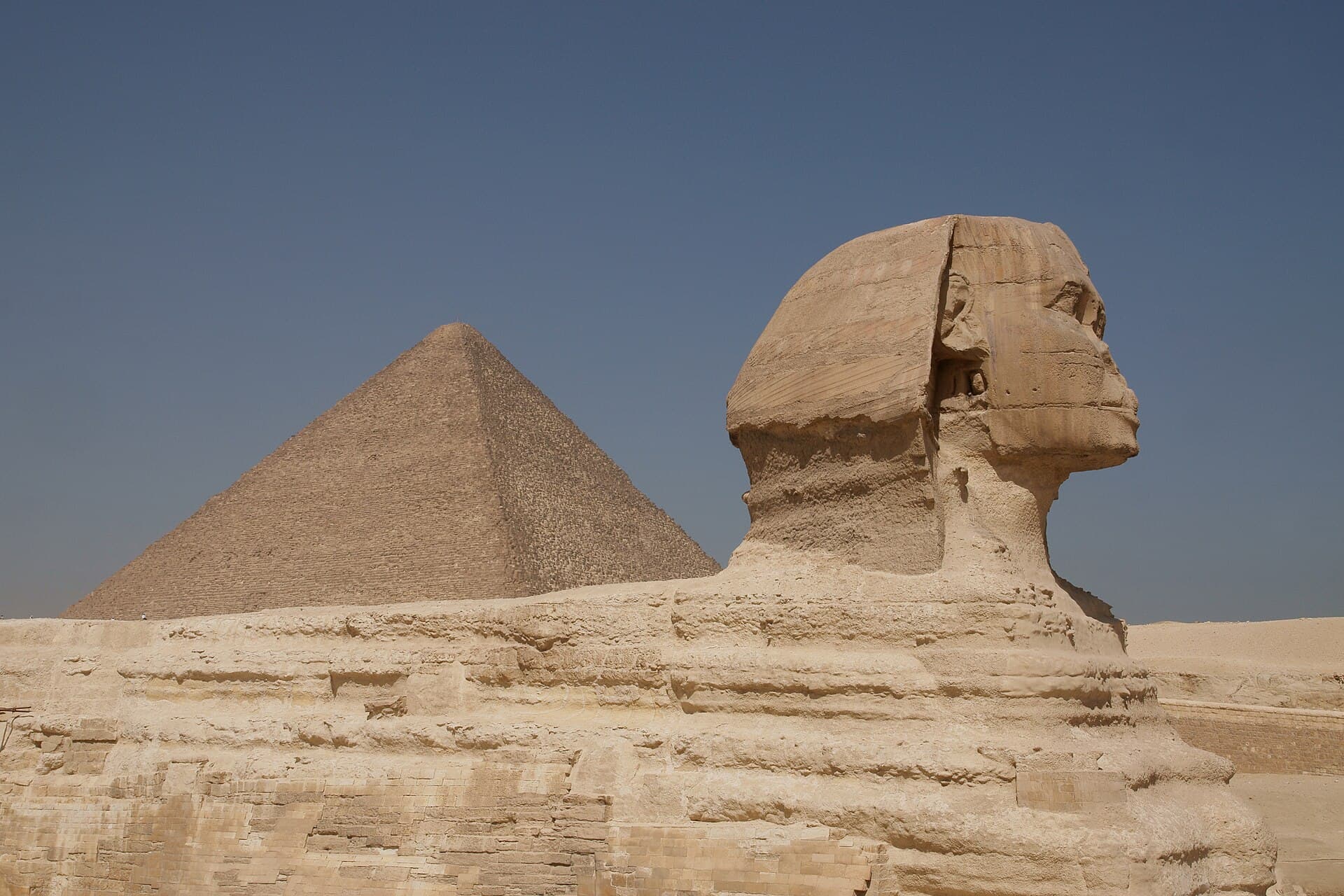
1. The Pyramids of Giza and the Sphinx, at opening and not a minute later
This is the reason most people come, and the single decision that changes the day is the hour you arrive. Go at opening. The plateau gets hot, there is no shade anywhere, and the coach groups land mid-morning. From May to September the site is punishing by late morning; October to April is the comfortable window, and December and January are cool enough to want a jacket at dawn. If you take one piece of advice from this page, take that one.
What is actually up there is three large pyramids built for Khufu, Khafre and Menkaure, a scatter of much smaller subsidiary pyramids, the Sphinx, several temples and a field of mastaba tombs. The site is well over a kilometre end to end and mostly uphill on sand and broken rock, and people routinely underestimate the walking. Khafre's pyramid looks taller than Khufu's because it stands on higher ground, and it keeps a cap of original casing stone near the summit which is the best thing on the plateau for understanding what these buildings once looked like: smooth, pale and reflective, nothing like the rough stepped mass you see now.
Going inside the Great Pyramid costs a separate ticket and, for most people, is a false economy. You get a long, low, sloping passage where you shuffle bent double, then the Grand Gallery, then a bare granite room with a lidless stone sarcophagus in it. No decoration, no inscriptions, no treasure, and air that is hot, humid and heavy with other people's breath. The Grand Gallery is the part that justifies it if anything does. Skip it if you are claustrophobic, and know that the second and third pyramids are usually far quieter and deliver much the same experience with less queueing. Which interiors are open rotates for conservation and is not published in a form you can rely on from abroad, so ask at the ticket office and buy everything you want at once. Our Pyramids of Giza guide goes through the mechanics in full.
The Great Sphinx needs twenty to thirty minutes, or an hour with the valley temple included, and it is smaller than most people expect because it sits in a pit rather than on a plinth. It faces due east, so the first two hours after opening put flat morning sun on the face and by mid-afternoon you are shooting into the sun at a face in its own shadow. Most itineraries do it first because it is nearest the lower gate, which delivers you to the busiest corner of the plateau at the busiest moment. Either go straight to it at opening or leave it until the pyramids are behind you. On the way, walk slowly through the Valley Temple rather than crossing it in thirty seconds: granite, alabaster, huge polished piers, and the best-preserved Old Kingdom building on the site.
2. The Grand Egyptian Museum, and why an hour there is wasted money
The Grand Egyptian Museum stands on the desert edge at Giza, roughly two kilometres from the pyramids, and opened fully in November 2025 after more than two decades of building. The headline is the Tutankhamun material: the complete find from the tomb, roughly five thousand objects, shown together for the first time since Carter's team cleared it between 1922 and the early 1930s. The old museum on Tahrir Square only ever displayed a selection. Here you get the chariots, the beds, the shrines, the linen and the walking sticks alongside the gold, and the assemblage tells you far more about the burial than the mask alone.
Four hours is the floor and a full day is right if you read the labels. This is a very large building on a very large plaza and the internal distances are of a different order to a normal city museum. The grand staircase climbs the full height of the building lined with royal statuary, towards a window onto the pyramids, and visitors who take the lift arrive at the galleries without having been walked up through the collection and then wonder why the sequence feels arbitrary. It is not arbitrary; they skipped the argument.
The pairing question comes up constantly, and the answer is that Giza and the museum work in the same day only in the right order: the plateau at opening for two to three hours, then the museum through the middle of the day, when the heat outside is at its worst and the air conditioning indoors becomes the point. They are separate sites with separate entrances, separate tickets and separate opening patterns, whatever their proximity suggests, and there is no combined ticket. Budget the transfer honestly too: minutes on a map, longer once you have found a car and cleared the plateau exit.
Two absences catch people out and are worth knowing before you go. The royal mummies are not here, having moved to the National Museum of Egyptian Civilisation at Fustat in 2021, and Tutankhamun's own mummy is not here either, since it stays in his tomb in the Valley of the Kings. We print no prices or opening hours on this page, deliberately: ticket categories in Egypt change, premium elements are added and removed, and a figure that is right when written is wrong within the year. Our Grand Egyptian Museum guide sets out what is in each gallery.
3. Saqqara and Dahshur: the pyramid day most visitors never take
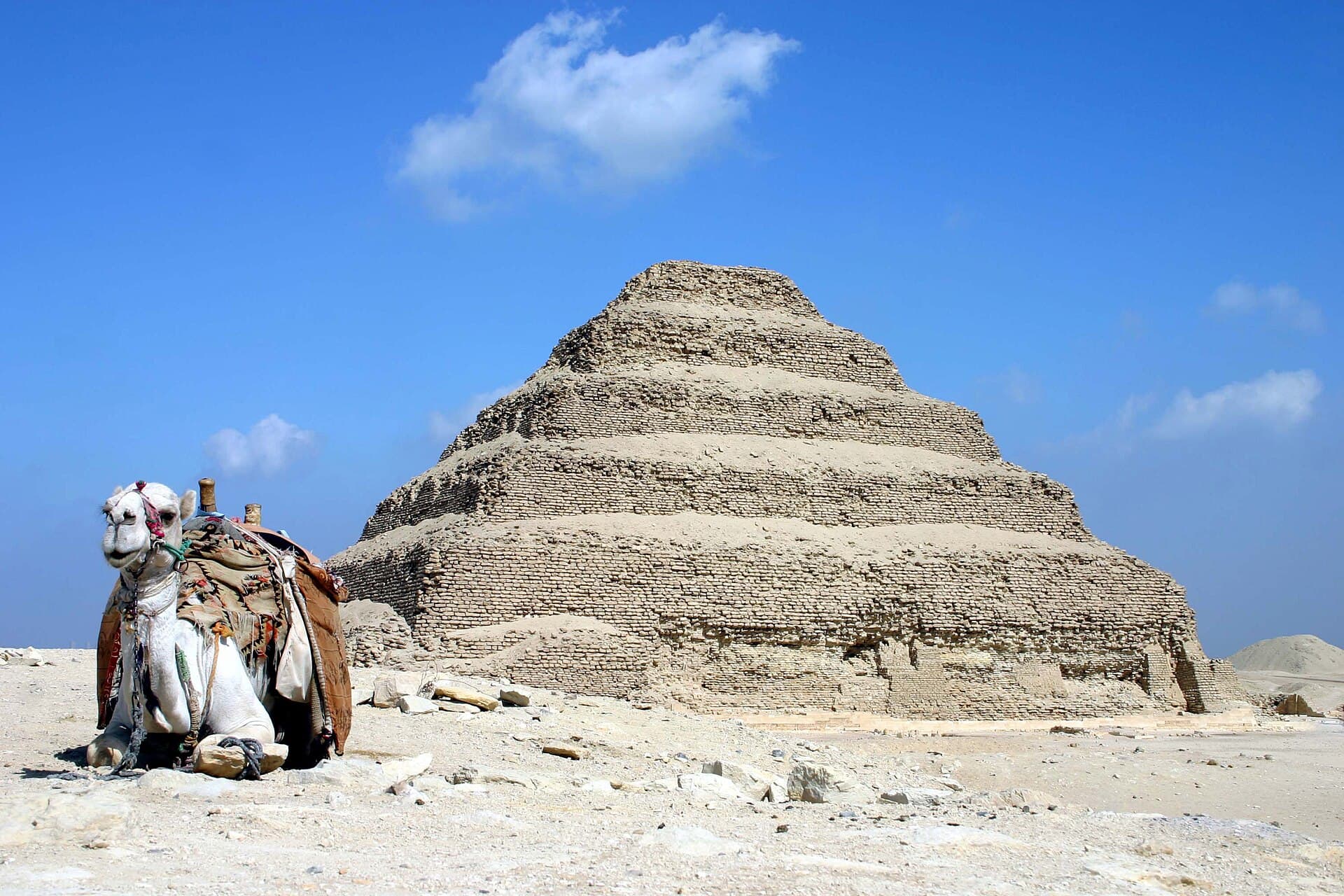
If you have a third day in Cairo, spend it south rather than in another museum. Saqqara sits about 30 kilometres south of central Cairo on a desert ridge above the palm belt, and it is the burial ground of ancient Memphis. Djoser's Step Pyramid at its centre, built around 2650 BC, is generally regarded as the earliest large stone building in the world and predates the Great Pyramid by roughly a century. Absolute dates this early are estimates and specialists differ by a century either way, which is worth knowing when a guide states one flatly.
The Step Pyramid is not the reason to go, though. The reason is the mastaba tombs of Old Kingdom officials around it, cut with painted reliefs of hunting, farming, butchery and boat-building, close enough to touch and far better preserved than anything on the Giza plateau. Saqqara is a necropolis several kilometres long that was used for more than three thousand years, so you cannot walk it end to end; vehicles move between the clusters and a visit means choosing which tombs to enter. Anyone who tells you they did Saqqara in ninety minutes saw the Step Pyramid from a distance and left. Our Saqqara guide names the tombs worth the extra ticket.
Dahshur is another twenty minutes south and usually near-empty. Sneferu, Khufu's father, built two pyramids here. The Bent Pyramid is the one that visibly went wrong: the lower courses rise steeply, the upper courses are noticeably shallower, and a visible kink runs right round the building. The usual reading is that the design was failing and the angle was reduced to take weight out of the upper part, though nobody has the site foreman's notes. Published figures put the lower slope near 54 degrees and the upper near 43, with the finished building a little over a hundred metres. The Red Pyramid beside it was the first successful smooth-sided one, and you can walk down a steep passage into corbelled chambers that smell of ammonia, often with the place to yourself.
Memphis is on the same road and is the honest disappointment of the day. It was the capital of ancient Egypt and there is almost nothing left of it, because the city was mudbrick on the floodplain and mudbrick gets rebuilt, carried off, silted over and farmed. What survives is a fenced open-air museum holding a fallen colossus of Ramesses II under a shelter and an alabaster sphinx on open ground. Twenty minutes, and those twenty minutes are usually better spent back up the hill at Saqqara. Giza shows you a solved problem; Dahshur shows you the problem being solved at full scale by people who could not take it down and start again, and that is the better morning of the two.
4. Islamic Cairo on foot: al-Muizz Street, Ibn Tulun and the Citadel
Islamic Cairo is the most underrated thing on any Cairo list, and it costs almost nothing to walk through. The Fatimids laid out al-Qahira in the tenth century as a walled palace city for the caliph and his court, with a processional avenue running through the middle and gates at either end. That avenue is al-Muizz Street, and the reason it still reads as the spine of the quarter eleven centuries later is that everything built afterwards was built along it. Walk it in the late afternoon, when the heat has gone and the street is at its busiest.
North from the crossing at Khan el-Khalili is the best street walk in Cairo. Bayn al-Qasrayn, which gave Mahfouz the title of the first novel in his Cairo Trilogy, puts the Qalawun complex and the Barquq and al-Nasir Muhammad facades one after another, with a run of sabil-kuttabs continuing towards the old northern gates at Bab al-Futuh and Bab al-Nasr. Those great stone gates belong to an eleventh-century rebuilding of the walls. Southwards the same street reaches Bab Zuweila, whose minarets can usually be climbed for the clearest view across the rooftops, and beyond it the covered Street of the Tentmakers, where appliqué is still stitched by hand.
Two buildings sit apart from that strip and are worth a taxi. Ibn Tulun is a ninth-century courtyard mosque, almost unchanged and almost empty, with a spiral minaret, and the emptiness is half of what makes it. Sultan Hassan, below the Citadel, is a fourteenth-century hall that muffles the traffic outside the moment you step in. Al-Azhar, directly across al-Azhar Street from the bazaar, was founded by the Fatimids in the tenth century and is still a working centre of teaching. Dress modestly, avoid prayer times, and check arrangements on the day rather than assuming.
The Citadel is the hilltop fortress associated with Saladin, and the Alabaster Mosque of Muhammad Ali inside it is what you see on the skyline from half the city. It is on nearly every guided Cairo day, including ours, and it is the one item in this section we would rank lowest: the mosque interior is impressive in a heavy, later-Ottoman way, the view over the city is the real draw, and the haze that sits over Cairo takes most of the view away on a bad day. Go if it is already in your itinerary, which it usually is. Do not build a morning around it at the cost of al-Muizz Street.
5. Khan el-Khalili, and how to handle being sold things
Khan el-Khalili is both one of Cairo's best hours and one of its most oversold. It takes its name from Emir Jaharkas al-Khalili, who built a merchants' inn here in the 1380s under the Mamluk sultan Barquq, on ground that had been part of the caliphs' palace enclosure. Most of the carved stone gateways and vaulted passages you see today date from a rebuilding under Sultan al-Ghuri in the early sixteenth century, with Ottoman and later work on top. It is not a preserved monument. It is a working market that has been continuously rebuilt.
It serves two customers at once and only one of them is you. The lanes nearest al-Azhar sell alabaster, papyrus, brass and cartouches to visitors, and prices open at several times what a thing is worth, with bargaining expected. Walk further in and it turns into a market for Cairo: goldsmiths supplying wedding jewellery, coppersmiths beating trays to order, wholesalers in beads and perfume bottles, fabric and hardware along the Muski. Both halves are real. If you dislike haggling, buy nothing in the first lanes and accept the tea, which is offered without obligation.
Two hours covers the market if you are browsing rather than buying; four or five covers the market plus the al-Muizz monuments at a walking pace. Evenings are best. A guide is not much use for the market itself, where a third person changes your dynamic with sellers and sometimes to your cost, but earns their fee for the al-Muizz interiors, which carry almost no labelling and a dense Mamluk history. And note the common confusion: Old Cairo, meaning Coptic Cairo, is several kilometres south with its own metro stop, and is not the same place as this at all. Our Khan el-Khalili guide covers what is actually made locally and what is not.
6. The Egyptian Museum on Tahrir, and the Royal Mummies at Fustat
The Egyptian Museum on Tahrir Square is the 1902 building in the middle of downtown: red, neoclassical, crowded and badly lit, with dense cases and old labels, some of them handwritten. The effect is closer to a Victorian collection than to a modern museum, and whether that is a fault depends entirely on your temperament. Its star pieces have left. Tutankhamun is at Giza and the royal mummies went to Fustat in 2021. What remains is a great deal of Old and Middle Kingdom material, the Amarna sculpture, and the pleasure of rummaging.
So the honest ranking is this. If you have three days in Cairo and a general rather than specialist interest, one big museum is enough and it should be the Grand Egyptian Museum. Adding Tahrir for completeness usually produces a tired afternoon and no clear memory of either building. If Egyptology is genuinely why you came, Tahrir is noticeably quieter than it used to be, and quiet is worth a great deal in this city, but it needs half a day to repay the effort because its value is in the density rather than in highlights.
If you can add only one more museum, make it the National Museum of Egyptian Civilisation at Fustat rather than Tahrir. The royal mummies are shown there in a dark, quiet hall that many visitors rate above both other museums, an hour covers it, and it is short and controlled enough to work at the end of a long day. Several of our Cairo itineraries put it in exactly that slot, on the second or third Cairo day, paired with the bazaar in the afternoon.
7. Coptic Cairo: the easiest half day in the city
Coptic Cairo takes about two hours and is the one quarter you can reach without worrying about traffic at all, because the metro stops at the gate. It sits inside the walls of a Roman fortress, and the round towers beside the station are the original walls, which is the first thing to look at rather than walk past. The Hanging Church is built over a Roman gatehouse, which is where its name comes from.
Around it are the church of St Sergius, the Ben Ezra synagogue and a Coptic museum that is good and quiet. The density is the point: three faiths and about two thousand years inside a few hundred metres, in a country where those histories are usually presented separately. Go in the morning. These are working churches, filled by services rather than emptied for tourists, and a little discretion goes a long way.
It is also the easiest Cairo quarter with children, for the same reason: the metro removes the traffic problem entirely, there is shade, and nothing takes long. Our page on Cairo with kids makes the same case at more length. Coptic Christmas falls on 7 January rather than 25 December and is the public holiday that matters here; banks and offices close, museums and sites stay open, and Cairo traffic is noticeably lighter that day.
8. The Nile in Cairo, and what it is actually good for
Cairo sits at the hinge of Egypt, the point where the single Nile valley opens out into the delta, which is the join the ancient Egyptians treated as the seam between Upper and Lower Egypt. That is why the capital is here and has been, in one form or another, for a very long time. It is a genuinely interesting fact and it gives you almost nothing to look at, which is the recurring problem with the Nile as a Cairo attraction.
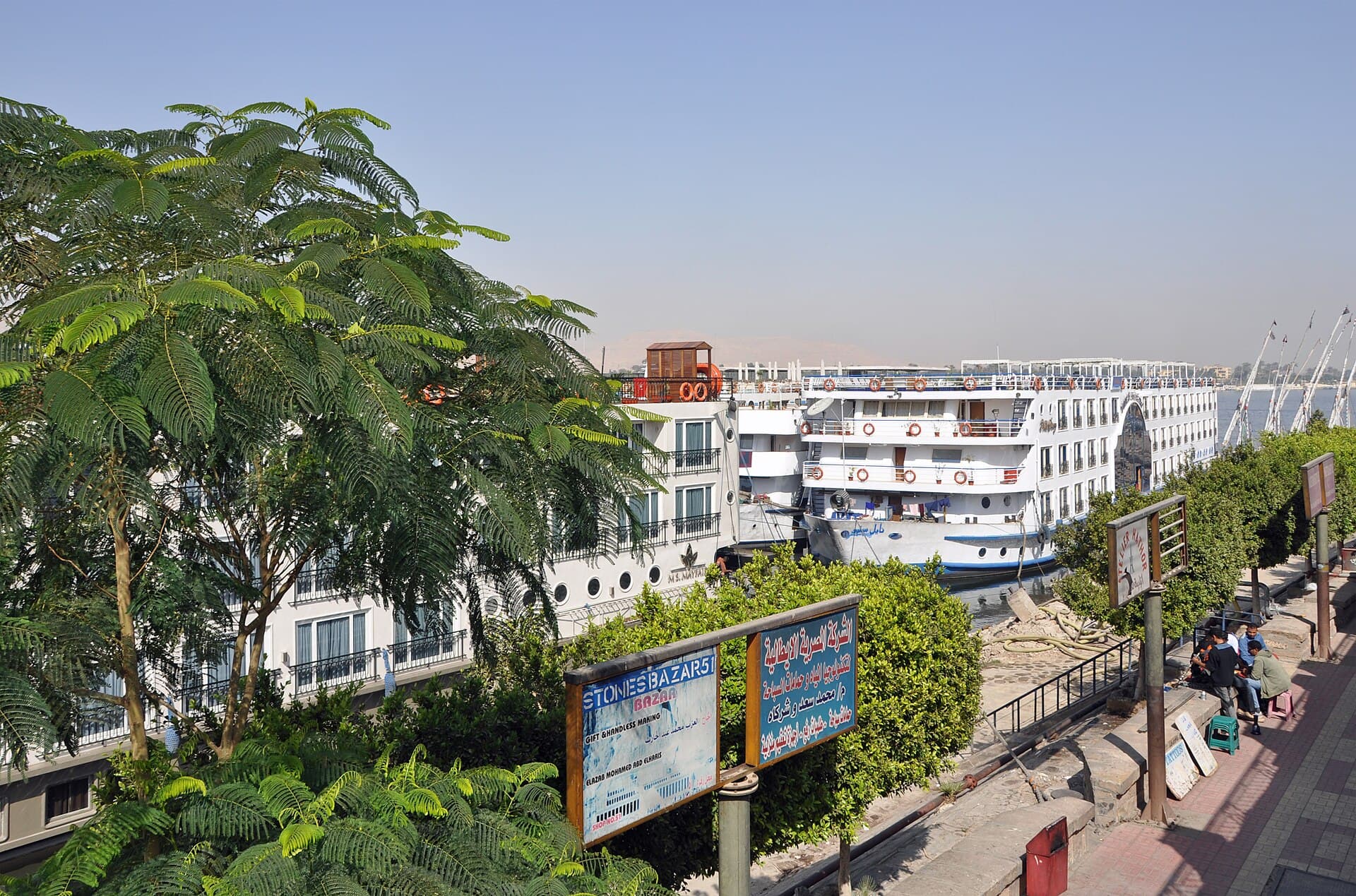
The river in Cairo is a working waterway with a city turned mostly sideways to it. There is no cruising from here: Nile cruises run between Luxor and Aswan, several hundred kilometres south, and a boat does not sail from Cairo to Luxor as a holiday. What Cairo does give you is the Corniche, the bridges, the island of Gezira with Zamalek on its northern half, and a late afternoon walk or a drink with the water in front of you, which after a day on the plateau is worth more than it sounds.
Dinner cruises are sold hard and we would not book one. They sell the view rather than the cooking, and the food follows the hotel-buffet rule: safe, plentiful, and not the meal you will remember. The feluccas, the small lateen-rigged sailing boats with no engine, do work this stretch, but the felucca hour worth planning a trip around is the one at Aswan among the islands in the late afternoon. If a boat on the Nile is high on your list, our pages on whether a Nile cruise is worth it and on Nile cruises from Cairo are the two to read before you book anything with the word cruise in it in this city.
9. A day trip to Alexandria, which is usually the wrong call
Alexandria is roughly 220 kilometres from Cairo. The fast trains take about two and a half hours and are the civilised option; by road it is about three hours each way, longer if Cairo traffic is having a bad morning. That is five to six hours of travelling out of a day with perhaps fourteen usable hours in it, before lunch, transfers and the walk in from a station. It is why day trips leave in the dark, and why the last site on the list is the one that gets cut.
If you go anyway, take the train and put the catacombs of Kom el Shoqafa first. They are the strongest single site in the city: a spiral staircase drops you into a second-century AD tomb complex where Egyptian, Greek and Roman carving share the same walls, including Anubis in a Roman soldier's uniform. The lowest level is usually flooded. The Bibliotheca Alexandrina, opened in 2002 on the Corniche at Shatby, is a working library rather than a reconstruction of the ancient one, and an hour covers it unless you like libraries. Qaitbay Citadel stands on the exact site of the Pharos lighthouse, built in the 1470s partly from the lighthouse's fallen stone; it is bare inside and you go for the position. Pompey's Pillar has nothing to do with Pompey, having been raised for the emperor Diocletian around AD 298, and takes twenty minutes.
The honest verdict is that a day is not free, and the comparison is not Alexandria against sitting in the hotel. A day spent on the coast is a day not spent in Cairo, and Cairo has more left in it than most itineraries allow. On a short trip, the Saqqara and Dahshur day beats Alexandria on every measure: older pyramids, near-empty, about an hour out of the city rather than three. One night in Alexandria is the sensible minimum if the city genuinely appeals. We set the case out at length on our page asking whether Alexandria is worth a day trip, and in the Alexandria guide itself.
10. Eating in Cairo, which is cheaper and better than the hotel
Cairo has the widest range of food in Egypt and every dish worth eating is easy to find done well here. Breakfast is ful medames: fava beans cooked slowly overnight then mashed with oil, lemon and cumin, with tahina, tomato or a boiled egg depending on the shop, eaten with aish baladi, the round wholemeal loaf you tear rather than cut and use as a scoop, a spoon and a plate at once. Alongside it comes taameya, the Egyptian falafel made from split fava beans rather than chickpeas, green in the middle and heavier than the Levantine version.
The dish to seek out is koshari, the national plate and the one most visitors end up eating twice: rice, macaroni, lentils and chickpeas in one bowl under tomato sauce and fried onions, with garlic vinegar and chilli added at the table. Downtown koshari shops do one thing all day and do it well, it is vegan without anyone having to think about it, and it costs a fraction of what a hotel charges for a lesser meal. Hawawshi, spiced mince baked inside bread until the crust crisps, is the street-corner meal to look for. Molokhia, a green soup of jute mallow leaves finished with fried garlic and coriander, divides people: try it once, and if the slippery texture is not for you, that is a common verdict rather than a failure of taste.
The rule that keeps you well is turnover, not price. A busy cart cooks and restocks fast so nothing sits; a quiet one may be selling food that has been out for hours. Hot, cooked to order and popular, in that order. Whole fruit you peel yourself is fine; a cut salad you did not watch being washed is the thing to be wary of. This is the reverse of what most first-timers assume, which is that the quiet hotel buffet is the safe option. Our Egyptian food guide goes dish by dish.
What the heat and the traffic actually cost you
Judge every Cairo journey by the hour you set out, not the kilometres. Giza to downtown is roughly 20 kilometres: half an hour early in the morning, most of two hours if you leave at the wrong time. Traffic builds late morning and again from mid-afternoon into the evening, and Friday morning is the one reliably quiet window. The single most useful planning rule in this city is to put two stops a day in the same part of it rather than four scattered across it, and to put the long transfers first.
Pair your days by which bank you are on. Giza, the Sphinx and the Grand Egyptian Museum are all on the west; al-Muizz Street, Khan el-Khalili and the Citadel are on the east; Coptic Cairo is south. Anyone trying to combine the Giza plateau and the medieval quarter in one day is planning two crossings of Cairo, and the traffic rather than the distance will decide how that goes. The metro is the exception to all of this: cheap, unaffected by the roads, with carriages reserved for women, and stops at downtown, Coptic Cairo and Giza, though not the plateau itself. Ride-hailing apps work well above ground and remove the fare argument; street taxis will negotiate, usually badly.
On heat, October to April is the comfortable season, which makes it the busy one. May to September is hot enough to spoil the plateau and makes no difference whatever to an air-conditioned museum, so summer visitors get the better museum and the worse pyramids. Build the day around that rather than fighting it: the plateau at opening and not a minute later, then indoors through the worst of the afternoon. Ramadan moves about eleven days earlier each year and changes opening patterns and the mood of the city, so check where it falls against your dates rather than assuming. Our pages on getting around Egypt and on the best time to visit go further into both.
What is overrated in Cairo, and what is quietly better
Overrated, in order: the camel photograph arranged at the Giza gate, where the animals are often in poor condition and an agreed price does not reliably prevent a second demand at the end; the evening sound and light show at the pyramids, which is dated and easy to drop; dinner cruises on the Nile; and the shopping stops built into cheap day tours, where the commission is the real product rather than the alabaster. The inside of the Great Pyramid belongs on this list for most people too, for the reasons given above.
Quietly better than their reputation: Saqqara and Dahshur, where you can walk into a pyramid without queueing and hear nothing; the al-Muizz Street walk, which is free in the sense that the street costs nothing even where individual monuments charge; Ibn Tulun, empty and unchanged; the Royal Mummies hall at Fustat, which is an hour and stays with people longer than a whole afternoon at Tahrir; and the Valley Temple at Giza, which most visitors cross in thirty seconds on the way to the Sphinx terrace and which in summer is the only real shade on the route, its granite staying cold well into the morning.
One more honest note about hassle. Expect persistent offers of camels, scarves and unrequested help at ticket gates, usually ending in a tip request; it is at its worst at Giza and mild almost everywhere else. It is rarely threatening. Carry small notes, decide in advance what you want, and say no once and clearly. A guide earns their fee in two places in this city, which are reading tombs and interiors that carry no labelling, and absorbing the constant approaches at the big sites. Between them, in the streets and on the metro, you do not need one. Our page on how much to tip in Egypt sets out the going rates.
How many days does Cairo need, and in what order?
Two full days is the honest minimum: one for Giza and the Grand Egyptian Museum, one for Islamic and Coptic Cairo. Three lets you add Saqqara and Dahshur without cutting anything, and three is the version most people should take. Four buys the Tahrir museum, a slow afternoon in Zamalek, or the Alexandria trip. One day means Giza and nothing else, and you should plan it that way rather than pretending otherwise. Five days in the city is usually one day too many unless you like cities for their own sake.
The three-day shape we would use runs like this. Day one, the plateau at opening, then the Grand Egyptian Museum through the middle of the day, and an early night. Day two, Saqqara and Dahshur in the morning while it is cool, Memphis only if the driver insists, and back for a late afternoon on al-Muizz Street finishing in Khan el-Khalili as the lights come on. Day three, Coptic Cairo by metro in the morning, Fustat for the mummies, and the Citadel or Tahrir in the afternoon depending on your appetite. Nothing in that plan crosses the city twice in a day.
Where you stay changes the trip more than the hotel standard does. Giza puts you beside the plateau and the museum, with a pyramid view from some rooftops, and leaves a long drive to everything else along a strip that is mostly hotels. Zamalek is quieter, greener and central for the museums and restaurants. Downtown is cheaper, louder and closest to the medieval city. Heliopolis only makes sense for an early flight. If Cairo is the first leg of a longer trip, our Egypt itinerary page and our ranked list of things to do in Egypt cover how the rest of the country fits around it.
Doing it on a guided trip: what our Cairo itineraries actually cover
If you would rather not assemble the days yourself, the trips named here are real operator itineraries with real prices, quoted in US dollars per person, land only, and excluding international flights, the Egypt entry visa, tipping and any extra tickets such as going inside a pyramid. The Cairo Short Break is five days in Cairo and nowhere else, from US$935 with four nights at the Flamenco Hotel, rising to US$1,200 at the Steigenberger El Tahrir and US$1,420 at the Four Seasons First Residence. It covers Giza and the Sphinx with a short camel ride included, the Grand Egyptian Museum, the Egyptian Museum, the Citadel with the Alabaster Mosque, Coptic Cairo for the Hanging Church and Ben Ezra, the mummies hall at Fustat, and Khan el-Khalili. Every sightseeing day is private.
That itinerary leaves out Saqqara, Dahshur and Alexandria, which is the honest limit of four nights. If those matter to you, add days rather than compress what is there. The longer trips do pick them up: the Grand Tour of Egypt at sixteen days from US$3,910 comes back to Cairo for Saqqara and Dahshur at the end, and the fifteen-day Cairo, Luxor and Nile cruise from US$3,985 adds Alexandria as well as Saqqara and Dahshur.
For most people, though, Cairo is the first leg rather than the whole trip. The five-day Cairo and Luxor short break from US$1,480 adds one night in Luxor with both domestic flights in the price, and the eight-day Cairo and Nile cruise from US$2,135 is the route most first-time visitors take, with Giza and the museum first and then four nights sailing down to Aswan. Our Cairo tour packages page compares the individual day trips, and our page on how much a trip to Egypt costs breaks down what sits outside the tour price.
Common questions
Is this page about Cairo, Egypt, or Cairo, Illinois?+
Cairo, Egypt: the capital on the Nile, with the Giza pyramid plateau on its western edge. Cairo, Illinois, is a small town in the United States at the confluence of the Ohio and Mississippi rivers, and nothing on this page applies to it. Everything here refers to the Egyptian city and its districts on both banks of the Nile.
How many days do you need in Cairo?+
Two full days is the honest minimum, one for Giza and the Grand Egyptian Museum and one for Islamic and Coptic Cairo. Three lets you add Saqqara and Dahshur without cutting anything, and that is the version we would take. One day realistically means Giza and nothing else, and five is usually one too many.
What is the single best thing to do in Cairo?+
The Giza plateau at opening, before the heat and the coach groups. It is the reason most people come and the only item on this list where the hour you arrive changes the experience completely. If you want the least obvious answer instead, it is the walk north along al-Muizz Street in the late afternoon, which costs almost nothing and which most itineraries skip entirely.
Is it worth going inside the Great Pyramid?+
For most people, no. It costs a separate ticket and gives you a long stooped climb up a narrow passage, the Grand Gallery, and then a bare granite room with a lidless sarcophagus, no decoration and no airflow. The Grand Gallery is the part that justifies it if anything does. Which interiors are open rotates for conservation, and the second and third pyramids are usually much quieter for a similar experience.
Can you see the Pyramids and the Grand Egyptian Museum in one day?+
Yes, in one order only. Plateau at opening for two to three hours, then the museum through the middle of the day when the heat outside is worst and the air conditioning indoors becomes the point. They are separate sites with separate tickets and no combined ticket, and the transfer takes longer than the two kilometres suggest, so build the day around the early start rather than the distance.
Is Khan el-Khalili a tourist trap?+
The lanes nearest al-Azhar are, and prices there open at several times what an item is worth. Walk further in and it becomes a market for Cairo: goldsmiths, coppersmiths, fabric along the Muski, beads and perfume bottles sold wholesale. Both halves are genuine. If you dislike haggling, browse the first lanes, buy nothing, and accept the tea, which is offered without obligation.
Is a day trip to Alexandria from Cairo worth it?+
Usually not on a short trip. It is about 220 kilometres, two and a half hours each way by fast train and around three by road, so five to six hours of the day goes on travelling before you have seen anything. On the same day, Saqqara and Dahshur give you older pyramids, near-empty, about an hour from the city. If Alexandria genuinely appeals, give it a night rather than a day.
What is the best time of year to visit Cairo?+
October to April is comfortable and therefore busy. May to September is hot enough to spoil the Giza plateau by late morning, though it makes no difference to an air-conditioned museum, so summer visitors get the better museum and the worse pyramids. Ramadan shifts about eleven days earlier each year and changes opening patterns, so check where it falls against your dates.
Official sources
Entry rules, opening hours, security advice and exchange rates all move. Check them at the source, not here.
Written and checked by the Nile Trip Guide editorial team · Last reviewed . Entry rules, prices and opening hours change — check anything critical against the official sources linked on this page.
Plan this trip
Tell us your dates and we will price it
A real itinerary with real prices, usually within 24 hours. Nothing is booked and nothing is charged until you say yes.
Five days in Cairo and nowhere else: Giza, the Grand Egyptian Museum, the Egyptian Museum, the Citadel, Coptic Cairo and Khan el-Khalili. Four nights in one hotel, and every sightseeing day run privately.
Giza and the Grand Egyptian Museum, then a flight south for one night in Luxor covering both banks, and a flight back. Five days, two cities, both domestic flights in the price and every day guided privately.