Things to do in Luxor, Egypt: both banks, done properly
Luxor is the town in Upper Egypt that stands on top of ancient Thebes, roughly 650 kilometres up the Nile valley from Cairo, and it holds the greatest concentration of ancient monuments anywhere on earth. If you have arrived here looking for a casino in Nevada, this is the wrong page. Everything below is about the Egyptian Luxor: two banks of a river, a dozen sites that matter, and the ordering problem that decides whether you enjoy them or endure them.
Luxor, Egypt: what you are actually looking at
Modern Luxor is a working Egyptian town of hotels, a corniche, a souq and a great deal of traffic, built directly over the remains of Thebes, the capital of Egypt through most of the New Kingdom. The Nile runs through the middle of it, and that river is not scenery here. It is the organising fact of the place, because the ancient Egyptians built for the living on the east bank, where the sun rises, and buried their dead on the west, where it sets. Nothing you plan in Luxor makes sense until you have absorbed that split.
What survives is extraordinary in quantity rather than in any single object. On the east bank you have Karnak, a walled temple precinct that around thirty pharaohs added to across roughly two thousand years, and Luxor Temple, standing in the centre of town with a still-functioning mosque suspended in its wall. On the west bank you have the Valley of the Kings with more than sixty rock-cut tombs, the terraced temple of Hatshepsut at Deir el-Bahari, the Valley of the Queens, Medinet Habu, the Ramesseum, the workmen's village at Deir el-Medina, and two seated colossi in a field. All of that sits inside about a twenty-minute drive.
The honest framing is that Luxor rewards editing rather than completeness. Nobody sees all of it well, and the visitors who come away flat are almost always the ones who tried. This page is arranged as a set of judgements about what earns your time, in what order, and at what hour of the day, because in Luxor the hour matters more than the itinerary.
East bank and west bank: the split that sets your timetable
The station, the airport, the museum and nearly every hotel are on the east bank. The tombs and mortuary temples are on the west. That means the west bank is a morning out and back rather than somewhere you base yourself, and it means you cross the river at least once on any serious day of sightseeing.
Crossing is less trivial than a map suggests. The road bridge sits several kilometres south of the centre, so going by car costs twenty to thirty minutes each way and quietly removes an hour from your day. The local passenger ferry crosses in a few minutes for about the price of a coffee and lands you close to Luxor Temple, which is the better option for an evening trip, though it leaves you needing transport on the far side. Private motorboats do the same crossing on demand for more.
Once you are on the west bank, distances are longer than they look. The Valley of the Kings, Deir el-Bahari, the Valley of the Queens, Medinet Habu and the Colossi are spread across several kilometres of desert edge with no shade and no useful public transport between them. You need a car and driver for the morning whichever way you crossed the river. Our guide to getting around Egypt covers the wider transport picture, but for the west bank the answer is simply a vehicle and someone to drive it.
Why the west bank has to be a morning, and not a negotiable one
The tombs are cut into rock and have no airflow. By mid-morning they hold the heat of every group that has walked through them, and the open valley outside can reach around 40C on a summer afternoon. A corridor that is pleasant at half past six is genuinely unpleasant by ten. That is the whole argument, and it is a physical one rather than a matter of taste.
The Valley of the Kings opens early, around six, and the first coaches arrive from roughly eight. Those two hours are the difference between having a painted corridor to yourself and queueing to shuffle down it. Hatshepsut's temple has the same problem in a worse form: the cliffs at Deir el-Bahari form a natural amphitheatre that catches the sun and blocks air movement almost completely, so you are warmed from below and from the sides as well as from above, with almost no shade on the terraces.
Karnak and Luxor Temple, by contrast, are open to the sky, take low afternoon light far better than noon, and are open late. So the shape of a good Luxor day is fixed: west bank before nine, a long break through the worst of the heat, east bank from late afternoon into the evening. Reversing that is the commonest planning mistake made in this town, and arriving off a coast transfer at midday and going underground at the hottest hour is the version of Luxor that people describe as disappointing.
The Valley of the Kings: what your ticket actually covers
The general entry ticket admits you to the site and to three tombs of your choice from those open that day, which usually means around eight to ten. The selection rotates for conservation, so nobody can promise you a particular tomb in advance and any operator who does is guessing. Which tombs are open is posted at the ticket office by the car park. Ramesses IV, Ramesses IX, Merenptah and Ramesses III are among the ones most often available, and Ramesses III is the pick if it is open: a long descending corridor with side chambers of painted scenes.
Three of the famous tombs sit outside that ticket and need their own. Tutankhamun, Seti I and Ramesses V/VI are each bought separately at the same office. Of those, Ramesses V/VI gives the most for the money, a wide bright tomb with an astronomical ceiling showing the sky goddess Nut. Seti I is the longest, deepest and finest in the valley, and priced accordingly. Tutankhamun is small, with only the burial chamber painted; his mummy is there, the treasures are in the Grand Egyptian Museum outside Cairo, and a good number of visitors come out feeling short-changed. We do not print prices for any of these, because Egyptian ticket prices are revised regularly and any figure here would be wrong within a year.
Three tombs plus one paid extra takes about two and a half hours. A small electric train runs the last stretch from the visitor centre; walking it takes about ten minutes in full sun. The one tactical thing worth doing is walking past the first tombs and starting at the far end of the valley, then working back. Everyone else does the opposite, which hands you the deep tombs to yourself for half an hour. Photography inside most tombs needs a separate photo ticket, the rules on whether a phone counts have changed more than once, and the answer is to ask at the window rather than to assume.
Hatshepsut's temple at Deir el-Bahari
This is a mortuary temple, not a tomb. Hatshepsut herself was buried over the ridge behind it, in the Valley of the Kings. What stands at Deir el-Bahari is where her cult was maintained after death, and it looks like nothing else that survives from ancient Egypt: three colonnaded terraces rising on a single axis, linked by long ramps, set against a semicircular bay of limestone cliff. The terraces echo the horizontal strata of the rock behind them, so the building reads as an extension of the cliff rather than an object placed in front of it.
A great deal of what you see is reconstruction. Polish and Egyptian teams have worked here for decades, re-erecting columns and rebuilding walls from fallen blocks. That is not a fault, but it is worth knowing before you arrive, because the clean geometry that photographs so well was partly assembled in living memory.
The mistake almost everyone makes is walking straight up the ramps and straight back down, which takes twenty minutes and shows you nothing. The content is on the middle terrace, and all of it is off the axis you are climbing: the Punt colonnade at the southern end, the divine birth colonnade at the northern end, the chapel of Hathor beyond the first and the chapel of Anubis beyond the second. Anubis keeps some of the best-preserved colour on the site. At each terrace, turn left and right and go to both ends before you climb. Ninety minutes done that way is a completely different visit from ninety minutes spent photographing ramps.
Go at opening if you can. The temple faces east, so the morning sun is full on the facade and rakes across the shallow relief carving; by late afternoon the cliff has thrown the whole bay into shade and the terraces go flat and grey. There is a shuttle from the car park to the forecourt for a small charge, and on a hot day it is a sensible way to save your legs for the ramps.
The Colossi of Memnon, and the temple that is not there any more
Two seated stone statues of Amenhotep III stand beside the road on the way in, and almost every visitor sees them because they are unavoidable rather than because they planned to. That is fine. Give them five to fifteen minutes and do not build a morning around them.
What makes them more interesting than they first appear is what is missing. They were the front gate of the largest mortuary temple ever built at Thebes, and flooding and later quarrying removed almost all of it. You are looking at the doorway of a vanished building rather than at a site in its own right. Archaeological work continues in the field behind them, and there is usually something visible being re-erected.
This is also the clearest example on the west bank of a general rule: the thing in front of you is usually a fragment of a much larger arrangement, and knowing what has gone makes the survivor legible. Nobody needs a guide to look at two statues. Everybody needs one to understand why they are there.
Medinet Habu, the Ramesseum and Deir el-Medina
If you can fit one more temple into a west bank day, make it Medinet Habu. It still holds colour on its walls, its high walls throw useful shade, and it sees almost no groups, which after the Valley of the Kings at nine in the morning is a material improvement in the experience. It is the single best-value addition available on this bank of the river and it is skipped by most standard itineraries.
Deir el-Medina is the village of the craftsmen who cut and painted the royal tombs, and it is the site for anyone more interested in how the tombs were made than in what they depict. Their own records survive well enough that we know their names, their pay disputes and their days off, and their own small decorated tombs are here, with Sennedjem's among the most likeable painted chambers in Luxor. The Ramesseum, Ramesses II's mortuary temple, is the other candidate and is more ruin than building, which suits some visitors and bores others.
The honest limit is four. Three sites is a full west bank morning, roughly four to five hours with transfers. Adding a fourth makes it a long day, and by the fourth temple most people have stopped looking properly. Two sites seen well beat four glanced at, and that trade is the one worth making deliberately rather than discovering at eleven o'clock in the heat.
The Valley of the Queens, and whether Nefertari is worth it
The Valley of the Queens sits in a dead-end bay of desert across the ridge from the Valley of the Kings, a short drive south. It holds the tombs of royal wives, princes and princesses, most of them Ramesside. Three modest tombs are usually open on the general ticket, and they are good rather than exceptional. On their own they are an addition to a west bank day, not a reason to build one.
Nefertari's tomb, QV66, is a different proposition entirely and is ticketed separately at a much higher price. The colour is better preserved than anything else on the west bank and nothing in Egypt comes close to it. The visit is capped at roughly ten minutes. That is the whole calculation: it is expensive and it is short. If painted decoration is the reason you came to Luxor, it is worth the money. If you are working through the big sites on a budget, it is not, and Sennedjem's tomb at Deir el-Medina gives you far more painted wall for far less.
Access to Nefertari has been suspended before now, so treat it as a decision to make in Luxor on the day rather than a plan to lock in months ahead. Our Valley of the Queens page goes into which of the other tombs are usually open and what is on their walls.
Karnak: the one site that takes longer than anyone plans for
Karnak is not one temple. It is a precinct of around 100 hectares containing several separate temple complexes, of which almost everyone sees only the Precinct of Amun-Re, which is the central and by far the largest. Roughly thirty pharaohs built here across about two thousand years, each wanting their name on the most important religious site in Egypt, so each built outwards or knocked something down and rebuilt it larger. There is no single viewpoint from which the place resolves. You walk through a sequence of courts and halls built centuries apart, and the joins are visible everywhere.
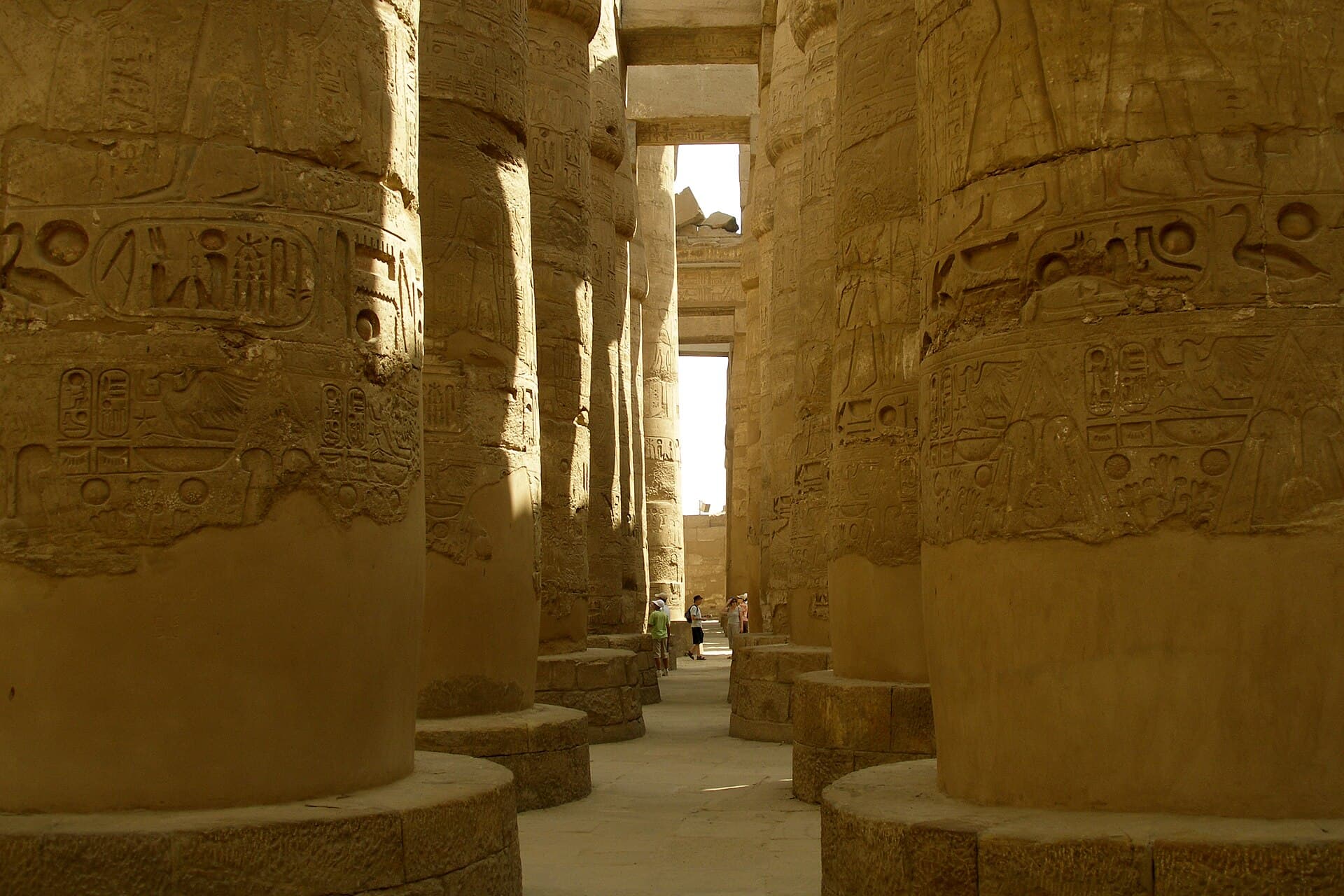
The Great Hypostyle Hall is what people come for and it deserves the reputation: a forest of 134 columns covering around 5,000 square metres, the tallest of them about 21 metres, with traces of original paint surviving high up where the roof once protected them. Look for the blues and reds near the tops of the central columns. Beyond it stand obelisks, including Hatshepsut's at about 29 metres, the tallest still upright in Egypt, a sacred lake, and a spine of ten pylons that get older as you walk inwards, so you are travelling backwards in time with every gate.
Two hours is the realistic minimum and three is better. Groups working to a cruise timetable typically get about ninety minutes, which covers the central axis and almost nothing either side of it. Go late in the afternoon if the choice is yours: the light comes in low between the columns and most of the coaches have gone back to the boats. Two small things repay two minutes each and are walked past by nearly everyone: the unfinished first pylon, where a mass of mudbrick survives from the construction ramp used to raise the stone, and the Open Air Museum near the entrance, which needs its own ticket, is almost always empty and holds Hatshepsut's reassembled Red Chapel.
Luxor Temple, and why to see it after dark
Luxor Temple stands in the middle of town behind the corniche, within a fifteen-minute walk of most east bank hotels. It was begun under Amenhotep III around 3,400 years ago and extended by Ramesses II roughly a century later, and after Karnak the thing you notice first is the clarity: one axis, one direction, no maze. Ninety minutes is right for most people.
It is the one major pharaonic site in Egypt that is genuinely better at night, and it is not close. The floodlighting is low and angled, so carving that reads as grey noise under a midday sun becomes legible. The columns of the great colonnade, roughly twenty metres tall, finally look like what they were built to be. The town noise drops away and the crowd thins to a fraction. In summer, going at night is also the difference between a pleasant hour and real discomfort.
The most interesting thing here is also the thing tour groups walk under without seeing. The Mosque of Abu al-Haggag sits on top of the Ramesses court with its door hanging in mid-air several metres above the paving, because for centuries the temple was buried in the debris of the town built over it and the mosque was constructed at what was then ground level. When the court was dug out, the mosque was left where it stood. People still pray in it daily and have done for something like eight hundred years. The same footprint has been a pharaonic temple, a Roman military headquarters with a painted imperial cult chamber, a Christian church and a working mosque, and you can see traces of all of it.
Two practical notes. There is no sound-and-light show here; that is at Karnak, and it divides people enough that we would not book it sight unseen. And closing times shift with the season and with Ramadan, so confirm the evening hours locally on the day rather than trusting a schedule found online, including ours.
The Luxor Museum and the avenue of sphinxes
The Luxor Museum is a short walk north along the corniche, takes about an hour, and is small, well arranged, properly lit and badly under-visited. It holds statues found buried beneath Luxor Temple and a reconstructed wall of talatat, the small blocks from Akhenaten's dismantled temples that were reused as rubble fill inside later pylons at Karnak. It is the natural follow-up to a morning at Karnak when the heat has driven you indoors, and it is the most sensible use of a Luxor afternoon that almost nobody plans.
The paved processional way between Karnak and Luxor Temple runs roughly 2.7 kilometres and is lined with sphinxes, rams' heads at the Karnak end and human heads at the Luxor stretch. It was excavated in stages over decades and formally reopened in 2021. Walking the whole thing is less romantic than it sounds: a sunken corridor below street level, no shade, the same sphinx several hundred times over, and few exits. Early and in cool weather it is a fine walk of well under an hour. In heat it is a slog, and the access points have changed since it reopened, so check which gates are open before committing to it on foot.
Both of these are third-day activities rather than first-day ones. If you have two days in Luxor, neither will make the cut, and that is the correct decision.
The balloon at dawn: worth it, with caveats
The sunrise balloon over the west bank is one of the few aerial add-ons in Egypt that earns its price. Pick-up is in the dark, launch is from a field on the west bank at first light, and you are up for something like three quarters of an hour to an hour depending on wind. What it shows best is the geography that no ground-level visit gives you: the hard line where irrigated green stops and desert begins, with the Theban cliffs standing over the whole necropolis.
Three caveats, all of which operators tend to leave out. First, you go where the wind takes you. The pilot controls height, not direction, so nobody can promise you the Valley of the Kings from above, and an operator selling you a named list of monuments is describing a good morning rather than a guaranteed one. Second, the baskets are large and shared, and the field at launch is louder and busier than most people expect at that hour. Third, the flight is the short part of the morning: the pick-up, the crossing, the wait, the landing and the retrieval drive back take considerably longer than the hour in the air.
Flights are cancelled for wind often enough that the single most useful piece of planning advice is to book the balloon for your first Luxor morning rather than your last. A cancellation usually means a refund rather than another attempt, and there is no later slot the same day: the calm air that makes ballooning straightforward at first light is gone by mid-morning. Take the operator's confirmation call the night before seriously, and if nobody contacts you the evening before, that is a small warning sign about how the booking has been handled. Bring closed shoes, because landing fields are rough and often ploughed, and a fleece between late autumn and early spring, when it is genuinely cold before dawn.
A felucca, the ferry, and the river itself
A felucca is a small lateen-rigged sailing boat with no engine, and you can hire one in Luxor for an hour or two on the river. It is pleasant and it costs little. It is also, honestly, better in Aswan, where the current is stronger, the wind more reliable and the river scattered with granite islands to sail around. In Luxor the felucca is a nice way to spend a late afternoon rather than a reason to come. Agree a price and a duration on the bank before you step aboard, because disputes afterwards are the commonest small argument visitors have here.
The cheapest good thing on the water in Luxor is the public ferry. It crosses in a few minutes for about the price of a coffee, it is full of people going to work rather than tourists, and it lands you close to Luxor Temple. Taking it once in each direction gives you the river at eye level and the two banks in sequence for almost nothing.
Calèche drivers work the corniche hard and will offer to take you the short distance from the hotels to the temple gate. It is a pleasant enough way to arrive if the horse looks well kept. Agree the price and the route before you get in, and be explicit about whether the figure is per person or for the carriage, because that ambiguity is where nearly every argument starts. Walking is usually faster.
Dendera and Abydos: the two day trips, and who should take them
North of Luxor by road sit two of the best-preserved temples in Egypt, and no Nile cruise reaches either of them. Dendera, the Temple of Hathor, is a little over an hour's drive and holds painted ceilings in better condition than anything at Karnak or Luxor. Abydos, closer to three hours, holds the Temple of Seti I, widely reckoned to carry the finest relief carving to survive in Egypt, along with the king list and the Osireion. Most visitors to the Nile Valley never go to either. The ones who do often rate them above anything else they saw.
Done together it is a full day and a hard one, twelve hours door to door with an early start. The order that works is Abydos first: drive the full three hours while you are fresh, take the harder and more detailed site in the morning, and stop at Dendera on the way back, where the main attraction is lying on your back looking at a ceiling rather than reading fine relief. Dendera on its own is a half-day if you leave at opening, and that version stops it competing with the rest of your Luxor plans. Carry your passport, because checkpoints along the valley road are routine and a copy in the glovebox is not always accepted, and let your operator confirm the current permit position rather than assuming it.
Who should not go: anyone on a first visit with three or four days in Luxor. Karnak, a west bank morning, Luxor Temple after dark and enough slack for the heat will fill that time, and each of those is a stronger use of a day for a first-time visitor than six hours in a car. With five days or more, or on a second trip to Egypt, Dendera and Abydos move near the top of the list. Our twelve-day Cairo, Luxor and Nile cruise trip is the one in our range that builds the Dendera and Abydos day in as a land day before boarding, which is the only way to get them without inventing a boat that does not exist.
What is not worth your time in Luxor
Being specific is more useful than being encouraging. The Karnak sound-and-light show is dated and divides people, and we would not book it unedited. Walking the full avenue of sphinxes in heat is a slog rather than an experience. A fourth temple bolted onto an already full west bank morning is money spent on something you will not look at properly. And the alabaster workshop stop built into cheap itineraries is a commission arrangement wearing the costume of a cultural visit.
Luxor is also a working tourist town and behaves like one. Touts at the temple gates, carriage drivers, felucca captains and shop owners who have heard every deflection you can think of. The pressure is persistent rather than aggressive, and it wears people down by about the third day. Tomb guards will sometimes lift a rope, point a torch at a detail or offer to take your photograph somewhere you are not meant to stand, and they expect a tip for it. You are free to decline, politely and once, and nothing bad follows. Carry small notes, because change is chronically short and arriving with only large ones makes every transaction harder than it needs to be.
One thing that is underrated rather than overrated: doing nothing between eleven and four. The visitors who come away from Luxor flat are usually the ones who filled that window. It is not dead time, it is the reason the rest of the day works.
How many days Luxor needs, and two plans that work
Two full days is the working minimum: one west bank morning, one east bank afternoon and evening, and enough slack for what you did not plan. Three is the comfortable number, and the third day buys the Valley of the Queens or Deir el-Medina, an hour in the Luxor Museum, and a pace that does not require you to be efficient in forty-degree heat. Four or five days is where Dendera and Abydos become sensible rather than greedy.
The two-day plan: day one, cross to the west bank before it is light, Valley of the Kings at opening on the standard three-tomb ticket, Hatshepsut second, the Colossi as a five-minute stop on the road back, and be across the river by noon. Rest. Day two, Karnak from about four in the afternoon for two to three hours, then dinner, then Luxor Temple after dark. That is Luxor's core, properly seen, with nothing rushed.
The three-day plan adds a balloon at first light on day one, which slots in before the tombs and changes nothing else about the morning, and gives day three to Medinet Habu early, the Luxor Museum through the middle of the day, and a felucca or the ferry in the late afternoon. One day is possible if you choose ruthlessly, which means three tombs and Hatshepsut before nine, Karnak at four, and nothing else. What does not work is arriving at midday and going underground at the hottest hour.
Cruise boat or hotel: how Luxor changes depending on where you sleep
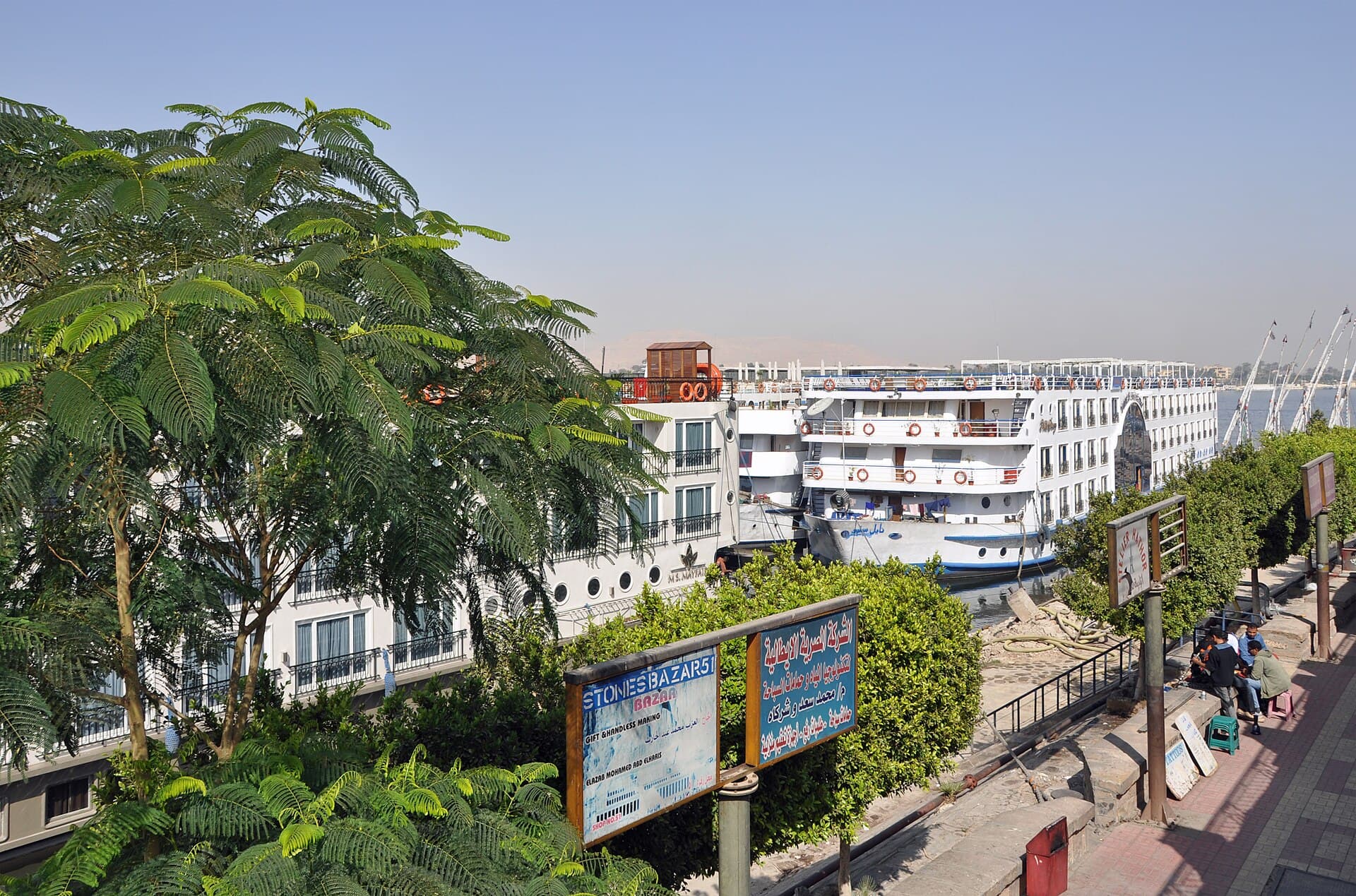
A Nile cruise is an efficient way to reach Edfu and Kom Ombo, which are awkward to get to any other way, and a poor way to see Luxor. Boats moor on the east bank, often rafted several deep, and Luxor is either the first stop or the last: one compressed west bank morning in a group, Karnak on a departure schedule, evenings on board. Our four-day Aswan to Luxor cruise and our five-day Luxor to Aswan cruise both give Luxor exactly that treatment, which is an honest description of what a cruise is for rather than a criticism of these particular boats.
Staying in a hotel gives you the two things a boat cannot: the hour before the coaches arrive, and the evening, which is when Luxor Temple is worth seeing. In exchange you arrange your own driver and guide and deal with more of the selling around the temple gates and the ferry landing. Skipping the on-board entertainment and walking ten minutes to a floodlit temple is the single best decision available to a cruise passenger in Luxor, and it costs one entry ticket.
The usual compromise, and the one we would recommend to most people, is a short cruise with a night or two on land in Luxor at either end. That gets you the sailing stretch and the sites that are only reachable from the water, without reducing the greatest concentration of monuments in Egypt to a morning with a departure horn attached. Our comparison of a Nile cruise against a land tour sets out the wider trade.
When to come, and how bad the heat gets
November to March. Days are warm and the evenings cool, which is what you want when most of your sightseeing is walking around open sites with no shade. December and January are the busiest and priciest, and Christmas and Easter weeks are worse again. March and October are manageable if you start early. May to September is severe, and in those months the early start stops being about comfort and becomes about safety: summer temperatures in the Valley of the Kings pass 45C, and heat exhaustion is a routine problem on the west bank rather than a rare one.
If you are travelling in high summer anyway, build the entire west bank plan around being finished before midday and accept that the middle of the day is not usable. Bring more water than you think you need, cover your head, and wear something over your shoulders rather than nothing. Our packing guide covers the rest of it.
One fixed date is worth knowing about because it inverts this advice. On 2 August 2027 a total solar eclipse crosses Upper Egypt, and Luxor sits very close to the centreline and gets a little over six minutes of totality. August is the hottest, hardest month here, which is precisely the opposite of the window this section recommends. If the eclipse is the reason you are coming, treat the temples as something you see around the edges of the heat rather than the point of the trip.
Getting to Luxor, and getting around once you are there
From Cairo it is about an hour by air or roughly ten hours on the overnight sleeper train. The flight is the obvious choice for a short trip and the train is a genuine experience for people who want one, though it costs you a night either way. Luxor has its own airport, though its international traffic is thin, so most visitors connect through Cairo. It is also the standard start or end point for Nile cruises, which means a good number of people arrive by boat from Aswan without seeing an airport here at all.
Within Luxor, the east bank is walkable: the corniche, the souq, Luxor Temple and the museum are all within a short walk of most hotels, and you will not need a vehicle to reach any of them. The west bank is the opposite and needs a car and driver for the morning, arranged through your hotel or a ground operator.
A guide is worth more here than almost anywhere else in Egypt, and the reason is specific. Karnak and the tombs are close to meaningless without someone to read the walls, tell you which century you are standing in, and point out the erasures and recut names that are the most interesting thing on the stone. Elsewhere in Egypt you can manage without one. In Luxor a good guide is the difference between a set of large hot buildings and the ancient world.
What a Luxor trip costs, and which of ours give it enough time
Our prices below are real, per person, in US dollars, and land only, meaning international flights are not in them. Our cheapest route through Luxor is the four-day Aswan to Luxor cruise at US$840, which finishes with the west bank on day three and Karnak and Luxor Temple on the morning you disembark. The five-day Luxor to Aswan cruise runs from US$1,095 and does the same two Luxor days at the start instead. Both run their sightseeing as a shared group of roughly fifteen, and neither includes domestic flights, so add getting yourself to and from Upper Egypt.
If you want Luxor with a hotel rather than a cabin, the five-day Cairo and Luxor short break is US$1,480 and includes both domestic flights, Giza and the Grand Egyptian Museum, then a west bank afternoon and an east bank morning in Luxor with private guiding throughout. That is a hard day and a half in Luxor and it leaves no room for Dendera, Abydos or a second look at Karnak, which we would rather say plainly than dress up.
For Luxor at a pace that actually suits it, the twelve-day Cairo, Luxor and Nile cruise from US$3,160 is the one in our range that does the job: two nights in a Luxor hotel before boarding, the Valley of the Queens, Medinet Habu and the Ramesseum on one day, Dendera and Abydos on another, and Karnak, Luxor Temple and the Valley of the Kings from the boat after that. Tipping is excluded from every price on this site and is expected rather than optional; allow around US$10 to 15 per person per day for a guide and about US$5 for a driver, and carry small notes.
Common questions
Is this page about Luxor in Egypt or the Luxor in Las Vegas?+
Egypt. Luxor is a town in Upper Egypt on the Nile, built over ancient Thebes, and it holds Karnak, Luxor Temple and the Valley of the Kings. The Las Vegas hotel and casino borrowed the name and the pyramid shape. Nothing on this page applies to Nevada.
How many days do you need in Luxor?+
Two full days is the working minimum and covers both banks properly: one west bank morning, one east bank afternoon and evening. Three is comfortable and buys the Valley of the Queens or Deir el-Medina, the Luxor Museum, and a slower pace in the heat. Five or more makes Dendera and Abydos sensible.
Should you do the east bank or the west bank first?+
West bank first, and start before it is light. The tombs are cut into rock with no airflow and hold the heat of every group that has walked through by mid-morning. Karnak and Luxor Temple are open to the sky, take low afternoon light far better than noon, and are open in the evening.
Which Valley of the Kings tombs does the standard ticket include?+
Three tombs of your choice from the set open that day, usually around eight to ten, and the selection rotates for conservation. Tutankhamun, Seti I and Ramesses V/VI each need a separate ticket, and Nefertari is not here at all but in the Valley of the Queens, with its own entry fee and its own extra ticket.
Is the hot air balloon over Luxor worth it?+
Yes, for what it shows you rather than as a novelty: the hard edge where irrigated green stops and desert begins, with the Theban cliffs over the necropolis. Two caveats. You drift where the wind goes, so no operator can promise you a particular monument from above, and flights are cancelled for wind often enough that you should book your first morning, not your last.
How much time does Karnak really need?+
Two hours as a minimum and three is better. The Hypostyle Hall alone, 134 columns with the tallest about 21 metres, absorbs half an hour before you have looked at anything else. Groups on a cruise timetable typically get about ninety minutes, which covers the central axis and almost nothing either side of it.
Can you see Luxor properly from a Nile cruise?+
Not really. Boats moor on the east bank and Luxor is the first stop or the last, which means one compressed west bank morning in a group and Karnak against a departure time. The fix is a night or two on land at either end of the cruise rather than looking for a boat that allows more, because none of them do.
Are Dendera and Abydos worth a day out of a Luxor trip?+
Not on a first visit with three or four days, when Karnak, a west bank morning and Luxor Temple after dark will use that time better. With five days or more, or on a second trip to Egypt, they are among the best days available in the country. No Nile cruise reaches either, so it has to be a land day by road.
When is the best time of year to visit Luxor?+
November to March, when the days are warm and the evenings cool. May to September is severe, with summer temperatures in the Valley of the Kings passing 45C, and in those months an early start is a safety measure rather than a preference. The Red Sea works all year, but Luxor does not.
Official sources
Entry rules, opening hours, security advice and exchange rates all move. Check them at the source, not here.
Written and checked by the Nile Trip Guide editorial team · Last reviewed . Entry rules, prices and opening hours change — check anything critical against the official sources linked on this page.
Plan this trip
Tell us your dates and we will price it
A real itinerary with real prices, usually within 24 hours. Nothing is booked and nothing is charged until you say yes.
The route most people take first, at the length it was built for: Giza and the Grand Egyptian Museum, then a flight to Luxor and four nights sailing down to Aswan.
No boat on this one. Giza and the Grand Egyptian Museum, a night in Luxor for both banks, two nights on the Red Sea, then back to Cairo for the Citadel, Coptic Cairo and the Royal Mummies.
Five nights in Cairo either side of a four-night sail from Luxor to Aswan. The Cairo days are private, just your party and a guide; the sightseeing off the boat is shared with a small group.